Page 420 of 560

The anti-lock brake system (ABS)
helpspreventthewheelsfrom
locking up, and helps you retain
steering control by pumping the
brakes rapidly, much f aster than a
person can do it.If this indicator comes on, the anti-
lock f unction of the braking system
has shut down. The brakes still work
like a conventional system, but
without anti-lock. You should have
your dealer inspect your vehicle as
soon as possible.
You will f eel a pulsation in the brake
pedal when the ABS activates, and
you may hear some noise. This is
normal: it is the ABS rapidly
pumpingthebrakes.Ondry
pavement, you will need to press on
thebrakepedalveryhardbeforethe
ABS activates. However, you may
feel the ABS activate immediately if
you are trying to stop on snow or ice.
Let the ABS work f or you by always
keeping f irm, steady pressure on the
brake pedal. This is sometimes
ref erred to as ‘‘stomp and steer.’’
The electronic brake distribution
(EBD) system, which is part of the
ABS, also balances the f ront-to-rear
braking distribution according to
vehicle loading. When the ABS indicator comes on,
you will also see a ‘‘CHECK ABS
SYSTEM’’ message on the multi-
inf ormation display.
You should never pump the brake pedal.
CONT INUED
ABS Indicator
Anti-lock Brakes (ABS)
Driving
417
2009 RL
Page 421 of 560
on loose or
uneven surfaces, such as gravel or
snow, than a vehicle without anti-
lock.
It only helps with steering
control during braking.
such as trying to take a
corner too f ast or making a sudden
lane change. Always drive at a safe
speed f or the road and weather
conditions.
Always steer moderately
when you are braking hard. Severe
or sharp steering wheel movement
can still cause your vehicle to veer
into oncoming traffic or off the road.
If the ABS indicator and the brake
system indicator come on together,
and the parking brake is f ully
released, the EBD system may also
be shut down.
Test your brakes as instructed on
page . If the brakes f eel normal,
drive slowly and have your vehicle
repaired by your dealer as soon as
possible. Avoid sudden hard braking
which could cause the rear wheels to
lock up and possibly lead to a loss of
control.
The VSA indicator will come on
alongwiththeABSindicator.
508
A vehicle with A BS may require a
longer distance to stop
Important Saf ety Reminders
A BS does not reduce the time or
distance it takes to stop the
vehicle.
A BS will not prevent a skid that
results f rom changing direction
abruptly,
A BS cannot prevent the loss of
stability.
Anti-lock Brakes (ABS)
418
2009 RL
Page 459 of 560
The component parts in the engine
compartment are protected by
several covers. You may need to
remove the covers when you
perf orm some simple maintenance
work.
All of the covers are secured by
holding clips.
To remove the battery cover, turn
the knob of the f astener and remove
the holding clips by pushing on the
center of each f astener head.
To remove the f ront bulkhead cover:Remove the battery cover.
Remove the holding clips by
pushingonthecenterof each
f astener head.
1.
2.
Engine Compartment Covers
456
FRONT BULKHEAD COVER BATTERY COVER
:
: CLIPS
CLIPS
KNOB
Push to remove clip
Push to reset/install clip CLIPS
Unlock
Lock
2009 RL
Page 463 of 560

Remove the oil f ilter, and let the
remaining oil drain. A special
wrench (available from your
dealer) is required.Refill the engine with the
recommended oil.
Engine oil change capacity
(including f ilter):
Replace the engine oil f ill cap.
Start the engine. The oil pressure
indicator should go out within 5
seconds. If it does not, turn of f the
engine, and check your work.
Let the engine run f or several
minutes, then check the drain bolt
and oil f ilter f or leaks.
Turn of f the engine and let it sit
f or several minutes, then check
the oil level on the dipstick. If
necessary, add more oil.
Put a new washer on the drain bolt,
then reinstall the drain bolt.
Tighten the drain bolt to:
Install a new oil f ilter according to
the instructions that come with it.
Make sure the oil f ilter gasket is
not stuck to the engine block. If it
is, remove it bef ore installing a
new oil f ilter.
3. 6.
7.
8.
9.
5.
4.
Changing the Engine Oil and Filter
460
OIL FILTER
29 lbf·ft (39 N·m , 4.0 kgf·m)
4.5 US qt (4.3
) Improper disposal of engine oil can be
harmf ul to the environment. If you
change your own oil, please dispose of
the used oil properly. Put it in a sealed
container, and take it to a recycling
center. Do not discard it in a trash bin
or dump it on the ground.
2009 RL
Page 465 of 560
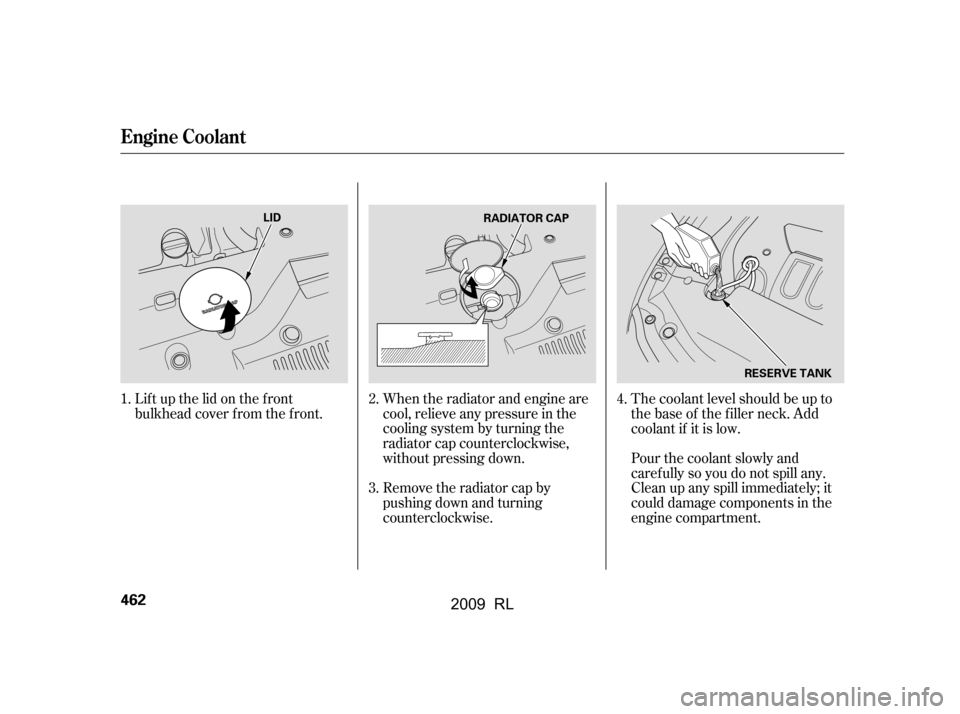
The coolant level should be up to
the base of the f iller neck. Add
coolant if it is low.
When the radiator and engine are
cool, relieve any pressure in the
cooling system by turning the
radiator cap counterclockwise,
without pressing down.
Remove the radiator cap by
pushing down and turning
counterclockwise.
Lift up the lid on the front
bulkhead cover f rom the f ront.
Pourthecoolantslowlyand
caref ully so you do not spill any.
Clean up any spill immediately; it
could damage components in the
engine compartment.
3.
2.
1. 4.
Engine Coolant
462
LID
RADIATOR CAP
RESERVE TANK
2009 RL
Page 470 of 560

�µ�µ
If you f requently tow a trailer.
In very high temperatures
(over 110°F, 43°C).
In very low temperatures
(under 20°F, 29°C).
The timing belt should be replaced
at the intervals shown on the
maintenance minder. Replace the
belt at 60,000 miles (100,000 km) if
you regularly drive your vehicle in
one or more of these conditions:
Pour the f luid slowly and caref ully so
you do not spill any. Clean up any
spill immediately; it could damage
components in the engine
compartment.
A low power steering f luid level can
indicate a leak in the system. Check
the f luid level f requently, and have
the system inspected as soon as
possible.
Always use Acura Power Steering
Fluid. You may use another power
steering f luid as an emergency
replacement, but have the power
steering system f lushed and ref illed
with Acura PSF as soon as possible.
Power Steering Fluid, Timing Belt
Timing Belt
Maint enance
467
Turning the steering wheel to f ull lef t
or right lock and holding it there can
damage the power steering pump.
2009 RL
Page 472 of 560
CONT INUED
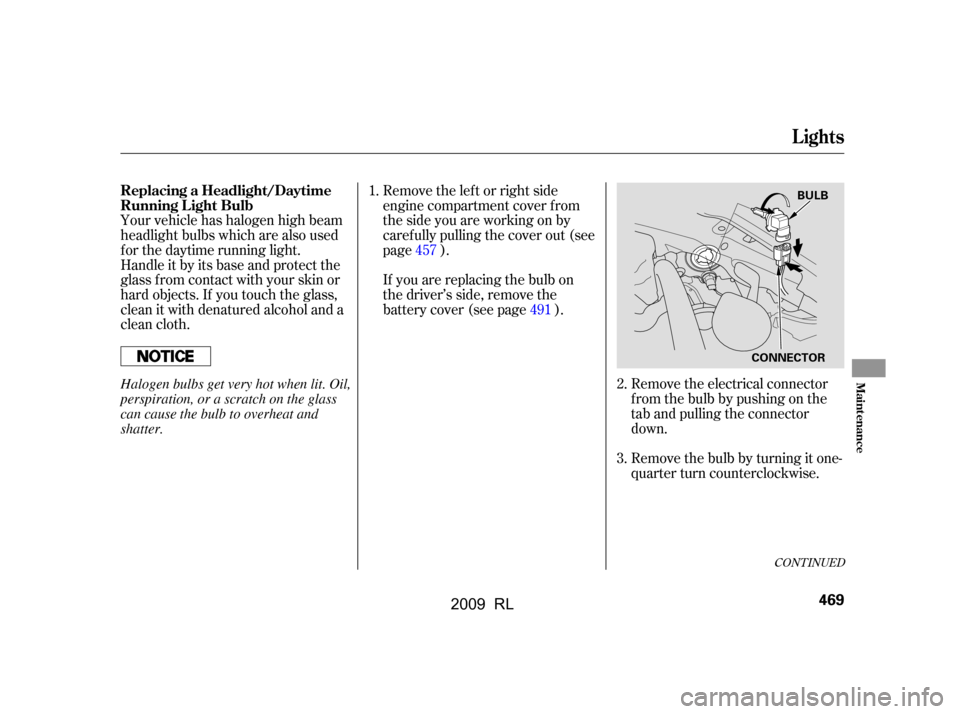
Remove the electrical connector
f rom the bulb by pushing on the
tab and pulling the connector
down.
Remove the bulb by turning it one-
quarter turn counterclockwise.
Remove the left or right side
engine compartment cover f rom
thesideyouareworkingonby
caref ully pulling the cover out (see
page ).
If youarereplacingthebulbon
the driver’s side, remove the
battery cover (see page ).
Your vehicle has halogen high beam
headlight bulbs which are also used
f or the daytime running light.
Handle it by its base and protect the
glass from contact with your skin or
hard objects. If you touch the glass,
clean it with denatured alcohol and a
clean cloth.
2.
3.
1.
457 491
Lights
Replacing a Headlight/Daytime
Running L ight Bulb
Maint enance
469
BULB
CONNECTOR
Halogen bulbs get very hot when lit. Oil,
perspiration, or a scratch on the glass
can cause the bulb to overheat and
shatter.
2009 RL
Page 473 of 560
Insert the new bulb into the hole,
and turn it one-quarter turn
clockwise to lock it in place.
Turn on the headlights to test the
new bulb.
Push the electrical connector back
onto the bulb. Make sure it is on
all the way.Remove the socket from the
headlight assembly by turning it
one-quarter turn counterclockwise.
Push the bulb in slightly, and turn
it counterclockwise.
Remove the left or right side
engine compartment cover f rom
thesideyouareworkingonby
caref ully pulling the cover out (see
page ).
Reinstall the engine compartment
side cover.
(Driver’s side)
Reinstall the battery cover. 2.
1.
4.
5.
6.
7.
8.
3.
457
Lights
Replacing a Front T urn Signal
Light Bulb
470
BULB SOCKET
2009 RL