Page 32 of 116
5-1
1
2
3
45
6
7
8
9
10
11
EBU19200
PRE-OPERATION CHECKS
EBU19222
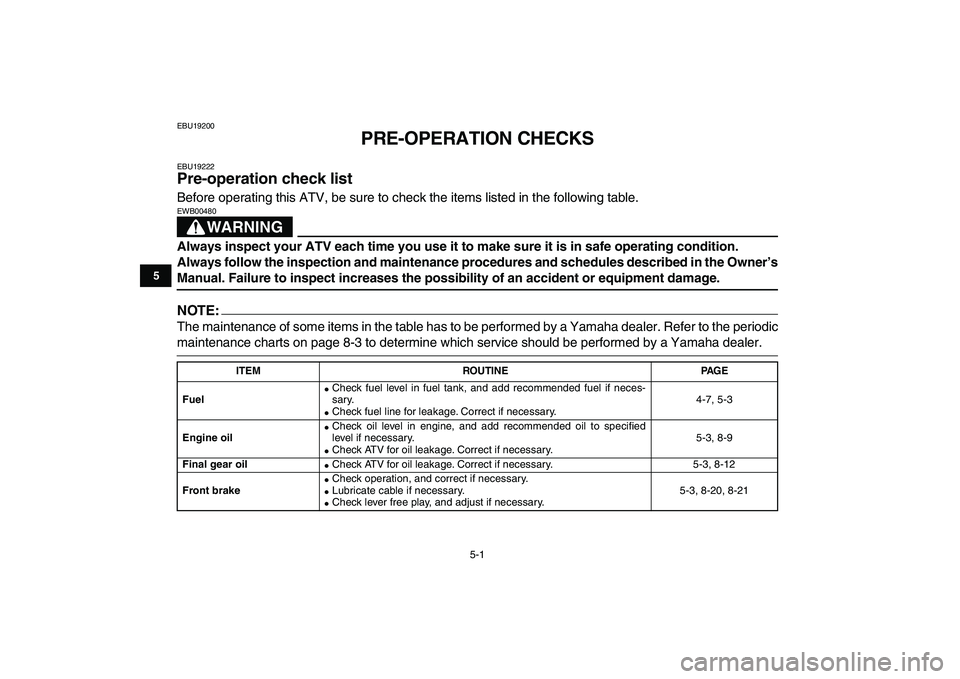
Pre-operation check list
Before operating this ATV, be sure to check the items listed in the following table.
WARNING
EWB00480
Always inspect your ATV each time you use it to make sure it is in safe operating condition.
Always follow the inspection and maintenance procedures and schedules described in the Owner’s
Manual. Failure to inspect increases the possibility of an accident or equipment damage.
NOTE:
The maintenance of some items in the table has to be performed by a Yamaha dealer. Refer to the periodic
maintenance charts on page 8-3 to determine which service should be performed by a Yamaha dealer.
ITEM ROUTINE PAGE
Fuel
�
Check fuel level in fuel tank, and add recommended fuel if neces-
sary.
�
Check fuel line for leakage. Correct if necessary.4-7, 5-3
Engine oil
�
Check oil level in engine, and add recommended oil to specified
level if necessary.
�
Check ATV for oil leakage. Correct if necessary.5-3, 8-9
Final gear oil
�
Check ATV for oil leakage. Correct if necessary. 5-3, 8-12
Front brake
�
Check operation, and correct if necessary.
�
Lubricate cable if necessary.
�
Check lever free play, and adjust if necessary.5-3, 8-20, 8-21
Page 69 of 116

8-1
1
2
3
4
5
6
78
9
10
11
EBU28781
PERIODIC MAINTENANCE AND MINOR REPAIR
EBU21670
Safety is an obligation of the owner. Periodic in-
spection, adjustment and lubrication will keep your
ATV in the safest and best operating condition
possible. The most important points of inspection,
adjustment, and lubrication are explained on the
following pages.
The intervals given in the periodic maintenance
and lubrication chart should be considered as a
general guide under normal riding conditions.
However, DEPENDING ON THE WEATHER,
TERRAIN, GEOGRAPHICAL LOCATION, AND
INDIVIDUAL USE, THE MAINTENANCE INTER-
VALS MAY NEED TO BE SHORTENED.
WARNING
EWB01840
Never service an engine while it is running.
Moving parts can catch clothing or parts of the
body, causing injury. Electrical components
can cause shocks or start fires. Turn off the en-
gine when performing maintenance unless
otherwise specified. Have a Yamaha dealer
perform the service if you are not familiar with
maintenance work.
EBU27110
Owner’s manual and tool kit
Be sure to put this owner’s manual in the plastic
bag and to always carry it as well as the owner’s
tool kit and the low-pressure tire gauge in their re-
spective compartments under the seat.
1. Owner’s manual
2. Low-pressure tire gauge
3. Owner’s tool kit
3
1
2
Page 70 of 116
8-2
1
2
3
4
5
6
78
9
10
11
The service information included in this manual
and the tools provided in the owner’s tool kit are in-
tended to assist you in the performance of preven-
tive maintenance and minor repairs. However,
additional tools such as a torque wrench may be
necessary to perform certain maintenance work
correctly.
NOTE:
If you do not have the tools or experience required
for a particular job, have a Yamaha dealer perform
it for you.
WARNING
EWB01850
Never modify this ATV through improper in-
stallation or use of accessories, as it may
cause changes in handling, which in some sit-
uations could lead to an accident. All parts and
accessories added to this ATV should be gen-
uine Yamaha or equivalent components de-
signed for use on this ATV and should be
installed and used according to instructions. If
you have questions, consult an authorized
Yamaha ATV dealer.
Page 75 of 116
8-7
1
2
3
4
5
6
78
9
10
11
EBU23060
NOTE:
The air filter needs more frequent service if you are riding in unusually wet or dusty areas.
Page 91 of 116

8-23
1
2
3
4
5
6
78
9
10
11
6. Tighten the upper locknut.
WARNING
EWB02080
Operating with improperly serviced or adjust-
ed brakes could cause loss of braking ability,
which could lead to an accident.
After servicing:
�
Make sure the brakes operate smoothly and
that the free play is correct.
�
Make sure the brakes do not drag.
Replacement of brake components requires
professional knowledge. These procedures
should be performed by a Yamaha dealer.
EBU24473
Adjusting the rear brake lever and
brake pedal free play
The brake lever and brake pedal free play must be
checked and, if necessary, adjusted at the inter-
vals specified in the periodic maintenance and lu-
brication chart.
NOTE:
�
Always perform this maintenance completely in
the following order whenever adjusting the rear
brake.
�
Before adjusting the brake lever and brake pedal
free play, check the rear brake shoes for wear.
Adjusting the brake lever free play
The brake lever free play should measure 5.0–8.0
mm (0.20–0.31 in) as shown. If the free play is in-
correct, adjust it as follows.
1. Cable joint
1
Page 93 of 116
8-25
1
2
3
4
5
6
78
9
10
11
�
Make sure the brake pedal does not move.
Adjusting the brake pedal free play
The brake pedal free play should measure 20.0–
30.0 mm (0.79–1.18 in) as shown. If the free play
is incorrect, adjust it as follows.
Turn the brake pedal free play adjusting nut on the
brake rod at the rear wheel hub in direction (a) to
increase the free play, and in direction (b) to de-
crease it.
WARNING
EWB02080
Operating with improperly serviced or adjust-
ed brakes could cause loss of braking ability,
which could lead to an accident.
After servicing:
�
Make sure the brakes operate smoothly and
that the free play is correct.
�
Make sure the brakes do not drag.
Replacement of brake components requires
professional knowledge. These procedures
should be performed by a Yamaha dealer.
1. Brake pedal free play
1
1. Brake pedal free play adjusting nut
1
(a)
(b)
Page 101 of 116

8-33
1
2
3
4
5
6
78
9
10
11
Rear
2. Elevate the ATV and place a suitable stand
under the frame.
3. Remove the nuts from the wheel.
4. Remove the wheel.
EBU25660
Installing a wheel
1. Install the wheel and the nuts.
2. Lower the ATV to the ground.
3. Tighten the wheel nuts to the specified
torques.
EBU25720
Troubleshooting
Although Yamaha ATVs receive a thorough in-
spection before shipment from the factory, trouble
may occur during operation. Any problem in the fu-
el, compression, or ignition systems, for example,
can cause poor starting and loss of power.
The following troubleshooting chart represents a
quick and easy procedure for checking these vital
systems yourself. However, should your ATV re-
quire any repair, take it to a Yamaha dealer, whose
skilled technicians have the necessary tools, expe-
rience, and know-how to service the ATV properly.
Use only genuine Yamaha replacement parts. Im-
itation parts may look like Yamaha parts, but they
are often inferior, have a shorter service life and
can lead to expensive repair bills.
1. Wheel nut
1
Tightening torques:
Front wheel nut:
28 Nm (2.8 m·kgf, 20.3 ft·lbf)
Rear wheel nut:
28 Nm (2.8 m·kgf, 20.3 ft·lbf)
Page 107 of 116
10-1
1
2
3
4
5
6
7
8
910
11
EBU25960
SPECIFICATIONS
EBU2597A
Dimensions:
Overall length:
1537 mm (60.5 in)
Overall width:
841 mm (33.1 in)
Overall height:
940 mm (37.0 in)
Seat height:
669 mm (26.3 in)
Wheelbase:
1030 mm (40.6 in)
Ground clearance:
100 mm (3.9 in)
Minimum turning radius:
2400 mm (94 in)
Weight:
With oil and fuel:
116.0 kg (256 lb)
Engine:
Engine type:
Air cooled 4-stroke, SOHC
Cylinder arrangement:
Forward-inclined single cylinder
Displacement:
79.0 cm
3
Bore
×
stroke:
47.0
×
45.6 mmCompression ratio:
9.60 :1
Starting system:
Electric starter
Lubrication system:
Wet sump
Engine oil:
Type:
SAE5W30 or SAE10W30 or SAE10W40 or SAE15W40
or SAE20W40 or SAE20W50
Recommended engine oil grade:
API service SG type or higher, JASO standard MA
-20˚-10˚0˚
10˚20˚30˚40˚50˚C
10W/30
15W/4020W/4020W/50
10W/40
5W/30