2008 YAMAHA WR 250F check oil
[x] Cancel search: check oilPage 67 of 224

3-12
ENGINE
5. Inspect:• Air filter elementDamage →Replace.
6. Apply:
• Foam-air-filter oil or equivalent oil to the element
• Squeeze out the excess oil. Ele-ment should be wet but not drip-
ping.
• Wipe off the oil left on the element surface using a clean dry cloth. (Ex-
cess oil in the element may ad-
versely affect engine starting.)
7. Install:• Air filter guide "1"
• Align the projection "a" on filter guide with the hole "b" in air filter el-
ement.
• Apply the lithium soap base grease on the matching surface "c" on air
filter element.
8. Install:
• Air filter element "1"
Align the projection "a" on filter guide
with the hole "b" in air filter case.
9. Hook:•Binder "1"
Hook the binder "1" so that it contacts
the filter guide projections "a".
CHECKING THE ENGINE OIL
LEVEL
1. Start the engine, warm it up for several minutes, and then turn off
the engine and wait for five min-
utes.
2. Place the machine on a level
place and hold it up on upright po-
sition by placing the suitable
stand under the engine.
3. Inspect: • Oil levelOil should be up to the full level in
the check window "1".
Level check window is not full. →
Add 0.2 L (0.18 Imp qt, 0.21 US
qt) of oil.
(For USA and CDN)
• Do not add any chemical addi- tives. Engine oil also lubricates
the clutch and additives could
cause clutch slippage.
• Do not allow foreign material to enter the crankcase.
(Except for USA and CDN)
• Do not add any chemical addi-tives or use oils with a grade of
CD "a" or higher.
• Do not use oils labeled "ENERGY CONSERVING II" "b" or higher.
Engine oil also lubricates the
clutch and additives could cause
clutch slippage.
• Do not allow foreign material to enter the crankcase.
4. Install:
• Oil tank cap
5. Start the engine and let it warm up for several minutes.
6. Turn off the engine and inspect the oil level once again.
Wait a few minutes until the oil settles
before inspecting the oil level.
CHANGING THE ENGINE OIL
1. Start the engine and warm it up for several minutes, and then turn
off the engine and wait for five
minute.
2. Place the machine on a level place and hold it on upright posi-
tion by placing the suitable stand
under the engine.
3. Place a suitable container under
the engine.
Recommended oil:Yamalube 4,
SAE10W30 or
SAE20W40
Yamalube 4-R,
SAE10W50
API service SG type or
higher, JASO standard
MA
Recommended oil: SAE10W30,
SAE10W40,
SAE15W40, SAE20W40
or SAE20W50
API service SG type or
higher, JASO standard
MA
Page 68 of 224

3-13
ENGINE
4. Remove:• Engine guard "1"
• Bolt (oil tank) "2"
• Washer "3"
• Oil filler cap "4"
• Oil tank drain bolt "5"
• Crankcase oil drain bolt "6"
• Oil filter element drain bolt "7"Drain the crankcase and oil tank
of its oil.
5. Remove: • Oil hose clamp "1"
• Bolt (oil hose)
• Oil hose "2"
• Oil strainer "3"
6. Inspect: • Oil strainerClogged →Blow.
7. If the oil filter is to be replaced dur-
ing this oil change, remove the fol-
lowing parts and reinstall them.
Replacement steps:
a. Remove the oil filter element cov-er "1" and oil filter element "2".
b. Check the O-rings "3", if cracked or damaged, replace them with a
new one.
c. Install the oil filter element and oil filter element cover.
8. Install:• O-ring "1"
• Oil strainer "2"
• Oil hose
• Bolt (oil hose)
• Oil hose clamp
9. Install: • Copper washer
• Oil filter element drain bolt
• Crankcase oil drain bolt
• Oil tank drain bolt
• Engine guard 10. Fill:
• Engine oil
11. Check: • Oil leakage
12. Install: • Oil filler cap
• Washer (oil tank)
• Bolt (oil tank)
13. Check: • Engine oil level
CHECKING THE OIL PRESSURE
1. Check: • Oil pressure
Checking steps:
a. Slightly loosen the oil pressure check bolt "1".
b. Start the engine and keep it idling
until oil starts to seep from the oil
pressure check bolt. If no oil
comes out after one minute, turn
the engine off so it will not seize.
c. Check oil passages and oil pump for damage or leakage.
d. Start the engine after solving the problem(s) and recheck the oil
pressure.
e. Tighten the oil pressure check bolt.
Oil filter element cover:10 Nm (1.0 m•kg, 7.2
ft•lb)
Oil strainer: 9 Nm (0.9 m•kg, 6.5
ft•lb)
Bolt (oil hose): 8 Nm (0.8 m•kg, 5.8
ft•lb)
Oil hose clamp: 2 Nm (0.2 m•kg, 1.4
ft•lb)
Oil filter element drain
bolt: 10 Nm (1.0 m•kg, 7.2
ft•lb)
Crankcase oil drain bolt: 20 Nm (2.0 m•kg, 14
ft•lb)
Oil tank drain bolt: 18 Nm (1.8 m•kg, 13
ft•lb)
Engine guard: 7 Nm (0.7 m•kg, 5.1
ft•lb)
Oil quantity: Periodic oil change:1.1 L (0.97 Imp qt, 1.16
US qt)
With oil filter replace-
ment:
1.2 L (1.06 Imp qt, 1.27
US qt)
Total amount:
1.4 L (1.23 Imp qt, 1.48
US qt)
Bolt (oil tank): 7 Nm (0.7 m•kg, 5.1
ft•lb)
Oil pressure check bolt: 10 Nm (1.0 m•kg, 7.2
ft•lb)
Page 69 of 224

3-14
ENGINE
ADJUSTING THE PILOT SCREW
1. Adjust:• Pilot screw "1"
Adjustment steps:
To optimize the fuel flow at a smaller
throttle opening, each machine's pilot
screw has been individually set at the
factory. Before adjusting the pilot
screw, turn it in fully and count the
number of turns. Record this number
as the factory-set number of turns
out.
a. Turn in the pilot screw until it is
lightly seated.
b. Turn out the pilot screw by the factory-set number of turns.
ADJUSTING THE ENGINE IDLING
SPEED
1. Start the engine and thoroughly warm it up.
2. Adjust: • Engine idling speed
Adjustment steps:
a. Turn the throttle stop screw "1"
until the specified engine idling
speed.
Using a digital engine tachometer for
idle speed adjustment, detect the en-
gine idling speed by bringing the
sensing element "c" of the engine ta-
chometer close to the ignition coil "2".
ADJUSTING THE VALVE
CLEARANCE
• The valve clearance should be ad0justed when the engine is cool
to the touch.
• The piston must be at Top Dead Center (T.D.C.) on compression
stroke to check or adjust the valve
clearance.
1. Remove:
•Seat
•Fuel tankRefer to "REMOVING THE SEAT,
FUEL TANK AND SIDE COV-
ERS" section.
2. Drain:
• CoolantRefer to "CHANGING THE
COOLANT" section.
3. Remove: • Right radiatorRefer to "RADIATOR" section in
the CHAPTER 5.
• Carburetor Refer to "CARBU RETOR" section
in the CHAPTER 5.
• Spark plug
• Upper engine bracket
• Cylinder head cover Refer to "CAMSHAFTS" section
in the CHAPTER 5. 4. Remove:
• Timing mark accessing screw "1"
• Crankshaft end accessing screw "2"
• O-ring
5. Check: • Valve clearanceOut of specification →Adjust.
Checking steps:
a. Turn the crankshaft counterclock-
wise with a wrench.
b. Align the T.D.C. mark "a" on the
rotor with the align mark "b" on the
crankcase cover when piston is at
T.D.C. on compression stroke.
In order to be sure t hat the piston is at
Top Dead Center, the punch mark "c"
on the exhaust camshaft and the
punch mark "d" on the intake cam-
shaft must align with the cylinder
head surface, as shown in the illustra-
tion.
Pilot screw (example):
1-1/2 turns out
(For EUROPE)
To increase idle speed →Turn the
throttle stop screw "1" in "a".
To decrease idle speed →Turn the
throttle stop screw "1" out "b".
Engine idling speed:1,750–1,950 r/min
Valve clearance (cold):
Intake valve:0.10–0.15 mm
(0.0039–0.0059 in)
Exhaust valve: 0.17–0.22 mm
(0.0067–0.0087 in)
Page 75 of 224

3-20
CHASSIS
3. Inspect:• Brake fluid levelRefer to "CHECKING THE
BRAKE FLUID LEVEL" section.
4. Check: • Brake pedal operationA softy or spongy feeling →Bleed
brake system.
Refer to "BLEEDING THE HY-
DRAULIC BRAKE SYSTEM" sec-
tion.
CHECKING THE REAR BRAKE
PAD INSULATOR
1. Remove: • Brake pad
Refer to "CHECKING AND RE-
PLACING THE REAR BRAKE
PADS" section.
2. Inspect: • Rear brake pad insulator "1"Damage →Replace.
CHECKING THE BRAKE FLUID
LEVEL
1. Place the brake master cylinder so that its top is in a horizontal po-
sition.
2. Inspect:
• Brake fluid levelFluid at lower level →Fill up.
• Use only designated quality
brake fluid to avoid poor brake
performance.
• Refill with same type and brand of brake fluid; mixing fluids
could result in poor brake perfor-
mance.
• Be sure that water or other con- taminants do not enter master
cylinder when refilling.
• Clean up spilled fluid immediate- ly to avoid erosion of painted
surfaces or plastic parts.
a. Lower level
A. Front
B. Rear
CHECKING THE SPROCKET
1. Inspect: • Sprocket teeth "a"Excessive wear →Replace.
Replace the drive sprocket, rear
wheel sprocket and drive chain as a
set.
CHECKING THE DRIVE CHAIN
1. Measure:
• Drive chain length (15 links) "a"
Out of specification →Replace.
• While measuring the drive chain
length, push down on the drive
chain to increase its tension.
• Measure the length between drive chain roller "1" and "16" as shown.
• Perform this measurement at two or
three different places.
2. Remove:• Drive chain "1"
Remove the drive chain using a drive
chain cutter "2".
3. Clean:• Drive chain
Brush off as much dirt as possi-
ble. Then clean the drive chain
using the chain cleaner.
This machine has a drive chain
with small rubber O-rings "1" be-
tween the side plates. Steam
cleaning, high-p ressure washes,
certain solvent and kerosene can
damage these O-rings.
4. Inspect: • O-ring "1" (drive chain)Damage →Replace the drive
chain.
•Roller "2"
• Side plate "3"
Damage/wear →Replace the
drive chain.
5. Check: • Drive chain stiffness "a"Clean and oil the drive chain and
hold as illustrated.
Stiff →Replace the drive chain.
6. Install: • Chain joint "1"
• O-ring "2"
• Drive chain "3"
• Link plate "4"
Recommended brake flu-
id:
DOT #4
Drive chain length (15
links):
(9.42 in)
Page 76 of 224

3-21
CHASSIS
When installing the drive chain, apply
the lithium soap base grease on the
chain joint and O-rings.
7. Install:• Link plate
• Press the link plate onto the chain
joint using a drive chain riveter "5".
• Rivet the end of the chain joint us- ing a drive chain riveter.
• After riveting the chain joint, make sure its movement is smooth.
8. Lubricate:• Drive chain
ADJUSTING THE DRIVE CHAIN
SLACK
1. Elevate the rear wheel by placing the suitable stand under the en-
gine.
2. Check: • Drive chain slack "a"Above the seal guard installation
bolt.
Out of specification →Adjust.
Before checking and/or adjusting, ro-
tate the rear wheel through several
revolutions and check the slack sev-
eral times to find the tightest point.
Check and/or adjust the drive chain
slack with the rear wheel in this "tight
chain" position.
3. Adjust:
• Drive chain slack
Drive chain slack adjustment
steps:
a. Loosen the axle nut "1" and lock- nuts "2".
b. Adjust the drive chain slack by turning the adjusters "3".
c. Turn each adjuster exactly the same amount to maintain correct
axle alignment. (There are marks
"a" on each side of the drive chain
puller alignment.)
Turn the adjuster so that the drive
chain is in line with the sprocket, as
viewed from the rear.
Too small drive chain slack will
overload the engine and other vital
parts; keep the slack within the
specified limits.
d. Tighten the axle nut while pushing down the drive chain. e. Tighten the locknuts.
CHECKING THE FRONT FORK
1. Inspect:
• Front fork smooth actionOperate the front brake and
stroke the front fork.
Unsmooth action/oil leakage →
Repair or replace.
CLEANING THE FRONT FORK OIL
SEAL AND DUST SEAL
1. Remove: •Protector
• Dust seal "1"
Use a thin screw driver, and be care-
ful not to damage the inner fork tube
and dust seal.
2. Clean:• Dust seal "a"
• Oil seal "b"
• Clean the dust seal and oil seal af-
ter every run.
• Apply the lithium soap base grease on the inner tube.
RELIEVING THE FRONT FORK
INTERNAL PRESSURE
If the front fork initial movement feels
stiff during a run, relieve the front fork
internal pressure.
Drive chain lubricant: SAE 10W-30 motor oil
or suitable chain lubri-
cants
Drive chain slack: 48–58 mm (1.9–2.3 in)
To tighten →Turn the adjuster "3"
counterclockwise.
To loosen →Turn the adjuster "3"
clockwise and push wheel for-
ward.
Axle nut:125 Nm (12.5 m•kg, 90
ft•lb)
Locknut: 19 Nm (1.9 m•kg, 13
ft•lb)
Page 77 of 224

3-22
CHASSIS
1. Elevate the front wheel by placing a suitable stand under the engine.
2. Remove the air bleed screw "1" and release the internal pressure
from the front fork.
3. Install: • Air bleed screw
ADJUSTING THE FRONT FORK
REBOUND DAMPING FORCE
1. Adjust: • Rebound damping forceBy turning the adjuster "1".
• STANDARD POSITION: This is the position which is back
by the specific number of clicks
from the fully turned-in position.
Do not force the adjuster past the
minimum or maximum extent of
adjustment. The adjuster may be
damaged.
Always adjust each front fork to
the same setting. Uneven adjust-
ment can cause poor handling and
loss of stability.
ADJUSTING THE FRONT FORK
COMPRESSION DAMPING FORCE
1. Remove:• Rubber cap
2. Adjust:
• Compression damping forceBy turning the adjuster "1".
• STANDARD POSITION: This is the position which is back
by the specific number of clicks
from the fully turned-in position.
Do not force the adjuster past the
minimum or maximum extent of
adjustment. The adjuster may be
damaged.
Always adjust each front fork to
the same setting. Uneven adjust-
ment can cause poor handling and
loss of stability.
3. Install:• Rubber cap CHECKING THE REAR SHOCK
ABSORBER
1. Inspect:
• Swingarm smooth action
Abnormal noise/unsmooth action
→ Grease the pivoting points or
repair the pivoting points.
Damage/oil leakage →Replace.
ADJUSTING THE REAR SHOCK
ABSORBER SPRING PRELOAD
1. Elevate the rear wheel by placing the suitable stand under the en-
gine.
2. Remove:
• Rear frame
3. Loosen: • Locknut "1"
4. Adjust: • Spring preloadBy turning the adjuster "2".
Air bleed screw:
1 Nm (0.1 m•kg, 0.7
ft•lb)
Stiffer "a" →Increase the re-
bound damping force. (Turn
the adjuster "1" in.)
Softer "b" →Decrease the re-
bound damping force. (Turn
the adjuster "1" out.)
Extent of adjustment:
Maximum Minimum
Fully turned in
position 20 clicks out
(from maximum
position)
Standard position: 9 clicks out
Stiffer "a" →Increase the com-
pression damping force. (Turn
the adjuster "1" in.)
Softer "b" →Decrease the com-
pression damping force. (Turn
the adjuster "1" out.)
Extent of adjustment:
Maximum Minimum
Fully turned in
position 20 clicks out
(from maximum
position)
Standard position: 10 clicks out
* 11 clicks out
* Except for USA and CDN
Stiffer →Increase the spring pre-
load. (Turn the adjuster "2" in.)
Softer →Decrease the spring pre-
load. (Turn the adjuster "2"
out.)
Spring length (installed)
"a":
Standard length Extent of ad-
justment
249 mm (9.80
in)
* 245.0 mm
(9.65 in)
** 248.5 mm
(9.78 in) 238.5–258.5
mm (9.39–10.18
in)
* For AUS, NZ and ZA
** For EUROPE
Page 82 of 224

3-27
ELECTRICAL
ELECTRICAL
CHECKING THE SPARK PLUG
1. Remove:• Spark plug
2. Inspect:
• Electrode "1"Wear/damage →Replace.
• Insulator color "2"
Normal condition is a medium to
light tan color.
Distinctly different color →Check
the engine condition.
When the engine runs for many hours
at low speeds, the spark plug insula-
tor will become sooty, even if the en-
gine and carburetor are in good
operating condition.
3. Measure: • Plug gap "a"Use a wire gauge or thickness
gauge.
Out of specification →Regap.
4. Clean the plug with a spark plug cleaner if necessary.
5. Tighten: • Spark plug
• Before installing a spark plug, clean the gasket surface and plug sur-
face.
• Finger-tighten "a" the spark plug before torquing to specification "b".
CHECKING THE IGNITION TIMING
1. Remove:• Timing mark accessing screw "1"
2. Attach: • Timing light
• Inductive tachometerTo the ignition coil lead (orange
lead"1").
3. Adjust: • Engine idling speedRefer to "ADJUSTING THE EN-
GINE IDLING SPEED" section.
4. Check: • Ignition timingVisually check the stationary
pointer "a" is within the firing
range "b" on the rotor.
Incorrect firing range →Check ro-
tor and pickup assembly.
5. Install: • Timing mark accessing screw
CHECKING AND CHARGING THE
BATTERY
Batteries generate explosive hy-
drogen gas and contain electrolyte
which is made of poisonous and
highly caustic sulfuric acid. There-
fore, always follow these preven-
tive measures:
• Wear protective eye gear when handling or working near batter-
ies. • Charge batteries
in a well-venti-
lated area.
• Keep batteries away from fire, sparks or open flames (e.g.,
welding equipment, lighted ciga-
rettes).
• DO NOT SMOKE when charging
or handling batteries.
• KEEP BATTERIES AND ELEC- TROLYTE OUT OF REACH OF
CHILDREN.
• Avoid bodily contact with elec- trolyte as it can cause severe
burns or permanent eye injury.
FIRST AID IN CASE OF BODILY
CONTACT:
EXTERNAL
• Skin — Wash with water.
• Eyes — Flush with water for 15
minutes and get immediate med-
ical attention.
INTERNAL
• Drink large quantities of water or milk followed with milk of magne-
sia, beaten egg or vegetable oil.
Get immediate medical attention.
Charging time, charging amperage
and charging voltage for an MF
battery are different from those of
conventional batteries. The MF
battery should be charged as ex-
plained in the charging method il-
lustrations. If the battery is
overcharged, the electrolyte level
will drop considerably. Therefore,
take special care when charging
the battery.
Since MF batteries are sealed, it is
not possible to check the charge state
of the battery by measuring the spe-
cific gravity of the electrolyte. There-
fore, the charge of the battery has to
be checked by measuring the voltage
at the battery terminals.
1. Remove:• Seat
2. Disconnect:
• Battery leads(from the battery terminals)
First, disconnect the negative bat-
tery lead "1", and then the positive
battery lead "2".
Spark plug gap: 0.7–0.8 mm (0.028–
0.031 in)
Spark plug: 13 Nm (1.3 m•kg, 9.4
ft•lb)
Timing light:
YM-33277-A/90890-
03141
Page 86 of 224
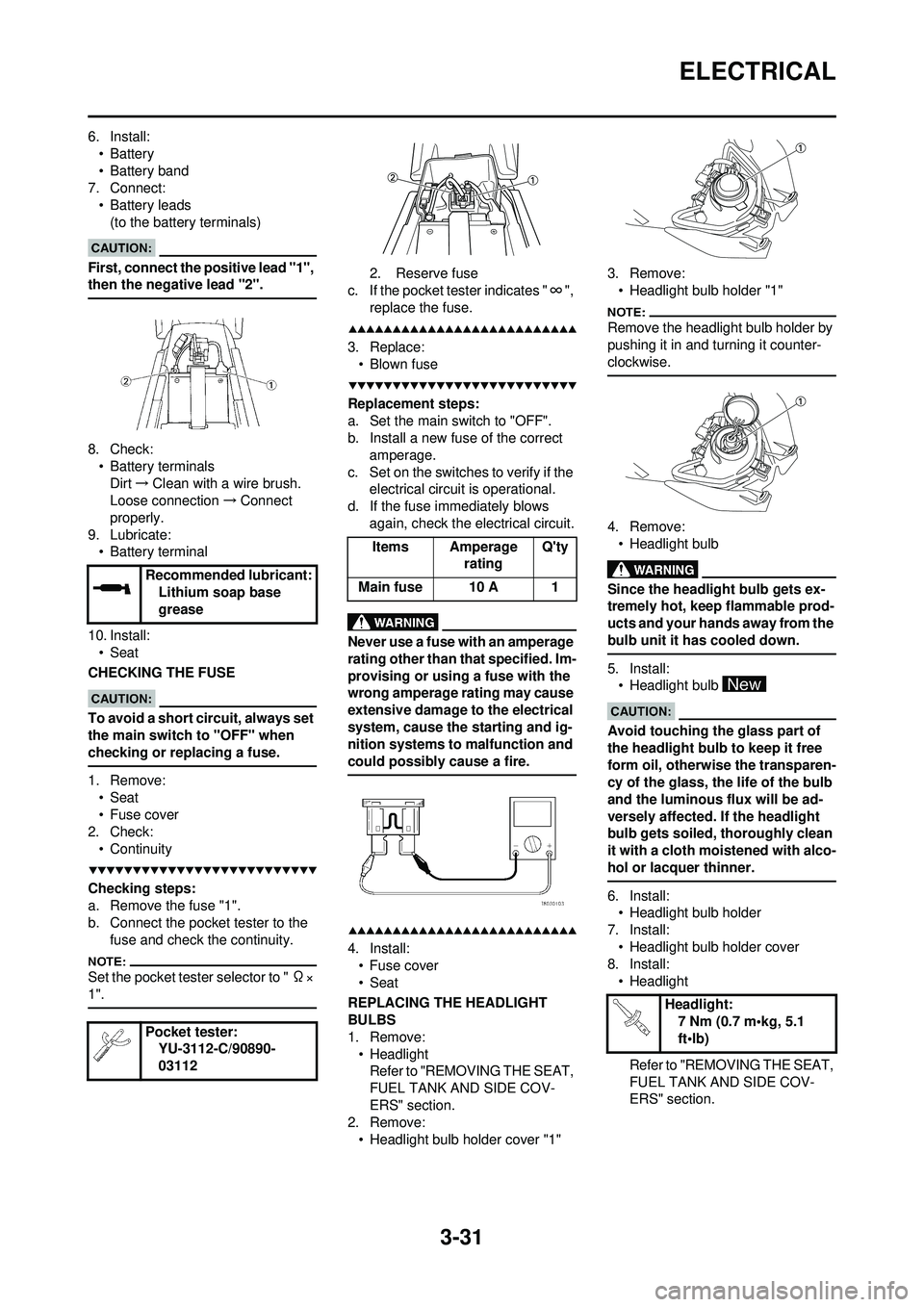
3-31
ELECTRICAL
6. Install:•Battery
• Battery band
7. Connect:
• Battery leads(to the battery terminals)
First, connect the positive lead "1",
then the negative lead "2".
8. Check:• Battery terminals
Dirt →Clean with a wire brush.
Loose connection →Connect
properly.
9. Lubricate: • Battery terminal
10. Install: • Seat
CHECKING THE FUSE
To avoid a short circuit, always set
the main switch to "OFF" when
checking or replacing a fuse.
1. Remove: • Seat
• Fuse cover
2. Check:
• Continuity
Checking steps:
a. Remove the fuse "1".
b. Connect the pocket tester to the fuse and check the continuity.
Set the pocket tester selector to " Ω×
1".
2. Reserve fuse
c. If the pocket test er indicates "∞",
replace the fuse.
3. Replace: • Blown fuse
Replacement steps:
a. Set the main switch to "OFF".
b. Install a new fuse of the correct amperage.
c. Set on the switches to verify if the electrical circuit is operational.
d. If the fuse immediately blows again, check the electrical circuit.
Never use a fuse with an amperage
rating other than th at specified. Im-
provising or using a fuse with the
wrong amperage rating may cause
extensive damage to the electrical
system, cause the starting and ig-
nition systems to malfunction and
could possibly cause a fire.
4. Install: • Fuse cover
•Seat
REPLACING THE HEADLIGHT
BULBS
1. Remove: • HeadlightRefer to "REMOVING THE SEAT,
FUEL TANK AND SIDE COV-
ERS" section.
2. Remove:
• Headlight bulb holder cover "1" 3. Remove:
• Headlight bulb holder "1"
Remove the headlight bulb holder by
pushing it in and turning it counter-
clockwise.
4. Remove:• Headlight bulb
Since the headlight bulb gets ex-
tremely hot, keep flammable prod-
ucts and your hands away from the
bulb unit it has cooled down.
5. Install:• Headlight bulb
Avoid touching the glass part of
the headlight bulb to keep it free
form oil, otherwis e the transparen-
cy of the glass, the life of the bulb
and the luminous flux will be ad-
versely affected. If the headlight
bulb gets soiled, thoroughly clean
it with a cloth moistened with alco-
hol or lacquer thinner.
6. Install: • Headlight bulb holder
7. Install:
• Headlight bulb holder cover
8. Install: • Headlight
Refer to "REMOVING THE SEAT,
FUEL TANK AND SIDE COV-
ERS" section.
Recommended lubricant:
Lithium soap base
grease
Pocket tester: YU-3112-C/90890-
03112
Items Amperage ratingQ'ty
Main fuse 10 A 1
Headlight: 7 Nm (0.7 m•kg, 5.1
ft•lb)