2008 YAMAHA WR 250F seat adjustment
[x] Cancel search: seat adjustmentPage 56 of 224

3-1
MAINTENANCE INTERVALS
REGULAR INSPECTION AND ADJUSTMENTS
MAINTENANCE INTERVALS
The following schedule is intended as a general guide to maint enance and lubrication. Bear in mind that such factors as
weather, terrain, geographical location, and individual usage will alter the required maintenance and lubrication intervals. If
you are a doubt as to what intervals to follow in maintaini ng and lubricating your machine, consult your Yamaha dealer.
ItemAfter
break- in Every
race
Every third
(or 500
km) Every
fifth (or 1,000
km)
As re-
quired Remarks
ENGINE OIL Replace ●●
VALVES Check the valve clearances ●● The engine must be cold.
Inspect ●Check the valve seats and valve
stems for wear.
Replace ●
VALVE SPRINGS Inspect ●Check the free length and the tilt.
Replace ●
VALVE LIFTERS Inspect ●Check for scratches and wear.
Replace ●
CAMSHAFTS Inspect the camshaft surface.
Inspect ●Inspect the decompression system.
Replace ●
CAMSHAFT SPROCKETS Inspect ●Check for wear on the teeth and for
damage.
Replace ●
PISTON Inspect ●●Inspect crack.
Clean ●Inspect carbon deposits and eliminate
them.
Replace ●
PISTON RING Inspect ●Check ring end gap.
Replace ●●
PISTON PIN Inspect ●
Replace ●
CYLINDER HEAD Inspect carbon deposits and eliminate
them.
Inspect and clean ●Change gasket.
CYLINDER Inspect and clean ●Inspect score marks.
Replace ●Inspect wear.
Page 65 of 224

3-10
ENGINE
Handling notes of coolant:
The coolant is harmful so it should be
handled with special care.
• When coolant splashes to your eye.
Thoroughly wash your eye with
water and see your doctor.
• When coolant splashes to your clothes.
Quickly wash it away with water
and then with soap.
• When coolant is swallowed. Quickly make him vomit and take
him to a doctor.
9. Install:• Radiator cap
Start the engine and warm it up
for a several minutes.
10. Check:
• Coolant levelCoolant level low →Add coolant.
CHECKING THE RADIATOR CAP
1. Inspect: • Seal (radiator cap) "1"
• Valve and valve seat "2"Crack/damage →Replace.
Exist fur deposits "3" →Clean or
replace.
CHECKING THE RADIATOR CAP
OPENING PRESSURE
1. Attach: • Radiator cap tester "1" and adapt-er "2"
Apply water on the radiator cap seal.
3. Radiator cap
2. Apply the specified pressure.
3. Inspect: •PressureImpossible to maintain the speci-
fied pressure for 10 seconds →
Replace.
CHECKING THE COOLING
SYSTEM
1. Inspect: • Coolant level
2. Attach: • Radiator cap tester "1" and adapt-
er "2"
3. Apply the specified pressure.
• Do not apply pressure more than specified pressure.
• Radiator should be filled fully.
4. Inspect: •PressureImpossible to maintain the speci-
fied pressure for 10 seconds →
Repair.
• Radiator "1"
• Radiator hose joint "2" Coolant leakage →Repair or re-
place.
• Radiator hose "3" Swelling →Replace. ADJUSTING THE CLUTCH CABLE
FREE PLAY
1. Check:
• Clutch lever free play "a"Out of specification →Adjust.
2. Adjust: • Clutch lever free play
Clutch lever free play adjustment
steps:
a. Loosen the locknuts "1".
b. Adjust the free play by changing their tightening position.
c. Tighten the locknuts.
• Make minute adjustment on the le- ver side using the adjuster "2".
• After adjustment, check proper op- eration of clutch lever.
ADJUSTING THE THROTTLE
CABLE FREE PLAY
1. Check:
• Throttle grip free play "a"Out of specification →Adjust.
Radiator cap tester:
YU-24460-01/90890-
01325
Radiator cap tester
adapter: YU-33984/90890-01352
Radiator cap opening
pressure:110 kPa (1.1 kg/cm
2,
15.6 psi)
Radiator cap tester: YU-24460-01/90890-
01325
Radiator cap tester
adapter:
YU-33984/90890-01352
Standard pressure: 180 kPa (1.8 kg/cm
2,
25.6 psi)
Clutch lever free play "a"
: 8–13 mm (0.31–0.51 in)
Locknut: 7 Nm (0.7 m•kg, 5.1
ft•lb)
Throttle grip free play
"a": 3–5 mm (0.12–0.20 in)
Page 69 of 224

3-14
ENGINE
ADJUSTING THE PILOT SCREW
1. Adjust:• Pilot screw "1"
Adjustment steps:
To optimize the fuel flow at a smaller
throttle opening, each machine's pilot
screw has been individually set at the
factory. Before adjusting the pilot
screw, turn it in fully and count the
number of turns. Record this number
as the factory-set number of turns
out.
a. Turn in the pilot screw until it is
lightly seated.
b. Turn out the pilot screw by the factory-set number of turns.
ADJUSTING THE ENGINE IDLING
SPEED
1. Start the engine and thoroughly warm it up.
2. Adjust: • Engine idling speed
Adjustment steps:
a. Turn the throttle stop screw "1"
until the specified engine idling
speed.
Using a digital engine tachometer for
idle speed adjustment, detect the en-
gine idling speed by bringing the
sensing element "c" of the engine ta-
chometer close to the ignition coil "2".
ADJUSTING THE VALVE
CLEARANCE
• The valve clearance should be ad0justed when the engine is cool
to the touch.
• The piston must be at Top Dead Center (T.D.C.) on compression
stroke to check or adjust the valve
clearance.
1. Remove:
•Seat
•Fuel tankRefer to "REMOVING THE SEAT,
FUEL TANK AND SIDE COV-
ERS" section.
2. Drain:
• CoolantRefer to "CHANGING THE
COOLANT" section.
3. Remove: • Right radiatorRefer to "RADIATOR" section in
the CHAPTER 5.
• Carburetor Refer to "CARBU RETOR" section
in the CHAPTER 5.
• Spark plug
• Upper engine bracket
• Cylinder head cover Refer to "CAMSHAFTS" section
in the CHAPTER 5. 4. Remove:
• Timing mark accessing screw "1"
• Crankshaft end accessing screw "2"
• O-ring
5. Check: • Valve clearanceOut of specification →Adjust.
Checking steps:
a. Turn the crankshaft counterclock-
wise with a wrench.
b. Align the T.D.C. mark "a" on the
rotor with the align mark "b" on the
crankcase cover when piston is at
T.D.C. on compression stroke.
In order to be sure t hat the piston is at
Top Dead Center, the punch mark "c"
on the exhaust camshaft and the
punch mark "d" on the intake cam-
shaft must align with the cylinder
head surface, as shown in the illustra-
tion.
Pilot screw (example):
1-1/2 turns out
(For EUROPE)
To increase idle speed →Turn the
throttle stop screw "1" in "a".
To decrease idle speed →Turn the
throttle stop screw "1" out "b".
Engine idling speed:1,750–1,950 r/min
Valve clearance (cold):
Intake valve:0.10–0.15 mm
(0.0039–0.0059 in)
Exhaust valve: 0.17–0.22 mm
(0.0067–0.0087 in)
Page 94 of 224

4-7
CHASSIS
CHOOSING SET LENGTH
1. Place a stand or block under the engine to put the rear wheel
above the floor, and measure the
length "a" between the rear wheel
axle center and the rear fender
holding bolt.
2. Remove the stand or block from the engine and with a rider astride
the seat, measure the sunken
length "b" between the rear wheel
axle center and the rear fender
holding bolt.
3. Loosen the locknut "1" and make adjustment by turning the spring
adjuster "2" to achieve the stan-
dard figure from the subtraction of
the length "b" from the length "a".
• If the machine is new and after it is broken in, the same set length of
the spring may change because of
the initial fatigue, etc. of the spring.
Therefore, be sure to make reeval-
uation.
• If the standard figure cannot be
achieved by adjusting the spring
adjuster and changing the spring
set length, replace the spring with
an optional one and make re-ad-
justment.
SETTING OF SPRING AFTER
REPLACEMENT
After replacement, be sure to adjust
the spring to the set length [sunken
length 90–100 mm (3.5–3.9 in)] and
set it.
1. Use of soft spring• Set the soft sp ring for less re-
bound damping to compensate
for its less spring load. Run with
the rebound damping adjuster
one or two clicks on the softer
side and readjust it to suit your
preference.
2. Use of stiff spring • Set the soft spri ng for more re-
bound damping to compensate
for its greater spring load. Run
with the rebound damping adjust-
er one or two clicks on the stiffer
side and readjust it to suit your
preference.
Adjusting the rebound damping will
be followed more or less by a change
in the compression damping. For cor-
rection, turn th e low compression
damping adjuster on the softer side.
When using a rear shock absorber
other than currently installed, use
the one whose overall length "a"
does not exceed the standard as it
may result in faul ty performance.
Never use one whose overall
length is greater than standard.
REAR SHOCK ABSORBER
SETTING PARTS
• Rear shock spring "1"
The I.D. color "a" is marked at the end
of the spring.
• Extent of adjustment (spring length)
Standard figure:
90–100 mm (3.5–3.9 in)
Length "a" of standard
shock:
488.5 mm (19.23 in)
TY
PE SPR
ING
RAT E SPRIN
G
PART NUM-
BER (-
22212-) I.D.
COLOR/ POINT SPRI
NG
FRE E
LEN
GTH
SO FT 4.3 5UN-00 Brown/1 260
4.5 5UN-10 Green/1 260
4.7 5UN-20 Red/1 260
4.9 5UN-30 Black/1 260
5.1 5UN-40 Blue/1 260
ST D 5.3 5UN-50 Yellow/
1 260
STI FF 5.5 5UN-60 Pink/1 260
5.7 5UN-70 White/1 260
SPRING FREE
LENGTH EXTENT OF AD-
JUSTMENT "b"
260 mm (10.24 in) 238.5–258.5
mm (9.39–10.18 in)
Page 95 of 224

4-8
CHASSIS
SUSPENSION SETTING (FRONT FORK)
• If any of the following symptoms is experienced with the standard position as the base, make resetting by reference to the adjustment procedure gi ven in the same chart.
• Before any change, set t he rear shock absorber sunken length to the standard figure 90–100 mm (3.5–3.9 in).
SymptomSection
Check Adjust
Jump Large
gap Medi-
um
gap Small
gap
Stiff over entire
range ○○○ Compression damping Turn adjuster counterclockwise (about 2 clicks) to
decrease damping.
Oil level (oil amount) Decrease oil level by about 5–10 mm (0.2–0.4 in).
Spring Replace with soft spring.
Unsmooth move-
ment over entire
range ○○○○ Outer tube
Check for any bends, dents, and other noticeable
scars, etc. If any, replace affected parts.
Inner tube
Under bracket tighten-
ing torque Retighten to specified torque.
Poor initial move-
ment ○Rebound damping Turn adjuster counterclockwise (about 2 clicks) to
decrease damping.
Oil seal Apply grease in oil seal wall.
Soft over entire
range, bottoming
out ○○ Compression damping Turn adjuster clockwise (about 2 clicks) to in-
crease damping.
Oil level (oil amount) Increase oil level by about 5–10 mm (0.2–0.4 in).
Spring Replace with stiff spring.
Stiff toward stroke
end ○
Oil level (oil amount) Decrease oil level by about 5 mm (0.2 in).
Soft toward stroke
end, bottoming out ○
Oil level (oil amount) Increase oil level by about 5 mm (0.2 in).
Stiff initial move-
ment ○○○○
Compression dampingTurn adjuster counterclockwise (about 2 clicks) to
decrease damping.
Low front, tending to
lower front posture ○○Compression damping Turn adjuster clockwise (about 2 clicks) to in-
crease damping.
Rebound damping Turn adjuster counterclockwise (about 2 clicks) to decrease damping.
Balance with rear end Set sunken length for 95–100 mm (3.7–3.9 in) when one passenger is astride seat (lower rear
posture).
Oil level (oil amount) Increase oil level by about 5 mm (0.2 in).
"Obtrusive" front,
tending to upper
front posture ○○Compression damping Turn adjuster counterclockwise (about 2 clicks) to
decrease damping.
Balance with rear end Set sunken length for 90–95 mm (3.5–3.7 in) when one passenger is astride seat (upper rear
posture).
Spring Replace with soft spring.
Oil level (oil amount) Decrease oil level by about 5–10 mm (0.2–0.4 in).
Page 96 of 224

4-9
CHASSIS
SUSPENSION SETTING (REAR SHOCK ABSORBER)
• If any of the following symptoms is experienced with the standard position as the base, make resetting by reference to the adjustment procedure gi ven in the same chart.
• Adjust the rebound damping in 2-click increments or decrements.
• Adjust the low compression damping in 1-click increments or decrements.
• Adjust the high compression damping in 1/6 turn increments or decrements.
Symptom Section
Check Adjust
Jump Large
gap Medi-
um
gap Small
gap
Stiff, tending to sink ○○Rebound damping Turn adjuster counterclockwise (about 2 clicks) to
decrease damping.
Spring set length Set sunken length for 90–100 mm (3.5–3.9 in) when one passenger is astride seat.
Spongy and unsta-
ble ○○Rebound damping Turn adjuster clockwise (about 2 clicks) to in-
crease damping.
Low compression
damping Turn adjuster clockwise (about 1 click) to increase
damping.
Spring Replace with stiff spring.
Heavy and dragging ○○Rebound damping Turn adjuster counterclockwise (about 2 clicks) to
decrease damping.
Spring Replace with soft spring.
Poor road gripping ○Rebound damping Turn adjuster counterclockwise (about 2 clicks) to
decrease damping.
Low compression
damping Turn adjuster clockwise (about 1 clicks) to in-
crease damping.
High compression
damping Turn adjuster clockwise (about 1/6 turn) to in-
crease damping.
Spring set length Set sunken length for 90–100 mm (3.5–3.9 in) when one passenger is astride seat.
Spring Replace with soft spring.
Bottoming out ○○ High compression
damping
Turn adjuster clockwise (about 1/6 turn) to in-
crease damping.
Spring set length Set sunken length for 90–100 mm (3.5–3.9 in) when one passenger in astride seat.
Spring Replace with stiff spring.
Bouncing ○○ Rebound damping Turn adjuster clockwise (about 2 clicks) to in-
crease damping.
Spring Replace with soft spring.
Stiff travel ○○ High compression
damping
Turn adjuster counterclockw
ise (about 1/6 turn) to
decrease damping.
Spring set length Set sunken length for 90–100 mm (3.5–3.9 in) when one passenger is astride seat.
Spring Replace with soft spring.
Page 103 of 224

5-7
CARBURETOR
HANDLING NOTE
Do not loosen the screw (throttle
position sensor) "1" except when
changing the throttle position sen-
sor due to failure because it will
cause a drop in engine perfor-
mance.
REMOVING THE PILOT SCREW
1. Remove: • Pilot screw "1"
To optimize the fuel flow at a small
throttle opening, each machine's pilot
screw has been individually set at the
factory. Before removing the pilot
screw, turn it in fully and count the
number of turns. Record this number
as the factory-set number of turns
out.
CHECKING THE CARBURETOR
1. Inspect:
• Carburetor bodyContamination →Clean.
• Use a petroleum based solvent for
cleaning. Blow out all passages and
jets with compressed air.
• Never use a wire.
2. Inspect: •Main jet "1"
• Pilot jet "2"
• Needle jet "3"
• Starter jet "4"
• Pilot air jet "5"
• Leak jet "6" • Main air jet "7"
Damage →Replace.
Contamination →Clean.
• Use a petroleum based solvent for
cleaning. Blow out all passages and
jets with compressed air.
• Never use a wire.
CHECKING THE NEEDLE VALVE
1. Inspect: • Needle valve "1"
• Valve seat "2"
Grooved wear "a" →Replace.
Dust "b" →Clean.
• Filter "c"
Clogged →Clean.
CHECKING THE THROTTLE
VALVE
1. Check: • Free movementStick →Repair or replace.
Insert the throttle valve "1" into the
carburetor body, and check for free
movement.
CHECKING THE JET NEEDLE
1. Inspect: • Jet needle "1"Bends/wear →Replace.
• Clip groove Free play exists/wear →Replace. MEASURING AND ADJUSTING
THE FLOAT HEIGHT
1. Measure:
• Float height "a"Out of specification →Adjust.
Measurement and adjustment
steps:
a. Hold the carburetor in an upside
down position.
• Slowly tilt the ca rburetor in the op-
posite direction, then take the mea-
surement when the needle valve
aligns with the float arm.
• If the carburetor is level, the weight of the float will push in the needle
valve, resulting in an incorrect mea-
surement.
b. Measure the distance between the mating surface of the float
chamber and top of the float using
a vernier calipers.
The float arm should be resting on the
needle valve, but not compressing
the needle valve.
c. If the float height is not within specification, inspect the valve
seat and needle valve.
d. If either is worn, replace them both.
e. If both are fine, adjust the float height by bending the float tab "b"
on the float.
Float height:
8.0 mm (0.31 in)
Page 182 of 224
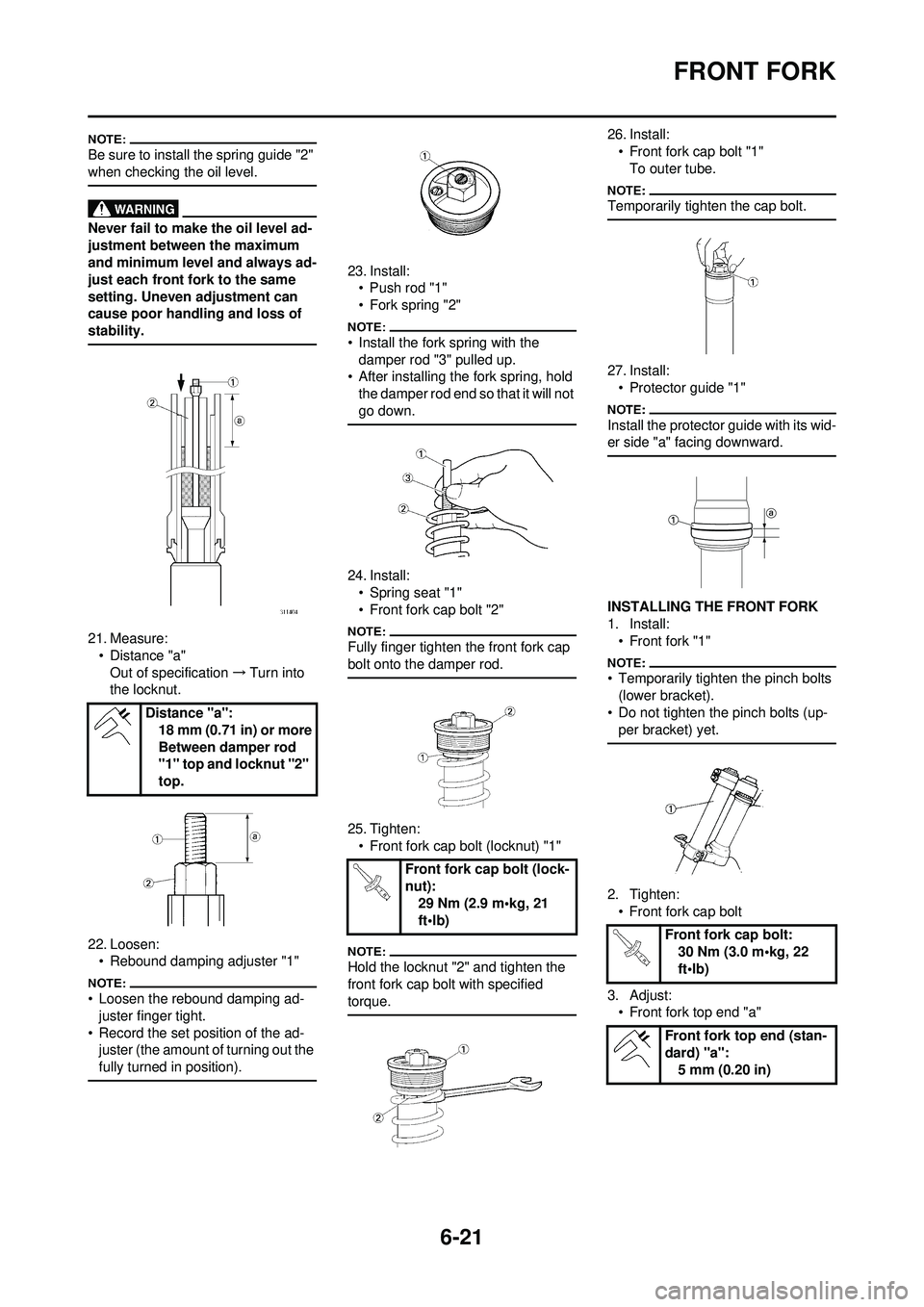
6-21
FRONT FORK
Be sure to install the spring guide "2"
when checking the oil level.
Never fail to make the oil level ad-
justment between the maximum
and minimum level and always ad-
just each front fork to the same
setting. Uneven adjustment can
cause poor handling and loss of
stability.
21. Measure: • Distance "a"
Out of specification →Turn into
the locknut.
22. Loosen: • Rebound damping adjuster "1"
• Loosen the rebound damping ad-juster finger tight.
• Record the set position of the ad- juster (the amount of turning out the
fully turned in position).
23. Install:• Push rod "1"
• Fork spring "2"
• Install the fork spring with the damper rod "3" pulled up.
• After installing the fork spring, hold
the damper rod end so that it will not
go down.
24. Install:• Spring seat "1"
• Front fork cap bolt "2"
Fully finger tighten the front fork cap
bolt onto the damper rod.
25. Tighten:• Front fork cap bolt (locknut) "1"
Hold the locknut "2" and tighten the
front fork cap bolt with specified
torque.
26. Install:
• Front fork cap bolt "1"To outer tube.
Temporarily tighten the cap bolt.
27. Install:
• Protector guide "1"
Install the protector guide with its wid-
er side "a" facing downward.
INSTALLING THE FRONT FORK
1. Install:• Front fork "1"
• Temporarily tighten the pinch bolts
(lower bracket).
• Do not tighten the pinch bolts (up- per bracket) yet.
2. Tighten:• Front fork cap bolt
3. Adjust: • Front fork top end "a"
Distance "a":
18 mm (0.71 in) or more
Between damper rod
"1" top and locknut "2"
top.
Front fork cap bolt (lock-
nut):29 Nm (2.9 m•kg, 21
ft•lb)
Front fork cap bolt: 30 Nm (3.0 m•kg, 22
ft•lb)
Front fork top end (stan-
dard) "a": 5 mm (0.20 in)