Page 171 of 230

Opening the hood
1. Pull the lever located under the left side of the dash to release the hood lock.
2. Lift the hood slightly.
3. Press up the release control located under the front edge of the hood (at the center) and lift.
WARNING
Check that the hood locks properly when closed!
Engine compartment
1. Expansion tank - coolant
2. Power steering fluid reservoir
3. Washer fluid reservoir
4. Dipstick - engine oil
5. Radiator
6. Cooling fan
7. Oil filler cap - engine
8. Clutch/brake fluid reservoir
9. Relay/fuse box
10. Air cleaner
11. Battery (in trunk)
12. Data plate
WARNING
The cooling fan (6) may start or continue to operate (for up to 6 minutes) after the engine has been switched off.
192 09 Maintenance and servicing
Engine oil
Oil specifications
Engine oil must meet the minimum ILSAC specification GF-3, API SL, or ACEA A1/B1. Lower quality oils may not
offer the same fuel economy, engine performance, or engine protection.
Volvo recommends Castrol.
Depending on your driving habits, premium or synthetic oils may provide superior fuel economy and engine protection.
Consult your Volvo retailer or a trained and qualified Volvo service technician for recommendations on premium or
synthetic oils.
ProCarManuals.com
Page 177 of 230
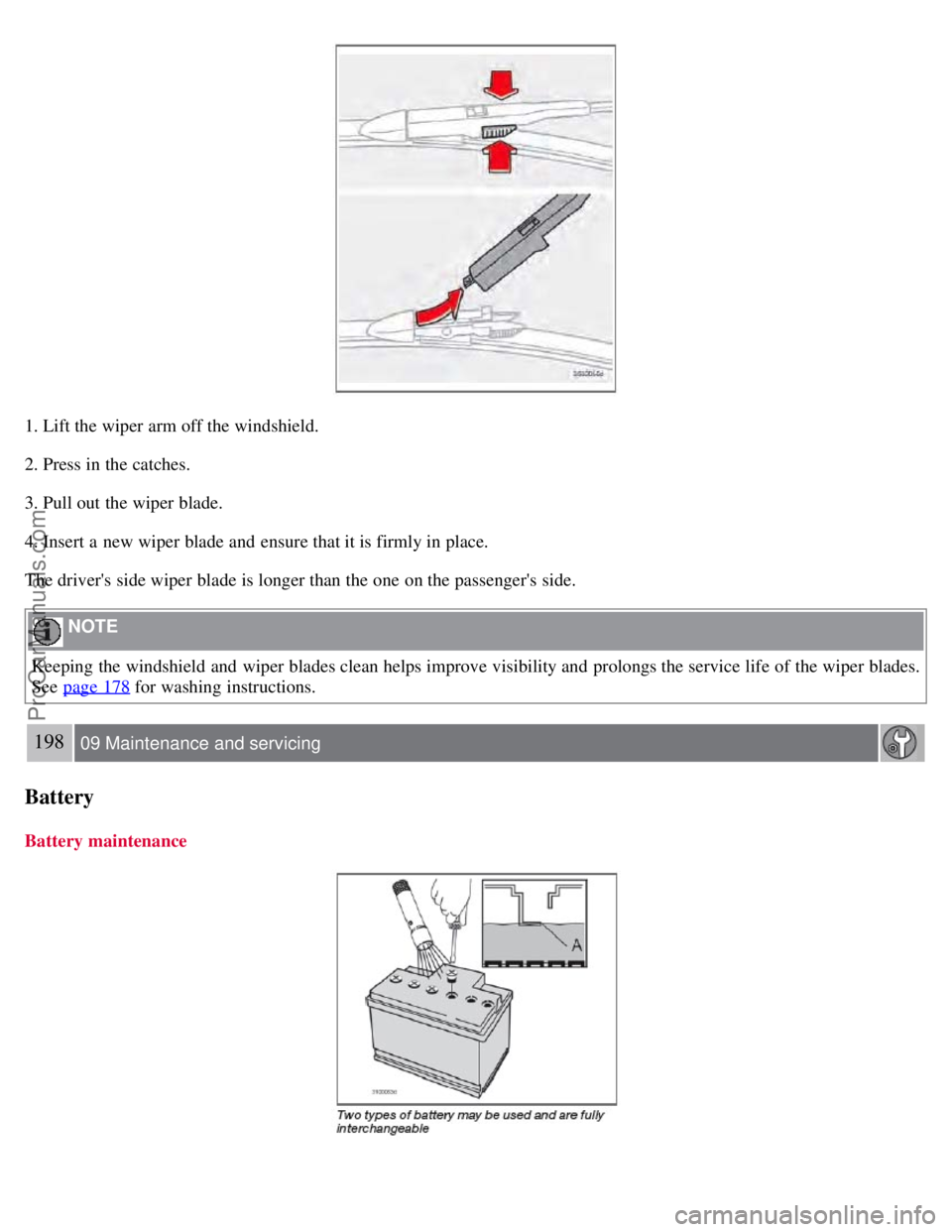
1. Lift the wiper arm off the windshield.
2. Press in the catches.
3. Pull out the wiper blade.
4. Insert a new wiper blade and ensure that it is firmly in place.
The driver's side wiper blade is longer than the one on the passenger's side.
NOTE
Keeping the windshield and wiper blades clean helps improve visibility and prolongs the service life of the wiper blades.
See page 178
for washing instructions.
198 09 Maintenance and servicing
Battery
Battery maintenance
ProCarManuals.com
Page 178 of 230

The battery in your vehicle is located under the floor of the trunk.
Driving habits and conditions, climate, the number of starts, etc. all affect the service life and function of the battery. In
order for your battery to perform satisfactorily, keep the following in mind:
Check the fluid level in each cell in the battery every 24 months or every 15,0001 miles (24,000 km), whichever is
sooner. The fluid should be at the level shown in the illustrations above (A)
2. Do not overfill.
1More frequently in warm climates.
Use a screw driver to open the caps or cover and a flashlight to inspect the level.
If necessary, add distilled water. The level should never be above the indicator (A).
The fluid level should be checked if the battery has been recharged.
After inspection, be sure the cap over each battery cell or the cover is securely in place.
Check that the battery cables are correctly connected and properly tightened. Route ventilation hose through opening in
floor (see page 199
)
2The level indicator inside the battery could be designed in various ways. See illustrations.
Never disconnect the battery when the engine is running, for example when changing the battery.
The battery should be disconnected from the vehicle when a battery charger is used directly on the battery.
However, if the battery is being charged via the connecting points in the engine compartment (see page 199), the
battery must be connected.
WARNING
PROPOSITION 65 WARNING!
Battery posts, terminals, and related accessories contain lead and lead compounds, chemicals known to the state of
California to cause cancer and reproductive harm. Wash hands after handling.
WARNING
Never expose the battery to open flame or electric spark.
Do not smoke near the battery.
Battery fluid contains sulfuric acid. Do not allow battery fluid to contact eyes, skin, fabrics or painted surfaces. If
contact occurs, flush the affected area immediately with water. Obtain medical help immediately if eyes are affected.
199 09 Maintenance and servicing
ProCarManuals.com
Page 179 of 230
Battery
NOTE
Used batteries should be properly disposed of at a recycling station or similar facility, or taken to your Volvo retailer.
Symbols:
Replacing the battery
1. Switch off the ignition and remove the key.
2. Wait at least 5 minutes after switching off the ignition before disconnecting the battery so that all information in the
vehicle's electrical system can be stored in the control modules.
ProCarManuals.com
Page 180 of 230
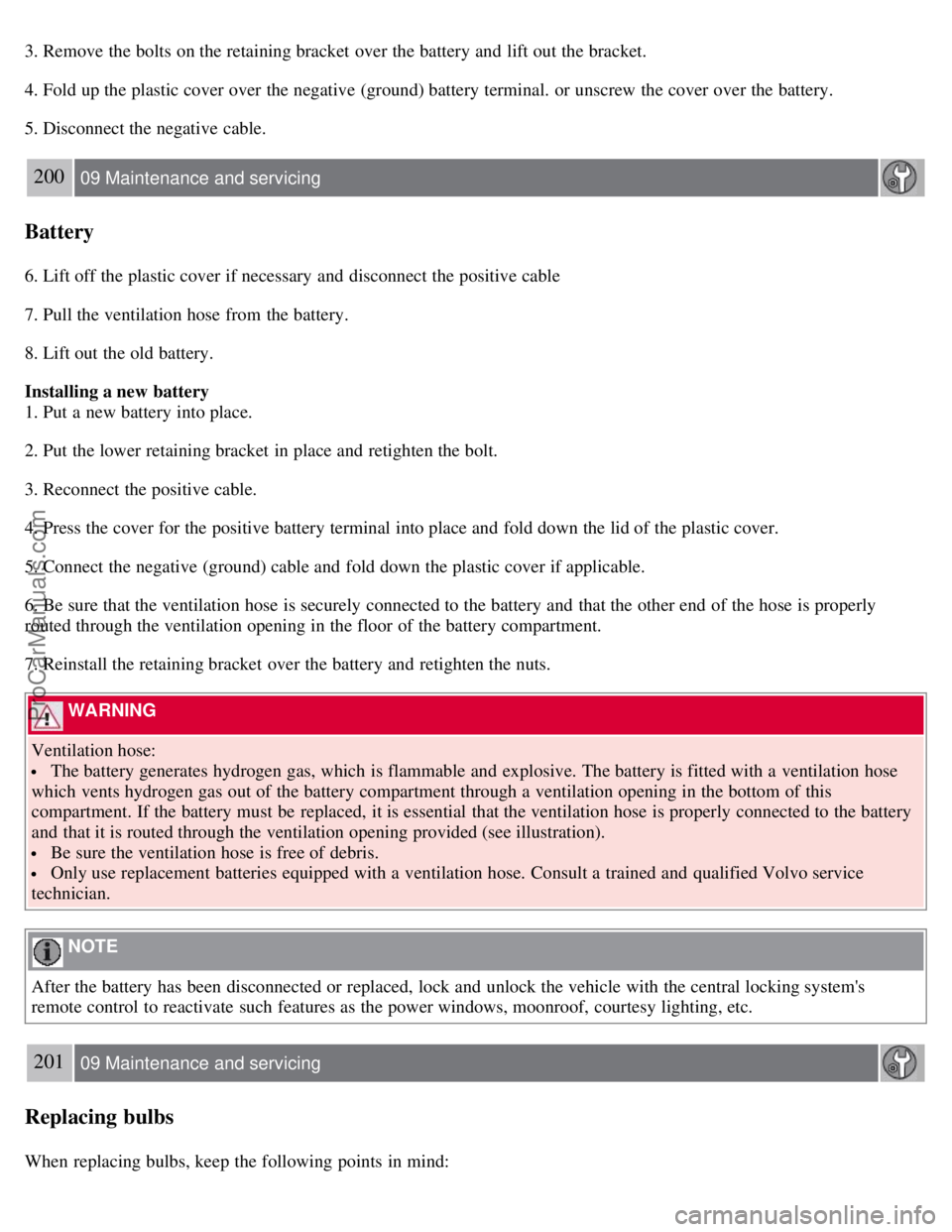
3. Remove the bolts on the retaining bracket over the battery and lift out the bracket.
4. Fold up the plastic cover over the negative (ground) battery terminal. or unscrew the cover over the battery.
5. Disconnect the negative cable.
200 09 Maintenance and servicing
Battery
6. Lift off the plastic cover if necessary and disconnect the positive cable
7. Pull the ventilation hose from the battery.
8. Lift out the old battery.
Installing a new battery
1. Put a new battery into place.
2. Put the lower retaining bracket in place and retighten the bolt.
3. Reconnect the positive cable.
4. Press the cover for the positive battery terminal into place and fold down the lid of the plastic cover.
5. Connect the negative (ground) cable and fold down the plastic cover if applicable.
6. Be sure that the ventilation hose is securely connected to the battery and that the other end of the hose is properly
routed through the ventilation opening in the floor of the battery compartment.
7. Reinstall the retaining bracket over the battery and retighten the nuts.
WARNING
Ventilation hose:
The battery generates hydrogen gas, which is flammable and explosive. The battery is fitted with a ventilation hose
which vents hydrogen gas out of the battery compartment through a ventilation opening in the bottom of this
compartment. If the battery must be replaced, it is essential that the ventilation hose is properly connected to the battery
and that it is routed through the ventilation opening provided (see illustration).
Be sure the ventilation hose is free of debris.
Only use replacement batteries equipped with a ventilation hose. Consult a trained and qualified Volvo service
technician.
NOTE
After the battery has been disconnected or replaced, lock and unlock the vehicle with the central locking system's
remote control to reactivate such features as the power windows, moonroof, courtesy lighting, etc.
201 09 Maintenance and servicing
Replacing bulbs
When replacing bulbs, keep the following points in mind:
ProCarManuals.com
Page 213 of 230
1The HU- 850 must be connected to an external amplifier.
NOTE
"Alarm!" is displayed when an alarm message is sent. The function is used to warn the driver of a serious accident or
disaster situation.
NOTE
The optional supplementary amplifier (HU-850) may be mounted under the front passenger's seat. If the floor of the
vehicle has become soaked for any reason, do not turn on the radio. This would cause damage to the amplifier.
Contact a trained and qualified Volvo service technician.
Low battery voltage
If the level of battery voltage is low, a message will be displayed.
The vehicle's energy conservation function may switch off the audio system. Recharge the battery by starting the
engine.
Contents | Top of Page
ProCarManuals.com
Page 219 of 230
248 11 Specifications
Bulbs
WARNING
Active Bi -Xenon® headlights (option) - due to the high voltage used by these headlights, these bulbs should only be
replaced by an authorized Volvo service technician.
249 11 Specifications
Electrical system
General information
12-volt system with voltage controlled generator. Single wire system in which the chassis and engine block are used as
conductors, grounded on the chassis.
Battery
Voltage: 12 V
Cold start capacity (CCA): 600 A
Reserve capacity (RC): 115 min
Capacity (Ah): 70
If you must replace your battery, be sure to replace it with a battery of the same cold start capacity and reserve capacity
as the original (See the decal on the battery).
Generator
Max. current: 140 A
Starter motor
Power: 1.4 kW
Spark plugs
P/N272313-8 or equivalent
ProCarManuals.com
Page 220 of 230

Gap: 0.028-0.032 in. (0.7-0.8 mm)
Tightening torque: 22 ft. lbs. (30 Nm)
Firing order: 1-2-4-5-3.
Battery
1Models equipped with the High Performance audio system
2 Models equipped with the Premium Sound audio system or the Volvo Navigation System
If the battery must be replaced, replace it with one with the same cold start capacity and reserve capacity as the original
(see the decal on the battery).
WARNING
The distributor ignition system operates at very high voltages. Special safety precautions must be followed to prevent
injury. Always turn the ignition off when:
Replacing distributor ignition components e.g. plugs, coil, etc.
Do not touch any part of the distributor ignition system while the engine is running. This may result in unintended
movements and body injury.
WARNING
PROPOSITION 65 WARNING!
Battery posts, terminals, and related accessories contain lead and lead compounds, chemicals known to the state of
California to cause cancer and reproductive harm. Wash hands after handling.
250 11 Specifications
Three-way catalytic converter
Three-way catalytic converter - general information
Keep your engine properly tuned. Certain engine malfunctions, particularly involving the electrical, fuel or distributor
ignition systems, may cause unusually high three-way catalytic converter temperatures. Do not continue to operate your
vehicle if you detect engine misfire, noticeable loss of power or other unusual operating conditions, such as engine
overheating or backfiring. A properly tuned engine will help avoid malfunctions that could damage the three-way
catalytic converter.
Do not park your vehicle over combustible materials, such as grass or leaves, which can come into contact with the
hot exhaust system and cause such materials to ignite under certain wind and weather conditions.
Excessive starter cranking (in excess of one minute), or an intermittently firing or flooded engine can cause three-way
catalytic converter or exhaust system overheating.
ProCarManuals.com