2008 VOLKSWAGEN JETTA Com
[x] Cancel search: ComPage 134 of 477

WARNING
To help preven t poiso nous ex haust gas bei ng draw n in to the ve hicle, always kee p th e
r ea r li d closed w hile dri vin g.
• Never tra nspo rt objec ts la rger than those
fill ing co mplete ly i nto
lu ggage area be
ca use re ar lid cann ot be full y close d.
• If you abso lutely m usl d rive
th e rear
li d ope n, obse rve fo llow ing notes to red uce ris k of poiso ning:
C lose a ll win dows,
C lose the power
Ope n all ai r o ut lets i n the instrume nt
panel,
Swi tc h olT air reci rc ul ati on,
Se t th e fr esh air fan lo h ig hes t speed .
WARNING
Always make su re that doo rs, the power all w indows a nd rea r lid a re secure ly
closed an d locked lo re du ce the r is k of injur y
w hen
ve hicl e is no t be ing used.
Tie-downs
Bo oklet 2 .1 Safety fir st
WARN ING
• Afte r clo sin g th e rea r lid, always make sure il i s proper ly closed a nd locked.
• Never leave your vehicle u nattended espe
cia lly
rear lid open. A chil d co uld
craw l in to ve hicle thro ugh th e lu ggage
com partmen t a n d cl ose t he rear lid o r wi ndow
b eco min g tra pp ed a nd un abl e to get ou l.
Be ing trapped in a ve hicle ca n lea d lo se rious
p ersona l injury.
• Neve r lei c hild ren play in or around th e ve
hi cle.
• Never le t p assenge rs ride in the lu ggage
co mp artm ent. Vehicle occ upan ts
a lways
be proper ly re stra ined in one of the veh icle's
sea ting positions ..
Mak e sure heat in g w ires in re a r
w indo w ca nnot b e scraped and damaged b y
in ve hi cle .
Tip s
Air ci rc ula tion h elps redu ce window fogg ing.
D o not co ver slot s becaus e can
pre vent stal e air from escap ing the vehicl e.
The lu ggag e compartm ent is equipped w ith Jou r ti e-downs to secure luggage and
other items.
U se 10 sec ure y our cargo prop erl y IO , " Loadin g th e lu gg age compa rtm ent ".
l n a collis ion ,
laws of p hys ics mean even
s m alle r are lo ose in veh icle w ill
b ecome hea vy mi ssiles can cause se rious
injur y. h em s in v ehicl e po ssess e nerg y which
v ar y ve hicl e spee d and wei gh t of the
i t em. Veh icl e s peed is s ignifi cant facto r.
Fo r ex amp le. in a
co lli sion at a sp eed of 30
mph (48 km /h ). th e fo rces ac tin g o n a IO lb s. (4 .5
kg )
arc 2 0 l ime s norma l of item. Thi s m ea ns o f th e
i t e m wo uld sudd en ly be ab out 200 lb s. (9 0 kg) .
You can im agine
inju ries a 200 lbs. (90
kg ) flyin g free ly th rou gh pa sse nger
c ompar tm ent cou ld cau se in a colli sion like thi s.
WARNING
Weak, damaged or im pro per stra ps use d l ose
c u re item s lo lie -d owns can fail durin g hard
braking or i n collisio n an d cause se rious pe r
so nal injur y.
• A lways use suit abl e m ountin g str aps a nd
p ro per ly se cur e ite ms lo the lie-downs in
lu ggage compartment lo he lp preven t items
from or flying forwa rd as dangero us
m issi le s.
• When th e rear seal backres t is fo lded down,
a lway s use sui tab le mo unt ing stra ps an d
proper ly sec ure items to the tie- downs in the
lu ggage compa rtme nt l o help prevent item s
Saf e drivin g 11
Page 135 of 477
Booklet 2.1 Safety fir st
WARN ING (continu ed)
fro m fl ying fonvar cl as dan gerous miss iles into
th e passe nge r co mp artmen t.
Reporting safety defects
If you believe tha t vehicl e has a de
f ec t, w hic h co uld ca use a cra sh, in jury, or
d eath , you sh ould info rm th e NHTSA im
m edia te ly . Yo u sh oul d als o no tif y Volk
sw agen of Am erica , Inc. If N HT SA recei ves
s imi lar com plaint s, it m ay open an inves ti
gat ion , and i f it find s th at a saf ety defec t
exists in a grou p of ve hicl es, it m ay ord er a
reca ll an d re m ed y c am paig n. How ever,
N HTSA can not becom e in vo lve d in ind i
v idu al proble ms between you, you r d ea ler ,
or Vo lkswag en of A me rica, In c.
Addr ess of N HT SA
T e l.: l -888-DAS H-2- DOT
Fro m 8:00 AM to 10 :00 Mo nday through
Friday
O r ha ve a look a t:
http :// www-o cli.nht sa.cl ot.gov /ivu q/
and print out th e
form and it to (202)
366-7882
12 Safe driving
WARN ING (con tinued)
• Never att ac h a c hild seat teth er strap to a
O r m ail it to:
U.S. Depa rtm ent of Transporta tion ,
N ati onal H ig hway
Safe ty A dmini stra tio n. of Defects Invest ig ation .
NSA- l0.01, 400 7 th Str eet, SW
Wa sh ington, D.C. 20590
A ppli cabl e to Canada onl y
If yo u beli eve that yo ur veh icle has
d efec t
w hich cou ld ca use a crash, injur y or dea th , you
s h ould inform Transport Canada imm ediately.
Yo u sh oul d also notif y Volksw age n Canada, In c.
A ddress of Tran sp ort Cana da
To conta ct Transpo rt Cana da, yo u ma y either
ca ll Transport Ca nada at:
Tel.: Phone: (800 ) 333-05[0 (o nly fro m Can ada)
Tel.: Pho ne: (613) 998-86 16 (O ttawa reg io n )
O r wr ite to:
Transport Canada R oad Safe ty
2780
R oad
Ottawa. ON
Page 140 of 477
Booklet 2.1 Safety first
it 's po ssibl e to use the to brace the body a ,ninor collision.
It 's simp ly not
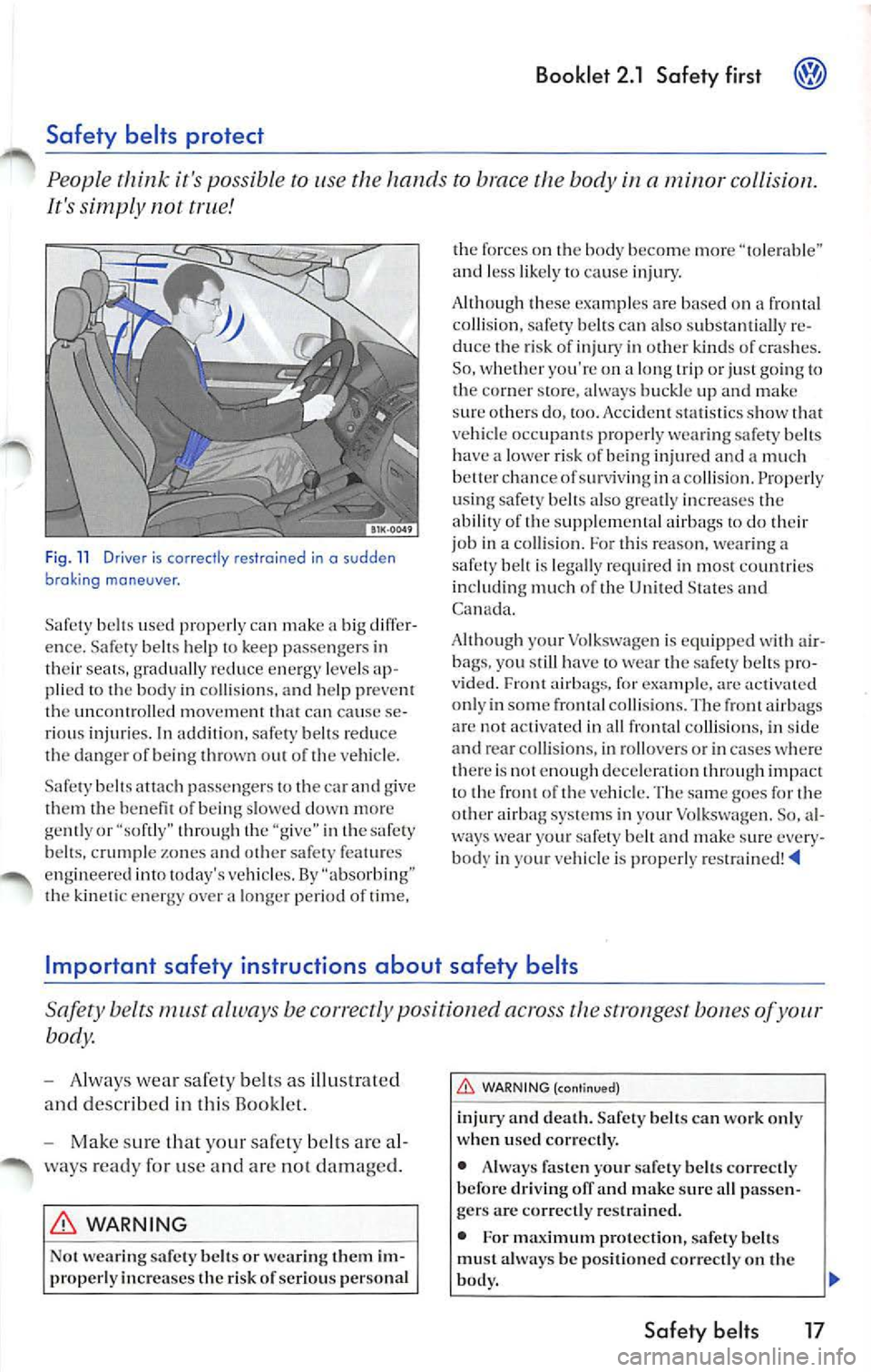
Fi g. 11 Driver is co rrectly re strained in o s udden
broki ng ma neuver .
Safely belt s used prop erl y can make a big diff er
ence. Safet y belts help to keep passe ngers in
the ir sea ls , gra dually r edu ce e nergy levels ap
pli ed
to the body in co llision s. and help preve nt
th e unc ontroll ed mo veme nl tha t can cause se
riou s injur ies. In ad di1i on, safe ty belt s redu ce
th e clang er of being thro wn ou1 o f th e ve hicl e.
Safe ty belt s atta ch passengers 10 the car and giv e
th em t he ben efi t of b eing
down more
ge nll yor "sof tly" through lhe "g ive" in the saf ety
b e lts, cru mp le zo ne s
other saf ely fea1 ures
e n gin ee re d into toda y's vehicl es. By "ab sorb ing"
t h e kinet ic ener gy ov er
longe r per iod of lime , th
e fo rces o n 1h e body be come more "tolerable "
and less likely to c ause injur y.
A lthoug h 1hese exa mples are ba sed on a frontal
co llision,
belt s can also sub sla nt ially re
duc e the risk of inju ry in 01h er kin ds of crash es.
So . w heth er yo u're on a long 1rip or ju sl go ing to
lh e c orner stor e, always buckle up and make
s ur e oth ers do, too. Acci denl statist ics sh ow 1h at
ve hicle occ upan 1s prop erl y wea ring sa fe ty
ha ve lower risk of bein g in jur ed and a much
b elie r ch an ce of in collis io n. Properl y
u sin g safe ty bell s also great ly in cre a ses the
abili 1y of 1 he s uppl em ent al a irbags 10 do their
job in a collisio n . Fo r thi s rea son, wea ring a
safe ty belt is lega lly re quir ed in mo sl cou ntries
includin g mu ch of th e Un ited
and
Canada .
A lth ough your Volk swage n i s eq uipped wilh a ir
ba gs. yo u still have to we ar th e safe ly be lts pro
v id ed. Fro nt a irba gs, for examp le,
a cti va ted
on ly in some frontal collisio ns. Th e front airb ags
a re no t acli vated in all fron ta l co lli sio ns, in sid e
and rea r co llisio ns. in rollo vers o r in cas es wh ere
is no t e nou gh de celeration through impac t
to the front of the vehicle. Th e sa me go es for the
01 hcr airbag sys1ems in yo ur Volk sw agen. So, al
w ays
you r saf ety belt and mak e sure ev ery
bo dy in ve hicle is prop erly
Impo rtant safety instructions about safety belts
Safety bel ts must alway s be cor rect ly pos i ri on ed across the strongest bones of you r
body.
- Always wea r saf ety bells as ill ustra ted
and descr ibed in thi s Bookl et.
- Make su re th at yo ur sa fet y be lts a rc a l
ways rea dy fo r u se and arc no t da ma ged.
WARNING
Not wea ring sa fe ty belt s or wearing t hem im
prop erl y inc re as es the ri sk of se rious per sona l
WAR NING (continued)
injury and death. Safety belts ca n w ork onl y
w hen u sed correct ly.
• Always fas te n yo ur safety belt s cor rect ly
before dri vin g o ff and make sure all pa sse n
ge rs are cor rec tly res tra in ed.
•
m ax imum protection, sa fel y belt s
mu st be po sitione d cor rectly on th e
body.
Safety belts 17
Page 141 of 477

Booklet 2.1 Safety first
WARN ING (continued)
• Neve r strap m ore than one perso n, in
cluding small ch ildr en, into belt.
• Neve r p lace a safety belt over a child sitting
o n your lap.
• Always keep fee t in the foot we ll in front of
th e scat w hile th e ve hicl e is being driven.
• Neve r let a n y perso n r ide with feet on the
instrument panel or sticking out th e window
or on th e sca t.
• Never remove a safety be lt whil e th e ve
hicle i s mo ving. Do ing so w ill increase yo ur
ri sk of being injur ed or kill ed.
• Neve r wear be lts twi sted.
• Never wear bel ts over rigid o r breakable
ob jects in or on your clothing, su ch as eye
glasses, pen s, keys, etc., as these may cause in
jur y.
• Neve r allo w sa fet y belts to become dam
aged by being caugh t in door or sea t hardware.
• Neve r wear t he s hou lder part of the be lt
und er you r ar m or otherwi se ou t of posi tion.
• Severa l layers of heavy clothing may inter
fere w ith correc t position ing of belt s and re
duce the overa ll eff ect ive ness of t he sys tem.
18 Safety belt s
WARNING (continued)
• Alwa ys keep b elt buckles free of a nyt hing
that may prevent th e buckl e from latc hing se
cure ly.
• Never use comfor t clips or dev ices that
crea te slac k in the sh ould er bel t. Howeve r,
s pecial clips may be required for the correc t
u se of some child restraint systems.
• Torn o r frayed safety belt s can tear a nd
damag ed belt hardw are can break in a colli
s ion. In spect belts reg ularl y. lf webb ing, bind
in gs, buckl es, or retractors are damaged, h ave
b elt s rep laced by an authorized Volkswage n
dealer or qualifi ed worksho p.
• Safety be lts that have been worn and
l oaded in an accident must b e re pl ace d w ith
the correct re placement safety belt by a n au
t h orized Volkswage n dea le r. Replacement
may be necessary even if damage canno t be
clea rly see n. Anchorages t hat were loaded
mu st a lso be inspecte d.
• Neve r remove, modify, disassembl e, or try
t o repa ir th e safe ty belts yourse lf.
• Always keep the belts clean. Dirty belts
m ay not work co rrectl y and can impair the
fun ction o f th e in erti a ree l
3.4 "Ti ps
an d Adv ice", c hap te r "C lea nin g and
Pro tect ion."
Page 145 of 477

Booklet 2.1 Safety fir st
Safety belt extender
A safety belt extende r is available if a belt is too short for the driver o r a pas
seng e,:
F ig . 16 Safety be lt ex tender
If a safe ty belt is too s hort t o co rrectly fit yo u or
one of your pa sse ngers , even when th e
b elt is pull ed o ut the way, you ca n use a safe ty
b elt ex te nd er 16 . Neve r use th e sa fe ty belt
ex te nd er any o ther purp ose. att ac hm ent of a child re straint.
Th e extender adds about
8 inche s (200 mm ) to
t h e sa fety belt. When is r e quired. always re
mo ve extender and stow it safe ly. See y our
a uthoriz ed Vo lksw agen d ealer for assista nce if
a n ex te nder i s re- qui re d.
How to faste n the s afet y be lt extender properly
23 , "Fa steni ng th e saf ety belt ex te nd er".
WARNING
Im proper use o f the safety belt ex te nder in
c reas es th e risk of serious perso nal injur y and
d eat h.
• U sing a sa fe ty belt ex te n der w hen n ot
n eede d can increase the r isk of inju ry, es pe
cia lly in a co llision . On ly use whe n th e safe ty
b e lt i s not lo ng eno ugh when it is wo rn low
a n d sn u g, and in the cor rect sea ting po sition .
R em ove a nd stow safely w hen not needed.
• Never use t he safe ty belt exte nder if you
can faste n th e safe ty belt w ith out it.
• Never use mo re t han one ex tende r w ith a
safe ty b elt . Th e use of more t han o ne ex ten der
ca n ch ange th e way the sa fe ty be lt passes ove r
th e body and ca n ca use ser ious injury.
22 Safety belts
WARN ING (continued)
• Neve r leave t he safety belt ex te n der at
t ac hed to t he ve hi cle safety belt latc h when it is
n ot needed and bei ng use d because t he a irb ag
con tro l m odul e will n ot r ec eive th e correct
s ig n al from the safety belt la tc h and preve nt
t h e Adva nce d Airbag Syste m fro m wo rk ing
proper ly .
• Neve r use the safety belt extende r to secure
a c hild restr ain t.
• Neve r use a safety belt exte nder from an
o the r au tomo bile manufact ure r or au to m o
t ive par ts sto re on yo ur Volk swagen.
• Never use the safety be lt ex tende r you ob
t a in ed fo r yo ur vehicl e for a ny o ther ve hicl e,
r egard less o f mak e, mo del o r m odel year.
• A drive r or passe nger who is no t correc tly
r es tra ined ca n be ser ious ly inj ured by striking
th e i nterior o f the passenger compartmen t o r
by t he safe ty belt itse lf w hich can be disp laced
f ro m stronge r pa rts of t he bo dy in to se nsit ive
areas like the abdom en.
• Always rea d and h eed all WARN INGS a nd
ot her im portant inform ation
17, " Im
por tan t safety instructio ns about safe ty belt s".
N ote
• Leav ing the extender
10 the safety
b elt bu ckle when the front scat is occ upied a nd
the saf ety belt is not b eing use d
will sig n al the
ai rba g co ntrol unit that the front passe nge r seat
i s occ up ie d and that the sa fe ty b elt is b eing use d.
Th e elec troni c control unit fo r th e airbag system
w ill th en r ece ive incorr ect informat io n that will
ca use the saf ety belt pr ete n sione r a nd fro nt pa s
s enger air bag to dep loy later in co llision s that
wou ld n orm ally trigge r th ese syste m s ea rlier in
th e colli sion
h elp prot ect an unr estrained
fr ont sea t occ up ant.
• If th e safe ty belt ex te nd er
19 is lef t tached to the sa fe ty belt buck le, th e safe ty be lt
warn ing sys te m will se nse th at the safety belt for
that scat is bei ng use d and the warn ing tone will
not soun d eve n thou gh th e sea t is occup ied and
the safe ty belt i s not be in g
Page 148 of 477
Booklet 2.1 Safety first
Improperly worn safety belts
Inco rrec tly position ed safety bel ts can cause severe injuries.
Wearing safe ty belts impro perl y can cause
se rious injury or death. Saf ety bel ts ca n
only work when they a re co rrect ly po si
tio ned on the body. Improper seating posi
t ions redu ce th e e ffec tive ne ss o f safe ty
a nd will eve n incr ease the risk of in
j ury and dea th by mo ving the safety belt t o
c riti ca l area s of the body. Improper seating
p osition s also inc rease the risk of serious
i njury and dea th when a n airbag dep loys
a nd str ik es an occ upant who is no r in the
cor rect seating position.
dri ver is re
spo nsibl e for the safety o f all vehicl e occ u
pants and espec iall y for ch ild ren. Ther e
fore:
Safety belt pretensioners
-permit anyone to assume an in
correct sittin g posi tion in the ve hicle w hile
WARNING
I mproperly worn belt s in crease the risk
of seriou s per sonal injury and d eath whenever
a ve hicl e is being use d.
• Always make sure that all vehicle occu
pants are co rrec tly res trai ned and sta y in a
corr ect sea ting position whenever the vehicl e
i s bein g use d.
• Always read and heed all WARN INGS and
other import ant inform ation
1 7 .
How safety belt pretensioners work
In a frontal collision, the safety belts for the front and rea r outboard* seating po
s itions are tightened up automatically.
The retractor s for the driver and fron t pas seng er
po sition s (r ear o utboar d seat ing positions only
i n co mb ination
op tional sid e air ba gs for
th e ou tboa rd rear sea tin g po sit ions ) are
eq uipped with b elt pre1 ensioner s. S en sors ac ti
v at e th e belt pre te n sion ers in frontal colli sion s
whe n dec ele ra ti on is high enough. Th is tig ht ens
t h e belt and ta kes up belt sla ck.
up s lack help s to re duce forwa rd o ccup a111 mov e
m ent durin g a co llis ion .
The belt p re te n sioncr can onl y be activ at ed
o n ce.
Th e belt pr ete nsion er can be
in a frontal, s ide or rea rcn cl colli sion. It will n ot acti
va te in a ro llo ve r in which side airb ags do not
d eplo y.
Note
Neve r le t th e belt re main ov er a re a r seat back
that has been fo lded forward . T he re ar belt p re - t
en sio ne r• c an be a cti vated unn ec es sar ily in a
co llision and will then have to be rep laced .
Tips
• When the s afety b elt pre ten sion cr is acti
v at ed, a fin e du st is re lea sed . Thi s is no rm al and
i s
c ause d by fire in th e ve hicl e.
• Applicab le s afet y req uirem en ts mu st be ob
s e rved when th e veh icle or comp onents of the
sy ste m are scrapp ed .
A qualified dealers hip i s fa
mi liar w ith th es e re g ul atio ns and w ill be pl ease d IO pa ss o n informat ion to yo u.
• B e sur e
to obse rv e all saf ety , e nvironm e111al
an d other r eg ul ation s if t he v eh icl e or ind iv idual
pan s of the sys tem, particu lar ly th e s afety b elt or
a irba g. are to be dispo sed. We re co mmen d yo u
h av e yo ur auth orized Vo lkswagen pe rform thi s
s ervi ce for yo u.
Safety belts 25
Page 149 of 477
Booklet 2.1 Saf ety first
Service and disposal of belt pretensioners
Th e belt p re te n sioner s are of the s afet y belt
a nd installed at th e fron t and rear outb oard •
se atin g positions on your vehicl e. Installin g, re
mo vin g, serv icing or repairing of b elt pr ete n
s io n ers ca n dama ge the safety belt syste m and
pr eve nt th at sys tem from wo rking correct ly in a
collisio n.
T here are some important thing s you hav e
tu kno w mak e sure that the effectiven ess of the
sys tem will not be impaired and that disca rded
co mp onent s do not cause injur y or po llut e the
e n viro nm ent.
WARNING
Im proper ca re, se rv icing and repai r pro ce
dur es can incre ase the risk of personal injur y
and death b y preventing a belt pr ctcnsio ncr
26 Safety belts
Lr!, WARN ING (continued)
from activa tin g w hen needed o r activating un
expected ly:
• T he belt prcten sioncr system can be acti
vated o nly once. If belt pretc nsioncr s have
been activa ted , th e sys tem must be rep laced.
• Neve r repair, adjust, or ch an ge any parts of
th e sa fety belt syste m .
• Safety belt systems including belt preten
s ioncrs canno t be repaired. Special proce
dure s are req uired fo r removal , in sta llatio n
a nd disposa l of this sys tem.
•
a ny wo rk on the safely belt system , str ongl y recommend that yo u sec your auth o
ri zed Volksw agen dealer or qualified tec hni
cian w ho ha s a Vo lkswage n approved repai r
manual, th e tr aining and sp ecial equipm ent
Page 150 of 477
Booklet 2.1 Safety first @
Airbag system
Important things to know
Importance of wearing safety belts and sitting properly .
Airbags are only supplemental res traint s. For airbags to do th eir job , occupant s
m ust
prope rly wea r th eir saf ety b elts and be in a proper seating position.
Fo r yo ur safet y an d the safet y of your pa s
s en gers, before d riv ing alwa ys:
Ad just dr iv er 's seat and stee rin g
wh eel properl y
4.
Adj ust fr on t passe nge r seal p rop erl y
5.
We ar sa fe ty belt s properly 13 .
A lways properl y use th e co rr ec t child
r es tra int lo protect childr en
5 1.
In a co llisio n a irba gs mu st infl ate within th e
blink of an eye and w ith con sid erabl e fo rc e. The
s uppl em ental airb ags c an cause injuri es if th e
dri ver or th e front seat pa sse nge r is not seate d
prop erl y. Ther efor e in order to help the airba g to
do its jo b , it is im porta nt, both as a driver and
a passe nger to sit pro perly at all times.
keepin g ro om betwe en yo ur body and the
s te erin g and th e fr ont of t he passenger
co mpa rtm ent , the a irbag can i nflate f ull y a nd
co mpl etel y and p rovid e suppl em ent al p rotec
t io n in certa in fro ntal co llision s
deta ils
o n th e opera tio n of the se at adju stm ent contro ls
" F ro nt seat s".
I t 's especia lly im port ant th at child ren b e prop
e rl y res train ed
5 1, "C hild safe ty".
Th ere is a lo t t hat th e drive r and the passe ngers
ca n and mu st d o to he lp th e in divi du al safe ty
f e atur es insta lled in yo ur Vo lks wa gen
to
get he r as sys te m .
Pro per seati ng posi tio n is i mp ort ant sn th a t th e
fron t airb ag o n th e dr ive r sid e ca n do its jo b . If
y ou ha ve
phys ica l imp airm ent or cond iti on
t h at p rev ent s yo u from sittin g prop erly on t he
dri ver
with the sa fe ty belt prop erl y
and r eachin g th e pe dals , s p ecia l m odific ation s
t o yo ur vehicl e ma y be necessary .
Co nta ct you r auth ori7.e d Vo lk sw agen dea le r, or
c all t he V olk swage n Custo m er
Ce nter at 1-800 -822 -8987 .
When the airba g sys te m deploy s, a ga s gen erator
w ill fill the airb ags , b re ak op en th e padd ed
cov ers, and inflate be twee n the ste erin g wheel
and th e dri ver and b etwee n the in strum ent
p an el and the fro nt p asse nge r. Th e a irbag s
w ill defl ate imm edi ate ly af ter dep loy ment so that
t he front o ccupan ts ca n see th ro ugh th e wind
s h ie ld a gain with out int errupt io n .
A ll of thi s takes place in the blink ofan ey e, so
fa st that many peopl e do n't eve n rea lize t hat th e
a irbags have dep lo ye d.
airbags a lso inflat e
wit h a grea t dea l of fo rc e and noth in g sh ould be
in their w ay w hen th ey depl oy .
airb ags in
com binati on with pr op erl y wo rn safe ty belt s
s lo w
an d limi t th e occ upant 's for wa rd
m ove ment. T ogether th ey help t o preve nt the
dri ver a nd fro nt sc at passe nge r fr om hillin g
pa rts of the in side th e ve hicle
redu cing th e
fo rces actin g o n th e occu pant duri ng the cras h.
In this way they help to red uce the risk of inju ry
t o th e hea d an d upp er bod y in the c rash . A irb ags
d o no t p rot ect t he arm s or the low er p art s o f th e
b ody.
B o th fron t a irb ags w ill no t i nfl ate in all fro ntal
colli sio n s. Fro nt airba gs w ill no t infla te in all
front al colli sio ns .. The tri gge ring o f the a irbag
sys te m depe nds on the ve hicle dec ele rat io n ra te
ca use d by th e co llisio n and regis te re d b y th e
e lec tron ic control uni t. I f thi s ra te is
th e
r efe re n ce v alu e prog ramm ed in to the c ont rol
u nit , th e air bags
n o t b e trig gere d , eve n
th ou gh th e car may be badl y dam aged as a res ult
o f the colli sio n . Ve hicle dama ge, re pai r co sts o r
eve n th e la ck of v ehi cle
is not n eces-
Airbag system 27