Page 133 of 384
118
2-2. Instrument cluster
Gauges and meters
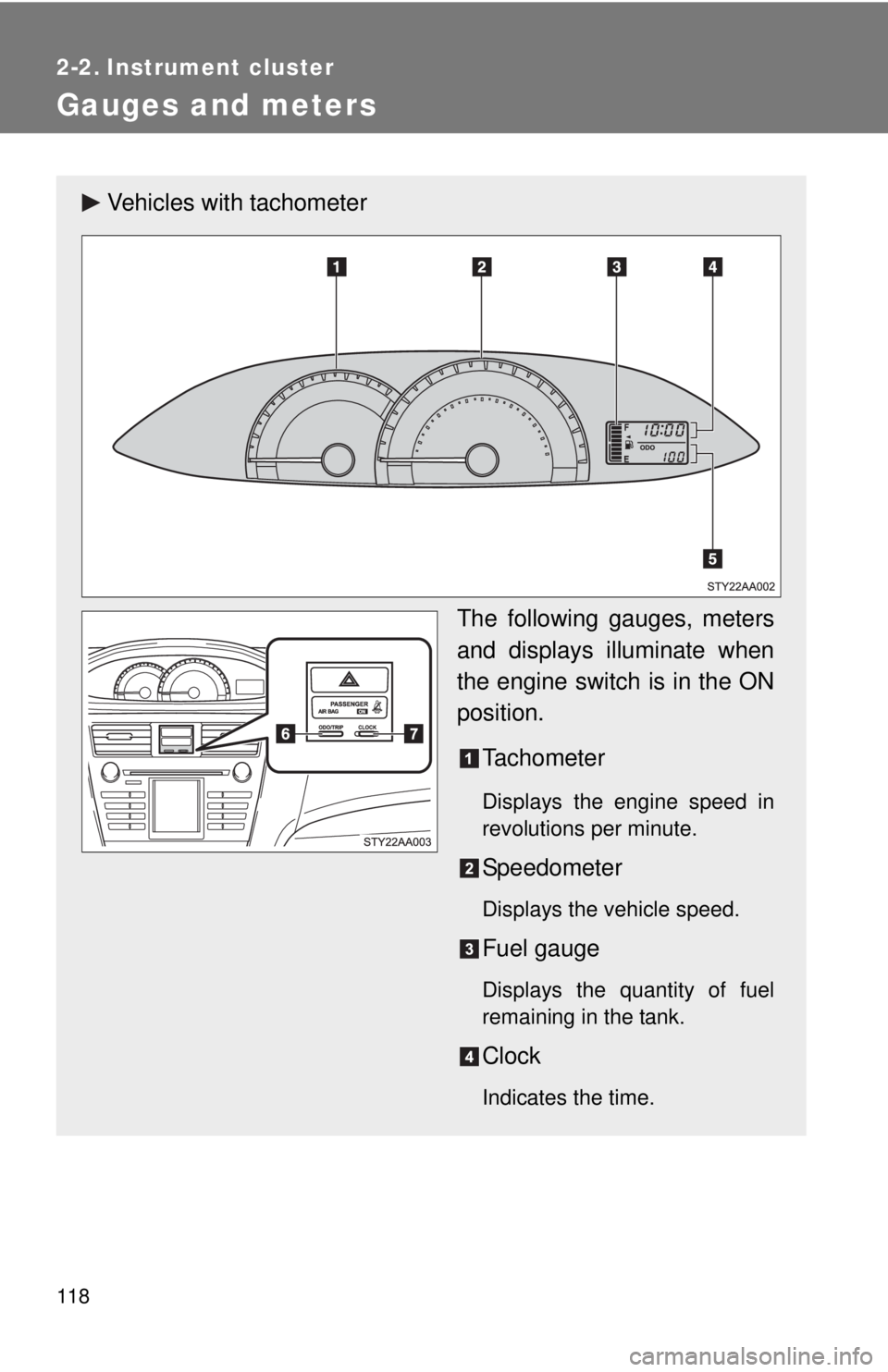
Vehicles with tachometerThe following gauges, meters
and displays illuminate when
the engine switch is in the ON
position.Tachometer
Displays the engine speed in
revolutions per minute.
Speedometer
Displays the vehicle speed.
Fuel gauge
Displays the quantity of fuel
remaining in the tank.
Clock
Indicates the time.
Page 137 of 384
122 2-2. Instrument cluster
NOTICE
nTo prevent damage to the engine and its components
lDo not let the indicator needle of the tachometer enter the red zone, which
indicates the maximum engine speed.
l The engine may be overheating if the high engine coolant temperature
warning light comes on. In this case, immediately stop the vehicle in a safe
place, and check the engine after it has cooled completely. (
→P. 320)
Page 140 of 384
125
2-2. Instrument cluster
2
When driving
n
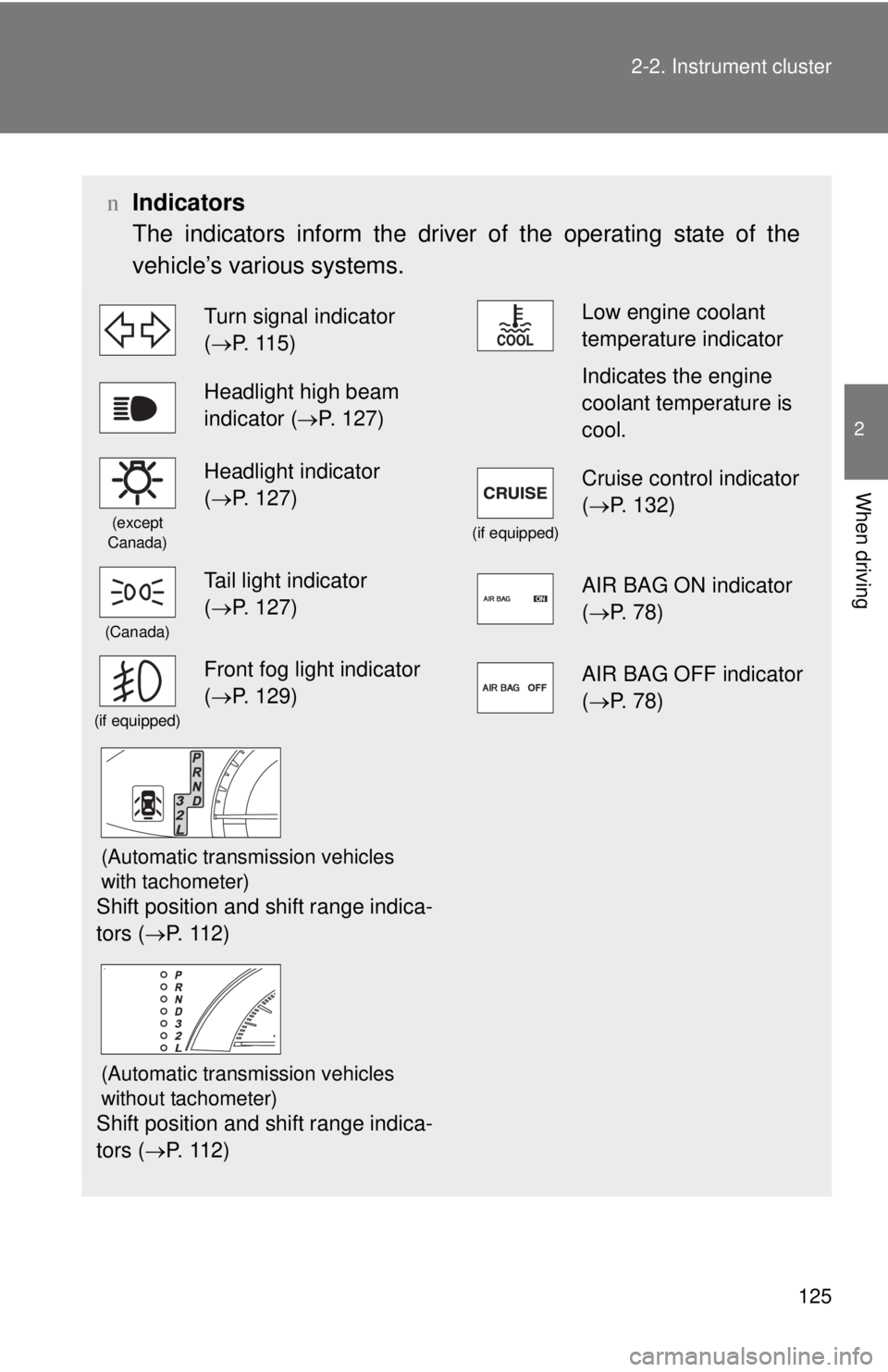
Indicators
The indicators inform the driver of the operating state of the
vehicle’s various systems.
Turn signal indicator
(→P. 115)Low engine coolant
temperature indicator
Headlight high beam
indicator ( →P. 127)Indicates the engine
coolant temperature is
cool.
(except
Canada)
Headlight indicator
( →P. 127)
(if equipped)
Cruise control indicator
( →P. 132)
(Canada)
Tail light indicator
(→P. 127)AIR BAG ON indicator
( →P. 78)
(if equipped)
Front fog light indicator
(→P. 129)AIR BAG OFF indicator
( →P. 78)
(Automatic transmission vehicles
with tachometer)
Shift position and shift range indica-
tors ( →P. 112)
(Automatic transmission vehicles
without tachometer)
Shift position and shift range indica-
tors (→P. 112)
Page 141 of 384
126 2-2. Instrument cluster
CAUTION
nIf a safety system warning light does not come on
Should a safety system light such as ABS and the SRS airbag warning light
not come on when you start the engine, this could mean that these systems
are not available to help protect you in an accident, which could result in
death or serious injury. Have the vehicle inspected by your Toyota dealer
immediately if this occurs.
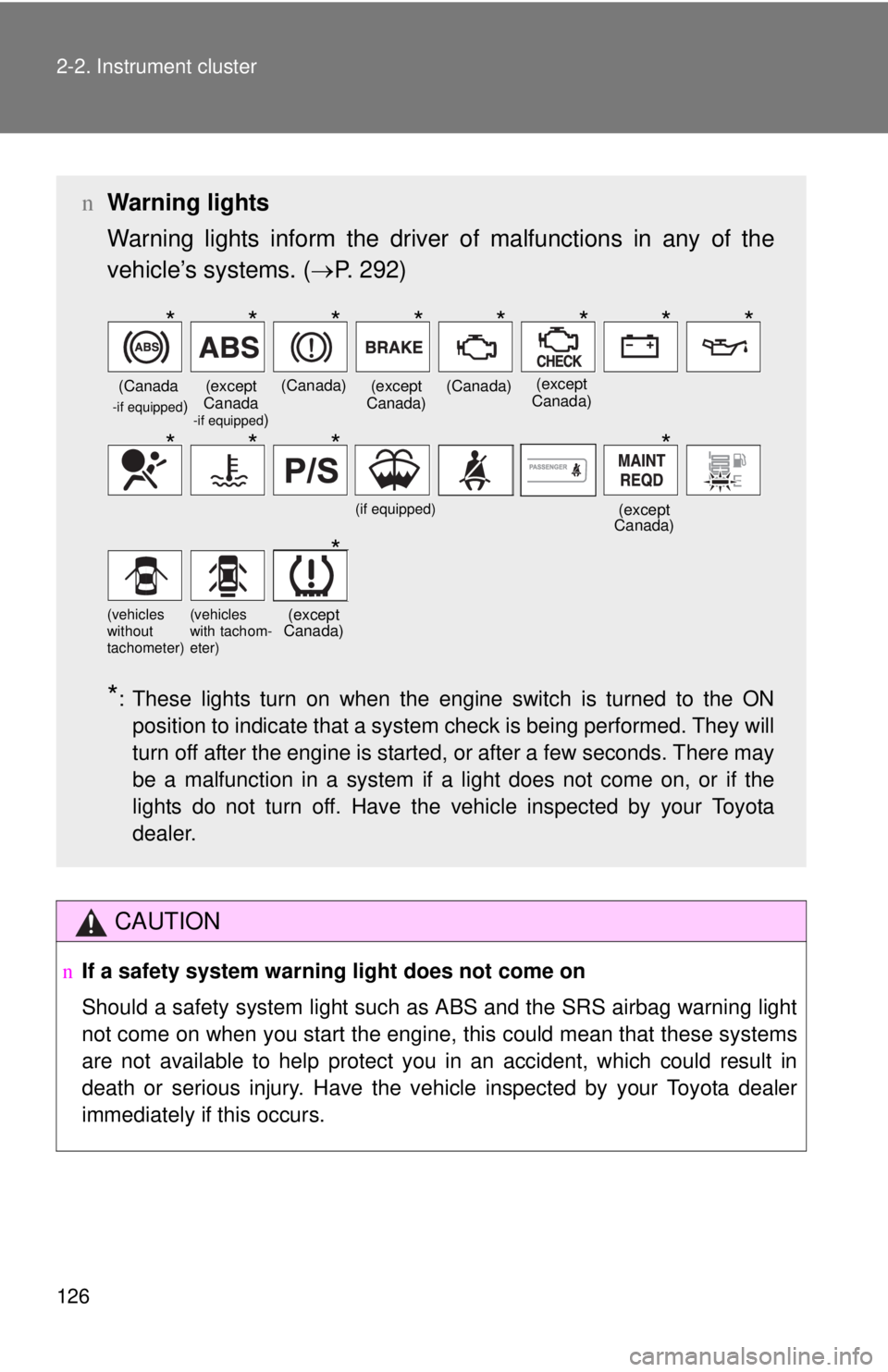
n Warning lights
Warning lights inform the driver of malfunctions in any of the
vehicle’s systems. ( →P. 292)
*: These lights turn on when the engine switch is turned to the ON
position to indicate that a system check is being performed. They will
turn off after the engine is started, or after a few seconds. There may
be a malfunction in a system if a light does not come on, or if the
lights do not turn off. Have the vehicle inspected by your Toyota
dealer.
(Canada -if equipped)(except
Canada
-if equipped)
(Canada)(except
Canada)(Canada)(except
Canada)
(if equipped)(except
Canada)
(vehicles
without
tachometer)(vehicles
with tachom-
eter)(except
Canada)
********
****
*
Page 143 of 384
128 2-3. Operating the lights and wipers
nDaytime running light system (if equipped)
To make your vehicle more visible to other drivers, the headlights turn on
automatically (at a reduced intensity) whenever the engine is started and the
parking brake is released. Daytime running lights are not designed for use at
night.
n Light reminder buzzer
A buzzer sounds when the key is removed and the driver's door is opened
while the lights are turned on.
NOTICE
nTo prevent battery discharge
Do not leave the lights on longer than necessary when the engine is not run-
ning.
Page 145 of 384
130
2-3. Operating the lights and wipers
Windshield wipers and washer
nThe windshield wiper and washer can be operated when
The engine switch must be in the ON position.
n If no windshield washer fluid sprays
Check that the washer nozzles are not blocked and if there is washer fluid in
the windshield washer fluid reservoir.
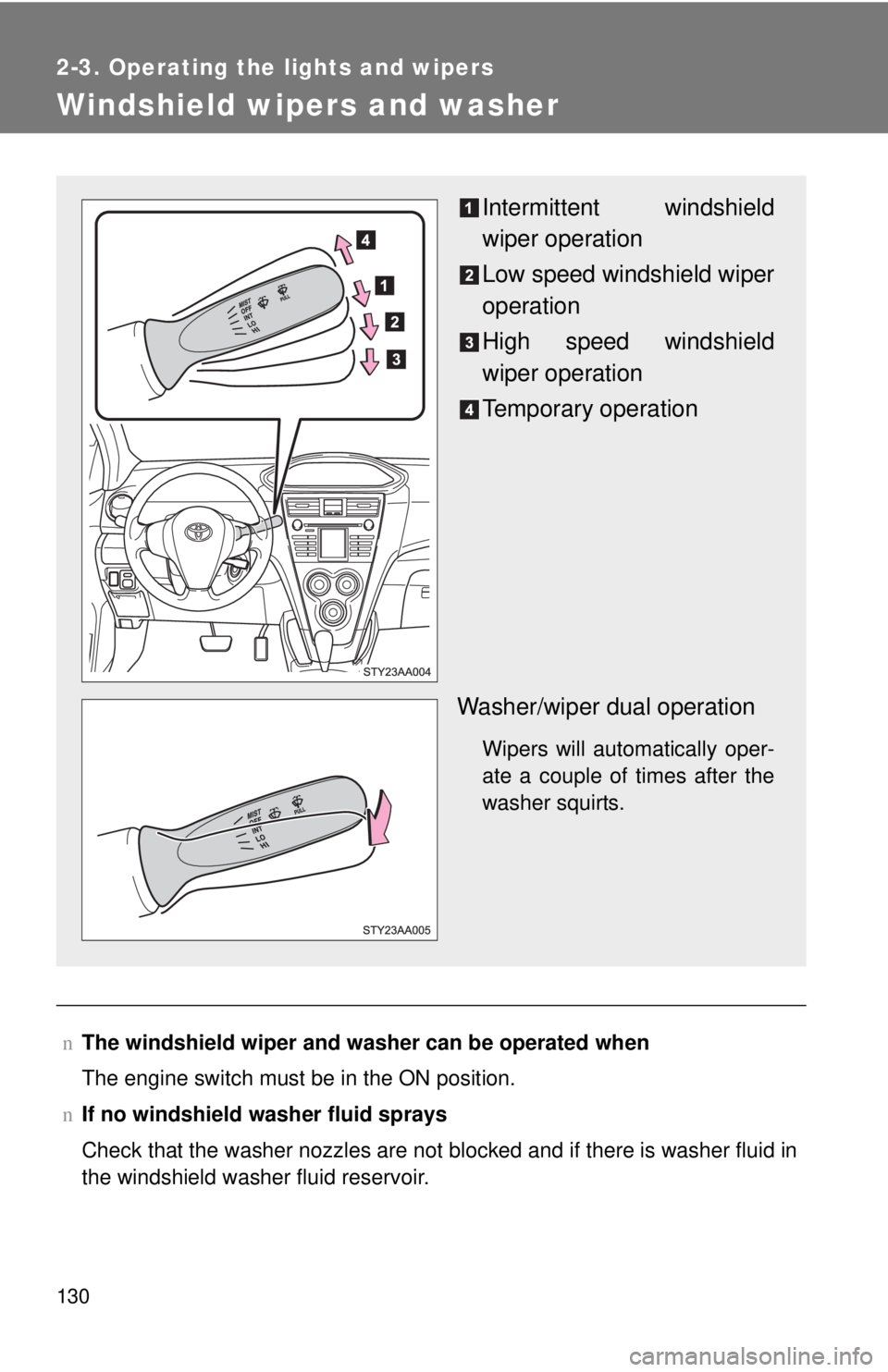
Intermittent windshield
wiper operation
Low speed windshield wiper
operation
High speed windshield
wiper operation
Temporary operation
Washer/wiper dual operation
Wipers will automatically oper-
ate a couple of times after the
washer squirts.
Page 149 of 384
134 2-4. Using other driving systems
CAUTION
nTo avoid operating the cruise control by mistake
Keep the ON-OFF button off when not in use.
n Situations unsuitable for cruise control
Do not use cruise control in any of the following situations.
Doing so may result in control of the vehicle being lost and could cause seri-
ous or fatal accident.
lIn heavy traffic
l On roads with sharp bends
l On winding roads
l On slippery roads, such as those covered with rain, ice or snow
l On steep hills
n While driving with the cruise control on
Vehicles with a manual transmission, do not shift to neutral without depress-
ing the clutch pedal, as this may cause engine racing or overrevving.
Page 150 of 384
135
2-4. Using other driving systems
2
When driving
Driving assist systems
nSounds and vibrations caused by the ABS
lA sound may be heard from the engine compartment when the engine is
started or just after the vehicle begins to move. This sound does not indi-
cate that a malfunction has occurred in this system.
l Any of the following conditions may occur when the above systems are
operating. None of these indicates that a malfunction has occurred.
• Vibrations may be felt through the vehicle body and steering.
• A motor sound may be heard after the vehicle comes to a stop.
• The brake pedal may pulsate slightly after the ABS is activated.
• The brake pedal may move down slightly after the ABS is activated.
n EPS operation sound
When the steering wheel operates, a motor sound (whirring sound) may be
heard.
This does not indicate a malfunction.
n Reduced effectiveness of EPS
The effectiveness of EPS is reduced to prevent the system from overheating
when there is frequent steering input over an extended period of time. The
steering wheel may feel heavy as a result. Should this occur, refrain from
excessive steering input or stop the vehicle and turn the engine off. The sys-
tem should return to normal within 10 minutes.
To help enhance driving safety a nd performance, the following sys-
tems operate automatically in res ponse to various driving situations.
Be aware, however, that these systems are supplementary and
should not be relied upon too heavi ly when operating the vehicle.
nABS (Anti-lock Brake System) (if equipped)
Helps to prevent wheel lock when the brakes are applied suddenly, or if
the brakes are applied while driving on a slippery road surface.
nEPS (Electric Power Steering)
Employs an electric motor to reduce the amount of effort needed to turn
the steering wheel.