Page 320 of 388

320 5-2. Steps to take in an emergency
CAUTION
■Using the jack
Improper use of the jack may lead to death or injuries due to the vehicle
suddenly falling off the jack.
●Do not use the jack for any purpose other than replacing tires or install-
ing and removing tire chains.
●Only use the jack that comes with this vehicle for replacing a flat tire.
Do not use it on other vehicles, an d do not use other jacks for replac-
ing tires on this vehicle.
●Always check that the jack is securely set to the jack point.
●Do not put any part of your body under the vehicle supported by a jack.
●Do not start or run the engine while your vehicle is supported by the
jack.
●Do not raise the vehicle while someone is in it.
●When raising the vehicle, do not put an object on or under the jack.
●Do not raise the vehicle to a hei ght greater than that required to
replace the tire.
●Use a jack stand if it is necessary to get under the vehicle.
Take particular care when lowering the vehicle to ensure that no one
working on or near the vehicle will be injured.
■Replacing a flat tire
Observe the following precautions to reduce the risk of death or serious
injury.
●Never use oil or grease on the wheel bolts or wheel nuts.
The oil or grease can cause the wheel nuts to loosen, causing a seri-
ous accident.
Remove any oil or grease on the wheel bolts or wheel nuts.
●Have the wheel nuts tightened with a torque wrench to 76 ft·lbf (103
N·m, 10.5 kgf·m) as soon as possible after changing wheels.
Failure to follow these precautions could cause the nuts to loosen and
the wheel may fall off, which could lead to an accident causing death
or serious injury.
Page 322 of 388

322 5-2. Steps to take in an emergency
NOTICE
■Do not drive the vehicle with a flat tire.
Do not continue driving with a flat tire.
Driving even a short distance with a flat tire can damage the tire and the
wheel beyond repair.
■Be careful when driving over bumps with the compact spare tire
installed on the vehicle.
The vehicle becomes lower when driving with the compact spare tire
compared to when driving with standard tires. Be careful when driving
over uneven road surfaces.
■Driving with tire chains and the compact spare tire
Do not fit tire chains to the compact spare tire.
Tire chains may damage the vehicle body and adversely affect driving
performance.
■When replacing the tires
●When removing or fitting the wheels, tires or the tire pressure warning
valve and transmitter, contact your Toyota dealer as the tire pressure
warning valve and transmitter may be damaged if not handled cor-
rectly.
●Replace the grommets for the tire pressure warning valves and trans-
mitters as well.
■To avoid damaging the tire pressure warning valves and transmit-
ters
Do not use liquid sealants on flat tires.
Page 345 of 388
345
6-1. Specifications
6
Vehicle specifications
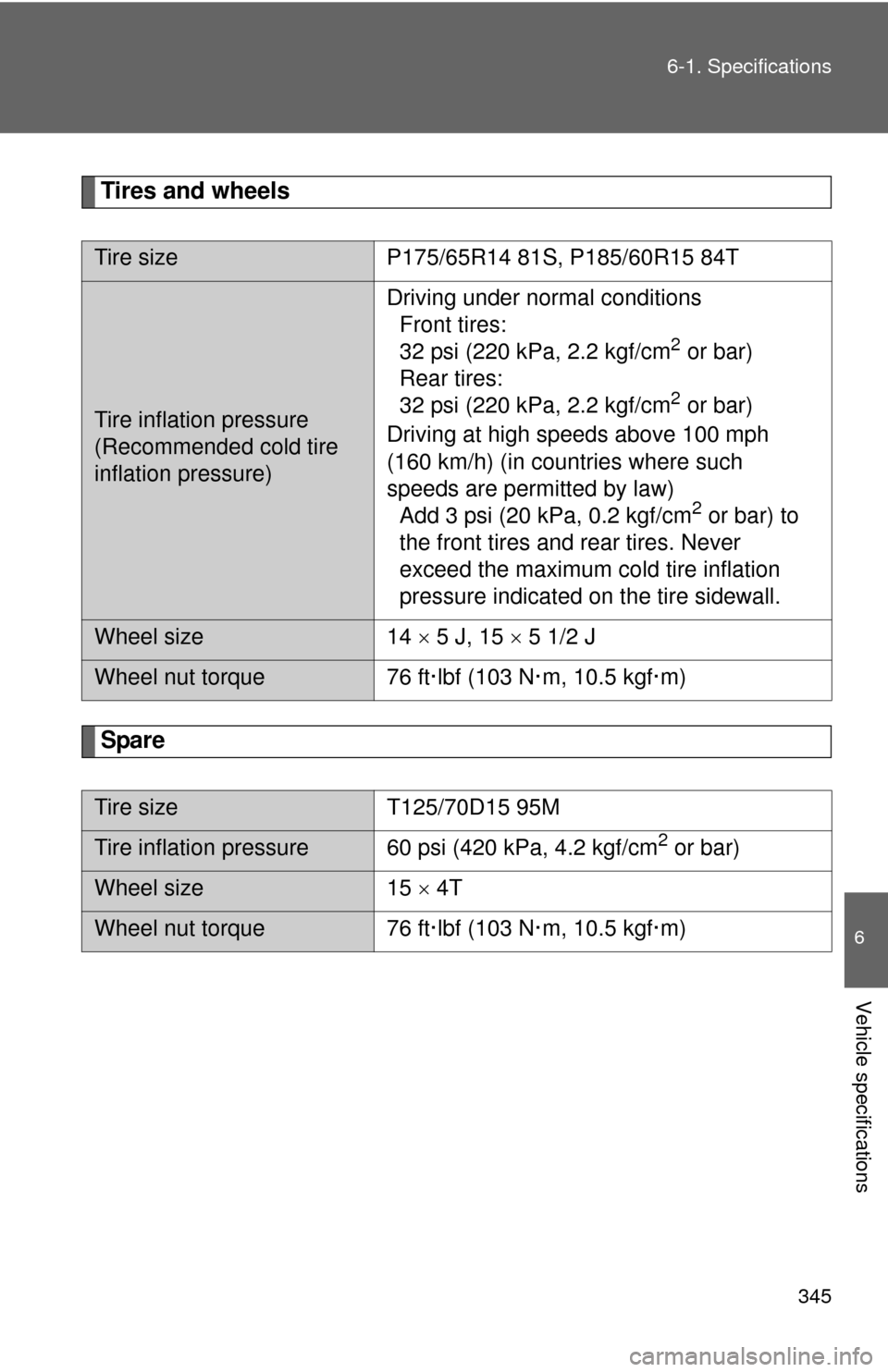
Tires and wheels
Spare
Tire size
P175/65R14 81S, P185/60R15 84T
Tire inflation pressure
(Recommended cold tire
inflation pressure)Driving under normal conditions
Front tires:
32 psi (220 kPa, 2.2 kgf/cm
2 or bar)
Rear tires:
32 psi (220 kPa, 2.2 kgf/cm
2 or bar)
Driving at high speeds above 100 mph
(160 km/h) (in countries where such
speeds are permitted by law) Add 3 psi (20 kPa, 0.2 kgf/cm
2 or bar) to
the front tires and rear tires. Never
exceed the maximum co ld tire inflation
pressure indicated on the tire sidewall.
Wheel size 14 5 J, 15 5 1/2 J
Wheel nut torque 76 ft·lbf (103 N·m, 10.5 kgf·m)
Tire size T125/70D15 95M
Tire inflation pressure 60 psi (420 kPa, 4.2 kgf/cm2 or bar)
Wheel size15 4T
Wheel nut torque 76 ft·lbf (103 N·m, 10.5 kgf·m)
Page 350 of 388
350
6-1. Specifications
Tire infor mation
Typical tire symbolsStandard tire
Tire size ( P. 354)
DOT and Tire Identification Number (TIN) ( P. 353)
Location of treadwear indicators ( P. 355)
Tire ply composition and materials
Plies are layers of rubber-coated parallel cords. Cords are the
strands which form the plies in a tire.
Uniform tire quality grading
For details, see “Uniform tire quality grading” that follows.
Load limit at maximum cold tire inflation pressure ( P. 357)
Maximum cold tire inflation pressure ( P. 357)
This means the pressure to which a tire may be inflated.
TUBELESS or TUBE TYPE
A tubeless tire does not have a tube and air is directly filled in the
tire. A tube type tire has a tube inside the tire and the tube main-
tains the air pressure.
Page 352 of 388
352 6-1. Specifications
Compact spare tire
TEMPORARY USE ONLY( P. 312)
A compact spare tire is identified by the phrase TEMPORARY USE
ONLY molded into its sidewall. Th is tire is designed for temporary
emergency use only.
Tire size ( P. 354)
DOT and Tire Identification Number (TIN) ( P. 353)
Location of treadwear indicators ( P. 355)
Load limit at maximum cold tire inflation pressure ( P. 357)
Maximum cold tire inflation pressure ( P. 357)
This means the pressure to which a tire may be inflated.
Tire ply composition and materials
Plies are layers of rubber-coated parallel cords. Cords are the
strands which form the plies in a tire.
TUBELESS or TUBE TYPE
A tubeless tire does not have a tube and air is directly filled in the
tire. A tube type tire has a tube inside the tire and the tube main-
tains the air pressure.
Page 357 of 388
357
6-1. Specifications
6
Vehicle specifications
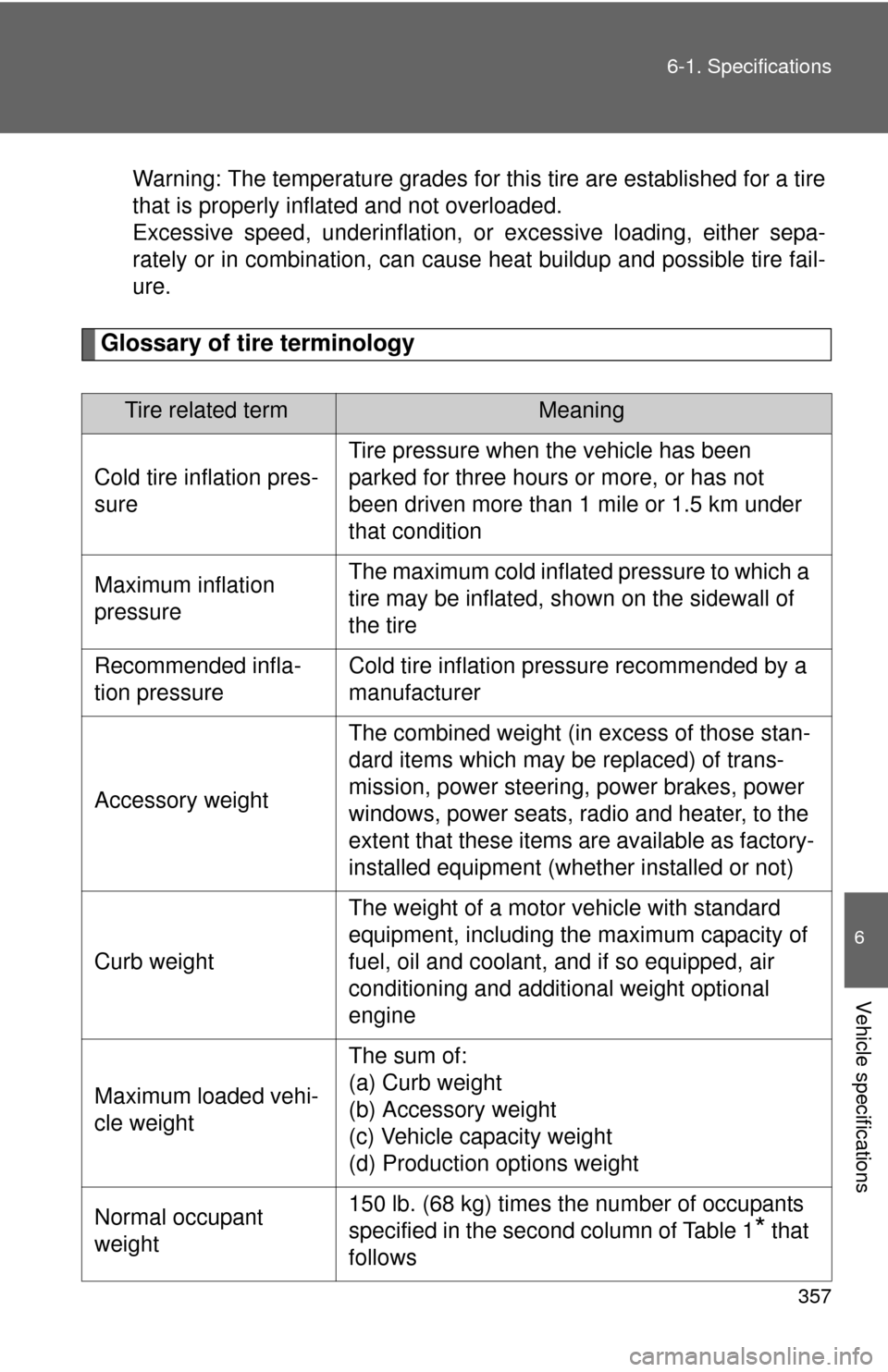
Warning: The temperature grades for this tire are established for a tire
that is properly inflated and not overloaded.
Excessive speed, underinflation, or
excessive loading, either sepa-
rately or in combination, can caus e heat buildup and possible tire fail-
ure.
Glossary of tire terminology
Tire related termMeaning
Cold tire inflation pres-
sure
Tire pressure when the vehicle has been
parked for three hours or more, or has not
been driven more than 1 mile or 1.5 km under
that condition
Maximum inflation
pressureThe maximum cold inflated pressure to which a
tire may be inflated, s hown on the sidewall of
the tire
Recommended infla-
tion pressureCold tire inflation pressure recommended by a
manufacturer
Accessory weight
The combined weight (in excess of those stan-
dard items which may be replaced) of trans-
mission, power steering, power brakes, power
windows, power seats, radio and heater, to the
extent that these items are available as factory-
installed equipment (whether installed or not)
Curb weight
The weight of a motor vehicle with standard
equipment, including the maximum capacity of
fuel, oil and coolant, and if so equipped, air
conditioning and additional weight optional
engine
Maximum loaded vehi-
cle weight
The sum of:
(a) Curb weight
(b) Accessory weight
(c) Vehicle capacity weight
(d) Production options weight
Normal occupant
weight150 lb. (68 kg) times the number of occupants
specified in the second column of Table 1
* that
follows
Page 358 of 388
358 6-1. Specifications
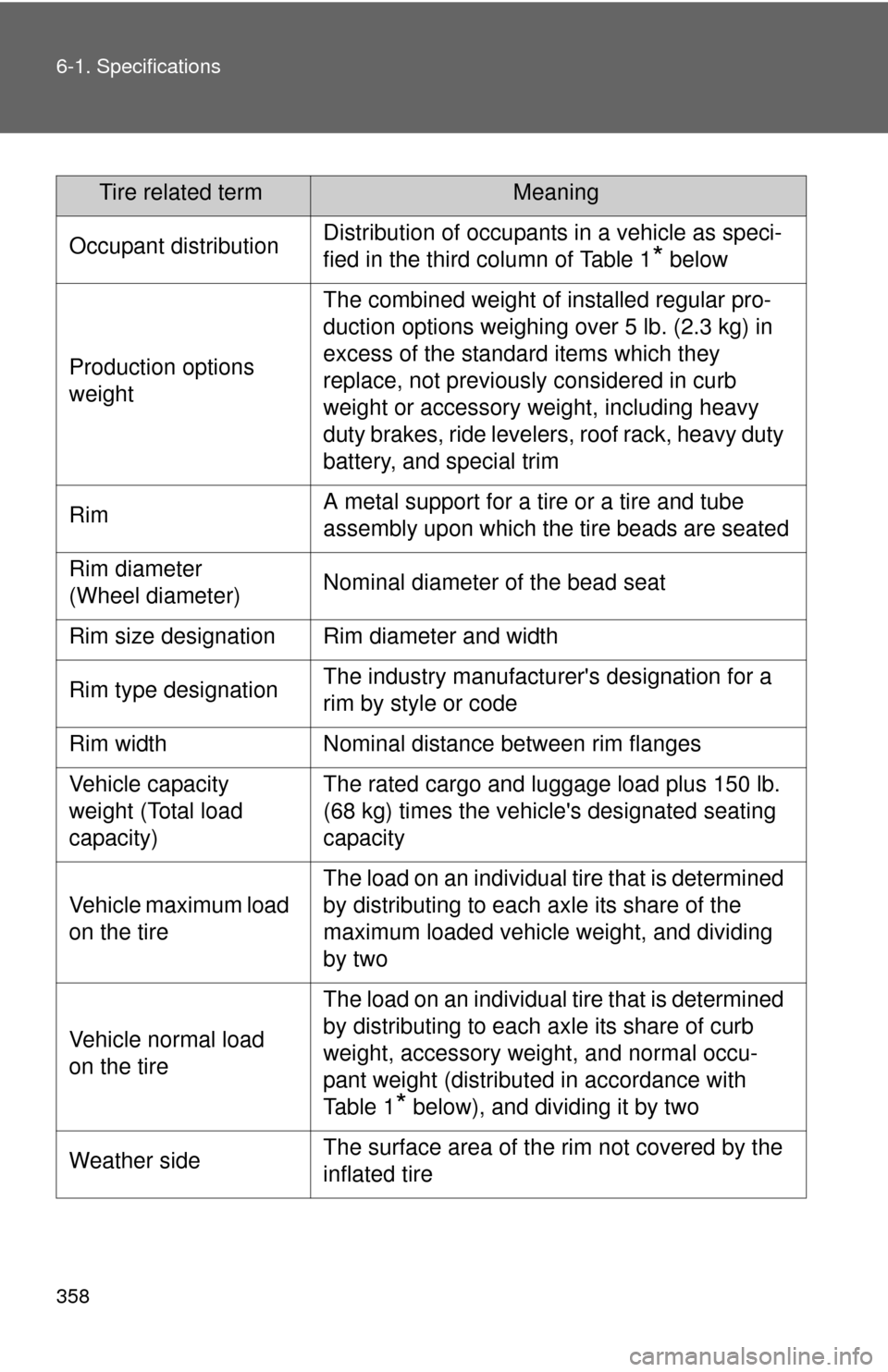
Tire related termMeaning
Occupant distributionDistribution of occupants in a vehicle as speci-
fied in the third column of Table 1
* below
Production options
weight
The combined weight of installed regular pro-
duction options weighing over 5 lb. (2.3 kg) in
excess of the standard items which they
replace, not previously considered in curb
weight or accessory weight, including heavy
duty brakes, ride levelers, roof rack, heavy duty
battery, and special trim
RimA metal support for a tire or a tire and tube
assembly upon which the tire beads are seated
Rim diameter
(Wheel diameter)Nominal diameter of the bead seat
Rim size designationRim diameter and width
Rim type designationThe industry manufacturer's designation for a
rim by style or code
Rim widthNominal distance between rim flanges
Vehicle capacity
weight (Total load
capacity)The rated cargo and luggage load plus 150 lb.
(68 kg) times the vehicle's designated seating
capacity
Vehicle maximum load
on the tire
The load on an individual tire that is determined
by distributing to each axle its share of the
maximum loaded vehicle weight, and dividing
by two
Vehicle normal load
on the tire
The load on an individual tire that is determined
by distributing to each axle its share of curb
weight, accessory weight, and normal occu-
pant weight (distributed in accordance with
Ta b l e 1
* below), and dividing it by two
Weather sideThe surface area of the rim not covered by the
inflated tire
Page 359 of 388
359
6-1. Specifications
6
Vehicle specifications
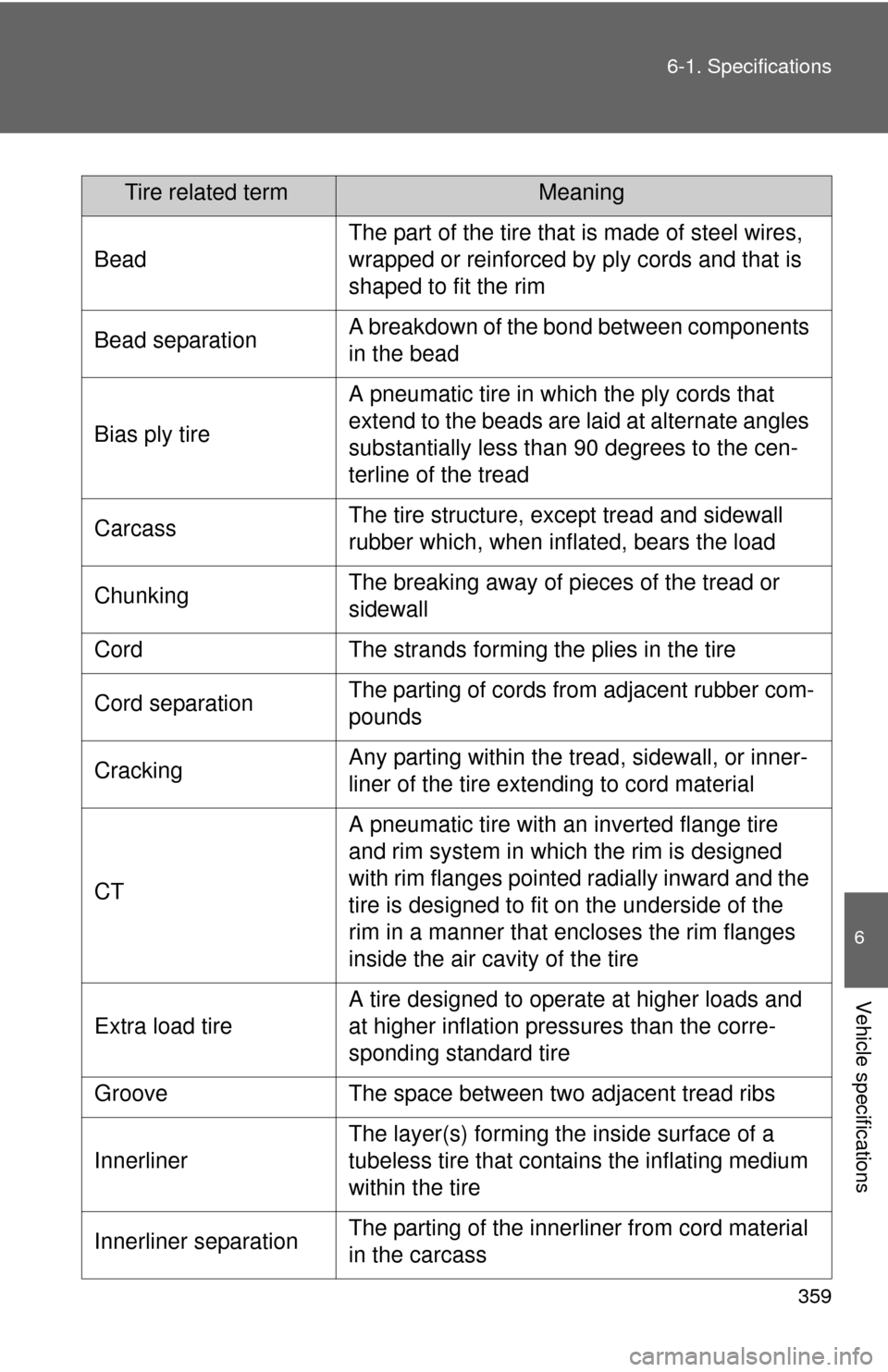
Tire related termMeaning
Bead
The part of the tire that is made of steel wires,
wrapped or reinforced by ply cords and that is
shaped to fit the rim
Bead separationA breakdown of the bond between components
in the bead
Bias ply tire
A pneumatic tire in which the ply cords that
extend to the beads are laid at alternate angles
substantially less than 90 degrees to the cen-
terline of the tread
CarcassThe tire structure, except tread and sidewall
rubber which, when inflated, bears the load
ChunkingThe breaking away of pieces of the tread or
sidewall
CordThe strands forming the plies in the tire
Cord separationThe parting of cords from adjacent rubber com-
pounds
CrackingAny parting within the tread, sidewall, or inner-
liner of the tire extending to cord material
CT
A pneumatic tire with an inverted flange tire
and rim system in which the rim is designed
with rim flanges pointed radially inward and the
tire is designed to fit on the underside of the
rim in a manner that encloses the rim flanges
inside the air cavity of the tire
Extra load tire
A tire designed to operate at higher loads and
at higher inflation pressures than the corre-
sponding standard tire
GrooveThe space between two adjacent tread ribs
Innerliner
The layer(s) forming the inside surface of a
tubeless tire that contains the inflating medium
within the tire
Innerliner separationThe parting of the innerliner from cord material
in the carcass