Page 308 of 388

308 5-2. Steps to take in an emergency
CAUTION
■Maintenance of the tire
Each tire, including the spare (if provided), should be checked monthly
when cold and inflated to the inflation pressure recommended by the
vehicle manufacturer on the vehicle placard or tire inflation pressure
label (tire and load information label). (If your vehicle has tires of a differ-
ent size than the size indicated on the vehicle placard or tire inflation
pressure label [tire and load information label], you should determine the
proper tire inflation pr essure for those tires.)
As an added safety feature, your vehicle has been equipped with a tire
pressure monitoring system (TPMS-ti re pressure warning system) that
illuminates a low tire pressure telltal e (tire pressure warning light) when
one or more of your tires is significantly under-inflated. Accordingly,
when the low tire pressu re telltale (tire pressure warning light) illumi-
nates, you should stop and check your tires as soon as possible, and
inflate them to the proper pressure. Driving on a significantly under-
inflated tire causes the tire to overheat and can lead to tire failure.
Under-inflation also reduces fuel effi ciency and tire tread life, and may
affect the vehicle’s handling and stopping ability.
Please note that the TPMS (tire pressure warning system) is not a sub-
stitute for proper tire main tenance, and it is the driver’s responsibility to
maintain correct tire pressure, even if under-inflation has not reached the
level to trigger illu mination of the TPMS low tire pressure telltale (tire
pressure warning light).
Your vehicle has also been equipped with a TPMS (tire pressure warning
system) malfunction indicator to indi cate when the system is not operat-
ing properly. The TPMS (tire pressure warning system) malfunction indi-
cator is combined with the low tire pressure telltale (tire pressure
warning light). When the system det ects a malfunction, the telltale will
flash for approximately one minute an d then remain continuously illumi-
nated. This sequence will continue upon subsequent vehicle start-ups as
long as the malfunction exists. When the malfunction indi cator is illumi-
nated, the system may not be able to detect or signal low tire pressure
as intended.
Page 309 of 388

5
When trouble arises
309
5-2. Steps to take in an emergency
CAUTION
TPMS (tire pressure warning system) malfunctions may occur for a vari-
ety of reasons, including the installati
on of replacement or alternate tires
or wheels on the vehicle that prevent the TPMS (tire pressure warning
system) from functioning properly. Always check the TPMS (tire pres-
sure warning system) malfunction te lltale after replacing one or more
tires or wheels on your vehicle to ensure that the replacement or alter-
nate tires and wheels allow the TPMS (tire pressure warning system) to
continue to function properly.
■If the tire pressure warning light comes on
Be sure to observe the following precautions. Failure to do so could
cause loss of vehicle control and result in death or serious injury.
●Stop your vehicle in a safe place as soon as possible. Adjust the tire
inflation pressure immediately.
●If the tire pressure warning light comes on even after tire inflation pres-
sure adjustment, it is pr obable that you have a flat tire. Check the tires.
If the tire is flat, change to the spare tire and have the flat tire repaired
by the nearest Toyota dealer.
●Avoid abrupt maneuvering and braking. If the vehicle tires deteriorate,
you could lose control of the steering wheel or the brakes.
■If a blowout or sudden air leakage should occur
The tire pressure warning syste m may not activate immediately.
NOTICE
■Precaution when installing a different tire
When a tire of a different specification or maker is installed, the tire pres-
sure warning system may not operate properly.
Page 310 of 388
310
5-2. Steps to take in an emergency
If you have a flat tire
Remove the flat tire and replace it with the spare provided.
■Before jacking up the vehicle
●Stop the vehicle on a hard, flat surface.
● Set the parking brake.
● Shift the shift lever to P (automatic transmission) or R (manual
transmission).
● Stop the engine.
● Turn on the emergency flashers.
■ Location of the spare tire, jack and tools
Spare tire
Jack
Jack handle
Tie-down belt
Tool bag
(including towing
eyelet)
Page 312 of 388
312 5-2. Steps to take in an emergency
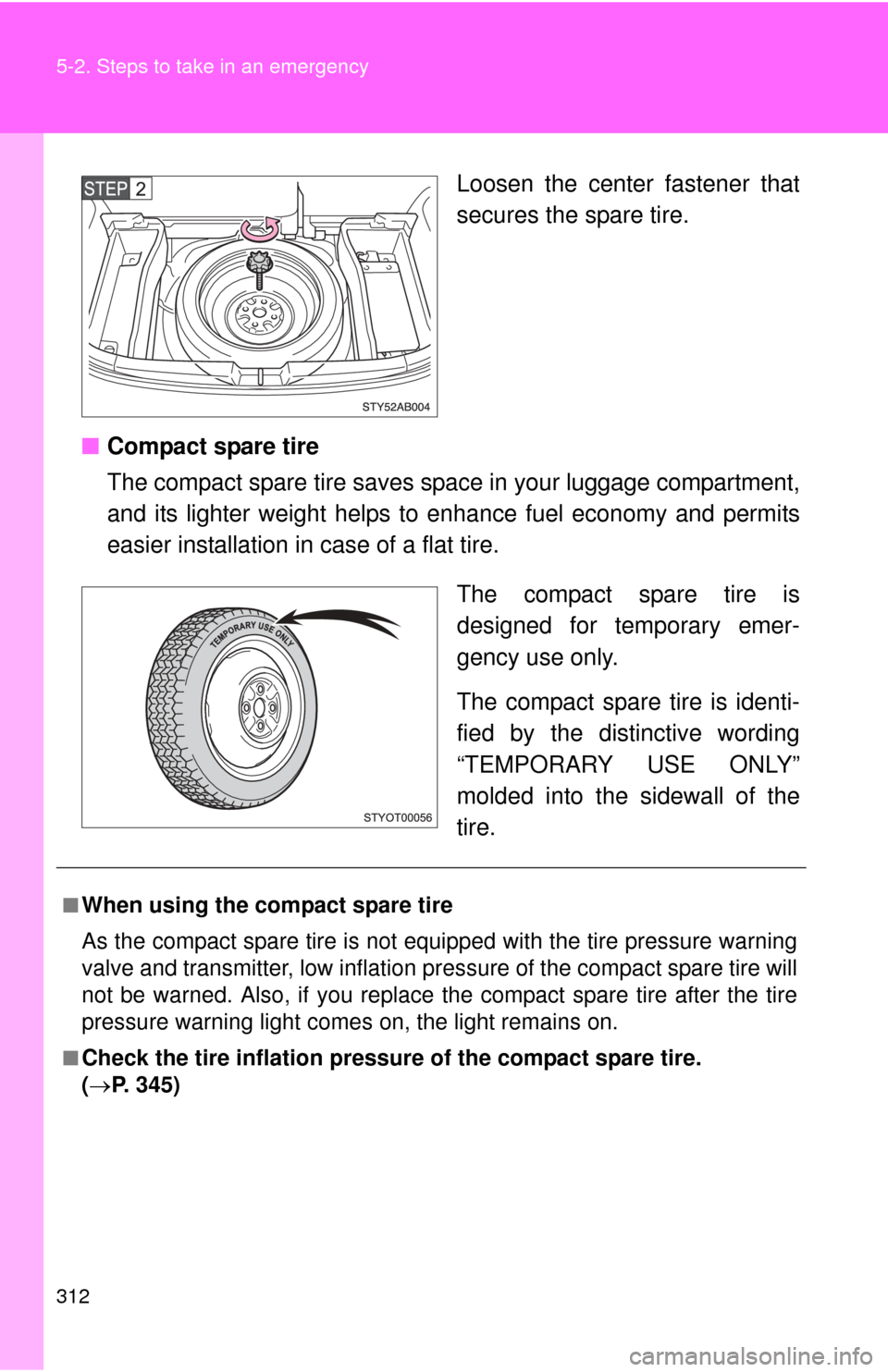
Loosen the center fastener that
secures the spare tire.
■ Compact spare tire
The compact spare tire saves space in your luggage compartment,
and its lighter weight helps to enhance fuel economy and permits
easier installation in case of a flat tire.
The compact spare tire is
designed for temporary emer-
gency use only.
The compact spare tire is identi-
fied by the distinctive wording
“TEMPORARY USE ONLY”
molded into the sidewall of the
tire.
■When using the compact spare tire
As the compact spare tire is not equipped with the tire pressure warning
valve and transmitter, low inflation pr essure of the compact spare tire will
not be warned. Also, if you replace the compact spare tire after the tire
pressure warning light comes on, the light remains on.
■Check the tire inflation pressure of the compact spare tire.
( P. 345)
Page 313 of 388
5
When trouble arises
313
5-2. Steps to take in an emergency
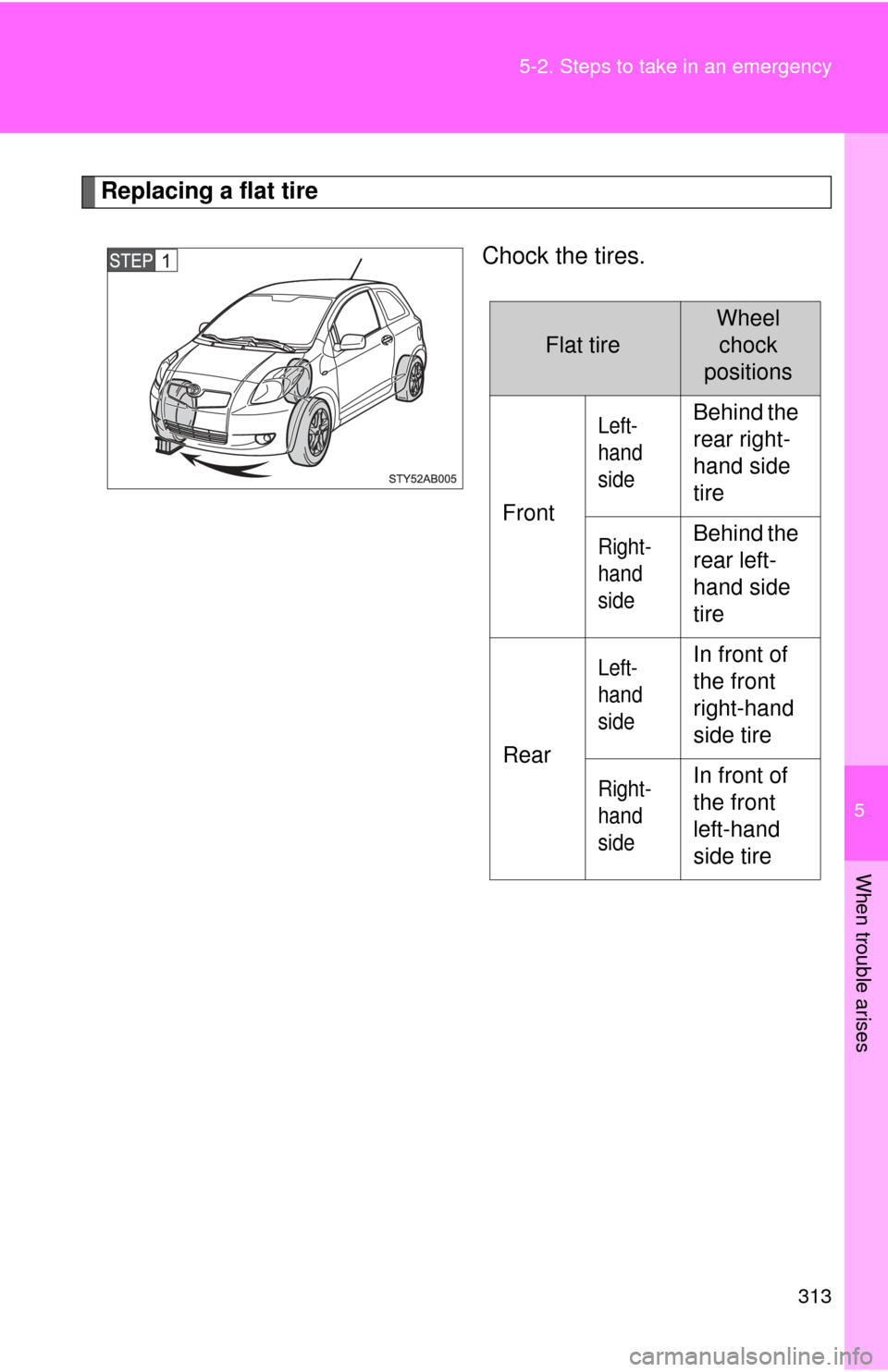
Replacing a flat tire
Chock the tires.
Flat tire
Wheel chock
positions
Front
Left-
hand
sideBehind the
rear right-
hand side
tire
Right-
hand
sideBehind the
rear left-
hand side
tire
Rear
Left-
hand
sideIn front of
the front
right-hand
side tire
Right-
hand
sideIn front of
the front
left-hand
side tire
Page 317 of 388
5
When trouble arises
317
5-2. Steps to take in an emergency
Lower the vehicle.
Firmly tighten each nut two or
three times in the order shown in
the illustration.
Tightening torque:
76 ft·lbf (103 N·m, 10.5 kgf·m)
Stowing the flat tire, jack and all tools
Position the tools as shown in
the illustration. Fold the tool bag
over.
Stow the jack and all tools.
Page 318 of 388
318 5-2. Steps to take in an emergency
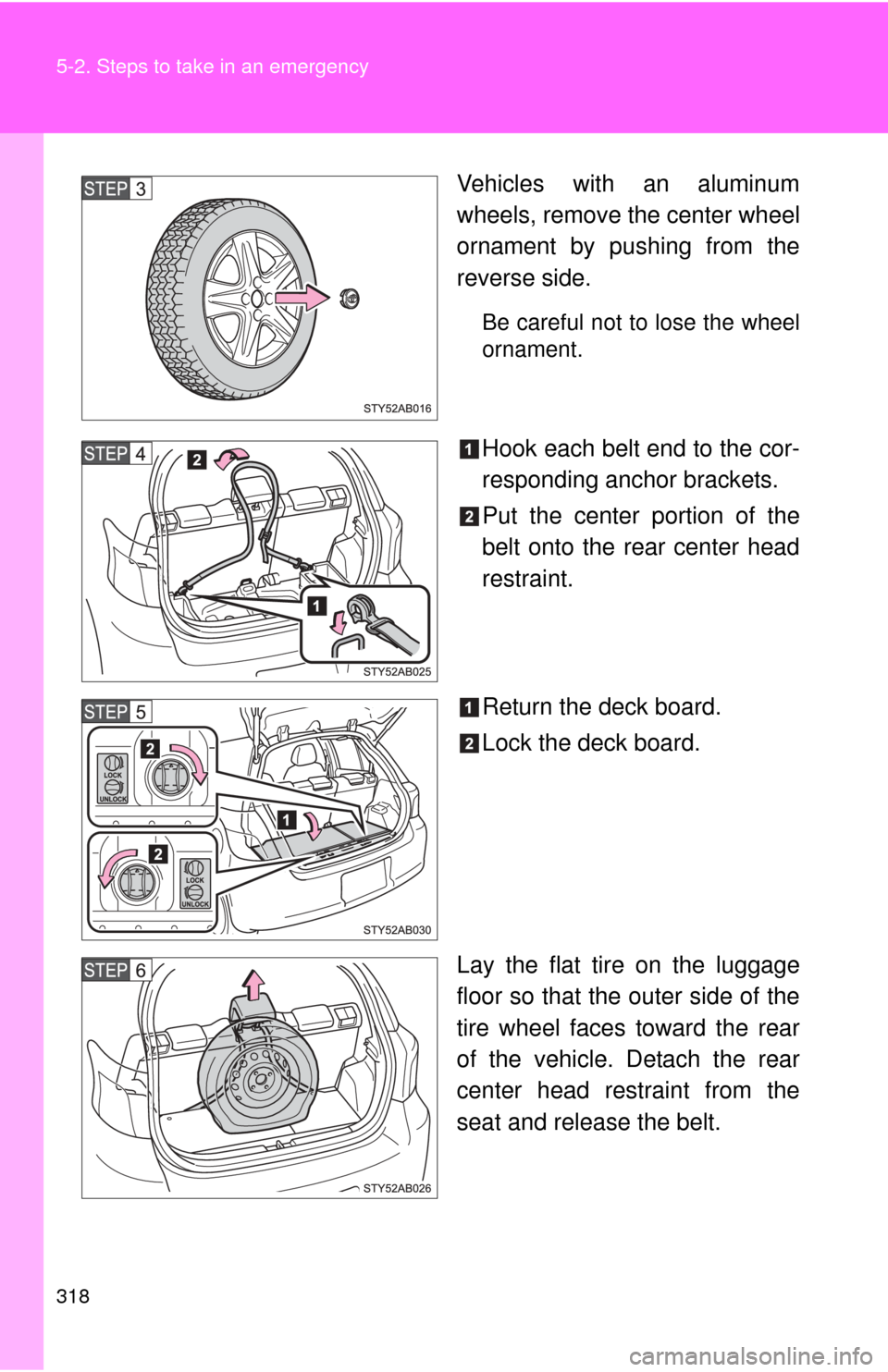
Vehicles with an aluminum
wheels, remove the center wheel
ornament by pushing from the
reverse side.
Be careful not to lose the wheel
ornament.
Hook each belt end to the cor-
responding anchor brackets.
Put the center portion of the
belt onto the rear center head
restraint.
Return the deck board.
Lock the deck board.
Lay the flat tire on the luggage
floor so that the outer side of the
tire wheel faces toward the rear
of the vehicle. Detach the rear
center head restraint from the
seat and release the belt.
Page 319 of 388
5
When trouble arises
319
5-2. Steps to take in an emergency
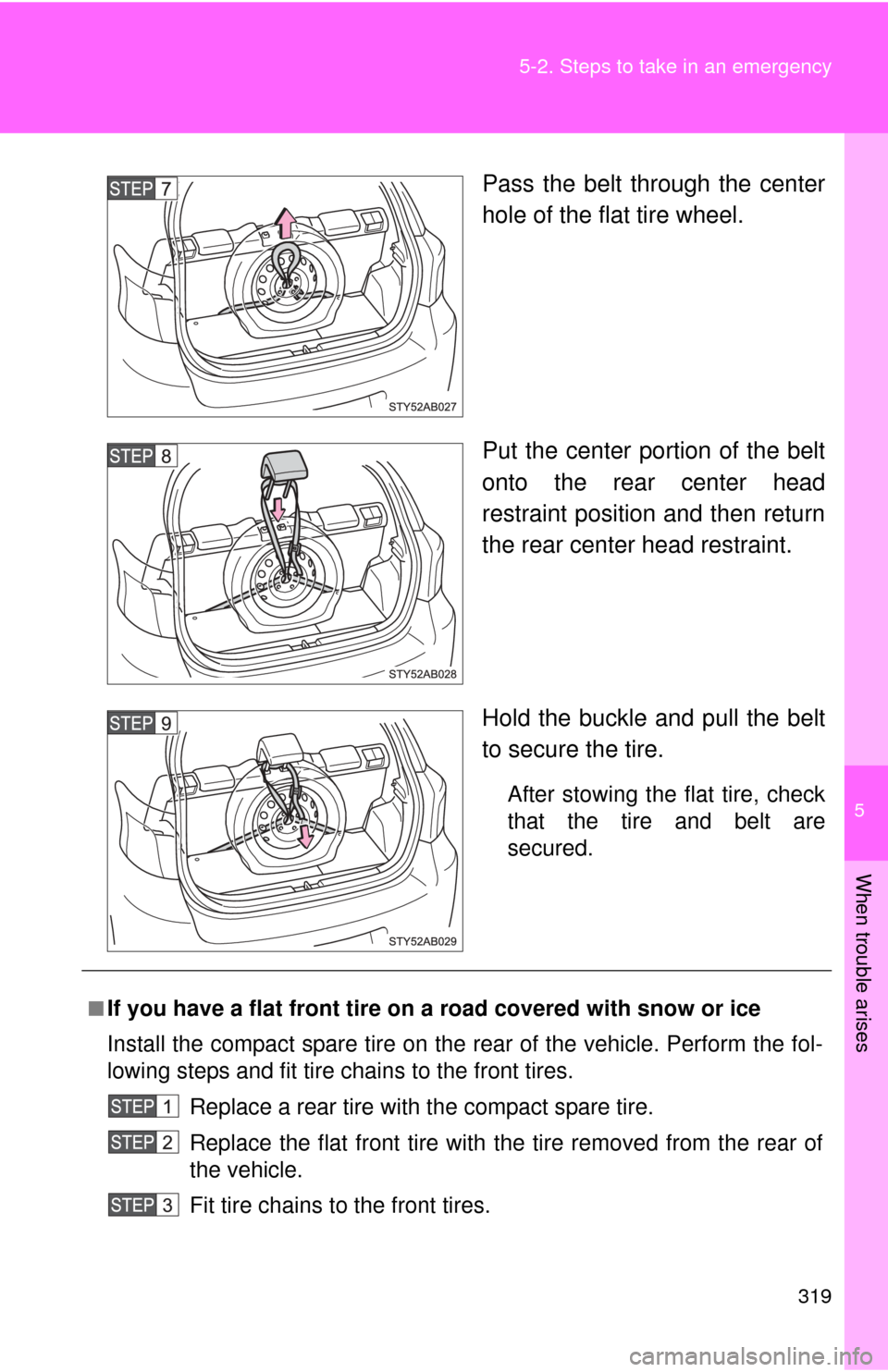
Pass the belt through the center
hole of the flat tire wheel.
Put the center portion of the belt
onto the rear center head
restraint position and then return
the rear center head restraint.
Hold the buckle and pull the belt
to secure the tire.
After stowing the flat tire, check
that the tire and belt are
secured.
■If you have a flat front tire on a road covered with snow or ice
Install the compact spare tire on the rear of the vehicle. Perform the fol-
lowing steps and fit tire chains to the front tires.
Replace a rear tire with the compact spare tire.
Replace the flat front tire with the tire removed from the rear of
the vehicle.
Fit tire chains to the front tires.