Page 439 of 512
5
When trouble arises
439
5-2. Steps to take in an emergency
PRIUS_U_(L/O_0802)
■The compact spare tire
●The compact spare tire is identifi
ed by the label “TEMPORARY USE
ONLY” on the tire sidewall.
Use the compact spare tire temporarily only in an emergency.
●Make sure to check the tire inflation pressure of the compact spare
tire. ( P. 470)
■Tread life
The compact spare tire can be used many times, if necessary. It has
tread life of up to 3000 miles (4800 km) depending on road conditions
and your driving habits. When tread wear indicators appear on the tire,
replace the tire. ( P. 379)
■When using the compact spare tire
As the spare tire is not equipped with the tire pressure warning valve and
transmitter, low inflatio n pressure of the spare tire will not be warned.
Also, if you replace the compact spare tire after the tire pressure warning
light comes on, the light remains on.
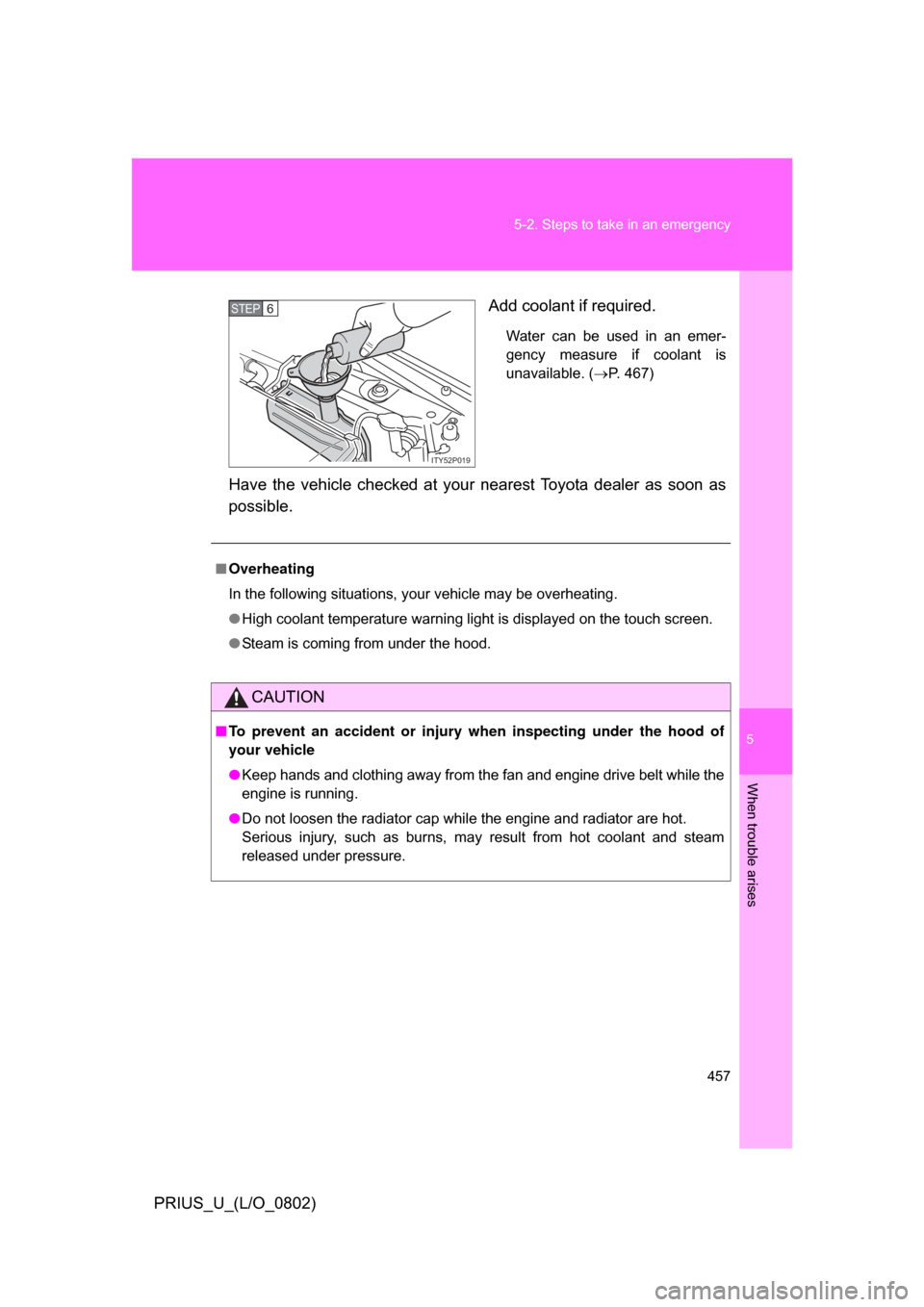
■ Compact spare tire
The compact tire saves space in your luggage compartment,
and its lighter weight helps to enhance fuel economy and per-
mits easier installation in case of a flat tire.
The compact spare tire is
designed for temporary emer-
gency use only.
Page 447 of 512

5
When trouble arises
447
5-2. Steps to take in an emergency
PRIUS_U_(L/O_0802)
NOTICE
■Do not drive the vehicle with a flat tire
Do not continue driving with a flat tire.
Driving even a short distance with a flat tire can damage the tire and the
wheel beyond repair.
■Be careful when driving over bumps with the compact spare tire
installed on the vehicle
The vehicle becomes lower when driving with the compact spare tire
compared to when drivin
g with standard tires. Be careful when driving
over uneven road surfaces.
■Driving with tire chains and the compact spare tire
Do not fit tire chains to the compact spare tire.
Tire chains may damage the vehicle body and adversely affect driving
performance.
■When replacing the tires
●When removing or fitting the wheels, tires or the tire pressure warning
valve and transmitter, contact your Toyota dealer as the tire pressure
warning valve and transmitter may be damaged if not handled cor-
rectly.
●Replace the grommets for the tire pressure warning valves and trans-
mitters as well.
■To avoid damaging the tire pressure warning valves and transmit-
ters
Do not use liquid sealants on flat tires.
Page 454 of 512

454 5-2. Steps to take in an emergency
PRIUS_U_(L/O_0802)
■When the 12 volt battery is removed or discharged
The following systems must be initialized.
● Power windows (
P. 75)
● Tire pressure warning system (
P. 380)
● The hybrid system may not start. ( P. 448)
CAUTION
■Avoiding 12 volt battery fires or explosions
Observe the following precautions to prevent accidentally igniting the flam-
mable gas that may be emitted from the 12 volt battery.
● Make sure the jumper cable is connected to the correct terminal and that it
is not unintentionally in contact with any part other than the intended termi-
nal.
● Do not allow the jumper cables to come into contact with the “+” and “-” ter-
minals.
● Do not allow open flame or use matc hes, cigarette lighters or smoke near
the 12 volt battery.
■ 12 volt battery precautions
The 12 volt battery contains poisonous and corrosive acidic electrolyte, while
related parts contain lead and lead compounds. Observe the following pre-
cautions when handling the 12 volt battery:
● When working with the 12 volt battery, always wear safety glasses and
take care not to allow any battery fluids (acid) to come into contact with
skin, clothing or the vehicle body.
● Do not lean over the 12 volt battery.
● In the event that battery fluid comes into contact with the skin or eyes,
immediately wash the affected area with water and seek medical attention.
Place a wet sponge or cloth over the affected area until medical attention
can be received.
● Always wash your hands after handling the battery support, terminals, and
other battery-related parts.
● Do not allow children near the 12 volt battery.
Page 456 of 512
456
5-2. Steps to take in an emergency
PRIUS_U_(L/O_0802)
If your vehicle overheats
Correction proceduresStop the vehicle in a safe place and turn off the automatic air
conditioning system.
Check to see if steam is coming out from under the hood.
If you see steam: Stop the engine and carefully lift the hood.
If you do not see steam: Leave the engine running and carefully lift the hood.
Remove the engine compartment cover. ( P. 365)
Check to see if the cooling fan is operating.
If the fan is operating: Wait until the engine coolant temperature gauge begins to
fall and then stop the engine.
If the fan is not operating: Stop the hybrid system immediately and call your local Toy-
ota dealer.
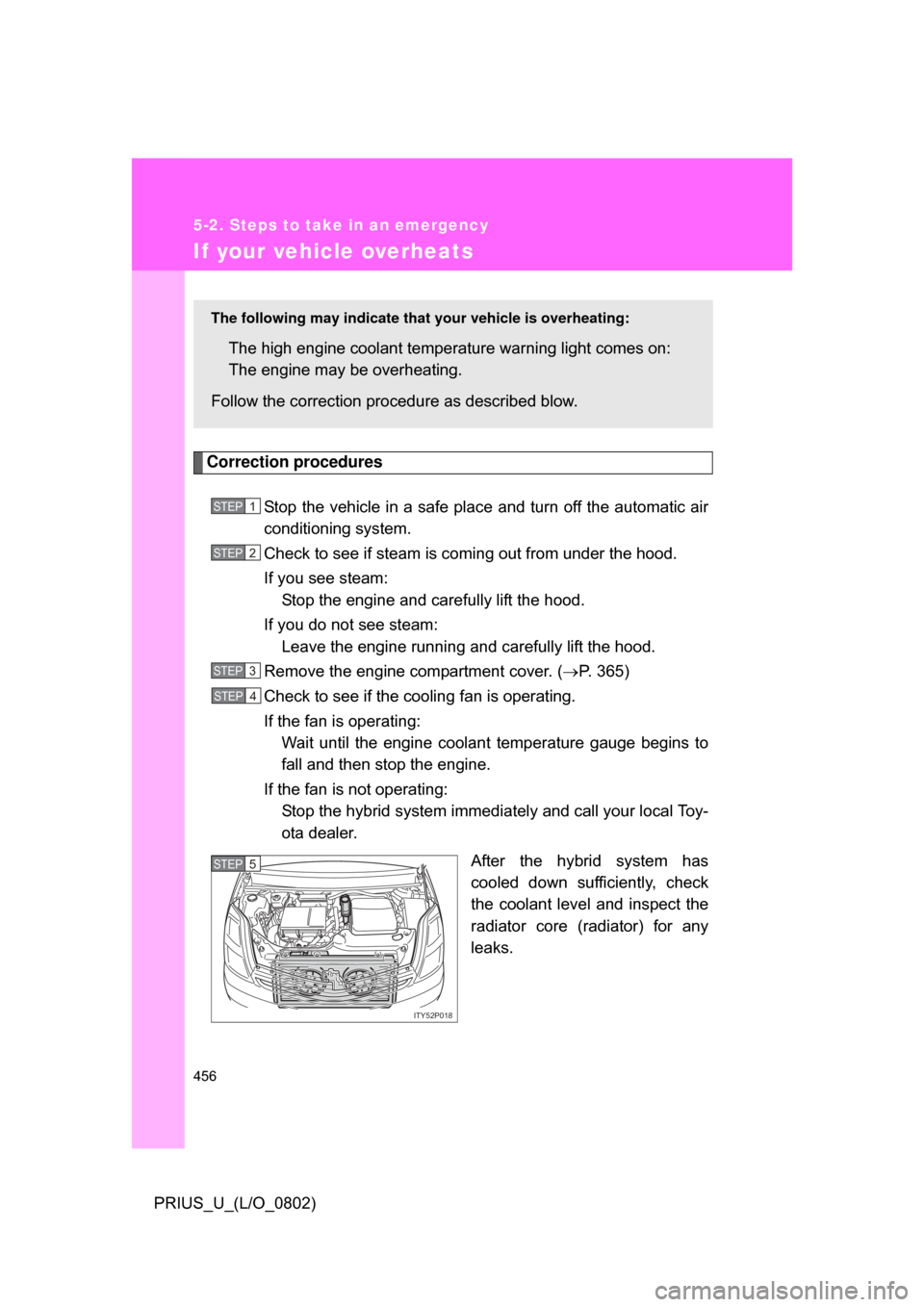
After the hybrid system has
cooled down sufficiently, check
the coolant level and inspect the
radiator core (radiator) for any
leaks.
The following may indicate that your vehicle is overheating:
The high engine coolant temperature warning light comes on:
The engine may be overheating.
Follow the correction procedure as described blow.
STEP1
STEP2
STEP3
STEP4
ITY52P018
STEP5
Page 457 of 512
5
When trouble arises
457
5-2. Steps to take in an emergency
PRIUS_U_(L/O_0802)
Add coolant if required.
Water can be used in an emer-
gency measure if coolant is
unavailable. (
P. 467)
Have the vehicle checked at your nearest Toyota dealer as soon as
possible.
ITY52P019
STEP6
■Overheating
In the following situations, your vehicle may be overheating.
● High coolant temperature warning light is displayed on the touch screen.
● Steam is coming from under the hood.
CAUTION
■To prevent an accident or injury when inspecting under the hood of
your vehicle
● Keep hands and clothing away from the fan and engine drive belt while the
engine is running.
● Do not loosen the radiator cap while the engine and radiator are hot.
Serious injury, such as burns, may result from hot coolant and steam
released under pressure.
Page 480 of 512

480 6-1. Specifications
PRIUS_U_(L/O_0802)■
Treadwear
The treadwear grade is a comparative rating based on the wear
rate of the tire when tested under controlled conditions on a speci-
fied government test course.
For example, a tire graded 150 would wear one and a half (1 - 1/2)
times as well on the government course as a tire graded 100.
The relative performance of tires depends upon the actual conditions
of their use, however, and may depart significantly from the norm due
to variations in driving habits, service practices and differences in
road characteristics and climate.
■ Traction AA, A, B, C
The traction grades, from highest to lowest, are AA, A, B and C,
and they represent the tire’s ab ility to stop on wet pavement as
measured under controlled cond itions on specified government
test surfaces of asphalt and concrete.
A tire marked C may have poor traction performance.
Warning: The traction grade assigned to this tire is based on braking
(straight ahead) traction tests and does not include cornering (turn-
ing) traction.
■ Temperature A, B, C
The temperature grades are A (the highest), B, and C, represent-
ing the tire’s resistance to the generation of heat and its ability to
dissipate heat when tested under controlled conditions on a speci-
fied indoor laboratory test wheel.
Sustained high temperature can cause the material of the tire to
degenerate and reduce tire life, and excessive temperature can lead
to sudden tire failure.
The grade C corresponds to a level of performance which all passen-
ger car tires must meet under the Federal Motor Vehicle Safety Stan-
dard No. 109.
Grades B and A represent higher levels of performance on the labo-
ratory test wheel than the minimum required by law.
Page 481 of 512

481
6-1. Specifications
6
Vehicle specifications
PRIUS_U_(L/O_0802)
Warning: The temperature grades for this tire are established for a
tire that is properly inflated and not overloaded.
Excessive speed, underinflation, or
excessive loading, either sepa-
rately or in combination, can caus e heat buildup and possible tire fail-
ure.
Glossary of tire terminology
Tire related termMeaning
Cold tire inflation
pressure Tire pressure when the vehicle has been
parked for three hours or more, or has not
been driven more than 1 mile or 1.5 km under
that condition
Maximum inflation
pressure The maximum cold inflated
pressure to which a
tire may be inflated, s hown on the sidewall of
the tire
Recommended
inflation pressure Cold tire inflation pressure recommended by a
manufacturer.
Accessory weight The combined weight (in excess of those stan-
dard items which may be replaced) of trans-
mission, power steering, power brakes, power
windows, power seats, radio and heater, to the
extent that these items
are available as factory-
installed equipment (whether installed or not)
Curb weight The weight of a motor vehicle with standard
equipment, including the maximum capacity of
fuel, oil and coolant, and if so equipped, air
conditioning and additional weight optional
engine
Maximum loaded
vehicle weight The sum of:
(a) Curb weight
(b) Accessory weight
(c) Vehicle capacity weight
(d) Production options weight
Normal occupant
weight 150 lb. (68 kg) times the number of occupants
specified in the second column of Table 1
* that
follows
Page 491 of 512
491
6
Vehicle specifications
PRIUS_U_(L/O_0802)
6-3. Initialization
Items to initialize
ItemWhen to initializeReference
Power window • After reconnecting or changing the
12 volt battery
• After changing a fuse P. 7 5
Engine oil mainte-
nance data • After changing engine oil
P. 369
Tire pressure warning
system • When rotating the tires on vehicles
differing with front and rear tire infla-
tion pressures.
• When changing the tire inflation pressure by changing traveling
speed or load weight, etc.
• When changing the tire size. P. 381
After reconnecting or performing
maintenance on the 12 volt battery,
the following items must be initia lized for normal system operation.