2008 TOYOTA PRIUS roof
[x] Cancel search: roofPage 98 of 512
98 1-8. Safety information
PRIUS_U_(L/O_0802)
CAUTION
■SRS airbag precautions
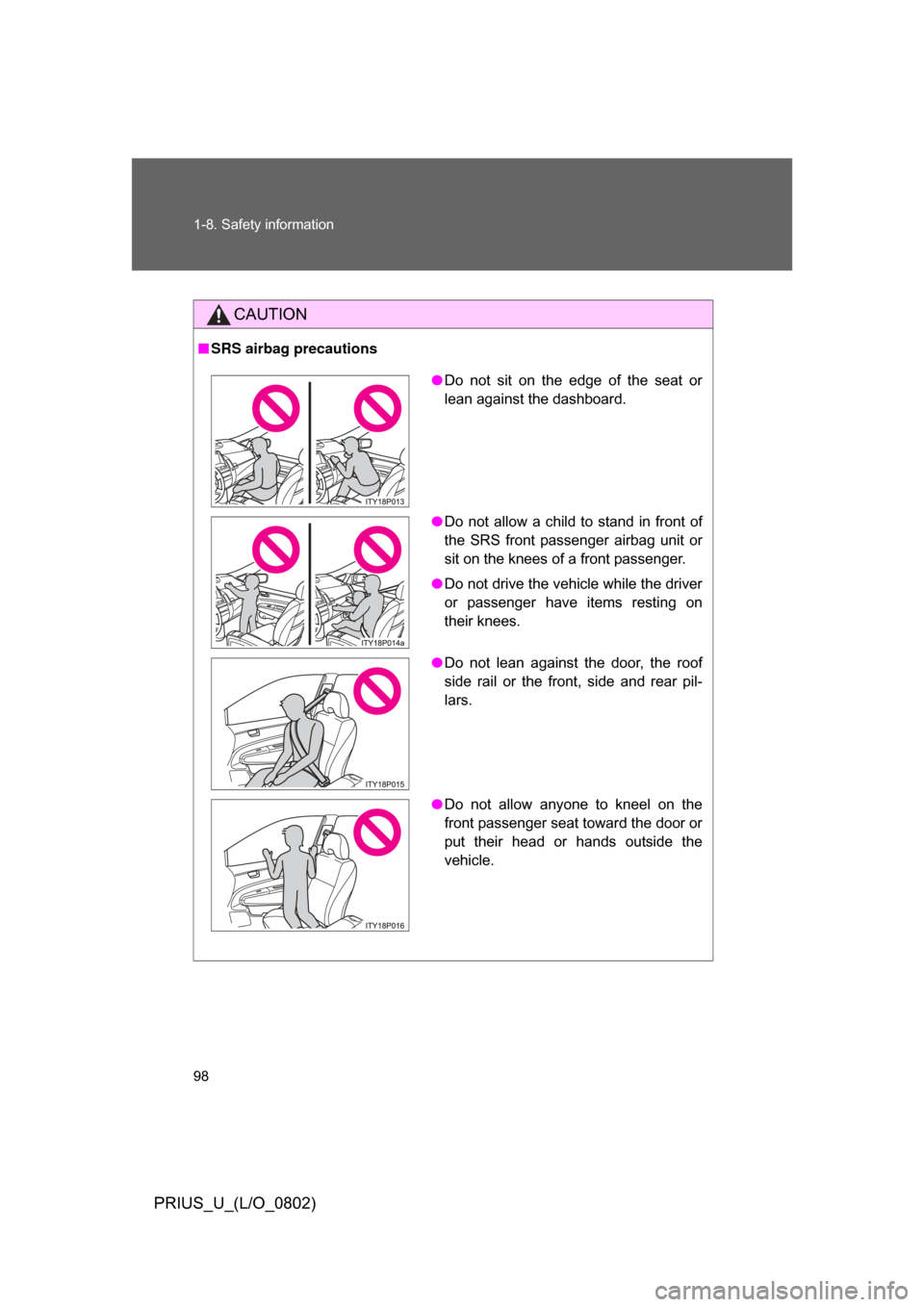
● Do not sit on the edge of the seat or
lean against the dashboard.
● Do not allow a child to stand in front of
the SRS front passenger airbag unit or
sit on the knees of a front passenger.
● Do not drive the vehicle while the driver
or passenger have items resting on
their knees.
● Do not lean against the door, the roof
side rail or the front, side and rear pil-
lars.
● Do not allow anyone to kneel on the
front passenger seat toward the door or
put their head or hands outside the
vehicle.
Page 99 of 512
99
1-8. Safety information
1
Before driving
PRIUS_U_(L/O_0802)
CAUTION
■
SRS airbag precautions
● Do not use seat accessories which cover the parts where the SRS side
airbags inflate as they may interf ere with inflation of the airbags.
● Do not strike or apply significant levels of force to the area of the SRS air-
bag components shown on P. 90. Doing so can cause the SRS airbags to
malfunction.
● Do not touch any of the component parts immediately after the SRS air-
bags have deployed (inflated) as they may be hot.
● If breathing becomes difficult after the SRS airbag has deployed, open a
door or window to allow fresh air in, or leave the vehicle if it is safe to do
so. Wash off any residue as soon as possible to prevent skin irritation.
● If the areas where the SRS airbags are stored, such as the steering wheel
pad and front pillar garnish, are dam aged or cracked, have them replaced
by your Toyota dealer.
● Do not place anything, such as a cushion, on the front passenger’s seat
Doing so will disperse the passenger’s weight, which prevents the sensor
from detecting the passenger’s weight properly. As a result, the SRS front
passenger airbag may not deploy in the event of a collision.
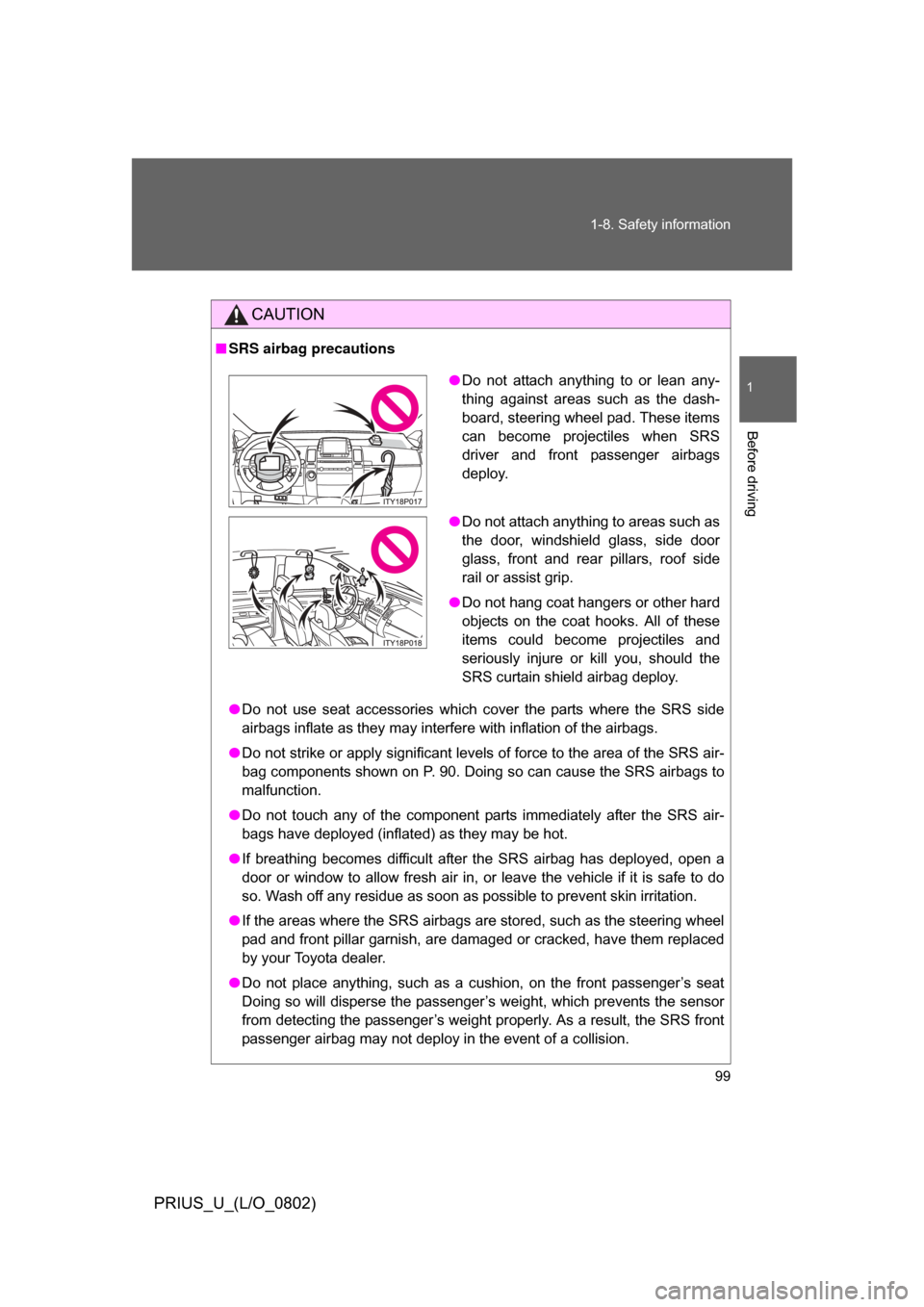
●Do not attach anything to or lean any-
thing against areas such as the dash-
board, steering wheel pad. These items
can become projectiles when SRS
driver and front passenger airbags
deploy.
● Do not attach anything to areas such as
the door, windshield glass, side door
glass, front and rear pillars, roof side
rail or assist grip.
● Do not hang coat hangers or other hard
objects on the coat hooks. All of these
items could become projectiles and
seriously injure or kill you, should the
SRS curtain shield airbag deploy.
Page 100 of 512
100 1-8. Safety information
PRIUS_U_(L/O_0802)
CAUTION
■Modification and disposal of SRS airbag system components
Do not dispose of your vehicle or perform any of the following modifications
without consulting your Toyota dealer. The SRS airbag may malfunction or
deploy (inflate) accidentally, causing death or serious injury.
● Installation, removal, disassembly and repair of the SRS airbags
● Repairs, modifications, removal or replacement of the steering wheel,
instrument panel, dashboard, seats or seat upholstery, front, side and rear
pillars or roof side rail
● Repairs or modifications of the front fender, front bumper, or side of the
occupant compartment
● Installation of snow plows, winches, etc. to the front grille (bull bars, kan-
garoo bar etc.)
● Modifications to the vehicle’s suspension system
● Installation of electronic devices such as mobile two-way radios or CD
players
● Modifications to your vehicle for a person with a physical disability.
Page 109 of 512
109
1-8. Safety information
1
Before driving
PRIUS_U_(L/O_0802)
CAUTION
■
Child restraint precautions
● Never install a rear-facing child restraint system on the front passenger
seat even if “AIR BAG OFF” indicator light is illuminated. In the event of an
accident, the force of the rapid inflation of the front passenger airbag can
cause death or serious injury to the child if the rear-facing child restraint
system is installed on the front passenger seat.
● A forward-facing child restraint system should allowed to be installed on
the front passenger seat only when it is unavoidable. Always move the
seat as far back as possible even if “A IR BAG OFF” indicator light is illumi-
nated, because the front passenger airbag could inflate with considerable
speed and force. Otherwise, the child may be killed or seriously injured.
● Do not use the seat belt extender when installing a child restraint system
on the front or rear passenger seat. If installing a child restraint system
with the seat belt extender connected to the seat belt, the seat belt will not
securely hold the child restraint system, which could cause death or seri-
ous injury to the child or other passengers in the event of collision.
● Do not allow the child to lean his/her head or any part of his/her body
against the door or the area of the seat, front pillar or roof side rail from
which the side airbags or curtain shield airbags deploy even if the child is
seated in the child restraint system. It is dangerous if the side airbags and
curtain shield airbags inflate, and the impact could cause death or serious
injury to the child.
● Make sure you have complied with all installation instructions provided by
the child restraint manufacturer and that the system is properly secured. If
it is not secured properly, it may cause death or serious injury to the child
in the event of a sudden stop or accident.
■ When the child restrain t system is not in use
● Keep the child restraint system properly secured on the seat even if it is
not in use. Do not store the restraint unsecured in the passenger compart-
ment.
● If it is necessary to detach the child restraint system, remove it from the
vehicle or store it securely in the luggage compartment. This will prevent it
from injuring passengers in the event of a sudden stop or accident.
Page 231 of 512
231
3-3. Using the audio system
3
Interior features
PRIUS_U_(L/O_0802)
■
When the 12 volt battery is disconnected
All preset stations are erased.
■ Reception sensitivity
● Maintaining perfect radio reception at all times is difficult due to the con-
tinually changing position of the antenna, differences in signal strength
and surrounding objects, such as trains, transmitters, etc.
● The radio antenna is mounted on the roof. To maintain clear radio recep-
tion, do not attach metallic window tinting or other metallic objects to the
antenna wire mounted inside the rear window.
■ XM
® satellite radio
An XM
® Satellite Radio is a tuner designed exclusively to receive broadcasts
provided under a separate subscription.
Availability is limited to the 48 contiguous states and 10 Canadian provinces.
● XM
® subscriptions
For detailed information about XM® Satellite Radio or to subscribe:
U.S.A. –
Visit on the web at www.xmradio.com
or call 1-800-967-2346.
Canada. –
Visit on the web at www.xmradio.ca
or call 1-877-438-9677.
● Radio ID
You will need the radio ID when activating XM
® service or reporting a
problem. Select “CH000” using the dial, and the receiver’s 8-char-
acter ID number will appear.
● Satellite tuner
The tuner supports only Audio Services (Music and Talk) and the accom-
panying Text Information of XM
® satellite radio.
*: Terms and services provided by XM® Radio are subject to change without
notice.
TUNE FILE
Page 238 of 512
238 3-3. Using the audio system
PRIUS_U_(L/O_0802)■
Traffic announcement
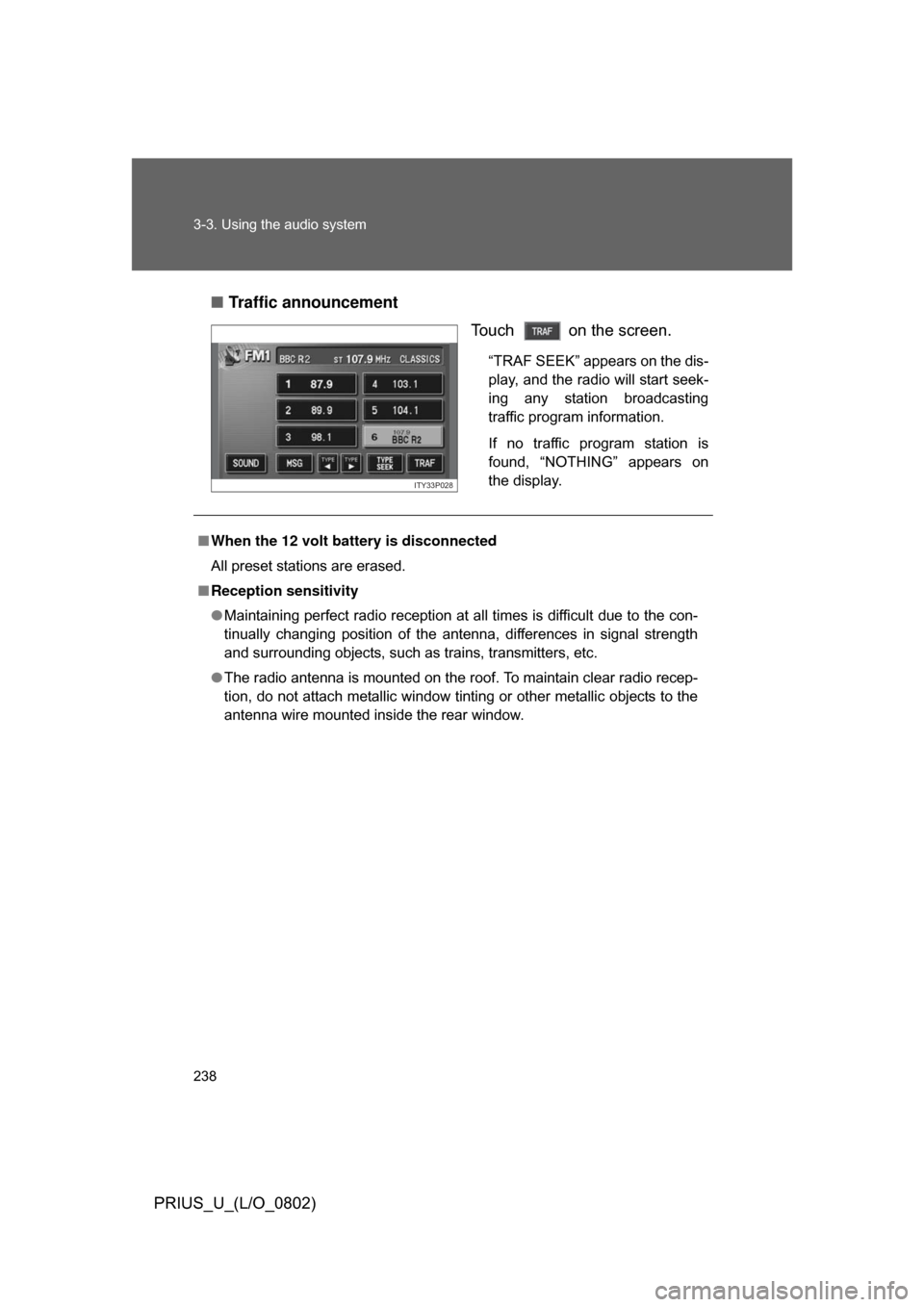
Touch on the screen.
“TRAF SEEK” appears on the dis-
play, and the radio will start seek-
ing any station broadcasting
traffic program information.
If no traffic program station is
found, “NOTHING” appears on
the display.
ITY33P028
■When the 12 volt battery is disconnected
All preset stations are erased.
■ Reception sensitivity
● Maintaining perfect radio reception at all times is difficult due to the con-
tinually changing position of the antenna, differences in signal strength
and surrounding objects, such as trains, transmitters, etc.
● The radio antenna is mounted on the roof. To maintain clear radio recep-
tion, do not attach metallic window tinting or other metallic objects to the
antenna wire mounted inside the rear window.
Page 346 of 512
346
PRIUS_U_(L/O_0802)
4-1. Maintenance and care
Cleaning and protecting the vehicle’s exterior
■Automatic car washes
● Fold the mirrors back before washing the vehicle.
● Brushes used in automatic car washes may scratch the vehicle surface
and harm your vehicle’s paint.
■ High pressure automatic car washes
Do not allow the nozzles of the car wash to come within close proximity of
the windows. Before entering an automatic car wash, check that the fuel filler
door is closed.
■ Aluminum wheels
Remove any dirt immediately by using a neutral detergent. Do not use hard
brushes or abrasive cleaners. Do not use strong or harsh chemical cleaners.
Use the same mild detergent and wax as used on the paint.
■ Bumpers and side moldings
Do not scrub with abrasive cleaners.
Perform the following to protect the vehicle and maintain it in prime
condition.
● Working from top to bottom, liber ally apply water to the vehicle
body, wheel wells and underside of the vehicle to remove any
dirt and dust.
Wash the vehicle body using a sponge or soft cloth, such as a cham-
ois.
● For hard-to-remove marks, use car wash soap and rinse thor-
oughly with water.
● Wipe away any water.
● Wax the vehicle when the waterproof coating deteriorates.
If water does not bead on a clean surface, apply wax when
the vehicle body is cool.
Page 482 of 512

482 6-1. Specifications
PRIUS_U_(L/O_0802)
Tire related termMeaning
Occupant distribution Distribution of occupants in a vehicle as speci-
fied in the third column of Table 1
* below
Production options
weight The combined weight of installed regular pro-
duction options weighing over 5 lb. (2.3 kg) in
excess of the standard items which they
replace, not previously considered in curb
weight or accessory weight, including heavy
duty brakes, ride levelers, roof rack, heavy duty
battery, and special trim
Rim A metal support for a tire or a tire and tube
assembly upon which the tire beads are seated
Rim diameter
(Wheel diameter) Nominal diameter of the bead seat
Rim size designation Rim diameter and width
Rim type designation The industry manufacturer’s designation for a
rim by style or code
Rim width Nominal distance between rim flanges
Vehicle capacity
weight (Total load
capacity) The rated cargo and luggage load plus 150 lb.
(68 kg) times the vehicle’s designated seating
capacity
Vehicle maximum load
on the tire The load on an individual tire that is determined
by distributing to each axle its share of the
maximum loaded vehicle weight, and dividing
by two
Vehicle normal load
on the tire The load on an individual tire that is determined
by distributing to each axle its share of curb
weight, accessory weight, and normal occu-
pant weight (distributed in accordance with
Ta b l e 1
* below), and dividing it by two
Weather side The surface area of the rim not covered by the
inflated tire