Page 108 of 326

’08 MATRIX_U (L/O 0706)
98
2008 COROLLA MATRIX from Aug. ’07 Prod. (OM12B26U)
To turn on the rear window wiper, twist
the lever knob upward.
The key must be in the “ON” position.Lever position
Speed setting
Position 1Intermittent
Position 2Normal
To squirt washer fluid on the rear window,
twist the knob upward or downward as far
as it will go (position 3 or 4). The knob
automatically returns from these positions
after you release it. The rear window wip-
er operates while the washer squirts.
For instructions on adding washer fluid,
see “Adding washer fluid” on page 293 in
Section 7 −3.
NOTICE
Do not operate the rear wiper if the
rear window is dry. It may scratch the
glass.
To defog or defrost the rear window,
push the switch.
The key must be in the “ON” position.
The thin heater wires on the inside of the
rear window will quickly clear the window
surface. An indicator light will illuminate to
indicate the defogger is operating.
Push the switch once again to turn the
defogger off.
The system will automatically shut off af-
ter the defogger have operated about 15
minutes.
Rear window wiper and
washer Rear window defogger
Page 109 of 326
’08 MATRIX_U (L/O 0706)
99
2008 COROLLA MATRIX from Aug. ’07 Prod. (OM12B26U)
Make sure you turn the defogger off when
the window is clear. Leaving the defogger
on for a long time could cause the battery
to discharge, especially during stop−and−
go driving. The defogger is not designed
for drying rain water or for melting snow.
NOTICE
When cleaning the inside of the rear
window, be careful not to scratch or
damage the heater wires or connec-
tors.
Page 139 of 326

’08 MATRIX_U (L/O 0706)
129
2008 COROLLA MATRIX from Aug. ’07 Prod. (OM12B26U)
NOTICE
�Do not use liquid sealants for a flat
tire as tire pressure warning valve
and transmitter will be damaged.
� When the tires must be repaired or
replaced, have them repaired or re-
placed by the nearest Toyota dealer
or authorized tire dealer. The tire
pressure warning valves and trans-
mitters will be affected by the
installation or removal of tires.
IF THE TIRE PRESSURE WARNING
LIGHT COMES ON AFTER BLINKING
FOR 1 MINUTE...
If the tire pressure warning light comes
on after blinking for 1 minute when the
ignition key is turned to the “ON” posi-
tion, the tire pressure warning system
is not working properly.
The system will be disabled in the follow-
ing conditions:
(When the condition becomes normal, the
system will work properly.)
�If tires not equipped with tire pressure
warning valves and transmitters are
used.
�If the ID code on the tire pressure
warning valves and transmitters is not
registered in the tire pressure warning
ECU.
�If the tire inflation pressure is more
than 500 kPa (5.1 kgf/cm2 or bar, 73
psi).
The system may be disabled in the follow-
ing conditions:
(When the condition becomes normal, the
system will work properly.)
�If electronic devices or facilities using
similar radio wave frequencies are
nearby.
�If a radio set at similar frequencies is
in use in the vehicle.
�If a window tint that affects the radio
wave signals is installed.
�If there is a lot of snow or ice on the
vehicle, in particular around the wheels
or wheel housings.
�If non −genuine Toyota wheels are used.
�If tire chains are used.
Page 169 of 326
’08 MATRIX_U (L/O 0706)
159
2008 COROLLA MATRIX from Aug. ’07 Prod. (OM12B26U)
�To cool off your Toyota after it has
been parked in the hot sun, drive with
the windows open for a few minutes.
This vents the hot air, allowing the air
conditioning to cool the interior more
quickly.
�Make sure the air intake grilles in front
of the windshield are not blocked (by
leaves or snow, for example).
�On humid days, do not blow cold air
on the windshield. The windshield could
fog up because of the difference in air
temperature on the inside and outside
of the windshield.
�Keep the area under the front seats
clear to allow air to circulate through-
out the vehicle.
�On cold days, set the fan speed to
high for a minute to help clear the
intake ducts of snow or moisture. This
can reduce the amount of fogging on
the windows.
�When driving on dusty roads, close all
windows. If dust thrown up by the ve-
hicle is still drawn into the vehicle after
closing the windows, it is recommended
that the air intake selector be set to
FRESH and the fan speed selector to
any setting except “OFF”.
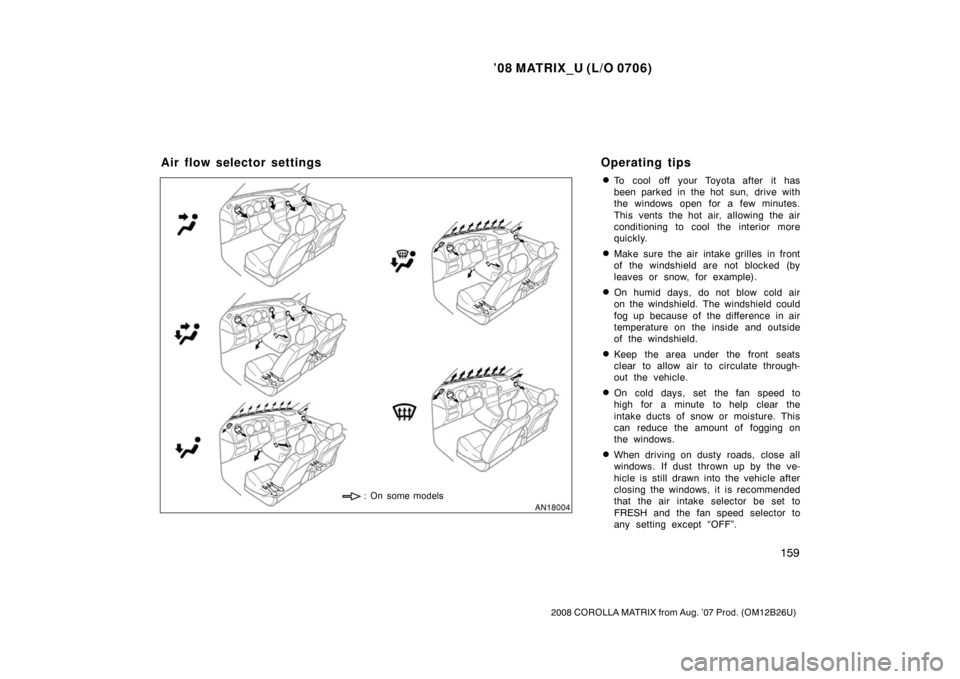
Air flow selector settings
: On some models
Operating tips
Page 170 of 326

’08 MATRIX_U (L/O 0706)
160
2008 COROLLA MATRIX from Aug. ’07 Prod. (OM12B26U)
�If following another vehicle on a dusty
road, or driving in windy and dusty
conditions, it is recommended that the
air intake selector be temporarily set to
RECIRCULATE, which will close off the
outside passage and prevent outside
air and dust from entering the vehicle
interior.Heating
For best results, set controls to:
Fan speed— Any setting except “OFF”
Temperature— To w a r d s WARM
(red zone)
Air intake—FRESH (outside air)
Air flow—FLOOR
Air conditioning—OFF
�For quick heating, select recirculated
air for a few minutes. To keep the
windows from fogging, select fresh af-
ter the vehicle interior has been
warmed.
�Press the “A/C” button on for dehumidi-
fied heating.
�Choose floor/windshield air flow to heat
the vehicle interior while defrosting or
defogging the windshield. Air conditioning
For best results, set controls to:
Fan speed— Any setting except “OFF”
Temperature— To w a r d s COLD
(blue zone)
Air intake—FRESH (outside air)
Air flow—PANEL
Air conditioning—ON
�For quick cooling, select recirculated
air for a few minutes.
Ventilation
For best results, set controls to:
Fan speed— Any setting except “OFF”
Temperature— To w a r d s COLD
(blue zone)
Air intake—FRESH (outside air)
Air flow—PANEL
Air conditioning—OFF
Page 173 of 326
’08 MATRIX_U (L/O 0706)
163
2008 COROLLA MATRIX from Aug. ’07 Prod. (OM12B26U)
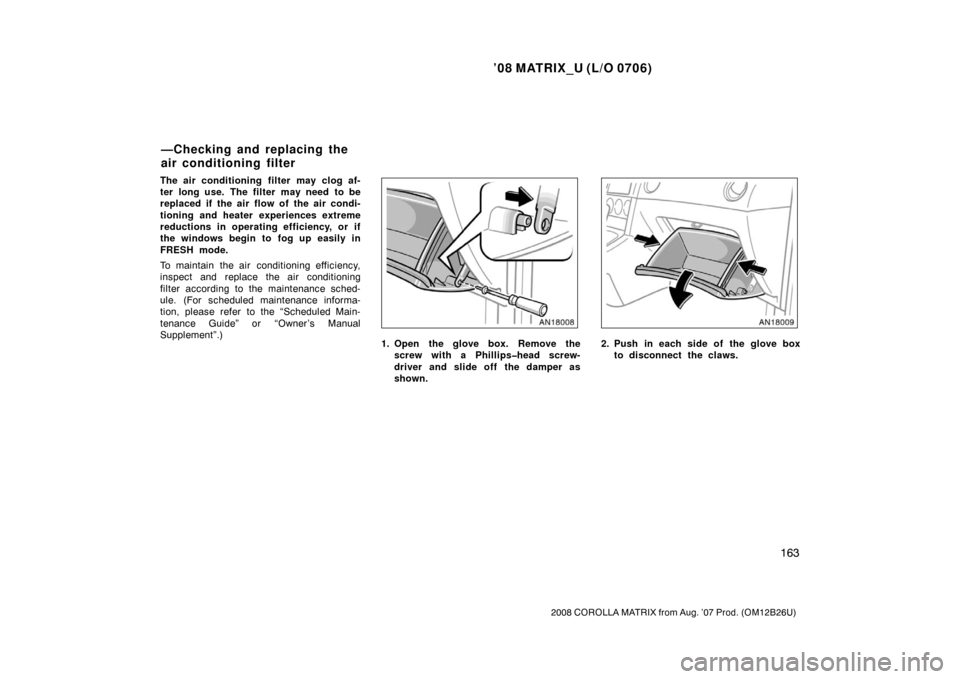
The air conditioning filter may clog af-
ter long use. The filter may need to be
replaced if the air flow of the air condi-
tioning and heater experiences extreme
reductions in operating efficiency, or if
the windows begin to fog up easily in
FRESH mode.
To maintain the air conditioning efficiency,
inspect and replace the air conditioning
filter according to the maintenance sched-
ule. (For scheduled maintenance informa-
tion, please refer to the “Scheduled Main-
tenance Guide” or “Owner ’s Manual
Supplement”.)
1. Open the glove box. Remove thescrew with a Phillipshead screw-
driver and slide off the damper as
shown.2. Push in each side of the glove boxto disconnect the claws.
—Checking and replacing the
air conditioning filter
Page 198 of 326

’08 MATRIX_U (L/O 0706)
188
2008 COROLLA MATRIX from Aug. ’07 Prod. (OM12B26U)
CAUTION
�Avoid inhaling the engine exhaust.
It contains carbon monoxide, which
is a colorless and odorless gas. It
can cause unconsciousness or even
death.
�Make sure the exhaust system has
no holes or loose connections. The
system should be checked from
time to time. If you hit something,
or notice a change in the sound of
the exhaust, have the system
checked immediately.
�Do not run the engine in a garage
or enclosed area except for the
time needed to drive the vehicle in
or out. The exhaust gases cannot
escape, making this a particularly
dangerous situation.
�Do not remain for a long time in a
parked vehicle with the engine run-
ning. If it is unavoidable, however,
do so only in an unconfined area
and adjust the heating or cooling
system to force outside air into the
vehicle.
�To allow proper operation of your
vehicle’s ventilation system, keep
the inlet grilles in front of the wind-
shield clear of snow, leaves, or oth-
er obstructions.
�Keep the back door and glass hatch
closed while driving. An open or
unsealed back door and glass
hatch, may cause exhaust gases to
be drawn into the vehicle.
If you smell exhaust fumes in the
vehicle, open the windows and
close the back door to ensure
plenty of fresh air enters the ve-
hicle. If you can smell exhaust
fumes even though there are no
other vehicles in the surrounding
area, have your vehicle checked by
your Toyota dealer. Continued in-
halation of exhaust fumes can lead
to death by gas poisoning.
FUNCTIONS OF ENGINE OIL
Engine oil has the primary functions of
lubricating and cooling the inside of the
engine, and plays a major role in main-
taining the engine in proper working order.
ENGINE OIL CONSUMPTION
It is normal that an engine should con-
sume some engine oil during normal
engine operation. The causes of oil
consumption in a normal engine are as
follows.
�Oil is used to lubricate pistons, piston
rings and cylinders. A thin film of oil
is left on the cylinder wall when a pis-
ton moves downwards in the cylinder.
High negative pressure generated when
the vehicle is decelerating sucks some
of this oil into the combustion chamber.
This oil as well as some part of the oil
film left on the cylinder wall is burned
by the high temperature combustion
gases during the combustion process.
�Oil is also used to lubricate the stems
of the intake valves. Some of this oil
is sucked into the combustion chamber
together with the intake air and is
burned along with the fuel. High tem-
perature exhaust gases also burn the
oil used to lubricate the exhaust valve
stems.
Engine exhaust cautionsFacts about engine oil
consumption
Page 214 of 326

’08 MATRIX_U (L/O 0706)
204
2008 COROLLA MATRIX from Aug. ’07 Prod. (OM12B26U)
Ti r e relat ed ter mMeaning
Cold tire inflation pressure
tire inflation pressure when the vehicle has been parked for at least 3
hours or more, or it has not been driven more than 1.5 km or 1 mile
under that condition
Maximum inflation pressurethe maximum cold inflation pressure to which a tire may be inflated and it
is shown on the sidewall of the tire
Recommended inflation pressurecold tire inflation pressure recommended by a manufacturer
Accessory weight
the combined weight (in excess of those standard items which may be
replaced) of automatic transmission, power steering, power brakes, power
windows, power seats, radio, and heater, to the extent that these items
are available as factory −installed equipment (whether installed or not)
Curb weight
the weight of a motor vehicle wi th standard equipment including the
maximum capacity of fuel, oil, and coolant, and, if so equipped, air
conditioning and additional weight optional engine
Maximum loaded vehicle weight
t he sum of —
(a) curb weight;
(b) accessory weight;
(c) vehicle capacity weight; and
(d) production options weight
Normal occupant weight68 kg (150 lb.) times the number of occupants specified in the second
column of Table 1 that follows
Occupant distributiondistribution of occupants in a vehicle as specified in the third column of Table
1 that follows
—Glossary of tire terminology