Page 109 of 531
110 1−7. Safety information
CAUTION
nSRS airbag precautions
Observe the following precautions regarding the airbags.
Failure to do so may cause death or serious injury.
lThe driver and all passengers in the vehicle must wear their seat belts
properly.
The SRS airbags are supplemental devices to be used with the seat belts.
lThe SRS driver airbag deploys with considerable force, and can cause
death or serious injury especially if the driver is very close to the airbag.
The National Highway Traffic Safety
Administration (“NHTSA”) advises:
Since the risk zone for driver airbag is the first 2 − 3 in. (50 − 75 mm) of
inflation, placing yourself 10 in. (250 mm) from your driver airbag provides
you with a clear margin of safety. This distance is measured from the cen−
ter of the steering wheel to your breastbone. If you sit less than 10 in. (250
mm) away now, you can change your driving position in several ways:
�Move your seat to the rear as far as you can while still reaching the
pedals comfortably.
�Slightly recline the back of the seat.
Although vehicle designs vary, many drivers can achieve the 10 in.
(250 mm) distance, even with the driver seat all the way forward, sim−
ply by reclining the back of the seat somewhat. If reclining the back of
your seat makes it hard to see the road, raise yourself by using a firm,
non−slippery cushion, or raise the seat if your vehicle has that feature.
�If your steering wheel is adjustable, tilt it downward. This points the air−
bag toward your chest instead of your head and neck.
The seat should be adjusted as recommended by NHTSA above, while still
maintaining control of the foot pedals, steering wheel, and your view of the
instrument panel controls.
Page 110 of 531
111
1−7. Safety information
1
Before driving
CAUTION
nSRS airbag precautions
lThe SRS front passenger airbag also deploys with considerable force, and
can cause death or serious injury especially if the front passenger is very
close to the airbag. The front passenger seat should be as far from the air−
bag as possible with the seatback adjusted, so the front passenger sits
upright.
lImproperly seated and/or restrained infants and children can be killed or
seriously injured by a deploying airbag. An infant or child who is too small
to use a seat belt should be properly secured using a child restraint sys−
tem. Toyota strongly recommends that all infants and children be placed in
the rear seats of the vehicle and properly restrained. The rear seats are
the safest for infants and children. (
P. 123)
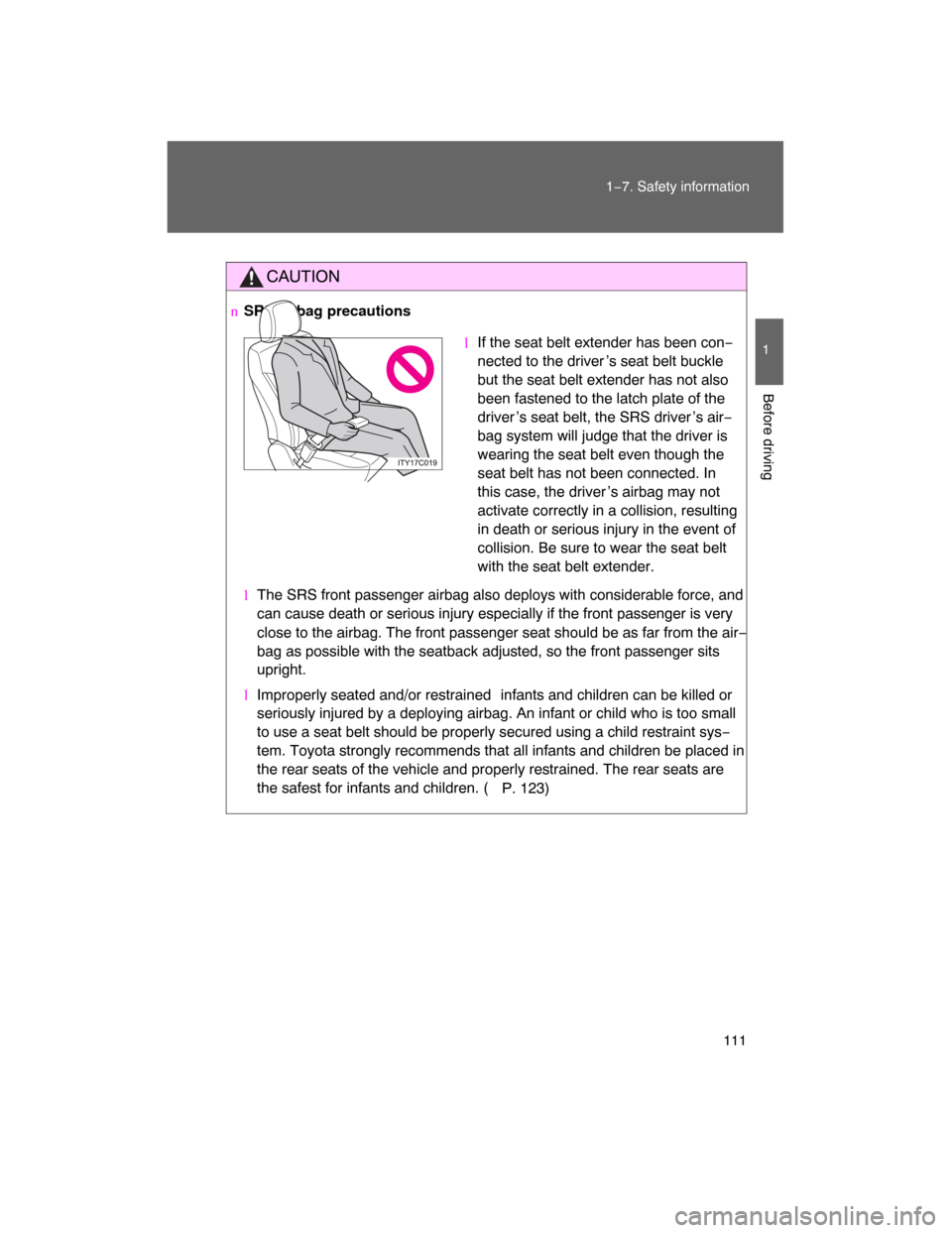
lIf the seat belt extender has been con−
nected to the driver ’s seat belt buckle
but the seat belt extender has not also
been fastened to the latch plate of the
driver ’s seat belt, the SRS driver ’s air−
bag system will judge that the driver is
wearing the seat belt even though the
seat belt has not been connected. In
this case, the driver ’s airbag may not
activate correctly in a collision, resulting
in death or serious injury in the event of
collision. Be sure to wear the seat belt
with the seat belt extender.
Page 111 of 531
112 1−7. Safety information
CAUTION
nSRS airbag precautions
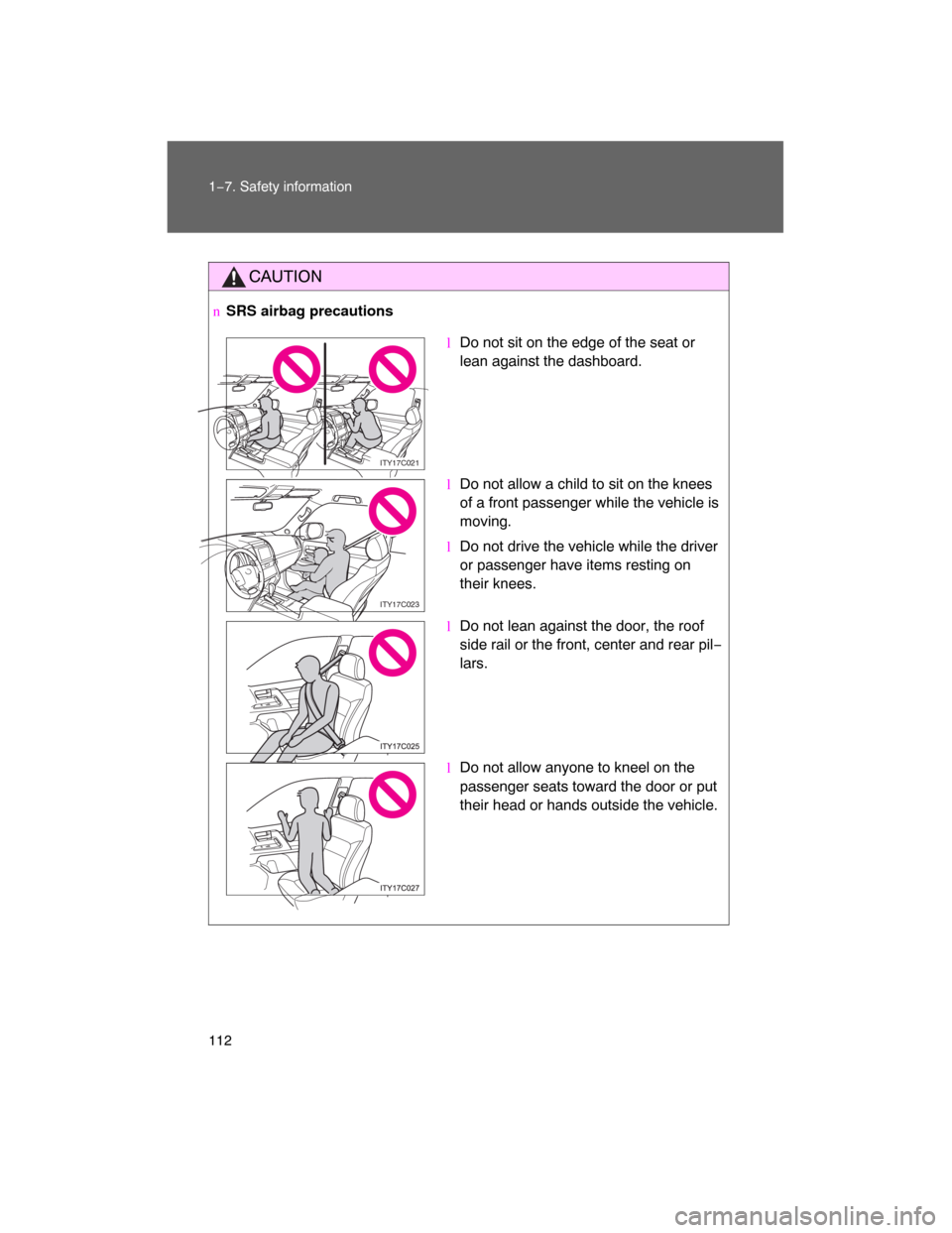
lDo not sit on the edge of the seat or
lean against the dashboard.
lDo not allow a child to sit on the knees
of a front passenger while the vehicle is
moving.
lDo not drive the vehicle while the driver
or passenger have items resting on
their knees.
lDo not lean against the door, the roof
side rail or the front, center and rear pil−
lars.
l
Do not allow anyone to kneel on the
passenger seats toward the door or put
their head or hands outside the vehicle.
ITY17C021
ITY17C023
Page 112 of 531
113
1−7. Safety information
1
Before driving
CAUTION
nSRS airbag precautions
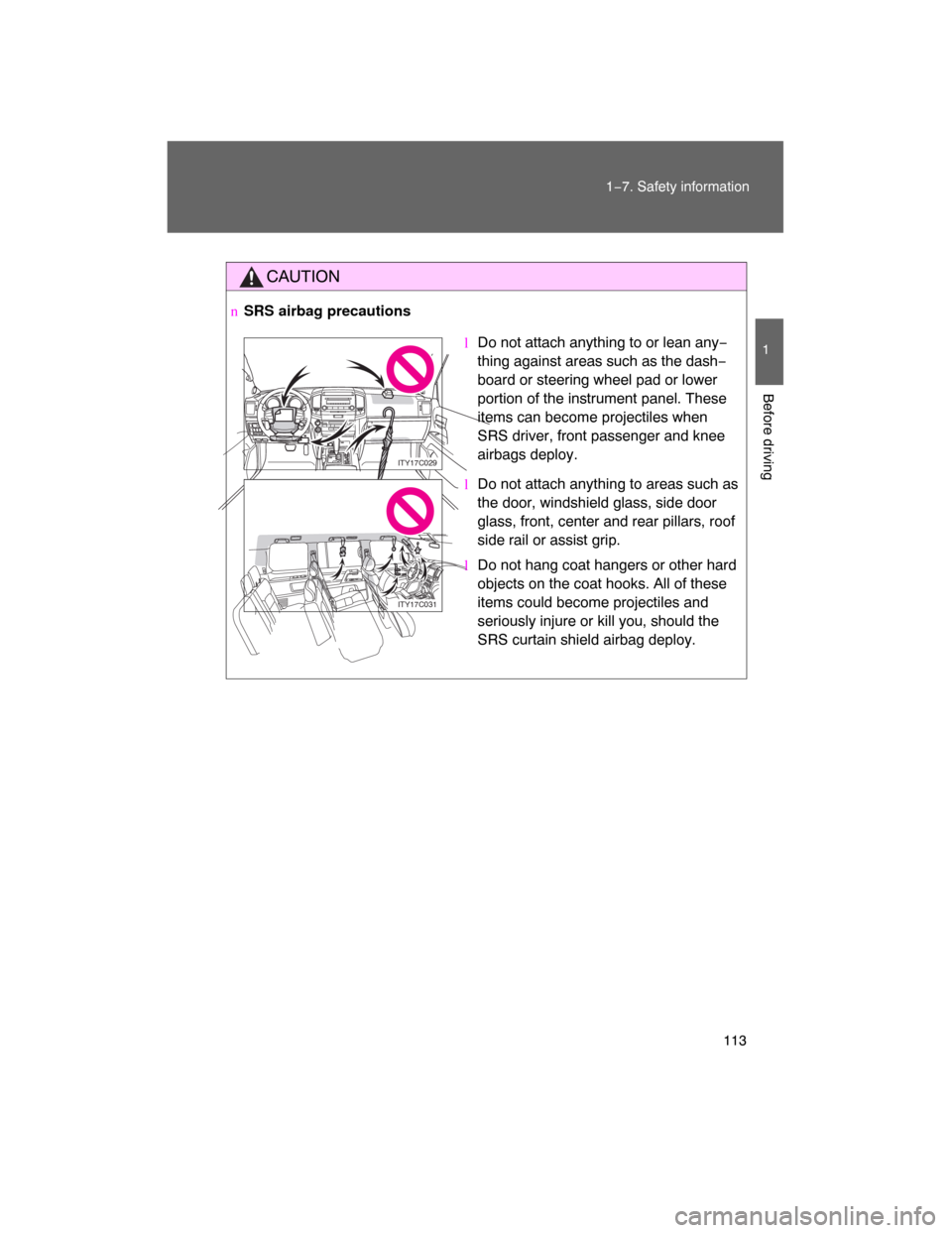
lDo not attach anything to or lean any−
thing against areas such as the dash−
board or steering wheel pad or lower
portion of the instrument panel. These
items can become projectiles when
SRS driver, front passenger and knee
airbags deploy.
lDo not attach anything to areas such as
the door, windshield glass, side door
glass, front, center and rear pillars, roof
side rail or assist grip.
l
Do not hang coat hangers or other hard
objects on the coat hooks. All of these
items could become projectiles and
seriously injure or kill you, should the
SRS curtain shield airbag deploy.
ITY17C029
ITY17C031
Page 126 of 531
127
1
1−7. Safety information
Before driving
Installing child restraints
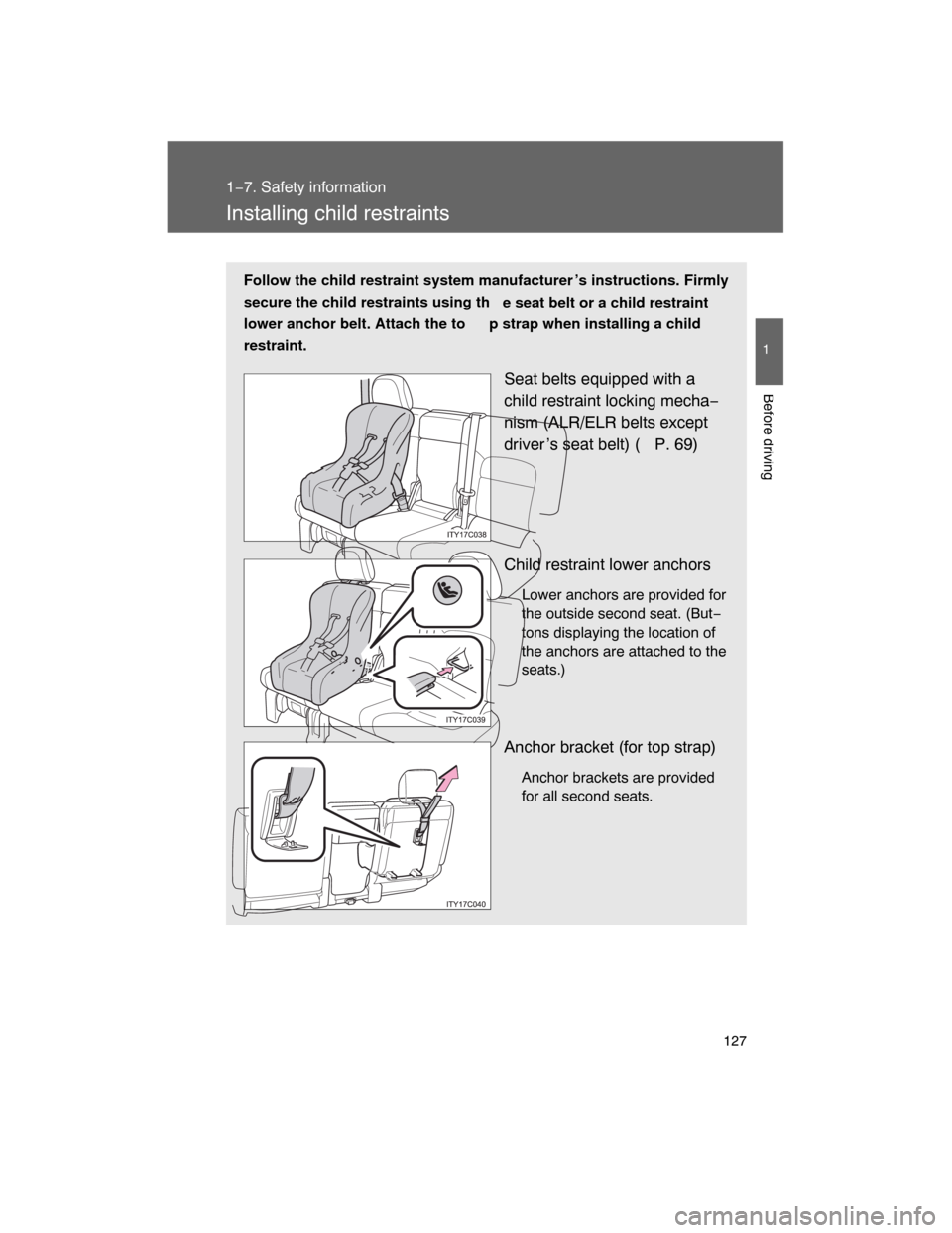
Follow the child restraint system manufacturer ’s instructions. Firmly
secure the child restraints using th
e seat belt or a child restraint
lower anchor belt. Attach the to p strap when installing a child
restraint.
Seat belts equipped with a
child restraint locking mecha−
nism (ALR/ELR belts except
driver ’s seat belt) ( P. 69)
Child restraint lower anchors
Lower anchors are provided for
the outside second seat. (But−
tons displaying the location of
the anchors are attached to the
seats.)
Anchor bracket (for top strap)
Anchor brackets are provided
for all second seats.
Page 136 of 531
137
1−7. Safety information
1
Before driving
CAUTION
nWhen installing a child restraint system
Follow the directions given in the child restraint system installation manual
and fix the child restraint system securely in place.
If the child restraint system is not correctly fixed in place, the child may be
seriously injured or even killed in the event of sudden braking or an accident.
lWhen a booster seat is installed, always ensure that the shoulder belt is
positioned across the center of the child’s shoulder. The belt should be
kept away from the child’s neck, but not so that it could fall off the child’s
shoulder. Failing to do so may result in death or serious injury in the event
of an accident or sudden braking.
lEnsure the belt and tab are securely locked and that the seat belt is not
twisted.
lPush and pull the child seat in different directions to be sure it is secure.
l
Follow all installation instructions provided by the child restraint system
manufacturer.
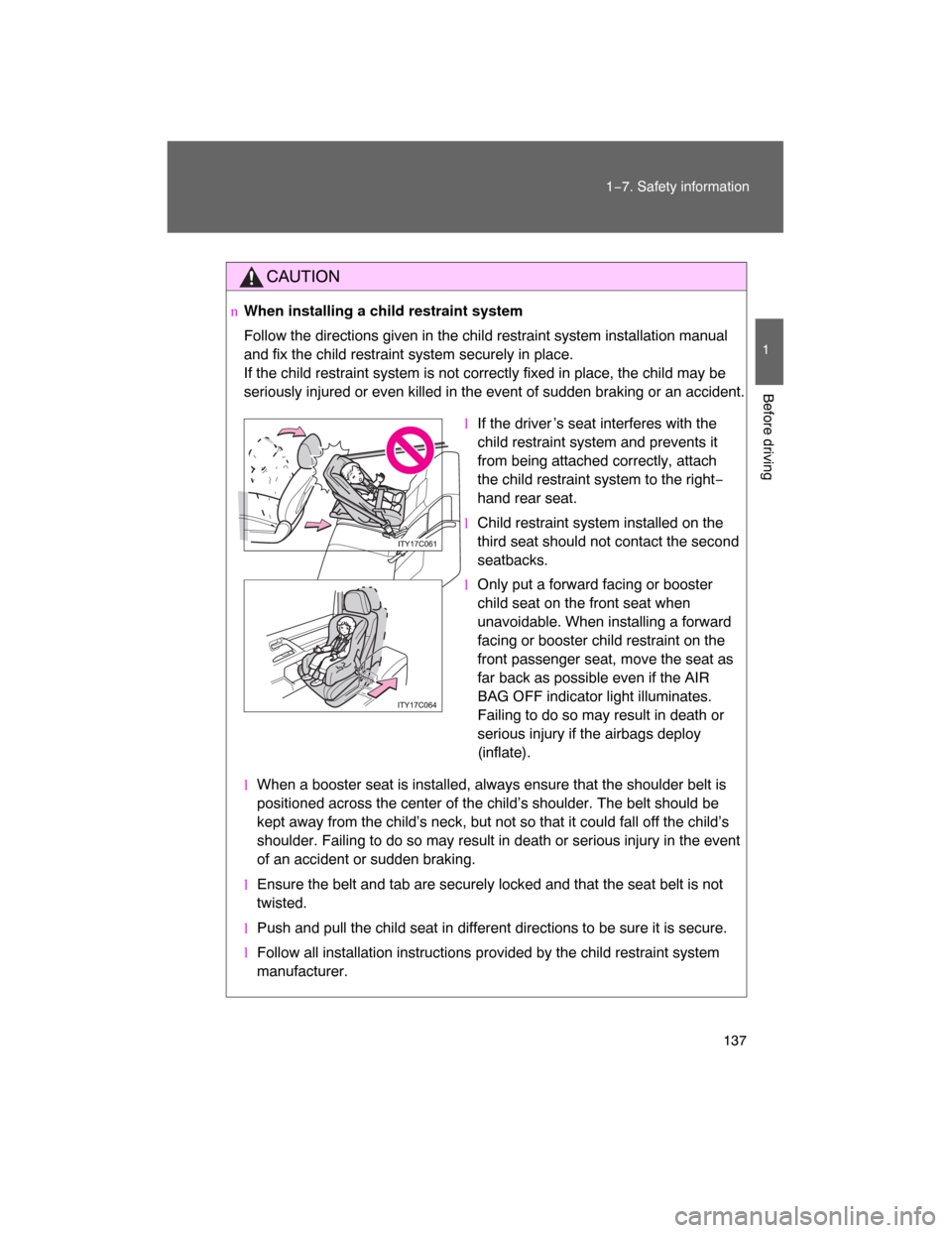
lIf the driver ’s seat interferes with the
child restraint system and prevents it
from being attached correctly, attach
the child restraint system to the right−
hand rear seat.
lChild restraint system installed on the
third seat should not contact the second
seatbacks.
l
Only put a forward facing or booster
child seat on the front seat when
unavoidable. When installing a forward
facing or booster child restraint on the
front passenger seat, move the seat as
far back as possible even if the AIR
BAG OFF indicator light illuminates.
Failing to do so may result in death or
serious injury if the airbags deploy
(inflate).
Page 139 of 531
141
2−1. Driving procedures
2
When driving
nDriving in the rain
lDrive carefully when it is raining, because visibility will be reduced, the
windows may become fogged−up, and the road will be slippery.
lDrive carefully when it starts to rain, because the road surface will be
especially slippery.
lRefrain from high speeds when driving on an expressway in the rain,
because there may be a layer of water between the tires and the road
surface, preventing the steering and brakes from operating properly.
nBreaking in your new Toyota
To extend the life of the vehicle, the following precautions are recommended
to observe:
lFor the first 200 miles (300 km):
Avoid sudden stops.
lFor the first 500 miles (800 km):
Do not tow a trailer.
lFor the first 1000 miles (1600 km):
�Do not drive at extremely high speeds.
�Avoid sudden acceleration.
�Do not drive continuously in the low gears.
�Do not drive at a constant speed for extended periods.
nDrumindisc type parking brake system
Your vehicle has a drum−in−disc type parking brake system.
This type of brake system needs bedding−down of the brake shoes periodi−
cally or whenever the parking brake shoes and/or drums are replaced.
Have your Toyota dealer perform the bedding−down.
nOperating your vehicle in a foreign country
Comply with the relevant vehicle registration laws and confirm the availability
of the correct fuel. ( P. 496)
Page 140 of 531

142 2−1. Driving procedures
CAUTION
nWhen starting the vehicle
Always keep your foot on the brake pedal while stopped with the engine run−
ning. This prevents the vehicle from creeping.
nWhen driving the vehicle
lDo not drive if you are unfamiliar with the location of the brake and accel−
erator pedals to avoid depressing the wrong pedal.
�Accidentally depressing the accelerator pedal instead of the brake
pedal will result in sudden acceleration that may lead to an accident
that could result in death or serious injury.
�When backing up, you may twist your body around, leading to a diffi−
culty in operating the pedals. Make sure to operate the pedals properly.
�Make sure to keep a correct driving posture even when moving the
vehicle only slightly, allowing you to depress the brake and accelerator
pedals properly.
�Depress the brake pedal using your right foot. Depressing the brake
pedal using your left foot may delay response in an emergency, result−
ing in an accident.
lDo not drive the vehicle over or stop the vehicle near flammable materials.
The exhaust system and exhaust gases can be extremely hot. This may
cause a fire if there is any flammable material nearby.
lDo not let the vehicle roll backwards while the shift lever is in a driving
position, or roll forward while the shift lever is in “R”.
Doing so may cause the engine to stall and lead to poor steering perfor−
mance, resulting in an accident or damage to the vehicle.
l
If the smell of exhaust is noticed inside the vehicle, open the windows and
check that the back door is closed.
Large amounts of exhaust in the vehicle can cause driver drowsiness and
an accident, resulting in death or a serious health hazard. Have the cause
of the problem inspected immediately.