Page 376 of 476
376 5-1. Essential information
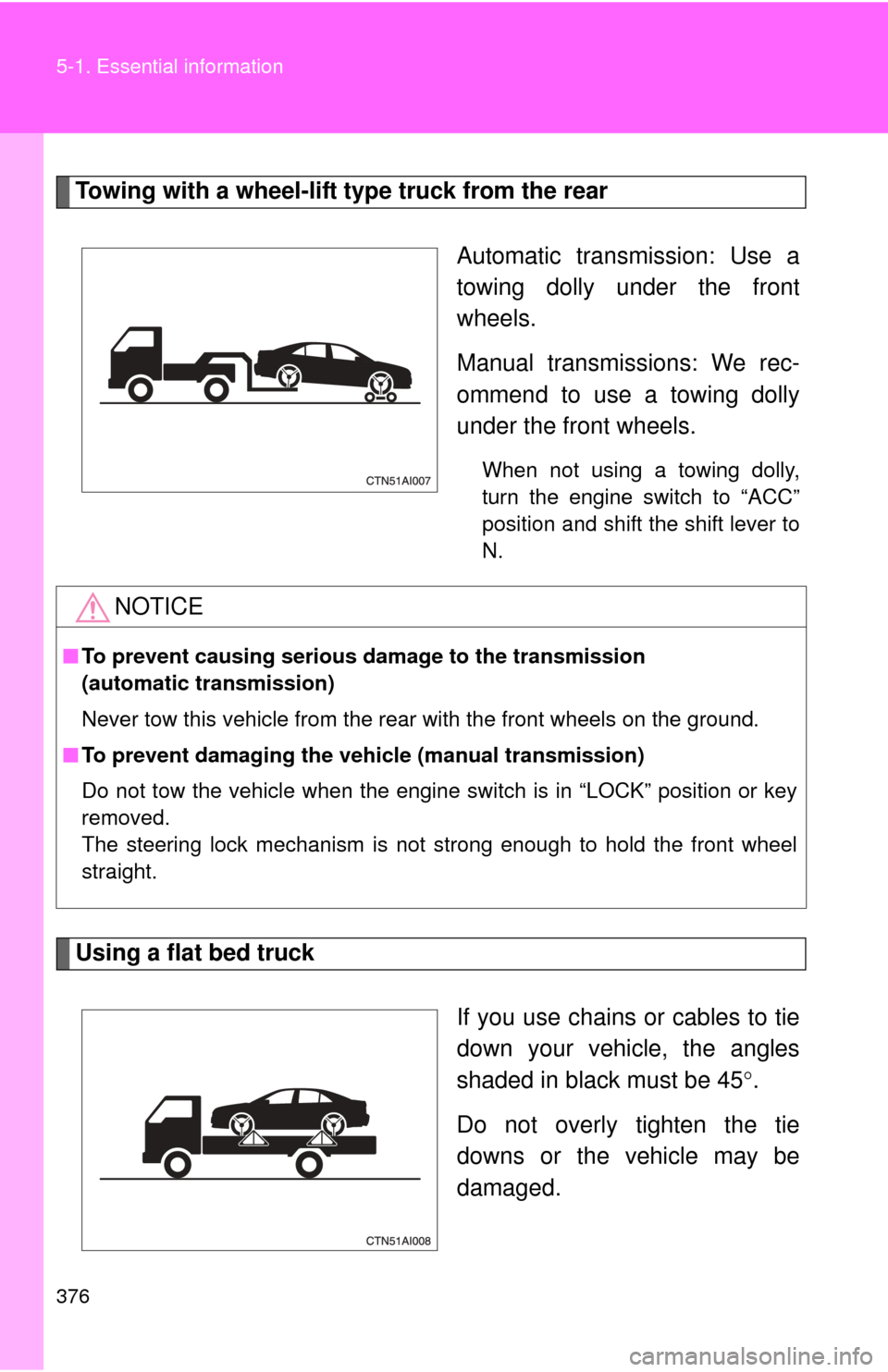
Towing with a wheel-lift type truck from the rearAutomatic transmission: Use a
towing dolly under the front
wheels.
Manual transmissions: We rec-
ommend to use a towing dolly
under the front wheels.
When not using a towing dolly,
turn the engine switch to “ACC”
position and shift the shift lever to
N.
Using a flat bed truckIf you use chains or cables to tie
down your vehicle, the angles
shaded in black must be 45.
Do not overly tighten the tie
downs or the vehicle may be
damaged.
NOTICE
■ To prevent causing serious dama ge to the transmission
(automatic transmission)
Never tow this vehicle from the rear with the front wheels on the ground.
■ To prevent damaging the vehicle (manual transmission)
Do not tow the vehicle when the engine switch is in “LOCK” position or key
removed.
The steering lock mechanism is not strong enough to hold the front wheel
straight.
Page 382 of 476

382 5-2. Steps to take in an emergency
Stop the vehicle immediately.The following warning indicates the possibility of damage to the vehi-
cle that may lead to an accident. Immediately stop the vehicle in a
safe place and contact your Toyota dealer.
Have the vehicle inspected immediately.Failing to investigate the cause of the following warnings may lead to
the system operating abnormally and possibly cause an accident.
Have the vehicle inspected by your Toyota dealer immediately.
Warning lightWarning light/Details
Charging system warning light Indicates a malfunction in the vehicle’s charging system.
Low engine oil pressure warn ing light (vehicles without
multi-information display) Indicates that the engine oil pressure is too low.
Warning lightWarning light/Details
(U.S.A.)
(Canada) Malfunction indicator lamp
Indicates a malfunction in:
• The electronic engine control system;
• The electronic throttle control system; or
• The electronic automatic transmission control system.
SRS warning light
Indicates a malfunction in:
• The SRS airbag system;
• The front passenger occupant classification system; or
• The seat belt pretensioner system.
Page 400 of 476
400
5-2. Steps to take in an emergency
If you have a flat tire
Remove the flat tire and replace it with the spare provided.
■Before jacking up the vehicle
●Stop the vehicle on a hard, flat surface.
● Set the parking brake.
● Shift the shift lever to P (automatic transmission) or R (manual
transmission).
● Stop the engine.
● Turn on the emergency flashers.
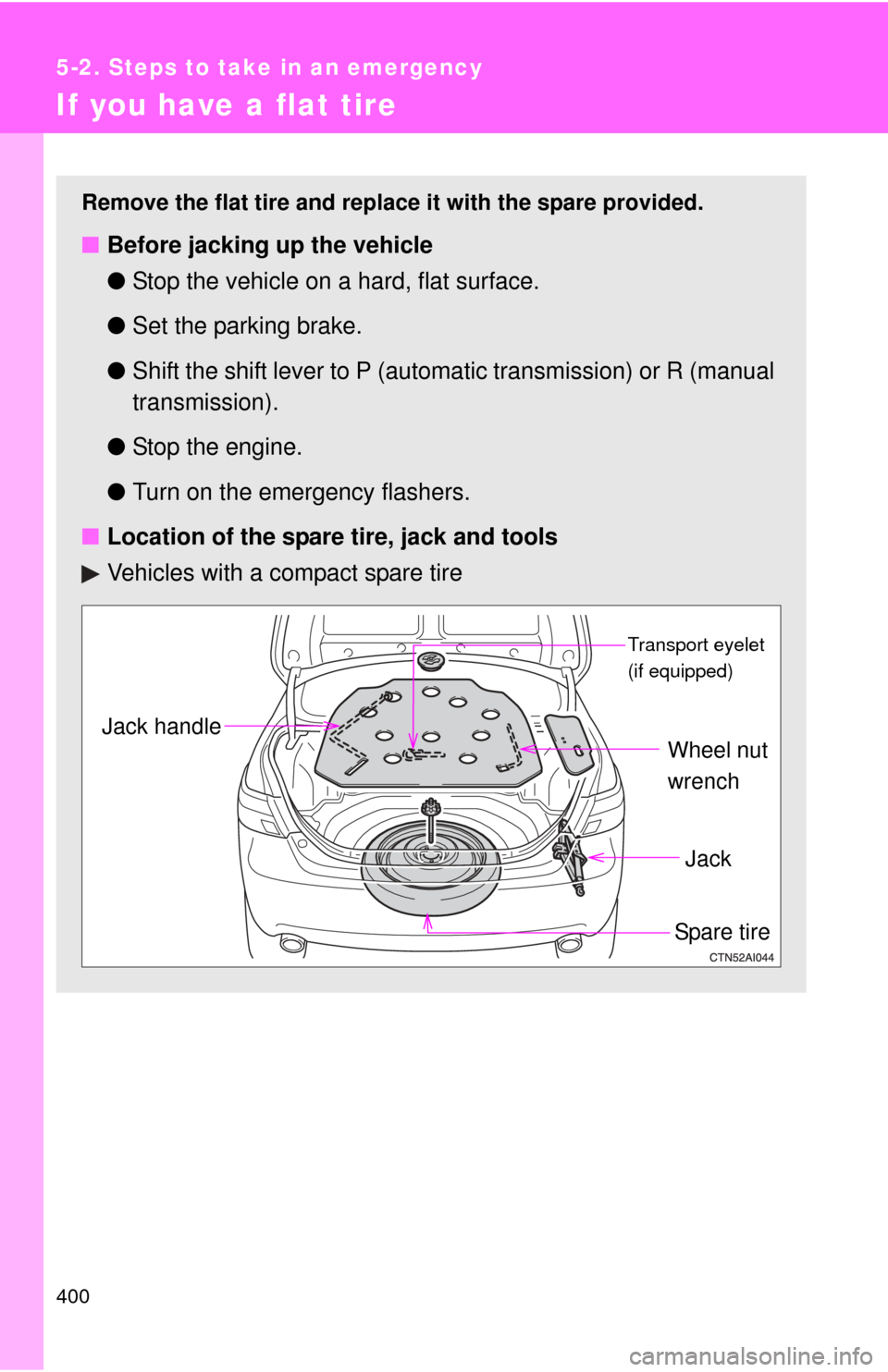
■ Location of the spare tire, jack and tools
Vehicles with a compact spare tire
Transport eyelet
(if equipped)
Spare tireJack
Wheel nut
wrench
Jack handle
Page 413 of 476
5
When trouble arises
413
5-2. Steps to take in an emergency
If the shift lever cannot be shifted from P (automatic transmission)
If the shift lever cannot be shifted with your foot on the brake, there
may be a problem with the shift lock system (a system to prevent
accidental operation of the shift lever). Have the vehicle inspected by
your Toyota dealer.
The following steps may be used as an emergency measure to
ensure that the shift lever can be shifted.
Set the parking brake.
Vehicles with smart key system: Turn the “ENGINE START
STOP” switch to the ACCESSORY mode.
Vehicles without smart key system: Turn the engine switch
to the “ACC” position.
Depress the brake pedal.
Pry the cover up with a flat-
head screwdriver or equiva-
lent.
Press the shift lock override
button.
The shift lever can be shifted
while the button is pressed.
STEP1
STEP2
STEP3
STEP4
STEP5
Page 424 of 476
424
5-2. Steps to take in an emergency
If the vehicle becomes stuck
■Emergency hooks (if equipped)
Carry out the following procedures if the tires spin or the vehicle
becomes stuck in mud, dirt, or snow.
Stop the engine. Set the parking brake and put the shift
lever in P (automatic transmission) or N (manual transmis-
sion).
Remove the mud, snow, or sand from around the stuck tire.
Place wood, stones or some other material to help provide
traction under the tires.
Restart the engine.
Shift the shift lever to the D or R position (automatic trans-
mission) or 1 or R position (manual transmission) and care-
fully apply the accelerator to free the vehicle.STEP1
STEP2
STEP3
STEP4
STEP5
When your vehicle becomes stuck and
cannot move, the emergency hooks are
used for another vehicle to pull your vehi-
cle out in an emergency.
Your vehicle is not designed to tow
another vehicle.
Page 425 of 476
5
When trouble arises
425
5-2. Steps to take in an emergency
CAUTION
■
When attempting to free a stuck vehicle
If you choose to rock the vehicle back and forth to free it, make sure the sur-
rounding area is clear, to avoid striking other vehicles, objects or persons.
The vehicle may also lunge forward or lunge back suddenly as it becomes
free. Use extreme caution.
■ When shifting the shift lever
For vehicles with an automatic transmission, be careful not to shift the shift
lever with the accelerator pedal depressed.
This may lead to unexpected rapid acceleration of the vehicle that may
cause an accident and result in death or serious injury.
NOTICE
■To avoid damaging the transmission and other components
●Avoid spinning the wheels and do not rev the engine.
● If the vehicle remains stuck after trying these procedures, the vehicle may
require towing to be freed.
Page 435 of 476
435
6-1. Specifications
6
Vehicle specifications
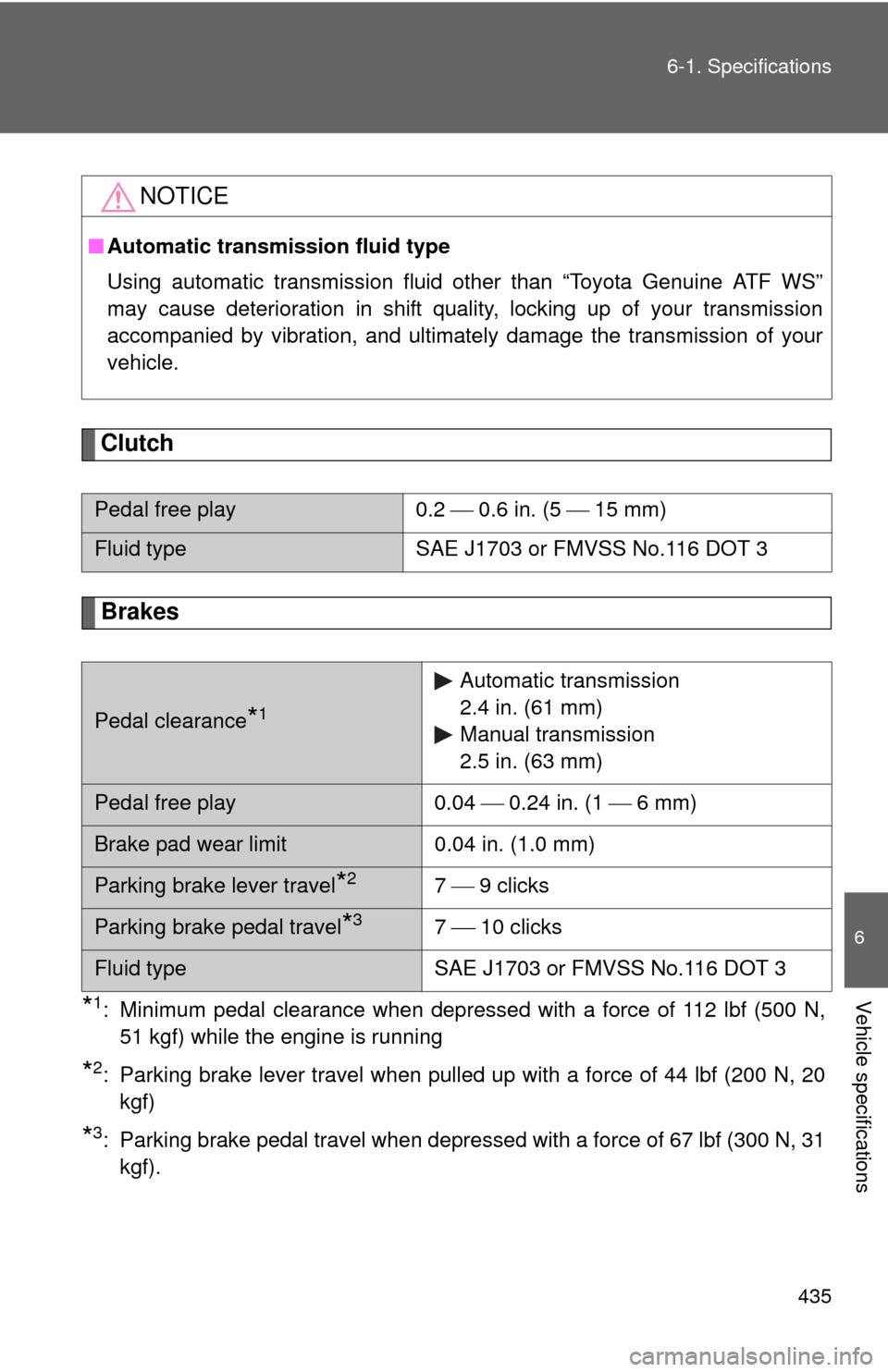
Clutch
Brakes
*1: Minimum pedal clearance when depressed with a force of 112 lbf (500 N,
51 kgf) while the engine is running
*2: Parking brake lever travel when pulled up with a force of 44 lbf (200 N, 20kgf)
*3: Parking brake pedal travel when depress ed with a force of 67 lbf (300 N, 31
kgf).
NOTICE
■ Automatic transmission fluid type
Using automatic transmission fluid other than “Toyota Genuine ATF WS”
may cause deterioration in shift quality, locking up of your transmission
accompanied by vibration, and ultimately damage the transmission of your
vehicle.
Pedal free play 0.2 0.6 in. (5 15 mm)
Fluid type SAE J1703 or FMVSS No.116 DOT 3
Pedal clearance*1
Automatic transmission
2.4 in. (61 mm)
Manual transmission
2.5 in. (63 mm)
Pedal free play 0.04 0.24 in. (1 6 mm)
Brake pad wear limit 0.04 in. (1.0 mm)
Parking brake lever travel*27 9 clicks
Parking brake pedal travel*37 10 clicks
Fluid type SAE J1703 or FMVSS No.116 DOT 3
Page 436 of 476
436 6-1. Specifications
Steering
Tires and wheels3.5 L V6 (2GR-FE) engine with 16-inch tires
Free play Less than 1.2 in. (30 mm)
Power steering fluid type Automatic transmission fluid DEXRON® II
or III
Tire size P215/60R16 94V,
T155/70D17 110M
Tire inflation pressure
(Recommended cold tire
inflation pressure)Driving under normal conditions
Front: 30 psi (210 kPa, 2.1 kgf/cm
2 or
bar)*
Rear: 30 psi (210 kPa, 2.1 kgf/cm
2 or
bar)*
Spare: Full-size spare tire
30 psi (210 kPa, 2.1 kgf/cm or bar)
Compact spare tire
60 psi (420 kPa, 4.2 kgf/cm or bar)
*: When driving at high speeds above 100 mph (160 km/h), in countries
where such speeds are permitted by
law, add 5 psi (30 kPa, 0.3 kgf/cm
2 or
bar) to the front tires and rear tires.
Never exceed the maximum cold tire
inflation pressure indicated on the tire
sidewall.
Wheel size 16
6 1/2 J or 16 6 1/2 JJ,
17 4 T (compact spare)
Wheel nut torque 76 ft•lbf (103 N•m, 10.5 kgf•m)