Page 454 of 496
442�
If you cannot adjust the tire
pressure when the tires are
cold, add 20 to 30 kPa more to
the front tires and rear tires than
the cold tire pressure, but never
exceed the maximum cold tire
pressure molded on the tire side-
wall.
� Always use a tire pressure
gauge. The appearance of a tire
can be misleading. Besides, tire
inflation pressures that are even
just a few pounds off can degrade
ride and handling.
� Do not bleed or reduce tire
inflation pressure after driving.
It is normal for the tire inflation
pressure to be higher after driving.
� Never exceed the vehicle capac-
ity weight. Passenger and lug-
gage weight should be located so
that the vehicle is balanced.
CY72019
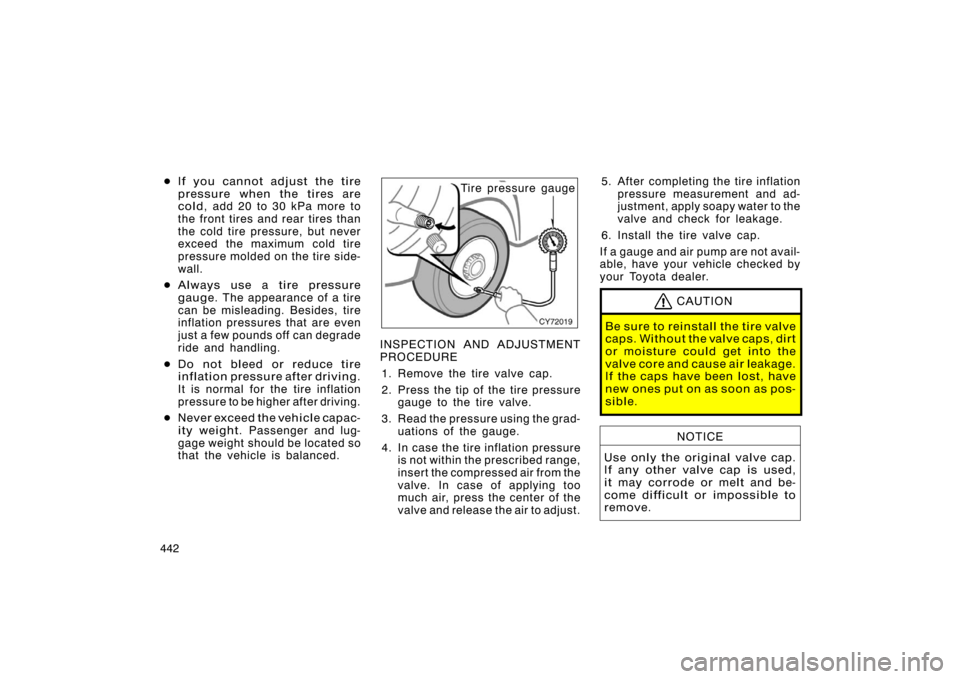
Tire pressure gauge
INSPECTION AND ADJUSTMENT
PROCEDURE
1. Remove the tire valve cap.
2. Press the tip of the tire pressure gauge to the tire valve.
3. Read the pressure using the grad- uations of the gauge.
4. In case the tire inflation pressure
is not within the prescribed range,
insert the compressed air from the
valve. In case of applying too
much air, press the center of the
valve and release the air to adjust. 5. After completing the tire inflation
pressure measurement and ad-
justment, apply soapy water to the
valve and check for leakage.
6. Install the tire valve cap.
If a gauge and air pump are not avail-
able, have your vehicle checked by
your Toyota dealer.
CAUTION
Be sure to reinstall the tire valve
caps. Without the valve caps, dirt
or moisture could get into the
valve core and cause air leakage.
If the caps have been lost, have
new ones put on as soon as pos-
sible.
NOTICE
Use only the original valve cap.
If any other valve cap is used,
it may corrode or melt and be-
come difficult or impossible to
remove.
Page 456 of 496

444 The tires on your Toyota have built−in
treadwear indicators to help you know
when the tires need replacement.
When the tread depth wears to 1.6
mm (0.06 in.) or less, the indicators
will appear. If you can see the indica-
tors in two or more adjacent grooves,
the tire should be replaced. The lower
the tread, the higher the risk of skid-
ding.
The effectiveness of snow tires is
lost if the tread wears down below
4 mm (0.16 in.).
If you have tire damage such as
cuts, splits, cracks deep enough to
expose the fabric, or bulges indi-
cating internal damage, the tire
should be replaced.
If a tire often goes flat or cannot be
properly repaired due to the size or
location of a cut or other damage, it
should be replaced. If you are not
sure, consult with your Toyota dealer.If air loss occurs while driving, do not
continue driving. Driving even a short
distance can damage a tire beyond
repair.
Any tires which are over 6 years
old must be checked by a qualified
technician even if damage is not
obvious.
Tires deteriorate with age even if they
have never or seldom been used.
This applies also to the spare tire and
tires stored for future use.
REPLACING YOUR TIRES
W h en rep l aci n g a ti re, use a ti re of
the same size and construction,
and the same or greater maximum
load as the originally installed
tires. Also, on four−wheel drive
models, all the tires must be the
same brand and have the same
tread patterns.
Using any other size or type of tire
may seriously affect handling, ride,
speedometer/odometer calibration,
ground clearance, and clearance be-
tween the body and tires or snow
chains.
Check that the maximum load of the
replaced tire is greater than 1/2 of the
Gross Axle Weight Ratings (GAWR)
of either the front axle or the rear
axle, whichever is greater. As for the
maximum load of the tire, see the load
limit at maximum cold tire inflation
pressure mentioned on the sidewall
of the tire, and as
for the Gross Axle
Weight Ratings (GAWR), see the Cer-
tification Label.
Page 460 of 496
448
WHEN TO REPLACE YOUR WHEELS
If you have wheel damage such as
bending, cracks or heavy corrosion, the
wheel should be replaced.
If you fail to replace a damaged wheel,
the tire may slip off the wheel or cause
loss of handling control.
WHEEL SELECTION
When replacing wheels, care should be
taken to ensure that the wheels are re-
placed by ones with the same load ca-
pacity, diameter, rim width, and offset.
Correct replacement wheels are available
at your Toyota dealer.
A wheel of a different size or type may
adversely affect handling, wheel and bear-
ing life, brake cooling, speedometer/odom-
eter calibration, stopping ability, headlight
aim, bumper height, vehicle ground clear-
ance, and tire or snow chain clearance to
the body and chassis. Replacement with used wheels is not rec-
ommended as they may have been sub-
jected to rough treatment or high mileage
and could fail without warning. Also, bent
wheels which have been straightened may
have structural damage and therefore
should not be used. Never use an inner
tube in a leaking wheel which is designed
for a tubeless tire.
CAUTION
Observe the following instructions.
Otherwise, an accident may occur re-
sulting in death or serious injuries.
�Do not use wheels other than the
manufacturer ’s recommended size,
as this may cause dangerous han-
dling characteristics resulting in
loss of control.
�Four−wheel drive models:
Do not use wheels of different
brands, sizes and types, as this
may cause dangerous handling
characteristics resulting in loss of
control.
�When installing aluminum w
heels,
check that the wheel nuts are tight
after driving your vehicle the first 1600
km (1000 miles).
�If you have rotated, repaired or
changed your tires, check that the
wheel nuts are still tight after driving
1600 km (1000 miles).
�When using tire chains, be careful not
to damage the aluminum wheels.
�Use only Toyota wheel nuts and
wrench designed for your aluminum
wheels.
�When balancing your wheels, use only
Toyota balance weights or equivalent
and a plastic or rubber hammer.
�As with any wheel, periodically check
your aluminum wheels for damage. If
damaged, replace immediately.
Aluminum wheel precautions
Page 473 of 496
461
SPECIFICATIONS
Dimensions and weights462
. . . . . . . . . . . . . . . . . . . . . . . . . . . . . . . . . . . .
Engine 463
. . . . . . . . . . . . . . . . . . . . . . . . . . . . . . . . . . . . \
. . . . . . . . . . . . . . . .
Fuel 463
. . . . . . . . . . . . . . . . . . . . . . . . . . . . . . . . . . . . \
. . . . . . . . . . . . . . . . . . .
Service specifications 463
. . . . . . . . . . . . . . . . . . . . . . . . . . . . . . . . . . . . \
. . .
Tires 467
. . . . . . . . . . . . . . . . . . . . . . . . . . . . . . . . . . . . \
. . . . . . . . . . . . . . . . . .
Fuses 468
. . . . . . . . . . . . . . . . . . . . . . . . . . . . . . . . . . . . \
. . . . . . . . . . . . . . . . .
SECTION 8
Page 474 of 496
462
Towing capacity (trailer weight + cargo
weight), kg (lb.):For weight carrying hitch 2268�(5000)
Also for weight distributing hitch
(4.7 L V8 [2UZ−FE] engine only)Two−wheel drive models 3311�(7300)
Four−wheel drive models
3175�(7000)
Dimensions and weights
Overall width mm (in.)
2790�(109.8)
Overall height
∗
1mm (in.)
1575��(62.0)
Wheelbase mm (in.)
Front tread mm (in.) 1575��(62.0)
Rear tread mm (in.)
�431���(950)
∗7
�477��(1050)∗8
∗1: Unladen vehicle∗2: Two−wheel drive models∗3: Four−wheel drive models∗4: With roof rails∗5: With rear spoiler∗6: With rear height control air suspension∗7: With 5 occupants∗8: With 7 occupantsOverall length mm (in.)
Vehicle capacity weight (occupants + luggage)
kg (lb.)4805�(189.2)
1910��(75.2)
1820��(71.7)
∗
2�or�3,�4
1800��(70.9)∗2,�3,�5
1755��(69.1)∗2,�3
1805��(71.1)∗2�or�3,�4,�6
1785��(70.3)∗2�or�3,�5,�6
1740��(68.5)∗2�or�3,�6
��91���(200)∗7
���0�����(0)∗8Luggage compartment load capacity kg (lb.)