2008 TESLA ROADSTER maintenance
[x] Cancel search: maintenancePage 75 of 115

Cleaning and vehicle care
9-7
Maintenance and care
Cleaning and vehicle careEnvironmental precautions
Some cleaning products contain
chemicals that are hazardous to the
environment. Always take precautions
to prevent fluids from spilling.
It is illegal to pollute drains, rivers and
waterways. Used toxic chemicals must be
disposed of at authorized waste disposal
sites only.
Cleaning the vehicle exteriorHand washing
Caution: Substances that are corrosive,
such as bird droppings, tree resin, dead
insects, tar spots, road salt and industrial
fall-out can damage the vehicle's paint.
Remove such deposits as soon as possible to
prevent damage. To preserve the paint finish, observe the
following:
• Before washing, use a hose to remove
heavy deposits of mud and dirt.
• Never wash a vehicle that is “hot to the
touch” or during exposure to strong,
direct sunlight.
• Wash the body using cold or lukewarm
water containing a good quality wash and
wax shampoo.
• Never use strong household detergents
or soap. These products can discolor and
spot painted surfaces.
• For best results, always use a clean
sponge or car wash mitt with plenty of
water.
• After washing, rinse with clean water and
thoroughly wipe dry with a chamois. Do
not allow cleaning agents to dry on the
finish.
Automatic car washers and pressure
washers
Caution: Tesla Motors recommends that
you hand wash your vehicle.
Do not use an automatic car washer or
pressure washer as these may damage your
vehicle’s paint finish, soft top, or other
components. The use of a pressure washer to
clean components in the Battery
compartment may damage critical seals on
the Battery and other electrical components.
Note: Vehicle or paint damage caused by
using an automatic car washer or pressure
washer is not covered under the New Vehicle
Limited Warranty.
Underbody maintenanceIf salt has been used on the highways (such as
during winter months), thoroughly remove all
traces of road salt. Use a hose to rinse salt
from the underside of the vehicle.
Flush away accumulations of mud in areas
where debris easily collects (such as wheel
arches and panel seams).Removing tar spotsUse denatured alcohol to remove tar spots
and stubborn grease stains from paint. After
cleaning, immediately wash the area with
soapy water to remove the alcohol.Washing the soft-top
Caution: Scrubbing or brushing with a
hard bristle brush will damage the
fibers of the fabric, causing fabric
deterioration and impairing its cosmetic
appearance.
When washing the soft-top, follow these
guidelines:
1. Before washing, vacuum the soft-top using a soft brush attachment to remove
dust and dirt.
2. Soften encrusted dirt using soap and water, then rinse with clean water.
3. Wash using mild soap and water. Never use solvent, petroleum or chemical-based
cleaners, detergents, or wash/wax
compounds.
TR0159
Roadster OHB.book Page 7 Th ursday, October 2, 2008 8:59 AM
Page 76 of 115
Cleaning and vehicle care9-8
Maintenance and care
WheelsWash wheels with warm, fresh water
containing a good quality wash and wax
shampoo. Thoroughly rinse the wheels to
remove any soap residue.Windshield, windows and mirrorsRegularly clean all windows inside and out
using a window cleaning solution. An
automotive glass cleaner is recommended.
After washing the vehicle with wash/wax
products, clean the outside of the windshield
with glass cleaner.
Mirror glass is particularly susceptible to
damage. Do not use abrasive cleaning
compounds.Wiper bladesClean wiper blades using mild soap and warm
water only. Do not use petroleum or
alcohol-based cleaners.
Polishing the bodyTo preserve the cosmetic appearance of the
body, occasionally apply a good quality
polish. A good polish should contain a very
mild abrasive that removes surface
contamination without damaging the
surface, a mild filling compound to reduce the
appearance of scratches, and wax to provide
a barrier between the cleaned body surface
and airborne contaminants.
Do not use cutting paste, color restoration
compounds, or polishes containing a harsh
abrasive. These can scour the surface and
permanently degrade the body.Using a car coverTo preserve the cosmetic appearance of the
body, you may want to use a car cover. Only
an approved Tesla Motors car cover should be
used. DONOT use the car cover when
charging the vehicle. Doing so can interfere
with adequate cooling during charging.Paint damage and rectificationTreat chips and scratches to the paint using a
paint touch-up pen. Use the touch-up pen
after washing but before polishing or waxing.
More extensive repairs to the body should
only be carried out by a facility approved by
Tesla Motors. Contact Tesla Motors for a list of
approved body repair facilities.
Cleaning the vehicle interiorPlastic materials
Caution: Do not polish the upper
surfaces of the dashboard. Polished
surfaces are reflective and may interfere with
the driver's view.
Clean with diluted upholstery cleaner, then
wipe with a damp cloth.
Carpet and fabricsClean with diluted upholstery cleaner. Test a
concealed area first.LeatherClean with warm water and a non-detergent
soap. Dry and polish with a dry, clean,
lint-free cloth.Seat beltsExtend the belts and clean with warm, soapy,
fresh water only. Do not use any type of
detergent or chemical cleaning agent. Allow
the belts to dry naturally while extended,
preferably away from direct sunlight.Instruments and display screensClean the instrument panel, Touch Screen,
and audio system screen using a damp cloth.
Do not use cleaning co mpounds or solutions.
Roadster OHB.book Page 8 Th ursday, October 2, 2008 8:59 AM
Page 99 of 115
Wheels and tires
11-9
Technical specifications
pressure telltale illuminates, you should stop
and check your tires as soon as possible, and
inflate them to the proper pressure.
Driving on a significantly under-inflated tire
causes the tire to overheat and can lead to
tire failure. Under-inflation also reduces
Battery range and tire tread life, and may
affect the vehicle’s handling and stopping
ability.
The TPMS is not a substitute for proper tire
maintenance, and it is the driver’s
responsibility to maintain correct tire
pressure, even if under-inflation has not
reached a level to trigger illumination of the
TPMS tire pressure telltale.Checking tire pressures
WARNING: Tire pressures should be
checked using an accurate pressure
gauge when cold. Under-inflation is the most
common cause of tire failures and may result
in severe tire cracking, tread separation or
“blowout”, with unexpected loss of vehicle
control and increased risk of injury.
S
Check the pressures when the tires are cold.
Be aware that it only takes 1 mile (1.5 km) of
driving to warm up the tires sufficiently to
affect the tire pressures. If it is necessary to
check the tires when they are warm, you
should expect the pressures to have
increased. Do not let air out of warm tires in
an attempt to match the recommended cold
tire pressures.
Note: When adjusting tire pressures, you can
display tire pressure values on the Touch
Screen’s tire pressure screen. However, the values displayed by the Touch Screen will not
be updated until you place the car in drive
long enough for the tire pressure monitoring
sensors to take new readings. For details,
refer to the Touch Screen Users Manual
provided in your owners package.
Always inflate your tires to the Tesla Motors
recommended inflation pressure even if it is
different from the maximum inflation
pressure information found on the tire itself.
For the correct tire pressures, refer to
Specifications and tire pressures, page 11-4
.
The following procedure should be used to
check and adjust tire pressures: 1. Remove the cap from the valve, then firmly press the tire gauge onto the valve
and measure the pressure.
2. If required add air to reach the required pressure.
3. Check the pressure by removing the tire gauge and then re-attaching it.
Note: Failure to remove and re-attach the
gauge to the valve could cause the gauge
to show an incorrect reading.
4. If too much air is added, air can be released by pushing on the metal stem in
the center of the valve.
5. Recheck the pressure with the tire gauge and adjust if necessary.
6. Refit the valve cap.
Va l ve sFit the valve caps securely to prevent dirt
from entering the valve. Periodically check
the valve for damage and leaks.
Tire wear
WARNING: The tires should be
regularly checked for wear and to make
sure that there are no cuts, bulges or
exposure of the ply/cord structure. Do not
drive with tires which are worn or damaged.
The safety of the vehicle and occupants will
be adversely affected.p
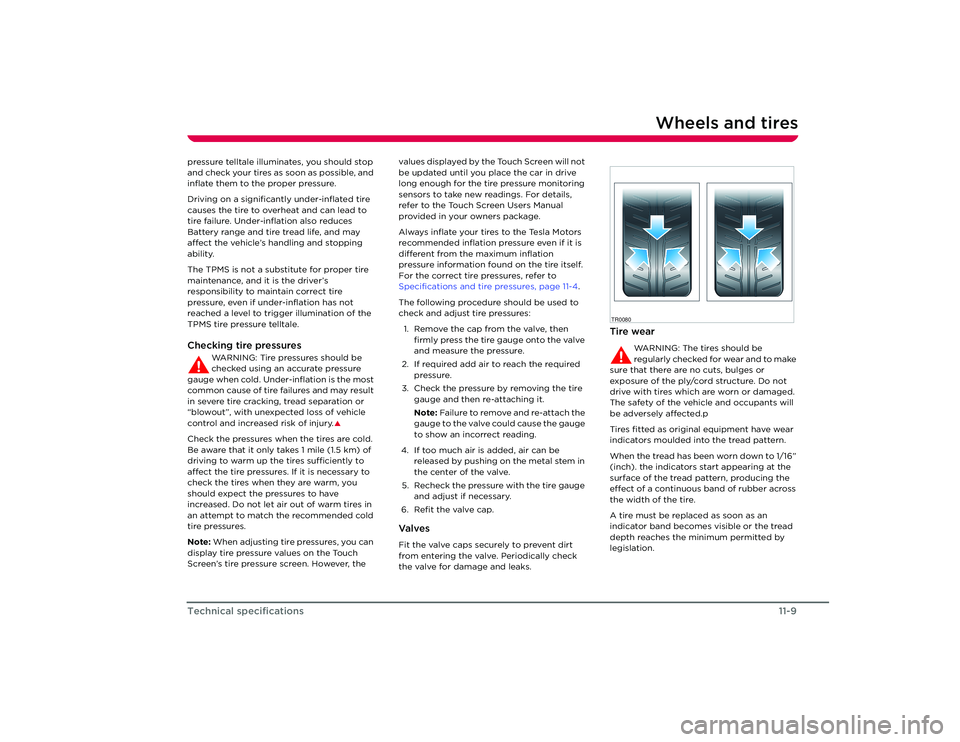
Tires fitted as original equipment have wear
indicators moulded into the tread pattern.
When the tread has been worn down to 1/16”
(inch). the indicators start appearing at the
surface of the tread pattern, producing the
effect of a continuous band of rubber across
the width of the tire.
A tire must be replaced as soon as an
indicator band becomes visible or the tread
depth reaches the minimum permitted by
legislation.
TR0080
Roadster OHB.book Page 9 Th ursday, October 2, 2008 8:59 AM
Page 112 of 115

Index
Locking your vehicle ........................................ 4-2
Low tire pressure indicator light ................ 6-12
Lumbar support...................................................3-2MMaintenanceBrake fluid ..................................................... 9-4
Cleaning the exterior ................................ 9-7
Cleaning the interior ................................. 9-8
Daily checks.................................................. 9-2
Fluids ............................................................... 9-4
Owner maintenance .................................. 9-2
Paint repair ................................................... 9-8
Removing tar ............................................... 9-7
Routine maintenance ................................ 9-2
Service internal indicator ........................ 9-2
Underbody .................................................... 9-7
Washer fluid ................................................. 9-5
Washer jets ................................................... 9-6
Weekly checks............................................. 9-2
Windshield wiper........................................ 9-6
Master door locking switch............................ 4-4
Mileage................................................................... 6-3
Mirrors .....................................................................7-3
Modifying your vehicle ......................................1-2
Motor specifications ........................................11-17NNavigation system.............................................. 8-1
NHTSA .................................................................... 1-4OOdometer display ............................................. 6-12
Opening the doors Inside the vehicle........................................ 4-4
Outside the vehicle .................................... 4-4
Ownership change ..............................................1-2
PPaint code ............................................................. 11-2
Paint damage....................................................... 9-8
Parking brake ...................................................... 6-5
Passenger airbag deactivation ..................... 3-7
Performance charge setting .......................... 5-4
PIN code ................................................................ 4-8
PIN lock ................................................................ 4-10
Polishing the bodywork................................... 9-8
Power socket ....................................................... 7-7
Power windows .................................................. 7-2
Pressure washers ............................................... 9-7
Programming the key fob .............................. 4-3
Proposition 65 ...................................................... 1-2RRaising the vehicle........................................... 10-11
Range charge setting ....................................... 5-4
Rear suspension specifications .................. 11-18
Rear view mirrors............................................... 7-3
Recovery eye ....................................................10-14
Regenerative braking ....................................... 6-5
Regenerative braking visual display ...........6-11
Removing the hard-top ..................................7-14
Replacement bulbs.......................................... 10-9
Reporting safety defects ................................. 1-4
Roof Hard-top........................................................ 7-13
Soft-top .......................................................... 7-11SSafety compliance certification label......... 11-3
Safety defects ...................................................... 1-4
Safety instructionsChild seats ............................................ 3-5, 3-7
Jacking the vehicle .................................. 10-11
Lifting the vehicle .................................... 10-12 Obstruction of airbags.............................. 3-7
Seat belts ....................................................... 3-3
Tire repair .................................................... 10-4
Wearing seat belts when pregnant ..... 3-4
Windows ........................................................ 7-2
Seat belts Care .................................................................. 3-4
Cleaning.......................................................... 9-8
General information ................................... 3-3
Pre-tensioners .............................................. 3-4
Reminder............................................. 3-4, 6-12
Safety instructions ..................................... 3-3
Testing ............................................................ 3-4
Wearing .......................................................... 3-3
Wearing when pregnant .......................... 3-4
Seat heater controls.......................................... 7-4
Seat heaters ......................................................... 7-6
Seats Adjustment.................................................... 3-2
Child seats and restraints ........................ 3-5
Lumbar support........................................... 3-2
Security .................................................................. 4-7
Security code .......................................................4-8
Service data recording...................................... 1-2
Soft top Installing ....................................................... 7-10
Removing .......................................................7-11
Specifications Antifreeze .................................................... 11-14
Battery .......................................................... 11-19
Brake fluid.................................................... 11-14
Brakes............................................................ 11-18
Coolant ......................................................... 11-14
Electrical....................................................... 11-19
Fluids ............................................................. 11-14
Front suspension ...................................... 11-18
Motor ............................................................. 11-17
Rear suspension ........................................ 11-18
Roadster OHB.book Page 3 Th ursday, October 2, 2008 8:59 AM