2008 SUBARU TRIBECA ignition
[x] Cancel search: ignitionPage 267 of 409
!To decrease the speed (by brake
pedal)
1. Depress the brake pedal to release
cruise control temporarily.
2. When the speed decreases to the
desired speed, press the control lever
downward in the “SET/COAST”direction
once. Now the desired speed is set and
the vehicle will keep running at that speed
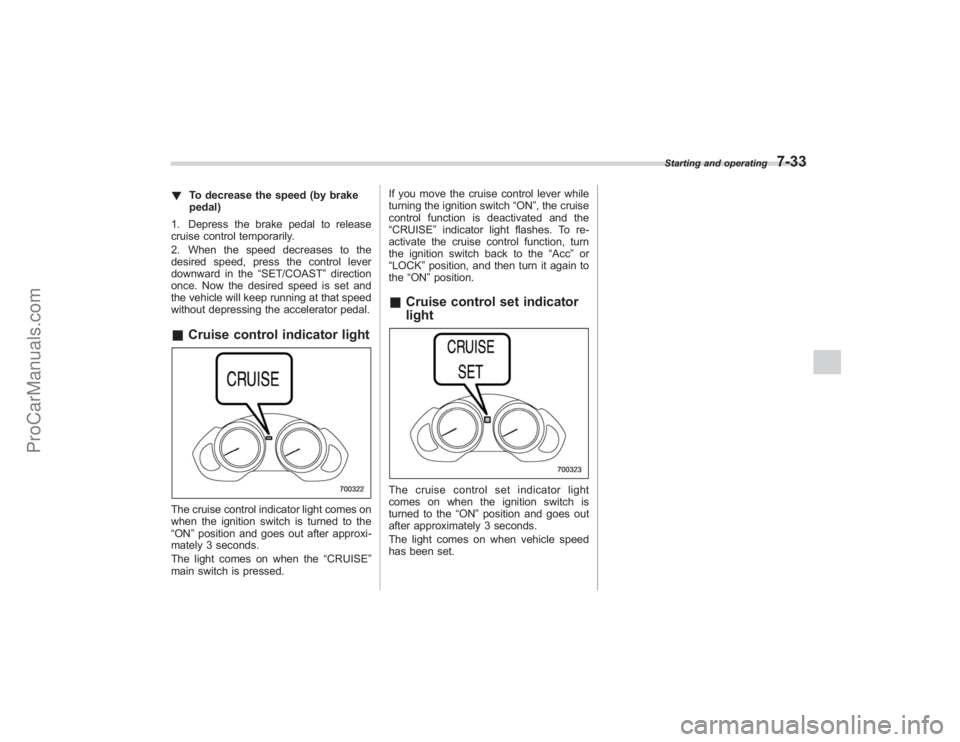
without depressing the accelerator pedal.& Cruise control indicator lightThe cruise control indicator light comes on
when the ignition switch is turned to the
“ON ”position and goes out after approxi-
mately 3 seconds.
The light comes on when the “CRUISE”
main switch is pressed. If you move the cruise control lever while
turning the ignition switch
“ON”, the cruise
control function is deactivated and the
“CRUISE” indicator light flashes. To re-
activate the cruise control function, turn
the ignition switch back to the “Acc”or
“LOCK” position, and then turn it again to
the “ON ”position.
& Cruise control set indicator
lightThe cruise control set indicator light
comes on when the ignition switch is
turned to the “ON”position and goes out
after approximately 3 seconds.
The light comes on when vehicle speed
has been set.
Starting and operating
7-33
ProCarManuals.com
Page 271 of 409
exhaust fumes are entering the
vehicle, have the problem
checked and corrected as soon
as possible. If you must drive
under these conditions, drive
only with all windows fully open.
. Keep the rear gate closed while
driving to prevent exhaust gas
from entering the vehicle.
NOTEDue to the expansion and contraction
of the metals used in the manufacture
of the exhaust system, you may hear a
crackling sound coming from the ex-
haust system for a short time after the
engine has been shut off. This sound is
normal.
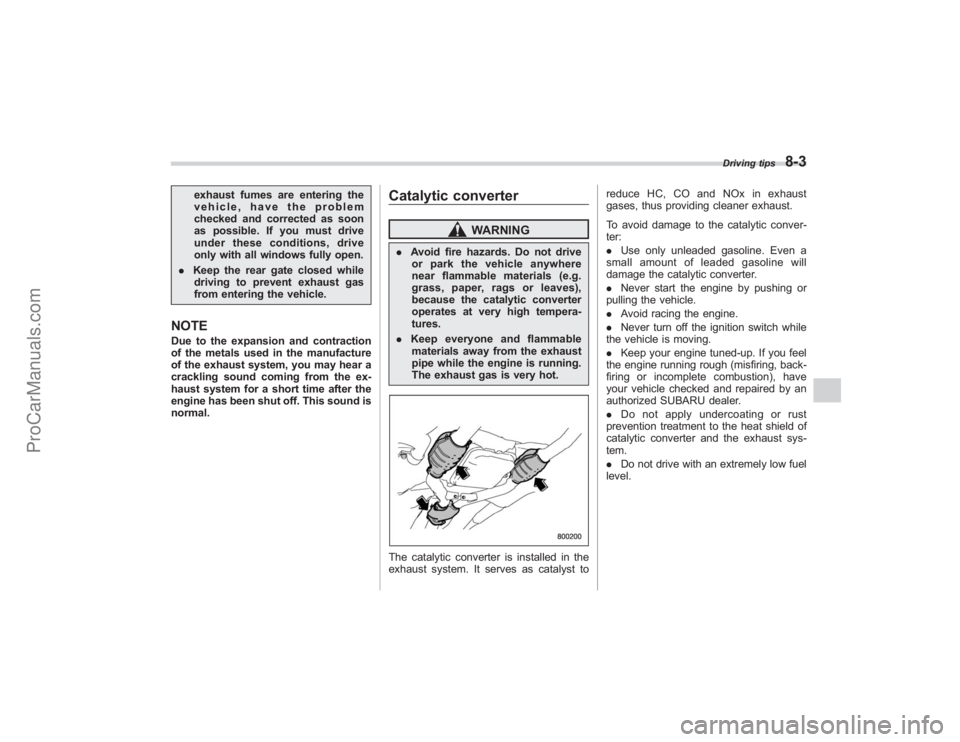
Catalytic converter
WARNING
. Avoid fire hazards. Do not drive
or park the vehicle anywhere
near flammable materials (e.g.
grass, paper, rags or leaves),
because the catalytic converter
operates at very high tempera-
tures.
. Keep everyone and flammable
materials away from the exhaust
pipe while the engine is running.
The exhaust gas is very hot.The catalytic converter is installed in the
exhaust system. It serves as catalyst to reduce HC, CO and NOx in exhaust
gases, thus providing cleaner exhaust.
To avoid damage to the catalytic conver-
ter:
.
Use only unleaded gasoline. Even a
small amount of leaded gasoline will
damage the catalytic converter.
. Never start the engine by pushing or
pulling the vehicle.
. Avoid racing the engine.
. Never turn off the ignition switch while
the vehicle is moving.
. Keep your engine tuned-up. If you feel
the engine running rough (misfiring, back-
firing or incomplete combustion), have
your vehicle checked and repaired by an
authorized SUBARU dealer.
. Do not apply undercoating or rust
prevention treatment to the heat shield of
catalytic converter and the exhaust sys-
tem.
. Do not drive with an extremely low fuel
level.
Driving tips
8-3
ProCarManuals.com
Page 298 of 409
9-2
In case of emergency
If you park your vehicle in an
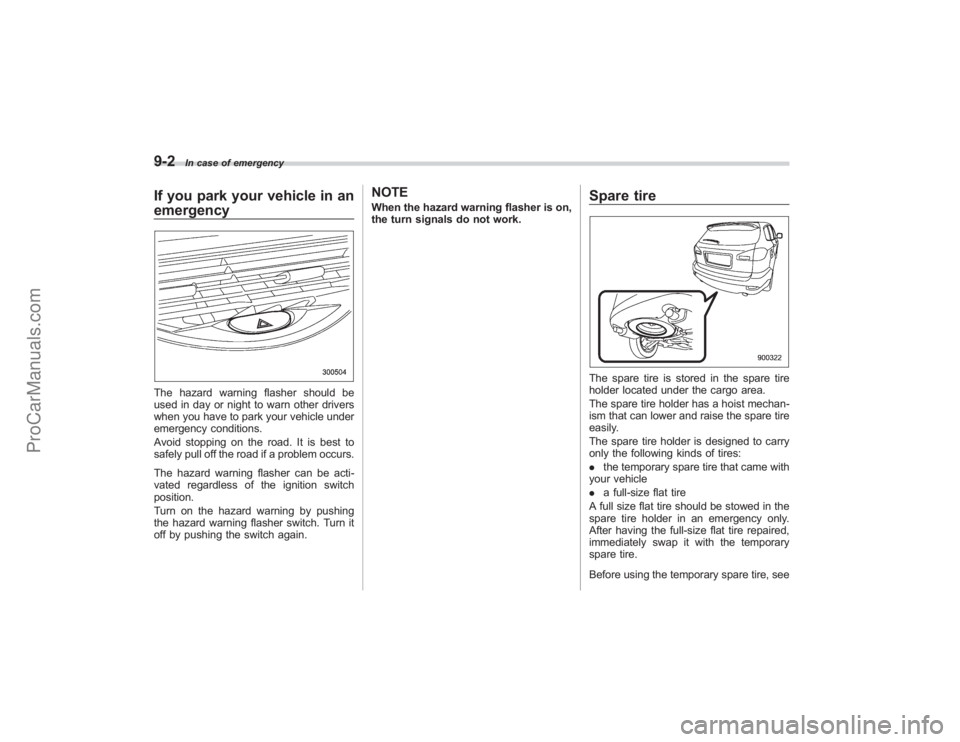
emergencyThe hazard warning flasher should be
used in day or night to warn other drivers
when you have to park your vehicle under
emergency conditions.
Avoid stopping on the road. It is best to
safely pull off the road if a problem occurs.
The hazard warning flasher can be acti-
vated regardless of the ignition switch
position.
Turn on the hazard warning by pushing
the hazard warning flasher switch. Turn it
off by pushing the switch again.
NOTEWhen the hazard warning flasher is on,
the turn signals do not work.
Spare tireThe spare tire is stored in the spare tire
holder located under the cargo area.
The spare tire holder has a hoist mechan-
ism that can lower and raise the spare tire
easily.
The spare tire holder is designed to carry
only the following kinds of tires:
.the temporary spare tire that came with
your vehicle
. a full-size flat tire
A full size flat tire should be stowed in the
spare tire holder in an emergency only.
After having the full-size flat tire repaired,
immediately swap it with the temporary
spare tire.
Before using the temporary spare tire, see
ProCarManuals.com
Page 314 of 409
9-18
In case of emergency
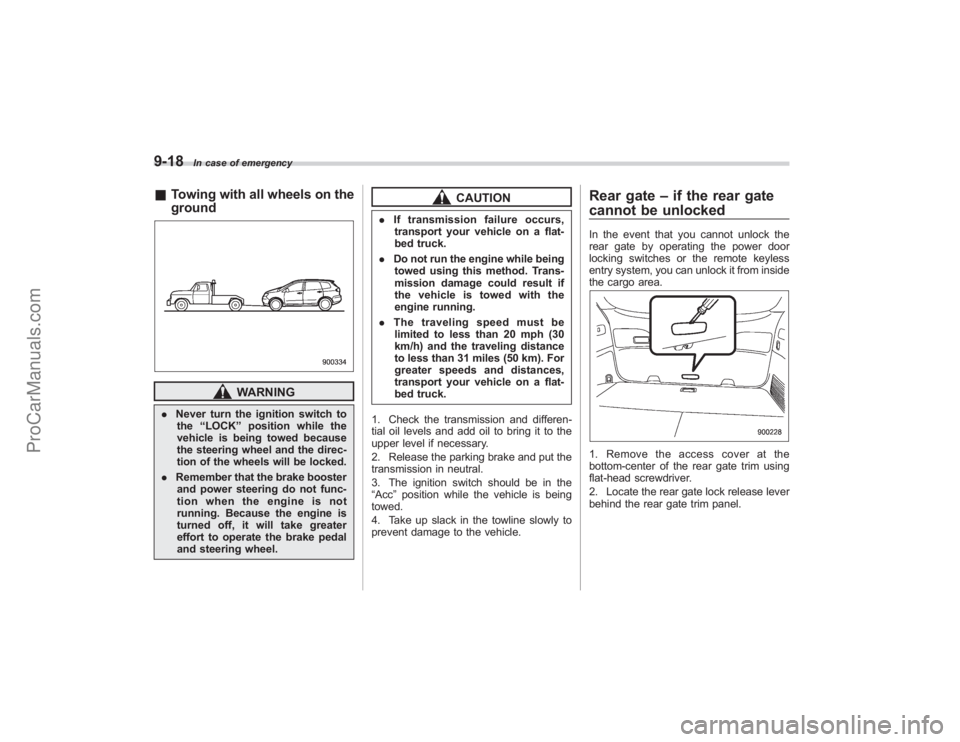
&Towing with all wheels on the
ground
WARNING
. Never turn the ignition switch to
the “LOCK ”position while the
vehicle is being towed because
the steering wheel and the direc-
tion of the wheels will be locked.
. Remember that the brake booster
and power steering do not func-
tion when the engine is not
running. Because the engine is
turned off, it will take greater
effort to operate the brake pedal
and steering wheel.
CAUTION
. If transmission failure occurs,
transport your vehicle on a flat-
bed truck.
. Do not run the engine while being
towed using this method. Trans-
mission damage could result if
the vehicle is towed with the
engine running.
. The traveling speed must be
limited to less than 20 mph (30
km/h) and the traveling distance
to less than 31 miles (50 km). For
greater speeds and distances,
transport your vehicle on a flat-
bed truck.
1. Check the transmission and differen-
tial oil levels and add oil to bring it to the
upper level if necessary.
2. Release the parking brake and put the
transmission in neutral.
3. The ignition switch should be in the
“Acc ”position while the vehicle is being
towed.
4. Take up slack in the towline slowly to
prevent damage to the vehicle.
Rear gate –if the rear gate
cannot be unlockedIn the event that you cannot unlock the
rear gate by operating the power door
locking switches or the remote keyless
entry system, you can unlock it from inside
the cargo area.1. Remove the access cover at the
bottom-center of the rear gate trim using
flat-head screwdriver.
2. Locate the rear gate lock release lever
behind the rear gate trim panel.
ProCarManuals.com
Page 326 of 409

11-4
Maintenance and service
guard against getting oil or fluids
in your eyes. If something does
get in your eyes, thoroughly
wash them out with clean water.
. Do not tamper with the wiring of
the SRS airbag system or seat-
belt pretensioner system, or at-
tempt to take its connectors
apart, as that may activate the
system or it can render it inop-
erative. The wiring and connec-
tors of these systems are yellow
for easy identification. NEVER
use a circuit tester for these
wiring.
If your SRS airbag or seatbelt
pretensioner needs service, con-
sult your nearest SUBARU deal-
er.
& Before checking or servicing
in the engine compartment
WARNING
. Always stop the engine and set
the parking brake firmly to pre-
vent the vehicle from moving.
. Always let the engine cool down.
Engine parts become very hot
when the engine is running and remain hot for some time after
the engine is stopped.
. Do not spill engine oil, engine
coolant, brake fluid or any other
fluid on hot engine components.
This may cause a fire.
. Always remove the key from the
ignition switch. When the ignition
switch is in the “ON ”position,
thecoolingfanmayoperate
suddenly even when the engine
is stopped.
& When you do checking or
servicing in the engine com-
partment while the engine is
running
WARNING
A running engine can be dangerous.
Keep your fingers, hands, clothing,
hair and tools away from the cooling
fan, belts and any other moving
engine parts. Removing rings,
watches and ties is advisable.
Engine hoodTo open the hood:
1. If the wiper blades are lifted off the
windshield, return them to their original
positions.
2. Pull the hood release knob under the
instrument panel.
ProCarManuals.com
Page 347 of 409
When a tire is replaced, adjustments are
necessary to ensure continued normal
operation of the tire pressure monitoring
system. As with wheel replacement, there-
fore, you should have the work performed
by a SUBARU dealer.
WARNING
If the low tire pressure warning light
does not come on briefly after the
ignition switch is turned ON or the
light illuminates steadily after blink-
ing for approximately one minute,
you should have your Tire Pressure
Monitoring System checked at a
SUBARU dealer as soon as possi-
ble.
If this light comes on while driving,
never brake suddenly and keep
driving straight ahead while gradu-
ally reducing speed. Then slowly
pull off the road to a safe place.
Otherwise an accident involving
serious vehicle damage and serious
personal injury could occur.
If this light still comes on while
driving after adjusting the tire pres-
sure, a tire may have significant
damage and a fast leak that causes
the tire to lose air rapidly. If you have
a flat tire, replace it with a spare tireas soon as possible.
When a spare tire is mounted or a
wheel rim is replaced without the
original pressure sensor/transmitter
being transferred, the low tire pres-
sure warning light will illuminate
steadily after blinking for approxi-
mately one minute. This indicates
the TPMS is unable to monitor all
four road wheels. Contact your
SUBARU dealer as soon as possible
for tire and sensor replacement and/
or system resetting. If the light
illuminates steadily after blinking
for approximately one minute,
promptly contact a SUBARU dealer
to have the system inspected.
&
Tire inspectionCheck on a daily basis that the tires are
free from serious damage, nails, and
stones. At the same time, check the tires
for abnormal wear.
Contact your SUBARU dealer immedi-
ately if you find any problem.NOTE. When the wheels and tires strike
curbs or are subjected to harsh treat-
ment as when the vehicle is driven on a
rough surface, they can suffer damage that cannot be seen with the naked eye.
This type of damage does not become
evident until time has passed. Try not
to drive over curbs, potholes or on
other rough surfaces. If doing so is
unavoidable, keep the vehicle
’s speed
down to a walking pace or less, and
approach the curbs as squarely as
possible. Also, make sure the tires are
not pressed against the curb when you
park the vehicle.
. If you feel unusual vibration while
driving or find it difficult to steer the
vehicle in a straight line, one of the
tires and/or wheels may be damaged.
Drive slowly to the nearest authorized
SUBARU dealer and have the vehicle
inspected.
& Tire pressures and wearMaintaining the correct tire pressures
helps to maximize the tires ’service lives
and is essential for good running perfor-
mance. Check and, if necessary, adjust
the pressure of each tire (including the
spare) at least once a month (for example,
during a fuel stop) and before any long
journey.
Maintenance and service
11-25
– CONTINUED –
ProCarManuals.com
Page 361 of 409

1) Good
2) BlownIf any lights, accessories or other electrical
controls do not operate, inspect the
corresponding fuse. If a fuse has blown,
replace it.
1. Turn the ignition switch to the“LOCK”
position and turn off all electrical acces-
sories.
2. Remove the cover.
3. Determine which fuse may be blown.
The back side of each fuse box cover and
the “Fuses and circuits ”section in chapter
12 in this manual show the circuit for each
fuse.
4. Pull out the fuse with the fuse puller.
5. Inspect the fuse. If it has blown,
replace it with a spare fuse of the same
rating.
6. If the same fuse blows again, this
indicates that its system has a problem.
Contact your SUBARU dealer for repairs.
Main fuseMain fuse boxThe main fuses are designed to melt
during an overload to prevent damage to
the wiring harness and electrical equip-
ment. Check the main fuses if any
electrical component fails to operate (ex-
cept the starter motor) and other fuses are
good. A melted main fuse must be
replaced. Use only replacements with the
same specified rating as the melted main
fuse. If a main fuse blows after it is
replaced, have the electrical system
checked by your nearest SUBARU dealer.
Maintenance and service
11-39
ProCarManuals.com
Page 401 of 409
High beam indicator light............................................ 3-20
High/low beam change (dimmer) .................................. 3-27
Horn ........................................................................\
. 3-42
Hose and connections .............................................. 11-11
I
Ignition switch ............................................................. 3-3
Light ...................................................................... 3-4
Illuminated entry ......................................................... 2-9
Illumination brightness control ...................................... 3-28
Immobilizer. ................................................................ 2-3
Indicator light .......................................................... 2-4
Immobilizer system Indicator light ......................................................... 3-19
Indicator light Cruise control ........................................................ 3-20
Cruise control set ................................................... 3-21
Front fog ............................................................... 3-21
Headlight .............................................................. 3-21
High beam ............................................................ 3-20
Security ................................................................ 3-19
Selector lever/Gear position .................................... 3-20
SPORT mode ........................................................ 3-20
Traction Control system OFF ................................... 3-18
Turn signal ............................................................ 3-20
Vehicle Dynamics Control operation ......................... 3-18
Indicator lights Vehicle Dynamics Control ............................... 7-25, 7-25
Inside mirror .............................................................. 3-38
Interior light ................................................................ 6-2 J
Jack and jack handle
................................................. 9-19
Jump starting ............................................................ 9-11
K
Key Keyless entry system ............................................... 2-7
Number .................................................................. 2-2
Reminder chime ...................................................... 3-4
Replacement. .......................................................... 2-4
Keys ........................................................................\
.. 2-2
L
Leather seat materials ................................................ 10-5
Light Cargo area ............................................................. 6-2
Control switch ....................................................... 3-26
Dome ..................................................................... 6-2
Map ....................................................................... 6-3
Rear gate ............................................................... 6-3
Loading your vehicle .................................................. 8-11
Low fuel warning light .......................................... 3-8, 3-17
Low tire pressure warning light .................................... 3-14
Lower and tether anchorage ....................................... 1-37
Lumbar support ........................................................... 1-6
M
Main fuse ................................................................ 11-39
Maintenance Precautions .......................................................... 11-3
Schedule .............................................................. 11-3
Index
14-5
ProCarManuals.com