2008 SKODA SUPERB towing
[x] Cancel search: towingPage 117 of 272
Starting-off and Driving
116
Front and rear parking aid*
The parking aid provides a warning of obstacles in front and behind
the vehicle.
The audible parking aid determines the distance between the front or rear bumper
and an obstacle with the aid of ultrasound sensors. The sensors are integrated in the
front and rear bumper. The signal tones for the front parking aid sound higher as
standard than for the rear parking aid. The tones of the parking aid can be adapted
in the menu of the information display* ⇒page 23.
Range of sensors
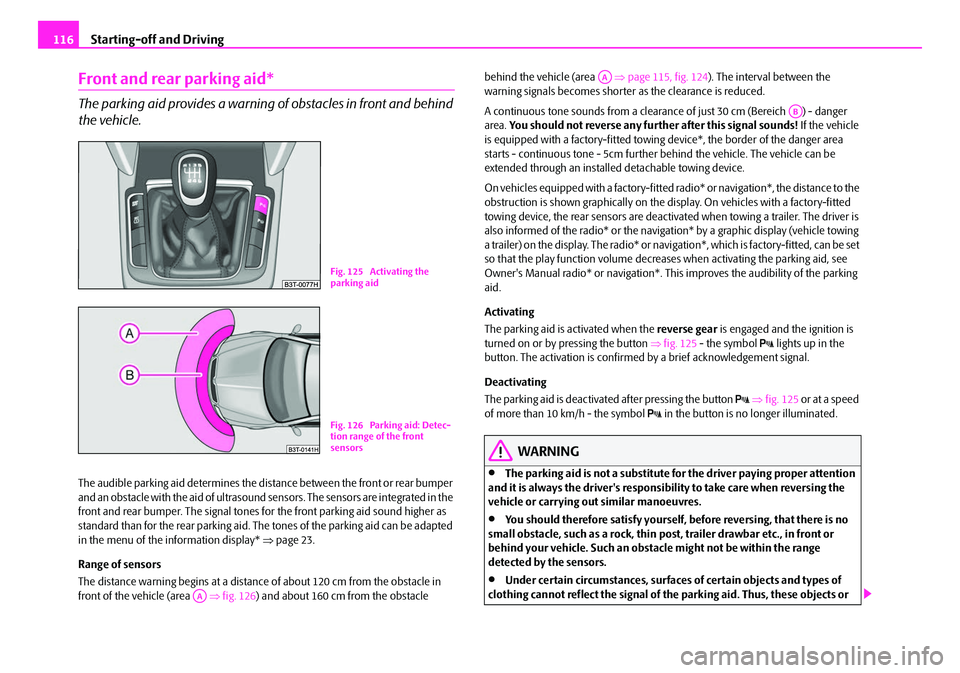
The distance warning begins at a distance of about 120 cm from the obstacle in
front of the vehicle (area ⇒fig. 126 ) and about 160 cm from the obstacle behind the vehicle (area
⇒page 115, fig. 124). The interval between the
warning signals becomes shorter as the clearance is reduced.
A continuous tone sounds from a clearanc e of just 30 cm (Bereich ) - danger
area. You should not reverse any further after this signal sounds! If the vehicle
is equipped with a factory-fitted towing device*, the border of the danger area
starts - continuous tone - 5cm further behind the vehicle. The vehicle can be
extended through an installed detachable towing device.
On vehicles equipped with a fa ctory-fitted radio* or navigation*, the distance to the
obstruction is shown graphically on the di splay. On vehicles with a factory-fitted
towing device, the rear sensors are deactivated when towing a trailer. The driver is
also informed of the radio* or the navigation* by a graphic display (vehicle towing
a trailer) on the display. The radio* or navi gation*, which is factory-fitted, can be set
so that the play function volume decreases when activating the parking aid, see
Owner's Manual radio* or navigation*. Th is improves the audibility of the parking
aid.
Activating
The parking aid is activated when the reverse gear is engaged and the ignition is
turned on or by pressing the button ⇒fig. 125 - the symbol
lights up in the
button. The activation is confirmed by a brief acknowledgement signal.
Deactivating
The parking aid is deactivated after pressing the button
⇒ fig. 125 or at a speed
of more than 10 km/h - the symbol in the button is no longer illuminated.
WARNING
•The parking aid is not a substitute fo r the driver paying proper attention
and it is always the driver's responsibility to take care when reversing the
vehicle or carrying out similar manoeuvres.
•You should therefore satisfy yourself, before reversing, that there is no
small obstacle, such as a rock, thin po st, trailer drawbar etc., in front or
behind your vehicle. Such an obstacle might not be within the range
detected by the sensors.
•Under certain circumstances, surfaces of certain objects and types of
clothing cannot reflect the signal of the parking aid. Thus, these objects or
Fig. 125 Activating the
parking aid
Fig. 126 Parking aid: Detec-
tion range of the front
sensors
AA
AA
AB
NKO B6 20.book Page 116 Wednesday, March 26, 2008 3:15 PM
Page 118 of 272

Starting-off and Driving117
Using the systemSafetyDriving TipsGeneral MaintenanceBreakdown assistanceTechnical Data
people who wear such clothing are not recognised by the sensors of the
parking aid.
Note
•Only the front parking aid operates if you are towing a trailer (applies only to
models which feature a factory-fitted towing device*).
•If a warning signal sounds for about 3 seconds after activating the system and
there is no obstacle close to your car, th is indicates a system fault. The fault is
confirmed additionally when the symbol
flashes in the button ⇒page 116,
fig. 125 . Have the fault rectified by a specialist workshop.
•The sensors must be kept clean and free of ice to enable the parking aid to
operate properly.
•If the parking aid is activated and the se lector lever of the automatic gearbox is
in the position , warning signal indicates interruption (vehicle can no longer
move).
Park Assist*
Description and important information
The park assist assists you when parkin g in a suitable parallel parking place
between two vehicles or behind a vehicle.
The park assist automatically searches fo r suitable parking spaces after switching
on the ignition and when driving up to 30 km/h.
During the parking procedure the park assist only takes over the steering move-
ments, the pedals continue to be operated by the driver.
Function of the system is based on:
•Length and depth measurement of the parking spaces when driving
•Evaluation of the size of the parking space
•Definition of the correct position of the vehicle for parking
•Calculating the line on which the vehi cle drives backwards into the parking
place
•Actuation of the steering force assistance , automatic spinning of the wheels of
the front axle when parking.
WARNING
The park assist does not take away th e responsability from the driver when
parking.
•Pay particular attention to small chil dren and animals as they would not
be recognised by the sensors of the parking aid.
•Under certain circumstances, surfaces of certain objects and types of
clothing cannot reflect the signal of the park assist or the parking aid. Thus,
these objects or people who wear such clothing are not recognised by the
sensors of the parking aid.
•The external sound source of the park assist and the parking aid can be
disruptively influenced and under unfavourable conditions, objects or
people cannot be recognised by the sensors of the parking aid.
Caution
•If other vehicles are parked behind or on the kurb, th e park assist guides your
vehicle beyond the kurb or onto it. Make su re that the wheels or the wheel rims of
your vehicle are not damaged and if necessary intervene in time.
•You should satisfy yourself before parking that there is no small obstacle, such
as a rock, thin post, trailer drawbar etc., in front or behind your vehicle. Such an
obstacle might not be within the range detected by the sensors.
•Under certain circumstances, surfaces or structures of certain objects such as
wire mesh fences, powder snow etc..., cannot be recognised by the system.
•The evaluation of the parking place an d the parking procedure depends on the
circumference of the wheels. The system does not function correctly if your vehicle
is mounted with wheels of non-permissible size, snow chains or a temporary spare
wheel (in order to reach the nearest work shop). If the tyres other than those
excepted by the manufacturer are mounted, the resulting position of the vehicle in
WARNING (continued)
AP
NKO B6 20.book Page 117 Wednesday, March 26, 2008 3:15 PM
Page 119 of 272

Starting-off and Driving
118
the parking place can differ slightly. This can be avoided through new calibration of
the system in a specialist garage.
•The accuracy of the evaluation for the parking place can be influenced by the
incorrectly determined outside temperature if the later is influenced by the thermal
radiation of the engine i.e for stop and go in a traffic jam.
•In order to avoid damaging the sensor s while cleaning with high-pressure
cleaners or steam jets, the sensors must on ly be directly sprayed for short periods
while a minimum distance of 10 cm must be observed.
Note
•A component of the park assist is the front and rear parking aid*.
•The electronic stability programme (ESP) must always be switched on for the
parking procedure.
•Only the front parking aid operates if yo u are towing a trailer (applies only to
models which feature a factory-fitted towing device*). This is why it is not possible
to park backwards with the help of the park assist when towing a trailer.
•The sensors must be kept clean and free of ice to enable the parking aid to
operate properly.
Switch on display of the park a ssist in the information display*
Switch on display of the park assist in the information display*
– Press the button ⇒fig. 127 .
– Drive past the parking row up to maximum 30 km/h and with a distance of 0.5 m to 1.5 m ⇒fig. 128 .
Operate the turn signal for the driver's side if you wish to park on this side of the
road. In the information display* the search area for the parking place is indicated
on the driver's side.
If the button is pressed above a speed of 30 km/h, the display appears in the display
of the instrument cluster as soon as you drive slower than 30 km/h.
Note
•If the park assist is switched on, a yell ow warning light lights up in the button.
•The search for suitable parking places is automatic after switching on the igni-
tion at speeds of more than 30 km/h. Sear ching for a parking place is performed at
the same time on the driver and front passenger side.
•If the sensors find a suitable parking place, they store its parameters until
another suitable parking place has been fo und or until a distance of 10 m had been
driven after finding the parking place. This is why it is possible to switch on the park
assist after driving past the driving place; on the information display* appears the
information if this parking space is suitable for parking.
Fig. 127 Switch on display of
the park assist in the infor-
mation display
Fig. 128 Information
display: Finding a suitable
parking place
NKO B6 20.book Page 118 Wednesday, March 26, 2008 3:15 PM
Page 121 of 272

Starting-off and Driving
120
Park Assist cancelled!
The parking procedure has ended or after switching on the ignition, the vehicle has
not been driven above 10 km/h.
Park Assist: Speed too high!
Reduce the speed below 30 km/h.
Driver steering intervention! Please take over steering!
The parking procedure is ended through driver intervention.
Park Assist cancelled! ESP switched off!
The parking procedure cannot be carried out because the ESP system is switched
off.
ESP switched off! Please take over steering!
The parking procedure was ended because the ESP system was switched off during
the parking procedure.
Park Assist cancelled! Trailer
The parking procedure is not possible beca use the trailer is hitched and a plug is
inserted in the socket of the towing device.
Park Assist cancelled! Time limit exceeded
The parking procedure was not started because a time limit of 180 seconds for
engaging the reverse gear was exceeded.
Time limit exceeded! Please take over steering!
The parking procedure was ended because a time limit of 180 seconds for parking
was exceeded.
Park Assist cancelled! System error
The parking procedure is not possible because a fault exists on the vehicle. Have the
fault rectified by a specialist workshop.
Park Assist defective! Service now!
The parking procedure is not possible because a fault exists on the park assist. Have
the fault rectified by a specialist workshop. Steering intervention! Check area around veh.!
The park assist is active and takes over the steering movements. Observe the
surroundings and carefully drive backward
s, at the same time operate the pedal.
Please take over steering! Finish parking manually
Take over the steering. End the parking procedure without using the park assist.
Speed too high! Please take over steering!
The parking procedure was ended while the speed was exceeded.
Park Assist: ESP Intervention!
Intervention of the ESP system while searching for a suitable parking place.
ESP intervention! Please take over steering!
Parking procedure is ended through the intervention of the ESP system.
Cruise control system (CCS)*
Introduction
The cruise control system (CCS) maintains a constant speed, more than 30 km/h (20
mph), once it has been set, without you having to depress the accelerator pedal.
This is only possible within the range wh ich is permitted by the power output and
braking power of the engine. The cruise control system makes it possible - particu-
larly on long journeys - for you to rest your “accelerator foot”.
WARNING
•The cruise control system must not, for safety reasons, be used in dense
traffic or on unfavourable road surfaces (such as icy roads, slippery roads or
loose chippings) - risk of accident!
•In order to prevent unintentional use of the cruise control system, always
switch off the system after use.
NKO B6 20.book Page 120 Wednesday, March 26, 2008 3:15 PM
Page 126 of 272

Automatic gearbox DSG*125
Using the systemSafetyDriving TipsGeneral MaintenanceBreakdown assistanceTechnical Data
D
, with the ignition switched on, on a vehicle travelling at less than 5 km/hour or on
a stationary vehicle.
The brake pedal must be depressed (if the le ver is in its position for longer than 2
seconds) in order to move the selector lever out of the position N into the position
R , with the ignition switched on, on a vehicl e travelling at less than 5 km/hour or on
a stationary vehicle.
D - Drive, position for driving forward
When the selector lever is in this position, the forward gears are shifted up and
down automatically in line with engine load, vehicle speed and the dynamic shift
programme.
You must depress the brake pedal if you wise to move into position D from N when
the vehicle is travelling at less than 5 km/hour or is stationary ⇒.
In certain circumstances (e.g. when driving in mountainous regions or when towing
a trailer) it may be beneficial to select the manual shift programme for a short time
in order to adapt the gearbox ratios manually to the driving situations.
S - Position for sporty style of driving
Shifting up later into a higher gear makes it possible to fully exploit the power
potential of the engine. The gearbox also then shifts down at higher engine speeds
as in the position D.
The Shiftlock on the selector lever grip must be pressed when moving the selector
lever out of the position D into the position S.
WARNING
•Never move the selector lever into position R or P when driving - risk of
an accident!
•When the engine is running and the vehicle is stationary, it is necessary
to hold the car with the brake pedal in all the positions of the selector lever
(except P and N) since the power transmission is never completely inter-
rupted, also not when the engine is idling - the vehicle "creeps".
•You must on no account unintentionally operate the throttle (e.g. by
hand from the engine compartment) if a drive position is engaged when the car is stationary. The vehicle would ot
herwise immediately start off - also
when the handbrake is firmly applied - risk of an accident!
•You must move the selector lever into position P and firmly apply the
handbrake first before you or any othe r person opens the bonnet and starts
working on the engine when it is runn ing - risk of accident! Pay particular
attention to the warning instructions.
Selector lever lock
Automatic selector lever lock
With the ignition on, the selector lever is locked when it is in the positions P and N .
You must first of all depress the brake pedal in order to move the selector lever out
of this position. The warning light
⇒ page 26 lights up in the instrument cluster
as a reminder for the driver when the selector lever is in position P and N:
A time delay element ensures that the sele ctor lever is not blocked when rapidly
switching over the position N (e.g. from R to D). This does, for example, allow one
to seesaw out a stuck vehicle. The selector lever lock will click into place if the lever
is in the N position for more than 2 seconds without the brake pedal being pressed.
The selector lever lock is only active if th e vehicle is stationary or moving at speed
of less than 5 km/hour. The lock is switched off automatically into position N when
the car is travelling at a higher speed.
Shiftlock button
The Shiftlock button in the handle of selector lever prevents certain selector lever
positions being engaged inadvertently. The selector lever lock is cancelled when
you press the Shiftlock button.
Keylock - Ignition key withdrawal lock
You can only withdraw the ignition key after switching off the ignition if the selector
lever is in position P. If the ignition key is withdrawn, the selector lever is blocked in
position P.
WARNING (continued)
NKO B6 20.book Page 125 Wednesday, March 26, 2008 3:15 PM
Page 129 of 272

Automatic gearbox DSG*
128
– If the rocker switches or are not pressed for some time, the manual shifting switches off. You can also switch off the temporary
switch over to manual shifting by pressing the right rocker switch
for more than 1 second.
Emergency programme
An emergency programme exists in the event of a fault in the system.
The gearbox operates in a corresponding emergency programme if there are func-
tional faults in the gearbox electronics. This is indicated by all of the segments in the
display lighting up or going out.
A functional fault can ha ve the following effect:
•The gearbox only shifts into certain gears.
•The reverse gear R cannot be used.
•The manual shift programme (Tiptronic) is switched off in the emergency mode.
If the gearbox has switched over to emergency mode, drive to the nearest
specialist garage in order to have the fault rectified.
Selector lever-emergency unlocking (DSG)
In case of interruption of the power supply (e.g. flat vehicle battery, defec-
tive fuse) or defect of the selector lever lock, the selector lever can no
longer be shifted from the position P in the normal way and the vehicle
can no longer be moved. The selector lever must be unlocked in case of
emergency.
– Apply the handbrake firmly.
– Carefully pull up the front left and right cover.
– Pull up rear cover.
– Press with a narrow object (e.g. ignition key) the yellow plastic hoop ⇒fig. 137 to the left.
– Simultaneously press the shiftlock bu tton in the handle of the selector
lever in the position N
11).
Tow-starting and towing vehicle
Tow-starting a vehicle
It is not possible to tow-start vehi cles fitted with automatic gearbox ⇒page 237.
You can use jump-start cabl es connected to the battery of another vehicle for
starting your car if the vehicle battery is flat ⇒page 236.
Towing a vehicle
Please pay attention to the following info rmation if it comes necessary to tow-in
your car ⇒page 237.
-+
+
Fig. 137 Selector lever-
emergency unlocking
11)If the selector lever is moved again into the position P, it is once again blocked.
NKO B6 20.book Page 128 Wednesday, March 26, 2008 3:15 PM
Page 184 of 272

Intelligent Technology185
Using the systemSafetyDriving TipsGeneral MaintenanceBreakdown assistanceTechnical Data
Tyre inflation pressure-control system*
The tyre inflation pressure-control system compares with the aid of the ABS sensors
the speed and also the rolling circumference of the individual wheels. If the rolling
circumference of a wheel is changed, the warning light
lights up in the dash
panel insert ⇒page 32. The rolling circumference of the tyre can change if:
•the tyre inflation pressure is too low,
•the structure of the tyre is damaged,
•the vehicle is loaded on one side,
•the wheels of an axle are loaded heavily (e.g. when towing a trailer or when
driving uphill or downhill),
•snow chains are mounted,
•the temporary spare wheel is mounted,
•one wheel per axle was changed.
Basic setting of tyre inflation pressure-control system
After changing the tyre inflation pressures or after changing one or several wheels,
a basic setting of the system must be carried out as follows.
•Inflate all tyres to the specified inflation pressure ⇒page 222.
•Switch on the ignition.
•Press button ⇒ fig. 177 for more than 2 seconds. While pressing the
button, the warning light lights up. At the same time the memory of the system is erased and the new calibration is star
ted, which is confirmed with an audible
signal and then the warning light
goes out.
•If the warning light does not go out after the basic setting, there is a fault in
the system. Have the vehicle inspected by your nearest specialist garage.
Warning light
lights up
If the tyre inflation pressure of at least on e wheel is insufficiently inflated in compar-
ison to the stored basic value, the warning light
⇒ lights up.
Warning light
flashes
If the warning light flashes, there is a system fault. Have the vehicle inspected by
your nearest specialist garage.
WARNING
•When the warning light lights up, immediately reduce the speed and
avoid sudden steering and brake mano euvres. Please stop the vehicle
without delay at the nearest possible stop and inspect the tyres and their
inflation pressures.
•The driver is responsible for the correc t tyre inflation pressures. For this
reason, the tyre inflation pressures must be checked regularly.
•Under certain circumstances (e.g. sporty style of driving, wintry or
unpaved roads) the warning light can be delayed or does not light up at
all.
•The tyre inflation pressure-control system does not take away the
responsability from the driver for the correct tyre inflation pressure.
Note
The tyre inflation pressure-control system:
•does not replace the regular tyre inflatio n pressure control, because the system
cannot detect an even pressure loss,
•cannot warn in case of very rapid tyre inflation pressure loss, e.g. in case of
sudden tyre damage. In this case carefully bring the vehicle to a standstill without
sudden steering movements and without sharp braking.
Fig. 177 Button for setting
the tyre inflation pressure
control value
NKO B6 20.book Page 185 Wednesday, March 26, 2008 3:15 PM
Page 187 of 272

Driving and the Environment
188
Catalytic converter
Proper operation of the emission co ntrol system (catalytic converter)
is of major significance for drivin g your vehicle in an environmen-
tally conscious way.
Please refer to the following guidelines.
– For vehicles with petrol engine only refuel with unleaded petrol
⇒ page 205, “Grades of petrol”.
– Never run the fuel tank completely empty.
– Do not switch off the ignition while you are driving the vehicle.
– Do not pour too much oil into the engine ⇒page 212, “Replenishing
engine oil”.
– Do not tow-start the vehicle over a distance of more than 50 metres
⇒ page 237, “Tow-starting and towing vehicle”.
If you drive your vehi cle in a country in which unleade d petrol is not available, you
must have the catalytic converter replaced later when driving the vehicle into a
country in which use of a cata lytic converter is mandatory.
WARNING
•In view of the high temperatures which may be produced in the catalytic
converter, one should always park a vehicle in such a way that the catalytic
converter cannot come into contact with easily flammable materials below
the vehicle - a risk of fire!
•Never use additional underbody protection or corrosion-protection
agents for the exhaust pipes, catalyti c converters or heat shields. Such
substances might ignite when driving - risk of fire!
Caution
•Vehicles fitted with catalytic converter should neve r be allowed to let the fuel
tank to run completely empty. An irregular fuel supply can result in poor ignition or misfiring. Unburnt fuel may get into the exhaust system and damage the catalytic
converter.
•Filling the tank even only once with le
aded petrol will result in the catalytic
converter being destroyed.
•If you detect misfiring, a drop in perf ormance or irregular engine running when
driving, reduce your speed immediately and have the vehicle inspected by the
nearest specialist garage. The symptoms described may be caused by a fault in the
ignition system. Unburnt fuel may get in to the exhaust system and damage the
catalytic converter.
For the sake of the environment
Even if the exhaust system is operating properly, a sulphur-like exhaust odour may
be produced under certain operating condit ions of the engine. This depends on the
sulphur content of the fuel. It is often su fficient to refuel with unleaded premium-
grade petrol of a different brand or at a different filling station.
Driving in an economical and environmentally
conscious manner
General
Your personal style of driving is a major factor.
Your fuel consumption, any pollution of the environmental and the wear-and-tear
to the engine, brakes and tyres, depend essentially on three factors:
•your personal style of driving,
•the conditions under which your vehicle is operated,
•technical aspects.
You can easily improve your fuel economy by 10 - 15 percent by driving in an
economical way with foresight. This section is intended to provide you with a
number of tips on how to protect the en vironment and at the same time save
money.
NKO B6 20.book Page 188 Wednesday, March 26, 2008 3:15 PM