2008 SKODA SUPERB height
[x] Cancel search: heightPage 175 of 272

Transporting children safely
176
passenger seat where the child is seated with its back facing in direction of
travel (in some countries also when the child is facing the direction of travel),
− in a specialist garage
− or by using the switch for the front passenger airbag* ⇒page 169,
“Switch for the front passenger airbag*”.
•In certain countries national legal provisions require that besides the
front airbag also the side or head ai rbags are deactivated. Please comply
with any differing national legal regula tions regarding the use of child safety
seats.
•If this is not done, a child seated on the front passenger seat may suffer
severe or even fatal injuries if the front passenger airbag or airbags are
deployed.
•You should have the front passenger ai rbag (or airbags) reactivated just
as soon as you no longer use a child sa fety seat on the front passenger seat.
Child safety seats in Group 2
For children up to about 7 years of age weighing between 15 and 25 kg the optimal
solution is a child safety seat in comb ination with the three-point seat belt
⇒ fig. 170 .
WARNING
•When transporting a child on the front passenger seat, please comply
with the appropriate national regulati ons regarding the use of child safety
seats. If required, the airbag has to be deactivated,
−in a specialist garage
− or by using the switch for the front passenger airbag* ⇒page 169,
“Switch for the front passenger airbag*”.
•The shoulder part of the seat belt must run approximately across the
middle of the shoulder and fit snugly agai nst the chest. It must on no account
run across the neck. The lap part of the seat belt must run across the pelvis
and fits snugly; it must not run over the belly. Tighten the belt webbing over
your hip if necessary.
•Please comply with any differing nati onal legal regulations regarding the
use of child safety seats.
Child safety seats in Group 3
For children of about 7 years of age weighi ng between 22 and 36 kg and of a height
of less than 150 cm, the optimal solution is a child safety seat (seat bolster) in
combination with the three-point seat belt ⇒fig. 171 .
WARNING (continued)
Fig. 170 Child seat in Group
2 installed on the rear seat
facing the direction of travelFig. 171 Child seat in Group
3 installed on the rear seat
facing the direction of travel
NKO B6 20.book Page 176 Wednesday, March 26, 2008 3:15 PM
Page 176 of 272

Transporting children safely177
Using the systemSafetyDriving TipsGeneral MaintenanceBreakdown assistanceTechnical Data
Children of more than 150 cm in height may use the seat belts fitted to the vehicle
without a seat bolster.
WARNING
•When transporting a child on the front passenger seat, please comply
with the appropriate national regulations regarding the use of child safety
seats. If required, the airb ag has to be deactivated,
− in a specialist garage
− or by using the switch for the front passenger airbag* ⇒page 169,
“Switch for the front passenger airbag*”.
•The shoulder part of the seat belt must run approximately across the
middle of the shoulder and fit snugly against the chest. It must on no account
run across the neck. The lap part of the seat belt must run across the pelvis
and fits snugly; it must not run over th e belly. Tighten the belt webbing over
your hip if necessary.
•Please comply with any differing nati onal legal regulations regarding the
use of child safety seats.
Attaching a child seat using the “ISOFIX” system
There are two fixing eyes* between the backrest and the seat of the front
passenger as well as on the rear exte rior seats for fixing the “ISOFIX”
system child seat in place. The places are marked with -ISOFIX-.
Install child seat
– Insert the mounting funnels onto the locking eyes between the backrest and seat cushion ⇒fig. 172 .
– Push the notched arms of the chil d seat over the mounting funnels
into the locking eyes, until it is heard to lock ⇒fig. 173 .
– Pull on both sides of the child seat!
One can mount a child safety seat using the “ISOFIX” system quickly, easily and reli-
ably. Please pay close attention to instru ctions from the manufacturer of the child
safety seat when installing and removing the seat.
Child seats fitted with the “ISOFIX” clampi ng system can only be mounted and fixed
in a vehicle fitted with an “ISOFIX system” when these child seats have been
released for this type of vehicle ac cording to the ECE-R 44 standard.
You can obtain child seats with the “ISOFIX” attachment system from specialist
garages who will also installed it as well.
Fig. 172 Locking eyes
(ISOFIX system)
Fig. 173 The ISOFIX child
seat is pushed into the
mounting funnels
AAAB
NKO B6 20.book Page 177 Wednesday, March 26, 2008 3:15 PM
Page 193 of 272

Towing a trailer
194
Towing a trailer
To w i n g a t r a i l e r
Technical requirements
The towing device must satisfy certain technical requirements.
Your vehicle is designed primarily for tr ansporting persons and luggage. It can,
however, also be used for towing a traile r - provided certain technical equipment is
fitted.
If your vehicle has already been supplied with a factory-fitted towing device then
everything that is necessary for towing a trailer in technical terms, and in terms of
the law, has already been taken into account.
Your vehicle is fitted with a 13-pin power socket for the electrical connection
between the vehicle and trailer. If th e trailer which you wish to tow has a 7-pin
connector, you can use a suitable adapter
14) from Škoda original accessories.
This work must be carried out in accordan ce with the manufacturer's specifications
if a towing device is retrofitted.
Škoda Service Partners are familiar with de tails relating to retrofitting a towing
device and for any necessary modi fications to the cooling system.
WARNING
We recommend that you have the towing device from Škoda original acces-
sories installed by a Škoda Service Partner. He is familiar with all the relevant
details relating to retrofitting such equi pment. There is a risk of an accident
if the towing device is not properly fitted!
General Maintenance
There are a number of points to pay attention to when towing a
trailer.
Trailer load
The permissible trailer load must on no account be exceeded.
You can negotiate appropriately steeper inclines and descents if you do not make
full use of the perm issible trailer load.
The trailer loads specified only apply for altitudes up to 1 000 metres above mean
sea level. The fact that the engine power ou tput drops with increasing height due to
a lowering of air pressure and thus the abil ity to climb, means that the towed weight
must be reduced by 10% for every further increase of 1 000 metres in height above
sea level. The towed weight is the weight of the (laden) vehicle and the (laden)
trailer together. One should take this into account before driving up to higher alti-
tudes.
The trailer and drawbar load information on the type plate of the towing
device are merely test data for the tow ing device The data relating to your
vehicle, which is often less than this test data, can be found in your vehicle
registration documents.
Distribution of the load
Distribute the load in the trailer in such a way that any heavy items are located as
close as possible to the axle. Secure the items to prevent them slipping.
Tyre inflation pressure
Select the tyre inflation pressure on your vehicle for that of “fully laden”,
⇒ page 222. The inflation pressure of the tyres fitted to the trailer adjust in accord-
ance with the manufacturer's recommendation.
Exterior mirrors
You have to have additional exterior mirrors fitted if you are not able to see the
traffic behind the trailer with the standard rear-view mirrors. Both exterior mirrors
14)In some countries the adapter is supplied with the towing device.
NKO B6 20.book Page 194 Wednesday, March 26, 2008 3:15 PM
Page 207 of 272
Inspecting and Replenishing
208
Inspecting and Replenishing
Engine compartment
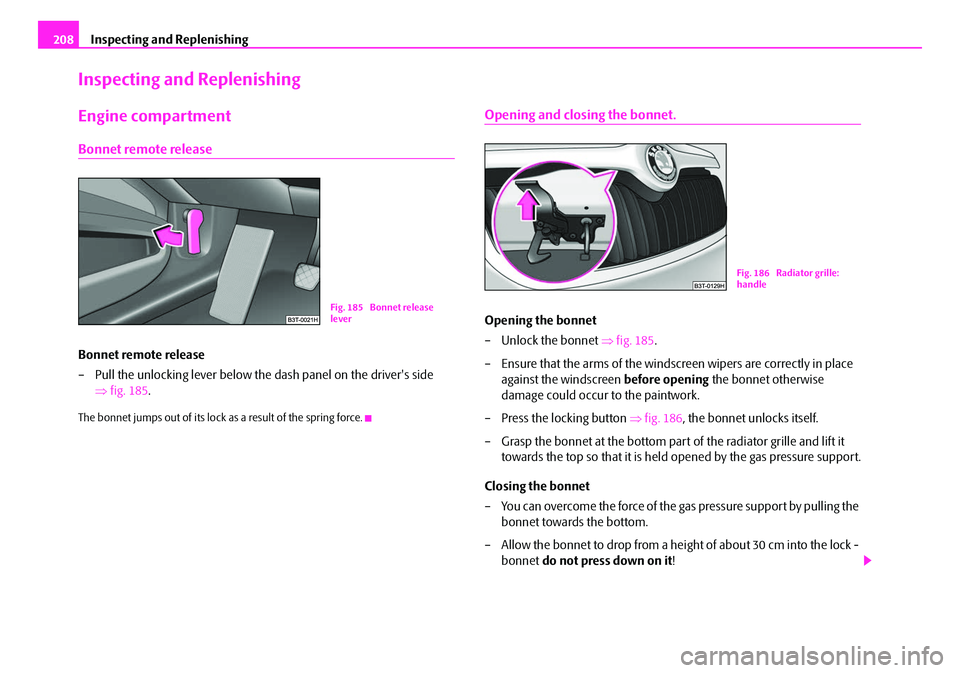
Bonnet remote release
Bonnet remote release
– Pull the unlocking lever below the dash panel on the driver's side
⇒ fig. 185 .
The bonnet jumps out of its lock as a result of the spring force.
Opening and closing the bonnet.
Opening the bonnet
– Unlock the bonnet ⇒fig. 185 .
– Ensure that the arms of the windsc reen wipers are correctly in place
against the windscreen before opening the bonnet otherwise
damage could occur to the paintwork.
– Press the locking button ⇒fig. 186 , the bonnet unlocks itself.
– Grasp the bonnet at the bottom part of the radiator grille and lift it
towards the top so that it is held opened by the gas pressure support.
Closing the bonnet
– You can overcome the force of the gas pressure support by pulling the bonnet towards the bottom.
– Allow the bonnet to drop from a height of about 30 cm into the lock -
bonnet do not press down on it !Fig. 185 Bonnet release
lever
Fig. 186 Radiator grille:
handle
NKO B6 20.book Page 208 Wednesday, March 26, 2008 3:15 PM
Page 223 of 272

Wheels and Tyres
224
Changing wheels around
If significantly greater wear is present on the front tyres, we recommend changing
the front wheels around with the rear wheels as shown in the diagram ⇒fig. 197 .
You will then obtain approximately the same life for all the tyres.
It may be advantageous to swap the tyre s over “crosswise” when certain types of
wear characteristic ar ise on the running surface of the tyres (but not in the case of
unidirectional tyres). Škoda Service Pa rtners can provide you with details.
We recommend that you change the wheels around every 10 000 km in order to
achieve even wear on all wheels and to obtain optimal tyre life.
New tyres and wheels
Tyres and wheel rims are important design elements. One should therefore use the
tyres and wheel rims which have been re leased for use by Škoda Auto. They are
exactly matched to the vehicle type and th erefore contribute significantly to good
road holding and safe driving characteristics ⇒.
Only fit radial tyres of the same type on all 4 wheels, size (rolling circumference)
and, if possible, the same tread pattern on one axle.
The Škoda Service Partners have access to the most current information about
which tyres we have released for use on your vehicle. We recommend that you have any work rela
ting to tyres or wheels carried out by
your Škoda Service Partner . Your dealer has all of the necessary special tools and
replacement parts available plus the required specialist knowledge and is also in a
position to properly dispose of the old ty res. A large number of Škoda Service Part-
ners also have an attractive range of tyres and wheels available.
The tyre/wheel combinations which are appr oved for your vehicle are indicated in
your vehicle documents. Approval and lice nsing may differ according to the legis-
lation prevailing in individual countries.
Proper knowledge of the tyre data makes it easier for you to select the correct type
of tyre. Tyres do, for exam ple, have the following inscription on their walls:
205 / 55 R 16 94 V
What this means is:
The following speed restrictions apply to tyres.
Fig. 197 Changing wheels
around
205Tyre w idt h in mm
55Height/width ratio in %
RCode letter for the type of tyre - R adial
16Diameter of wheel in inches
94Load index
VSpeed symbol
Speed symbolPermissible maximum speed
S180 km/h
T190 km/h
H210 km/h
V240 km/h
W270 km/h
Y300 km/h
NKO B6 20.book Page 224 Wednesday, March 26, 2008 3:15 PM
Page 256 of 272

Technical Data257
Using the systemSafetyDriving TipsGeneral MaintenanceBreakdown assistanceTechnical Data
Dimensions
Dimensions (mm)
Length4838
Width1817
Width including exterior mirror2009
Height1462/1482a)/1447b)
a)The value is valid for vehicles with rough road package.b)The value corresponds to the status with sport chassis.
Wheel base2761
Tr a c k g a u g e f r o n t / r e a r1545/1518
NKO B6 20.book Page 257 Wednesday, March 26, 2008 3:15 PM
Page 268 of 272

Index269
Power windows
Button in front passenger door and in rear doors48
Button on the driver's door . . . . . . . . . . . . . . . . . 47
Central locking system . . . . . . . . . . . . . . . . . . . . . 49
R
Radiator fan . . . . . . . . . . . . . . . . . . . . . . . . . . . . . . . . 215
Rear armrest . . . . . . . . . . . . . . . . . . . . . . . . . . . . . . 77, 91
Rear fog light . . . . . . . . . . . . . . . . . . . . . . . . . . . . . . . . . . 58 Warning light . . . . . . . . . . . . . . . . . . . . . . . . . . . . . . 28
Rear window heater . . . . . . . . . . . . . . . . . . . . . . . . . . . . . . . . . . . . 63
Rear window heater . . . . . . . . . . . . . . . . . . . . . . . . . . . 63
Rear-view mirror Exterior mirror . . . . . . . . . . . . . . . . . . . . . . . . . . . . . 69
Interior mirror . . . . . . . . . . . . . . . . . . . . . . . . . . . . . 68
Recharge battery . . . . . . . . . . . . . . . . . . . . . . . . . . . . 219
Refuelling . . . . . . . . . . . . . . . . . . . . . . . . . . . . . . . . . . . 206
Remote control . . . . . . . . . . . . . . . . . . . . . . . . . . . . . . . 43 Synchronisation . . . . . . . . . . . . . . . . . . . . . . . . . . . 45
Replacing fuses . . . . . . . . . . . . . . . . . . . . . . . . . . . . . 241
Replacing the wiper blades . . . . . . . . . . . . . . . . . . . . . 67
Roof aerial . . . . . . . . . . . . . . . . . . . . . . . . . . . . . . . . . . 198
S
Safe securing . . . . . . . . . . . . . . . . . . . . . . . . . . . . . . . . . 39
Safety . . . . . . . . . . . . . . . . . . . . . . . . . . . . . . . . . . . . . . 149
Safety information Engine compartment . . . . . . . . . . . . . . . . . . . . . 209
Safety wheel bolts . . . . . . . . . . . . . . . . . . . . . . . . . . . 235 Saving electrical energy . . . . . . . . . . . . . . . . . . . . . . . 188
Seat belt height adjuster . . . . . . . . . . . . . . . . . . . . . . 157
Seat belt warning light . . . . . . . . . . . . . . . . . . . . . . . . 156
Seat belts . . . . . . . . . . . . . . . . . . . . . . . . . . . . . . . 154, 158
Belt tensioners . . . . . . . . . . . . . . . . . . . . . . . . . . . 158
Cleaning . . . . . . . . . . . . . . . . . . . . . . . . . . . . . . . . . 203
fastening . . . . . . . . . . . . . . . . . . . . . . . . . . . . . . . . 156
Height adjustment . . . . . . . . . . . . . . . . . . . . . . . . 157
Safety information . . . . . . . . . . . . . . . . . . . . . . . . 155
taking off . . . . . . . . . . . . . . . . . . . . . . . . . . . . . . . . 158
Warning light . . . . . . . . . . . . . . . . . . . . . . . . . . . . . . 33
Seat heaters . . . . . . . . . . . . . . . . . . . . . . . . . . . . . . . . . . 77
Selector lever . . . . . . . . . . . . . . . . . . . . . . . . . . . . . . . . 124
Selector lever lock Warning light . . . . . . . . . . . . . . . . . . . . . . . . . . . . . . 32
Selector lever positions . . . . . . . . . . . . . . . . . . . . . . . 124
Selector lever-emergency unl ocking (DSG) . . . . . 128
Service Display . . . . . . . . . . . . . . . . . . . . . . . . . . . . . . . 12
Service Interval Display . . . . . . . . . . . . . . . . . . . . . . . . 12
Setting the clock . . . . . . . . . . . . . . . . . . . . . . . . . . . . . . 14
Shifting . . . . . . . . . . . . . . . . . . . . . . . . . . . . . . . . . . . . . . 113
Side airbag . . . . . . . . . . . . . . . . . . . . . . . . . . . . . . . . . . 165
Side lights . . . . . . . . . . . . . . . . . . . . . . . . . . . . . . . . . . . . 53
Snow chains . . . . . . . . . . . . . . . . . . . . . . . . . . . . . . . . . 226
Spare wheel . . . . . . . . . . . . . . . . . . . . . . . . . . . . . . . . . 231
Speedometer . . . . . . . . . . . . . . . . . . . . . . . . . . . . . . . . . 11
Stability system . . . . . . . . . . . . . . . . . . . . . . . . . . . . . . 179
Starting the engine . . . . . . . . . . . . . . . . . . . . . . . . . . . 112 after fuel tank has run empty . . . . . . . . . . . . . . 113
Diesel engines . . . . . . . . . . . . . . . . . . . . . . . . . . . 112
Petrol engines . . . . . . . . . . . . . . . . . . . . . . . . . . . . 112 Steering
Driver-steering recommendation . . . . . . . . . 181
Steering force assistance . . . . . . . . . . . . . . . . . . . . . 184
Storage compartment Lighting . . . . . . . . . . . . . . . . . . . . . . . . . . . . . . . . . . 61
Storage compartments . . . . . . . . . . . . . . . . . . . . . . . . 87
Storage facilities . . . . . . . . . . . . . . . . . . . . . . . . . . . . . . 87
Stowage compartment Umbrella . . . . . . . . . . . . . . . . . . . . . . . . . . . . . . . . . 92
Sun . . . . . . . . . . . . . . . . . . . . . . . . . . . . . . . . . . . . . . . . . . 64
Sun screen . . . . . . . . . . . . . . . . . . . . . . . . . . . . . . . . . . . 64
Switching lights on and off . . . . . . . . . . . . . . . . . . . . 53
Switching off the engine . . . . . . . . . . . . . . . . . . . . . . 113
T
Tailgate Lighting . . . . . . . . . . . . . . . . . . . . . . . . . . . . . . . . . . 63
Taking care of your vehicle . . . . . . . . . . . . . . . . . . . 197
TCS . . . . . . . . . . . . . . . . . . . . . . . . . . . . . . . . . . . . . . . . . 181 Warning light . . . . . . . . . . . . . . . . . . . . . . . . . . . . . 31
Telephone . . . . . . . . . . . . . . . . . . . . . . . . . . . . . . 133, 137
Temperature outside . . . . . . . . . . . . . . . . . . . . . . . . . . . . . . . . . . . 17
The roof luggage rack system . . . . . . . . . . . . . . . . . . 83
Thickness of brake pads Warning light . . . . . . . . . . . . . . . . . . . . . . . . . . . . . 33
Tilting roof . . . . . . . . . . . . . . . . . . . . . . . . . . . . . . . . . . . 50
Tiptronic automatic gearbox DSG . . . . . . . . . . . . . . . . . . 126
Tool . . . . . . . . . . . . . . . . . . . . . . . . . . . . . . . . . . . . . . . . 230
Top Tether . . . . . . . . . . . . . . . . . . . . . . . . . . . . . . . . . . 178
NKO B6 20.book Page 269 Wednesday, March 26, 2008 3:15 PM