2008 SKODA SUPERB bonnet
[x] Cancel search: bonnetPage 44 of 272

Unlocking and locking43
Using the systemSafetyDriving TipsGeneral MaintenanceBreakdown assistanceTechnical Data
Close large boot lid
– Pull the boot lid down and close it with a slight swing ⇒. The
bonnet locks automatically.
A handle which makes the clos ing easier is located on the inner paneling of the
boot lid.
WARNING
•Ensure that the lock is properly enga ged after closing the boot lid. Other-
wise, the boot lid might open suddenly wh en driving even if the boot lid lock
is closed - risk of accident!
•Never drive with the boot lid fully opened or slightly ajar otherwise
exhaust gases may get into the interior of the vehicle - risk of poisoning!
Note
•After closing the boot lid, it is automatically locked within 2 seconds and
the anti-theft alarm system* is activated. This applies only if the vehicle was
locked before closing the boot lid.
•The function of the hand grip on the bottom edge of the boot lid is deactivated
after starting off or as of a speed of more than 5 km/hour. The function of the hand
grip is acitvated again after stopping the vehicle and after opening the driver or
front passenger door or after pressing the button on the remote control
⇒ page 44.
Emergency unlocking of the boot lid
If there is a fault in the central locking, you can open the boot lid as
follows:
– Fold the rear seats forwards ⇒page 76.
– Guide the key into the slot in the trip panel as far as the stop ⇒fig. 33 .
– You can unlock the boot lid by the movement in the direction of arrow.
– Open the boot lid/luggage compartment door from outside.
Remote control
Description
You can use the remote control:
•to unlock and lock the car,
•unlock or open the boot lid,
•opening and closing window.
A1
Fig. 33 Emergency
unlocking of the boot lid
NKO B6 20.book Page 43 Wednesday, March 26, 2008 3:15 PM
Page 47 of 272

Unlocking and locking
46
The anti-theft alarm system is also deacti vated if you unlock the vehicle door using
the key within 45 seconds after locking the vehicle.
Once you unlock the vehicle by inserting the key into the driver door within 45
seconds, you then have to in sert the key into the ignition lock and switch the igni-
tion on within 15 seconds after opening the door in order to deactivate the anti-
theft alarm system. The alarm will be triggered if you do not switch on the igni-
tion within 15 seconds.
When is the alarm triggered?
The following security areas of the locked vehicle are monitored:
•Bonnet,
•Boot lid,
•Doors,
•Ignition lock,
•Socket of the factory-fitted towing device
•Angle of the vehicle*,
•Vehicle interior*,
•A drop in voltage of the on-board power supply.
An alarm is immediately triggered if either of the two battery terminals is discon-
nected while the anti-theft alarm system is activated.
How is the alarm switched off?
You switch the alarm off if you unlock the car with the radio remote control in the
key or if you switch the ignition on.
Note
•The working life of the alarm siren is 6 years. More detailed information is avail-
able by a specialist garage.
•Before leaving the car, check that al l the doors, windows and the electric
sliding/tilting roof* are properly closed in order to ensure that the anti-theft alarm
system is fully operational.
•Coding of the radio remote control and the receptor part precludes the use of
the radio remote control from other vehicles.
Interior monitor and towing protection monitoring*
The interior monitor detects movements inside the car and then trig-
gers the alarm.
Switch off the interior monitor and towing protection monitoring
– Switch off the ignition.
– Open the driver door.
– Press the button
at the centre c olumn o n the dr iver s ide ⇒fig. 35 ,
the symbol
which lights up in the button changes from red to
orange.
– Lock the vehicle within 30 seconds.
The interior monitor and the towing protec tion monitoring are switched on again
automatically the next time the car is locked.
Note
•You can switch the interior monitor and th e towing protection monitoring off if
there is a possibility that movements from (e.g. children or animals) inside the
vehicle interior or if the vehicle must be tr ansported (e.g. by train or ship) or towed,
might trigger the alarm.
Fig. 35 Button for interior
monitor and towing protec-
tion monitoring
NKO B6 20.book Page 46 Wednesday, March 26, 2008 3:15 PM
Page 64 of 272

Lights and Visibility63
Using the systemSafetyDriving TipsGeneral MaintenanceBreakdown assistanceTechnical Data
The warning light is located in the door trim panel below
⇒page 62, fig. 53 .
The warning light goes on every time the door is opened. The light goes out about
10 minutes after opening the door in order to avoid discharging the battery of the
vehicle.
Luggage compartment light
The lighting comes on automatically when the boot lid is opened. The luggage
compartment lighting will switch off agai n automatically if the boot lid remains
open for more than about 30 minutes.
Entry lighting*
The lighting is positioned on the bottom edge of the exterior mirror.
The light beam is directed towards the entry area of the front door.
The light comes on after the doors have been locked or on opening the boot lid. The
light goes out after switching on the ignition or up to 30 seconds after closing all the
doors, the bonnet and the boot lid.
If a door, the bonnet or the boot lid re mains open, the light goes out within 2
minutes if the ignition is switched off.
WARNING
If the entry light comes on, do not touch its cover - risk of burns!
Visibility
Rear window heater
– You can switch the rear window heater on or off by pressing the switch
⇒ fig. 54 - the indicator light in the switch comes on or goes out.
The rear window heater only oper ates when the engine is running.
The rear window heater switches off automatically after 10 minutes.
For the sake of the environment
You should switch off the rear window heater as soon as the rear window is clear.
The reduced current consumption will have a favourable effect on fuel economy
⇒ page 191, “Saving electricity”.
Note
•The position and the shape of the switch can differ depending on equipment
installed in the vehicle.
•If the on-board voltage drops, the rear window heater is switched off automat-
ically, in order to provide sufficient electrical energy for the engine control.
Fig. 54 Switch for rear
window heater
NKO B6 20.book Page 63 Wednesday, March 26, 2008 3:15 PM
Page 67 of 272
Lights and Visibility
66
Fast wipe
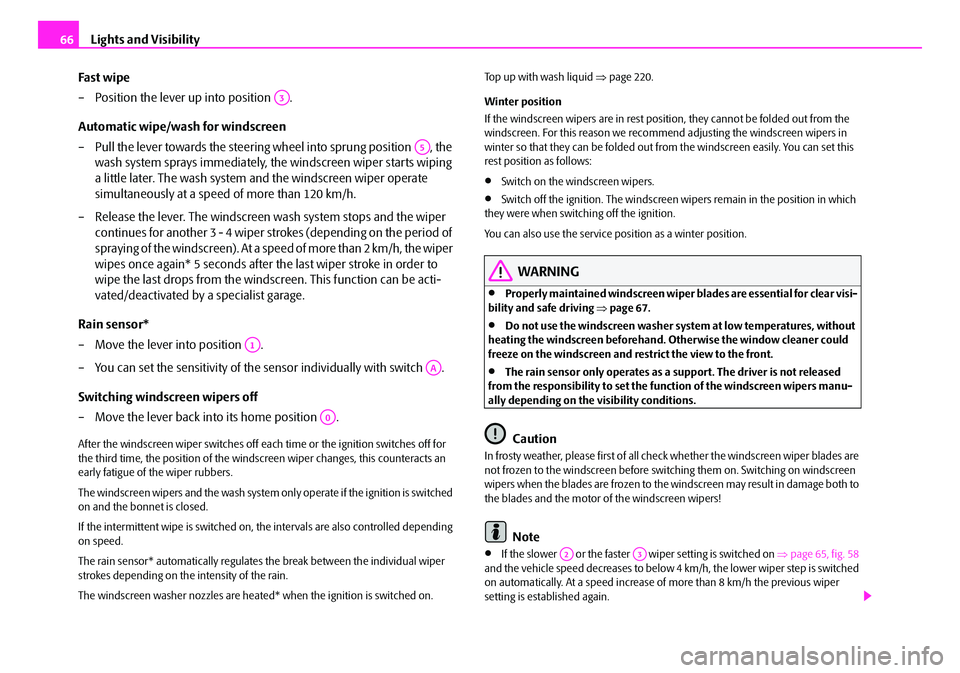
– Position the lever up into position .
Automatic wipe/wash for windscreen
– Pull the lever towards the steering wheel into sprung position , the wash system sprays immediately, the windscreen wiper starts wiping
a little later. The wash system and the windscreen wiper operate
simultaneously at a speed of more than 120 km/h.
– Release the lever. The windscreen wash system stops and the wiper continues for another 3 - 4 wiper stro kes (depending on the period of
spraying of the windscreen). At a speed of more than 2 km/h, the wiper
wipes once again* 5 seconds after the last wiper stroke in order to
wipe the last drops from the windsc reen. This function can be acti-
vated/deactivated by a specialist garage.
Rain sensor*
– Move the lever into position .
– You can set the sensitivity of the sensor individually with switch .
Switching windscreen wipers off
– Move the lever back into its home position .
After the windscreen wiper switches off each time or the ignition switches off for
the third time, the position of the windscreen wiper changes, this counteracts an
early fatigue of the wiper rubbers.
The windscreen wipers and the wash system only operate if the ignition is switched
on and the bonnet is closed.
If the intermittent wipe is switched on, the intervals are also controlled depending
on speed.
The rain sensor* automatically regulates the break between the individual wiper
strokes depending on the intensity of the rain.
The windscreen washer nozzles are heated* when the ignition is switched on. Top up with wash liquid
⇒page 220.
Winter position
If the windscreen wipers are in rest posi tion, they cannot be folded out from the
windscreen. For this reason we recommend adjusting the windscreen wipers in
winter so that they can be folded out fr om the windscreen easily. You can set this
rest position as follows:
•Switch on the windscreen wipers.
•Switch off the ignition. The windscreen wipers remain in the position in which
they were when switching off the ignition.
You can also use the service position as a winter position.
WARNING
•Properly maintained windscreen wiper blades are essential for clear visi-
bility and safe driving ⇒page 67.
•Do not use the windscreen washer system at low temperatures, without
heating the windscreen beforehand. Otherwise the window cleaner could
freeze on the windscreen and re strict the view to the front.
•The rain sensor only operates as a support. The driver is not released
from the responsibility to set the function of the windscreen wipers manu-
ally depending on the visibility conditions.
Caution
In frosty weather, please first of all check whether the windscreen wiper blades are
not frozen to the windscreen before switching them on. Switching on windscreen
wipers when the blades are frozen to the windscreen may result in damage both to
the blades and the motor of the windscreen wipers!
Note
•If the slower or the faster wiper setting is switched on ⇒page 65, fig. 58
and the vehicle speed decreases to below 4 km/h, the lower wiper step is switched
on automatically. At a speed increase of more than 8 km/h the previous wiper
setting is established again.
A3
A5
A1
AA
A0
A2A3
NKO B6 20.book Page 66 Wednesday, March 26, 2008 3:15 PM
Page 68 of 272

Lights and Visibility67
Using the systemSafetyDriving TipsGeneral MaintenanceBreakdown assistanceTechnical Data
•If there is an obstacle on the windscre en, the wiper will try to push away the
obstacle. If the obstacle cont inues to block the wiper, the wiper stops after 5 cycles,
in order to avoid a damage to the wiper. Remove the obstacle and and switch on
the wiper again.
Headlight cleaning system*
The headlights are being cleaned after the windscreen has been sprayed for the first
time and fifth time, the low beam or ma in beam are switched on and the wind-
screen wiper lever was he ld in the position ⇒page 65, fig. 58 for about 1
second.
The headlight washer nozzles are moved forward out of the bumper by the water
pressure for cleaning the headlights.
You should remove stubborn dirt (such as insect residues) from the headlight
lenses at regular intervals, for example when refuelling. Please refer to the following
guidelines.
You should remove any snow from the fixt ures of the washer nozzles and clear ice
in winter with a de-icing spray in order to ensure proper operation of the cleaning
system.
Replacing wiper blades fo r the windscreen wipers
One cannot fold out the wiper arms in the rest position from the wind-
screen. Before replacing the wiper arms you must put them into the
service position.
Service position for changing wiper blades
– Close the bonnet.
– Switch the ignition on and then again off.
– Then press the windscreen wiper lever in the position ⇒page 65,
fig. 58 within 10 seconds - the wiper arms move into the service posi-
tion.
Taking off the wiper blade
– Fold windscreen wiper arm away from the windscreen.
– Press the locking button, in order to unlock the wiper blade and pull off in the direction of arrow ⇒fig. 59 .
Attaching a wiper blade
– Push the wiper blade until it locks up to the stop.
– Check whether the wiper blade is correctly attached.
– Fold the windscreen wiper arm back onto the windscreen.
The wiper arms return to the rest position after switching on the ignition and
changing the position of the window wiper lever or when driving at a speed greater
than 6 km/h.
Wiper blades in proper condition are esse ntial to obtain good visibility. Wiper
blades should not be allowed to become dirtied by dust, insect remains and
preserving wax.
Juddering or smearing of the wiper blades could then be due to wax residues left
on the windscreen by vehicle washing in automatic vehicle wash systems. It is
therefore important to degrease the lips of the wiper blades after every pass
through an automatic vehicle wash system .
A5
Fig. 59 Wiper blade for the
windscreen wiper
A4
NKO B6 20.book Page 67 Wednesday, March 26, 2008 3:15 PM
Page 126 of 272

Automatic gearbox DSG*125
Using the systemSafetyDriving TipsGeneral MaintenanceBreakdown assistanceTechnical Data
D
, with the ignition switched on, on a vehicle travelling at less than 5 km/hour or on
a stationary vehicle.
The brake pedal must be depressed (if the le ver is in its position for longer than 2
seconds) in order to move the selector lever out of the position N into the position
R , with the ignition switched on, on a vehicl e travelling at less than 5 km/hour or on
a stationary vehicle.
D - Drive, position for driving forward
When the selector lever is in this position, the forward gears are shifted up and
down automatically in line with engine load, vehicle speed and the dynamic shift
programme.
You must depress the brake pedal if you wise to move into position D from N when
the vehicle is travelling at less than 5 km/hour or is stationary ⇒.
In certain circumstances (e.g. when driving in mountainous regions or when towing
a trailer) it may be beneficial to select the manual shift programme for a short time
in order to adapt the gearbox ratios manually to the driving situations.
S - Position for sporty style of driving
Shifting up later into a higher gear makes it possible to fully exploit the power
potential of the engine. The gearbox also then shifts down at higher engine speeds
as in the position D.
The Shiftlock on the selector lever grip must be pressed when moving the selector
lever out of the position D into the position S.
WARNING
•Never move the selector lever into position R or P when driving - risk of
an accident!
•When the engine is running and the vehicle is stationary, it is necessary
to hold the car with the brake pedal in all the positions of the selector lever
(except P and N) since the power transmission is never completely inter-
rupted, also not when the engine is idling - the vehicle "creeps".
•You must on no account unintentionally operate the throttle (e.g. by
hand from the engine compartment) if a drive position is engaged when the car is stationary. The vehicle would ot
herwise immediately start off - also
when the handbrake is firmly applied - risk of an accident!
•You must move the selector lever into position P and firmly apply the
handbrake first before you or any othe r person opens the bonnet and starts
working on the engine when it is runn ing - risk of accident! Pay particular
attention to the warning instructions.
Selector lever lock
Automatic selector lever lock
With the ignition on, the selector lever is locked when it is in the positions P and N .
You must first of all depress the brake pedal in order to move the selector lever out
of this position. The warning light
⇒ page 26 lights up in the instrument cluster
as a reminder for the driver when the selector lever is in position P and N:
A time delay element ensures that the sele ctor lever is not blocked when rapidly
switching over the position N (e.g. from R to D). This does, for example, allow one
to seesaw out a stuck vehicle. The selector lever lock will click into place if the lever
is in the N position for more than 2 seconds without the brake pedal being pressed.
The selector lever lock is only active if th e vehicle is stationary or moving at speed
of less than 5 km/hour. The lock is switched off automatically into position N when
the car is travelling at a higher speed.
Shiftlock button
The Shiftlock button in the handle of selector lever prevents certain selector lever
positions being engaged inadvertently. The selector lever lock is cancelled when
you press the Shiftlock button.
Keylock - Ignition key withdrawal lock
You can only withdraw the ignition key after switching off the ignition if the selector
lever is in position P. If the ignition key is withdrawn, the selector lever is blocked in
position P.
WARNING (continued)
NKO B6 20.book Page 125 Wednesday, March 26, 2008 3:15 PM
Page 199 of 272

Taking care of your vehicle and cleaning the vehicle
200
Plastic parts
External plastic parts are cleaned by normal washing. Plastic parts and synthetic
leather can also be treated with special solvent-free plastic cleaning agents if a
damp cloth is not sufficient. Paint care pr oducts are not suitable for plastic parts.
Caution
Solvent-free cleaners attack the material and can damage it.
Windows
Only use a plastic ice scraper for removing snow and ice from the windows and
mirrors. You should not move the ice scraper forward and backward but in one
direction on the window which you are clea ning in order to avoid any damage to
the surface of the glass.
You can best remove residues of rubber, oil, grease, wax or silicone by using a
special window cleaner or a special silicone remover.
You should also clean the windows regularly from the inside.
Do not use window leathers which you have used to polish the vehicle body to dry
off the windows. Residues of preservati ves in the window leather can dirty the
window and reduce visibility.
Do not affix any stickers over the inside of the rear window to avoid damage to the
heating elements of the rear window heater .
We recommend using a preservative from Škoda genuine accessories offered by
your Škoda dealer.
Caution
Never remove snow or ice from the glass parts with warm or hot water - risk of
formation of cracks in the glass!
The headlight lenses
Please do not use any aggres sive cleaning or chemical solvent pr oducts - risk of
damage to the plastic lenses Please use soap and clean warm water.
Caution
Never wipe the headlights dry and do not use any sharp objects for cleaning the
plastic lenses, this may result in damage to the protective paintwork and conse-
quently in formation of cracks on the head light lenses, e.g through effect of chem-
ical products.
Door and window seals
The rubber seals on the doors, boot lid, bonnet and windows remain supple and
last longer if you treat them from time to time with a rubber care product (e.g. with
a spray with silicone-free oil). You also avoid premature wear of the seals and
prevent leakages in this way. It is also easier to open the doors. Rubber seals which
are well cared for also do not stick together in cold winter weather.
Locks
We recommend that you use the spray from Škoda original accessories with
regreasing and anticorrosive effect for de-icing locks.
Note
When washing your vehicle, ensure that as little water as possible gets into the
locks.
NKO B6 20.book Page 200 Wednesday, March 26, 2008 3:15 PM
Page 207 of 272
Inspecting and Replenishing
208
Inspecting and Replenishing
Engine compartment
Bonnet remote release
Bonnet remote release
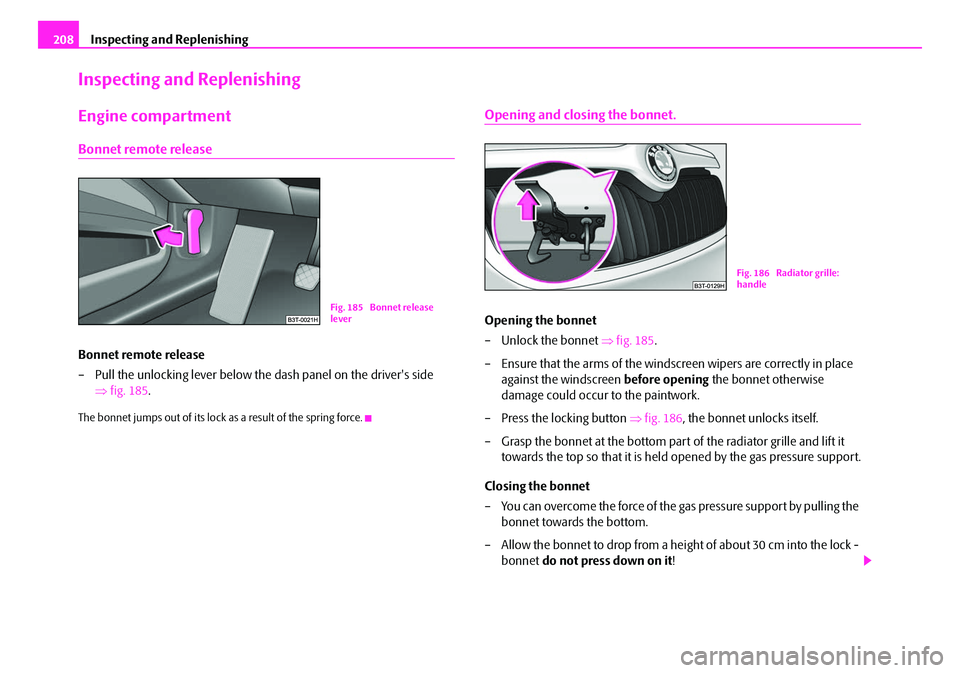
– Pull the unlocking lever below the dash panel on the driver's side
⇒ fig. 185 .
The bonnet jumps out of its lock as a result of the spring force.
Opening and closing the bonnet.
Opening the bonnet
– Unlock the bonnet ⇒fig. 185 .
– Ensure that the arms of the windsc reen wipers are correctly in place
against the windscreen before opening the bonnet otherwise
damage could occur to the paintwork.
– Press the locking button ⇒fig. 186 , the bonnet unlocks itself.
– Grasp the bonnet at the bottom part of the radiator grille and lift it
towards the top so that it is held opened by the gas pressure support.
Closing the bonnet
– You can overcome the force of the gas pressure support by pulling the bonnet towards the bottom.
– Allow the bonnet to drop from a height of about 30 cm into the lock -
bonnet do not press down on it !Fig. 185 Bonnet release
lever
Fig. 186 Radiator grille:
handle
NKO B6 20.book Page 208 Wednesday, March 26, 2008 3:15 PM