2008 SKODA OCTAVIA vin
[x] Cancel search: vinPage 104 of 304

Seats and Stowage103
Using the systemSafetyDriving TipsGeneral MaintenanceBreakdown assistanceTechnical Data
The armrest is adjustable for height and length.
Opening stowage compartment
– Open the lid of the armrest in the direction of arrow ⇒page 102,
fig. 125 .
Closing stowage compartment
– Open the lid up to the stop, then you can fold it downwards.
Setting height
– First of all fold the lid to the bottom and lift it in the direction of arrow into one of the 4 fixed positions.
Adjusting in forward/back direction
– Push the lid into the desired position.
Opening air inlet
– Pull the lock in upward direction ⇒fig. 126 .
Closing air inlet
– Push the lock as far as the stop downwards.
On vehicles fitted with air conditioning, the storage compartment is equipped with
a lockable inlet for thermally treated (warmed-up) air.
At open air supply, air flows into the storage with a temperature which is as high as
the one out of the air outlet nozzles, depending on temperature setting.
The air inlet in the storage compar tment is connected to position
through
adjustment of the control dial for air distribution. This position causes the
maximum amount of air to flow into th e storage compartment (depending on the
rotary regulator position for the fan).
You can use the storage compartment, for example, to temper drinks cans, etc.
If you do not use the air inlet in the storage compartment, the end cover
should always be kept closed.
Note
Push the lid of the armrest up to stop to the rear before operating the handbrake.
Rear seat armrest with storage compartment*
A storage compartment* is located in the armrest. You open the compartment by
pressing the button on the front side and raising the cover ⇒fig. 127 .
Fig. 126 Armrest: Cooling of
storage compartment
AA
AA
Fig. 127 Armrest of rear
seats:
20A5Facelift.book Page 103 Saturday, September 6, 2008 2:13 PM
Page 106 of 304

Seats and Stowage105
Using the systemSafetyDriving TipsGeneral MaintenanceBreakdown assistanceTechnical Data
Opening from luggage compartment
– Push the unlock button downwards ⇒page 104, fig. 130 and fold
the lid (with armrest) to the front.
Closing
– Fold the lid and the armrest up to the stop in upward direction - the lid must click into place audibly.
Ensure that the armrest is always locked into place after closing. You can recognize
this on the fact that the red field above the unlocking button of the luggage
compartment is not visible.
Through-loading bag*
Loading
– Open the boot lid/luggage compartment door.
– Push the unlock button downwards ⇒fig. 131 and fold the lid
(with armrest) to the front.
– Place the empty through-loading bag in such a way that the end of the bag with the zip lies in the boot.
– Push the objects into the through-loading bag from the boot ⇒.
Securing
– Insert the securing belt of the through-loading bag into the middle seat belt buckle ⇒fig. 132 .
– Place the securing belt on ski sport articles in the middle between the bindings ⇒.
– Pull the securing belt tight at the free end of the belt .
Stowing
– Fold the lid and the armrest up to the stop in upward direction - the lid must click into place audibly. You can recognize this on the fact that
the red field above the unlocking button of the luggage compart-
ment is not visible ⇒fig. 131.
AA
AA
Fig. 131 Luggage compart-
ment: Unlock button
Fig. 132 Attaching through-
loading bag to middle seat
belt buckle of rear seats
AA
AA
AC
AB
AA
20A5Facelift.book Page 105 Saturday, September 6, 2008 2:13 PM
Page 107 of 304

Seats and Stowage
106
– Carefully fold the empty (dry) through-loading bag together, place it in the luggage compartment and secure it to prevent it slipping.
WARNING
•After placing items into the through- loading bag, you must secure the
bag with the securing belt .
•The securing belt must hold the items tight.
•Ensure that the securing belt on ski sport articles lies in the middle
between the bindings (see imprint on the through-loading bag).
Note
•Place the skis with the tips facing the front, snowboards and ski sticks with the
tips facing the rear into the through-loading bag.
•If there are several pairs of skis in the through-loading bag, ensure that the bind-
ings are positioned at the same height.
•The through-loading bag must never be folded together or stowed when
moist.
Side compartment*
– You can open the compartment by turning the locks in the direction of arrow.
The CD changer* is housed in this compartment.
Stowage compartment behind the rear seats (estate
car)
Removing
– First remove the luggage compartment cover ⇒page 89.
– Grasp the compartment with both hands and remove it by pulling in direction of arrow ⇒fig. 134 .
Installing
– Push the compartment up to the stop into the catch.
– Re-insert the luggage compartment cover.
WARNING
Only place small and light objects up to a total weight of 3 kg into the
stowage compartment. In the event of a vehicle collision heavy objects
AA
Fig. 133 Luggage compart-
ment: Side compartment
Fig. 134 Removing the
stowage compartment
20A5Facelift.book Page 106 Saturday, September 6, 2008 2:13 PM
Page 108 of 304
Seats and Stowage107
Using the systemSafetyDriving TipsGeneral MaintenanceBreakdown assistanceTechnical Data
could be thrown out of the compartment - risk of injuries! For this reason,
the front part of the luggage compartmen
t cover must always cover over the
stowage compartment.
Clothes hooks*
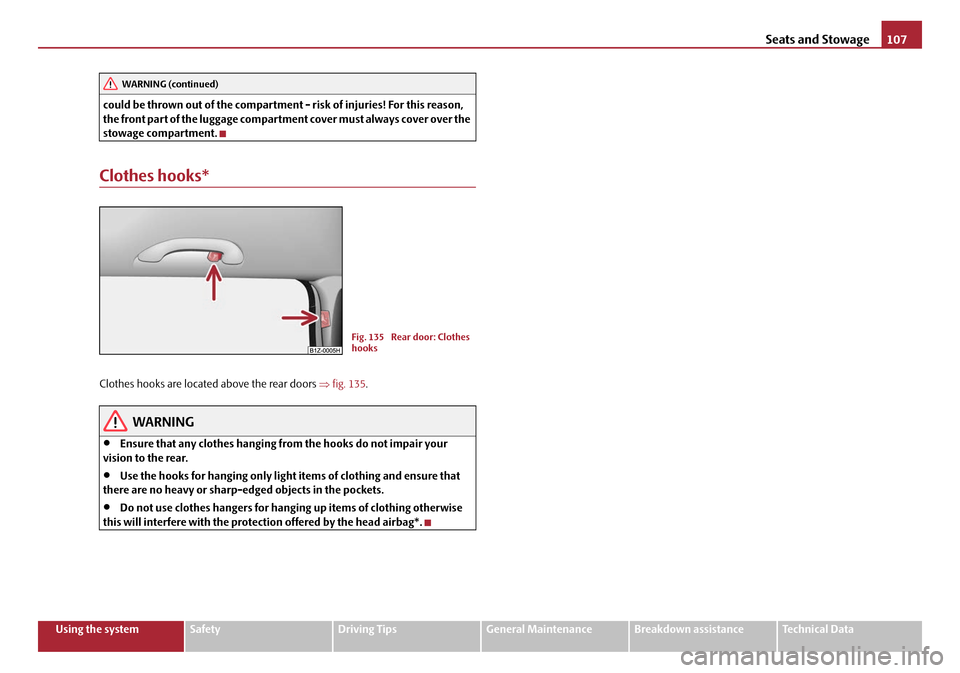
Clothes hooks are located above the rear doors ⇒fig. 135 .
WARNING
•Ensure that any clothes hanging from the hooks do not impair your
vision to the rear.
•Use the hooks for hanging only light items of clothing and ensure that
there are no heavy or sharp- edged objects in the pockets.
•Do not use clothes hangers for hanging up items of clothing otherwise
this will interfere with the protection offered by the head airbag*.
WARNING (continued)
Fig. 135 Rear door: Clothes
hooks
20A5Facelift.book Page 107 Saturday, September 6, 2008 2:13 PM
Page 110 of 304

Heating and air conditioning system109
Using the systemSafetyDriving TipsGeneral MaintenanceBreakdown assistanceTechnical Data
Heating
Using the system
The heating system delivers air into the interior of the vehicle and
warms it as required.
Fig. 138 Heating: Control elements
Setting temperature
– Turn the control dial ⇒fig. 138 to the right in order to increase the
temperature.
– Turn the control dial to the left in order to increase the tempera- ture.
Controlling blower
– Turn the blower switch into one of the positions, 1 to 4, in order to switch the blower on.
– Turn the blower switch into position 0 in order to switch the blower off. – Pressing button causes the recirculating air system
⇒ to be
switched on.
Control for air distribution
– You can adjust the direction of the air flow using the air distribution control ⇒page 108.
Rear window heater
– Press button . Further information ⇒page 67, “Rear window
heater”.
Auxiliary heating (auxiliary heating)*
– Press the button in order to directly switch on/off the auxiliary heating (auxiliary heating and ve ntilation). Further information
⇒ page 119, “Auxiliary heating (auxiliary heating and ventilation)*”.
The air inlet in front of the windscreen must be free of ice, snow or leaves in order
to ensure that the heating and ventilation systems operate properly.
The heating effect is dependent upon th e coolant temperature, thus full heat
output only occurs when the engine has reached its operating temperature.
The blower should aways be on to prevent the windows from misting up.
WARNING
You should not leave recirculated air mode on over a longer period of time,
as “stale” air may result in fatigue in the driver and occupants, divert your
attention and also cause the windows to mist up. The risk of having an acci-
dent increases. Switch recirculated air mode off as soon as the windows
begin misting up.
Note
•The whole heat output will be needed to unfrost the windscreen and side
windows. No warm air will be fed to the footwell. This can lead to restriction of the
heating comfort.
AA
AA
AB
AB
A1
AC
A2
A3
20A5Facelift.book Page 109 Saturday, September 6, 2008 2:13 PM
Page 112 of 304

Heating and air conditioning system111
Using the systemSafetyDriving TipsGeneral MaintenanceBreakdown assistanceTechnical Data
Recirculated air mode
In recirculated air mode air is sucked out of the interior of the vehicle
and then fed back into the interior.
Recirculated air mode prevents polluted air outside the vehicle from
getting into the vehicle, for example when driving through a tunnel or
when standing in a traffic jam.
Switching recirculated air mode on
– Press the button - the warning light lights up in the button
⇒page 109, fig. 138 .
Switching recirculated air mode off
– Press again the button - the warning light in the button goes out.
The recirculated air mode is switched off au tomatically if the air distribution control
is in position ⇒ page 109, fig. 138 . You can also switch recirculated air mode
on again from this setting by repeatedly pressing button .
WARNING
You should not leave recirculated air mode on over a longer period of time,
as “stale” air may result in fatigue in the driver and occupants, divert your
attention and also cause the windows to mist up. The risk of having an acci-
dent increases. Switch recirculated air mode off as soon as the windows
begin misting up.
Climatic* (semi-automatic air conditioning system)
Description
The Climatic is a combined cooling and heating system. It makes it
possible to optimally control the air temperature at any season of the
year.
Description of the Climatic
It is important for your safety and for your driving comfort that the Climatic is oper-
ating properly.
The cooling only operates if button ⇒page 112, fig. 139 is pressed, and the
following conditions are met:
•engine running,
•outside temperature above approx. +2°C and
•blower switch switched on (positions 1 to 4).
If the cooling system is switched on, th e temperature and air humidity drops in the
vehicle. The wellbeing of the occupants of the car is enhanced as a result of this
particularly at high outside temperatur es and a high air humidity. The system
prevents the windows misting up during the cold season of the year.
The heating effect is dependent upon th e coolant temperature, thus full heat
output only occurs when the engine has reached its operating temperature.
It is possible to briefly activate recirc ulated air mode in order to enhance the
cooling effect ⇒.
Air at a temperature of about 5°C may flow out of the vents under certain circum-
stances when the cooling system is operating. Lengthy and uneven distribution of
the air flow out of the vents and large differences in temperature, for example when
getting out of the vehicle, can resu lt in chills in sensitive persons.
The air inlet in front of the windscreen must be free of ice, snow or leaves in order
to ensure that the heating and cooling systems operate properly.
After switching on the cooling Condensation from the evaporator of the air condi-
tioning may drip down and form a puddle below the vehicle. This is quite normal
and not an indication of a leak!
AC
ACA1
20A5Facelift.book Page 111 Saturday, September 6, 2008 2:13 PM
Page 113 of 304

Heating and air conditioning system
112
WARNING
•For your own safety and that of other road users, ensure that all the
windows are free of ice, snow and mistin g. Please familiarize yourself about
how to correctly operate th e heating and ventilation systems, how to demist
and defrost the windows, as well as with the cooling mode.
•You should not leave recirculated air mode on over a longer period of
time, as “stale” air may result in fatigue in the driver and occupants, divert
your attention and also cause the windows to mist up. The risk of having an
accident increases. Switch recirculated air mode off as soon as the windows
begin misting up.
Note
•We recommend that you do not smoke in the vehicle when the recirculating air
mode is operating since the smoke which is drawn at the evaporator from the inte-
rior of the vehicle forms deposits in the evaporator of the air conditioning system.
This produces a permanent odour when the air conditioning system is operating
which can only be eliminated through co nsiderable effort and expense (replace-
ment of compressor).
Using the system
Fig. 139 Climatic: Control elements
Setting temperature
– Turn the control dial ⇒fig. 139 to the right in order to increase the
temperature.
– Turn the control dial to the left in order to increase the tempera- ture.
Controlling blower
– Turn the blower switch into one of the positions, 1 to 4, in order to
switch the blower on.
– Turn the blower switch into positi on 0 in order to switch the blower
off.
– Pressing button - causes the recirculating air system
⇒ page 114 to be switched on.
AA
AA
AB
AB
A4
20A5Facelift.book Page 112 Saturday, September 6, 2008 2:13 PM
Page 114 of 304

Heating and air conditioning system113
Using the systemSafetyDriving TipsGeneral MaintenanceBreakdown assistanceTechnical Data
Control for air distribution
– You can adjust the direction of the air flow using the air distribution
control ⇒page 108.
switching cooling on and off
– Press the button ⇒page 112, fig. 139 . The warning light lights
up in the button.
– When you again press the switch , the cooling system is switched off. The warning light in the button goes out.
Rear window heater
– Press button . Further information ⇒page 67, “Rear window
heater”.
Auxiliary heating (auxiliary heating)
– Press the button in order to directly switch on/off the auxiliary heating (auxiliary heating and ventilation. Further information
⇒page 119, “Auxiliary heating (auxil iary heating and ventilation)*”.The set temperature will be automatically maintained other than when the
control dial is on the extreme right or extreme left position:
•Extreme right position - full heating;
•Extreme left position - full cooling;
•The blower should aways be on to prevent the windows from misting up.
Note
•The whole heat output will be needed to unfrost the windscreen and side
windows. No warm air will be fed to the footwell. This can lead to restriction of the
heating comfort.
•The used air streams out through the air removal openings in the luggage
compartment.
•If the cooling system has not been switched on for a lengthy period, odours may
be produced at the evaporator because of deposits. Switch the cooling system on
at least once a month for approximately 5 mi nutes at the highest blower stage - also
during the cold season of the year - in order to remove such odours. Also open a
window for a short time.
•Please refer to the information regarding recirculated air mode ⇒page 114.
Set Climatic
Recommended settings of Climatic controls for the respective operating modes:
AC
ACA1
AC
A2
A3
Set-upSetting of the control dialButtonAir outlet vents 3
Defrosting the windscreen and
side windowsrecommended
22°C3switched offdo not switch onopen and align with the side window
Free windscreen and side win-
dows from mistdesired tempera-ture2switched ondo not switch onopen and align with the side window
the fastest heatingrecommended
22°C2switched offbriefly switched onopen
AAABACA1A4
20A5Facelift.book Page 113 Saturday, September 6, 2008 2:13 PM