2008 Seat Alhambra warning
[x] Cancel search: warningPage 254 of 295

If and when
252Towing and tow-startingTow-starting*
The use of jump leads is preferable to tow-starting.We recommend that you do not tow-start your vehicle. Jump-starting
is preferable ⇒page 249.
However, if your vehicle has to be tow-started:
–Engage the 2
nd or the 3
rd gear.
– Keep the clutch pressed down.
– Switch on the ignition.
– Once both vehicles are moving, release the clutch.
– As soon as the engine starts, press the clutch and move the gear lever into neutral. This helps to prevent driving into the towing
vehicle.
WARNING
The risk of accidents is high when tow-starting. The vehicle being towed
can easily collide with the towing vehicle.
Caution
When tow-starting, fuel could enter the catalytic converter and damage it.
Towing eye at the front of the vehicleThe towline anchorage is located on the right of the front bumper ⇒fig. 173.
To access the housing it is necessary to remove the cover.
Removing the cover of the front towing eye
- Remove the cover in the direction shown by the arrow ⇒fig. 173 levering
it out with a screwdriver.
Assembling the cover of the front towing eye
- Put the cover into its socket and press until it is firmly in place.
- Check that it is correctly fitted.
The towing eye should always be kept in the vehicle. Remember the instruc-
tions for tow starting or towing that are in the user's manual
Fig. 173 Towing eye at
the front of the vehicle
alhambra_ingles_0708 Seite 252 Mittwoch, 10. September 2008 10:55 10
Page 255 of 295

If and when253
Safety First
Operating instructions
Tips and Maintenance
Te c h n i c a l D a t a
Rear towline anchorageOn the right hand side of the lower rear section of the body, there is a fixed
towline anchorage ⇒ fig. 174 (arrow).
To w i n g b r a c k e t
If the vehicle has a factory-fitted towing bracket, it should also be used for
towing other vehicles.To w - s t a r t i n g
The use of jump leads is preferable to tow-starting.We recommend that you do not tow-start your vehicle. Jump-starting
is preferable ⇒page 250. However, if your vehicle has to be tow-started:
– Engage 2nd or 3rd gear.
– Keep the clutch pressed down.
– Switch on the ignition and switch on the hazard warning lights.
– Once both vehicles are moving, release the clutch.
– As soon as the engine starts, press the clutch and move the gear
lever into neutral. This helps to prevent driving into the towing
vehicle.
WARNING
The risk of accidents is high when tow-starting. The vehicle being towed
can easily collide with the towing vehicle.
Caution
When tow-starting, fuel could enter the catalytic converter and damage it.
Note
•
The legal requirements concerning towing should be observed.
•
Switch on the hazard warning lights of both vehicles. However, observe
any regulations to the contrary.
•
For technical reasons, vehicles with an automatic gearbox must not be
tow-started.
Fig. 174 Rear towline
anchorage
alhambra_ingles_0708 Seite 253 Mittwoch, 10. September 2008 10:55 10
Page 256 of 295

If and when
254Notes for tow-starting or towingIf a cable is used for towing the vehicle, please observe the
following:
As the driver of the towing vehicle
– Switch on the hazard warning lights. However, observe any regu-
lations to the contrary.
– Drive slowly at first until the tow-rope is taut. Then accelerate gradually.
– Begin and change gears cautiously. If you are driving an auto- matic vehicle, accelerate gently.
– Remember that the brake servo and power steering are not working in the vehicle you are towing. Brake earlier than you
would normally, but with a more gentle pressure on the brake.
As the driver of the vehicle being towed
– Switch on the hazard warning lights. However, observe any regu- lations to the contrary.
– Place the gearstick in neutral or position N .
– Ensure that the tow-rope remains taut at all times.Tow-rope or tow-bar
It is easier and safer to tow a vehicle with a tow-bar. You should only use a
tow-rope if you do not have a tow-bar.
A tow-rope should be slightly elastic to reduce the loading on both vehicles.
It is advisable to use a tow-rope made of synthetic fibre or similarly elastic
material. Attach the tow-rope or the tow-bar only to the towing eyes provided or a
towing bracket.
Driving tips
Towing requires some experience, especially when using a tow-rope. Both
drivers should be familiar with the technique required for towing. Inexperi-
enced drivers should not attempt to tow-start or tow away another vehicle.
Do not pull too hard with the towing vehicle and take care to avoid jerking the
tow-rope. When towing on an unpaved road, there is always a risk of over-
loading and damaging the anchorage points.
The ignition of the vehicle being towed must be switched on to prevent the
steering wheel from locking and also to allow the use of the turn signals,
horn, windscreen wipers and washers.
If the vehicle is towed, with the hazard warning lights on and the ignition
switched on, the turn signal may be used to indicate that you are going to
change direction. Move the turn signal lever accordingly. Meanwhile, the
hazard warning lights will go off. When the turn signal lever is returned to the
rest position, the hazard warning lights will automatically reconnect.
The brake servo works only when the engine is running. In this case the pedal
has to be pressed harder.
As the power assisted steering does not work if the engine is not running, you
will need more strength to steer than you normally would.
Towing vehicles with an automatic gearbox
•
Move the selector lever to N.
•
Do not drive faster than 50 km/h when towing a vehicle.
•
Do not tow further than 50 km.
•
If a breakdown truck is used, the vehicle must be towed with the front
wheels raised.
alhambra_ingles_0708 Seite 254 Mittwoch, 10. September 2008 10:55 10
Page 257 of 295
If and when255
Safety First
Operating instructions
Tips and Maintenance
Te c h n i c a l D a t a
WARNING
The braking behaviour and capacity of a vehicle changes when being towed
or when you are trying to start the vehicle by pulling. Please observe the
following notes in order to prevent injury and accident:•
Inexperienced drivers should refrain from trying in order to avoid acci-
dent.
•
Notes for the driver of the towed vehicle
− The brake must be depressed must harder as the brake servo does
not operate. Take care not to bump into the towing vehicle.
− More strength is required at the steering wheel as the power
steering does not operate when the engine is switched off.
•
Notes for the driver of the towing vehicle
− Accelerate smoothly and avoid any sudden movement.
− Brake more in advance than usual and brake gently.Caution
When tow-starting, fuel could enter the catalytic converter and damage it
⇒ page 252.
Note
•
Observe legal requirements when towing or tow-starting.
•
For technical reasons, vehicles with an automatic gearbox must not be
tow-started.
•
If, due to a breakdown, the gearbox does not have lubricant, the vehicle
should be towed with the drive wheels suspended.
•
If it is necessary to tow a vehicle with an automatic gearbox for more than
50 km, it should be towed by qualified personnel and with the drive wheels
suspended.
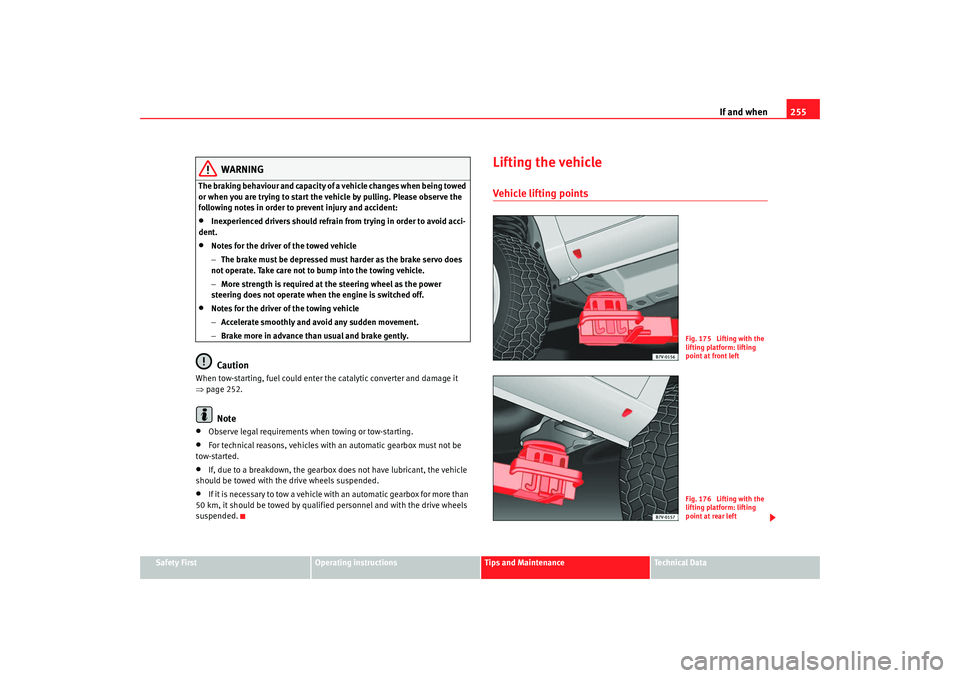
Lifting the vehicleVehicle lifting points
Fig. 175 Lifting with the
lifting platform: lifting
point at front leftFig. 176 Lifting with the
lifting platform: lifting
point at rear left
alhambra_ingles_0708 Seite 255 Mittwoch, 10. September 2008 10:55 10
Page 258 of 295

If and when
256Your vehicle may only be lifted by a lifting platform at the points shown in the
illustrations ⇒page 255, fig. 175 and ⇒page 255, fig. 176 ⇒ .
Using the jack to lift the vehicle ⇒page 239.
To prevent damage to the underside of the vehicle when lifting the vehicle,
rubber pads must be used.
Before driving onto a lifting platform, you must check there is sufficient clear-
ance between low parts of the vehicle and the lifting platform.
WARNING
If the lifting platform is inappropriate or the vehicle is lifted incorrectly,
accidents or injuries may be caused. The vehicle could even fall from the
lifting platform.•
All occupants should leave the vehicle before it is lifted.
•
The vehicle must only be lifted at the points indicated in the diagrams
⇒ page 255, fig. 175 and ⇒page 255, fig. 176 . If the vehicle is not lifted
at the indicated points, it may fall from the platform while the engine or
gearbox is being dismounted, for example.
•
Never start the engine when the vehicle is raised. Risk of accident. The
vehicle may fall from the platform due to the engine vibrations.
•
When work is being carried out underneath the vehicle, it must be
secured using suitable frames. If not, an accident may occur.
•
To lift the vehicle, only two-pillar or two-post lifting platforms with
sufficiently long arms and load-bearing capacity should be used.
•
Lifting platforms with fluid filled cushions may not be used for lifting
the vehicle.Caution
•
The vehicle should never be lifted at the engine oil sump, the gearbox, or
the front or rear axle. This could cause serious damage to the vehicle.
•
Before driving onto a lifting platform, you must check there is sufficient
clearance between low parts of the vehicle and the lifting platform.
alhambra_ingles_0708 Seite 256 Mittwoch, 10. September 2008 10:55 10
Page 262 of 295

General notes on the technical data
260WeightsKerb weight refers to the basic model with a fuel tank filled to 90% capacity
and without optional extras. The figure quoted includes 75 kg to allow for the
weight of the driver.
For special versions and optional equipment fittings or for the addition of
accessories, the weight of the vehicle will increase ⇒.
WARNING
•
Please note that the centre of gravity may shift when transporting
heavy objects; this may affect the vehicle's handling and lead to an acci-
dent. Always adjust your speed and driving style to suit road conditions
and requirements.
•
Never exceed the gross axle weight rating or the gross vehicle weight
rating. If the allowed axle load or the allowed total weight is exceeded, the
driving characteristics of the vehicle may change, leading to accidents,
injuries and damage to the vehicle.
To w i n g a t r a i l e rTra iler weig htsTrailer weigh ts
The trailer weights and drawbar loads approved are selected in intensive
trials according to precisely defined criteria. The approved trailer weights are
valid for vehicles in the EU for maximum speeds of 80 km/h (in certain
circumstances up to 100 km/h). The figures may be different in other coun-
tries. All data in the official vehicle documents take precedence over these
data ⇒ . Drawbar load
The
maximum permitted weight exerted by the trailer drawbar on the ball joint
of the towing bracket must not exceed 85 kg.
In the interest of road safety, we recommend that you always tow
approaching the maximum drawbar load. The response of the trailer on the
road will be poor if the drawbar load is too small.
If the maximum permissible drawbar load cannot be met (e.g. with small,
empty and light-weight single axle trailers or tandem axle trailers with an axle
base of less than 1 metre), at least 4% of the actual trailer weight is a legal
stipulation for a drawbar load.
WARNING
•
For safety reasons, you should not drive at speeds above 80 km/h when
towing a trailer. This also applies to countries where higher speeds are
permitted.
•
Never exceed the maximum trailer weights or the draw bar loading. If
the permissible axle load or the permissible total weight is exceeded, the
driving characteristics of the vehicle may change, leading to accidents,
injuries and damage to the vehicle.
WheelsTyre pressure, snow chains, wheel boltsTyre pressu res
The sticker with the tyre pressure values can be found on the inside of the
tank flap. The tyre pressure values given there are for cold tyres. The slightly
raised pressures of warm tyres must not be reduced. ⇒
alhambra_ingles_0708 Seite 260 Mittwoch, 10. September 2008 10:55 10
Page 263 of 295

General notes on the technical data261
Safety First
Operating instructions
Tips and Maintenance
Te c h n i c a l D a t a
Snow chains
Snow chains may be fitted only to the
front wheels.
Consult the chapter “wheels” of this manual.
Wheel bolts
After the wheels have been changed, the tightening torque of the wheel bolts
s h ou l d b e ch e cke d as s oo n as p o ssi bl e wit h a to rq u e w re n ch ⇒. The tight-
ening torque for steel and alloy wheels is 120 Nm.
WARNING
•
Check the tyre pressure at least once per month. Correct tyre pressure
is very important. If the tyre pressure is too high or too low, there is an
increased danger of accidents, particularly at high speeds.
•
If the torque of the wheel bolts is too low, they could loosen whilst the
vehicle is in motion. Risk of accident! If the tightening torque is too high,
the wheel bolts and threads could be damaged.Note
We recommend that you ask your Authorised Service Centre for information
about appropriate wheel, tyre and snow chain size.
alhambra_ingles_0708 Seite 261 Mittwoch, 10. September 2008 10:55 10
Page 285 of 295

Index283
Index4MOTION . . . . . . . . . . . . . . . . . . . . . . . . . . . . . . 184AABS . . . . . . . . . . . . . . . . . . . . . . . . . . . . . . . . . . . 180
Warning lamp . . . . . . . . . . . . . . . . . . . . . . . . . 74
warning lamp . . . . . . . . . . . . . . . . . . . . . . . . 181
Accessories . . . . . . . . . . . . . . . . . . . . . . . . . . . . 202
Acoustic signal . . . . . . . . . . . . . . . . . . . . . . . . . . 18
Acoustic warning . . . . . . . . . . . . . . . . . . . . . . . . 162
Additional instruction manual Roof carrier . . . . . . . . . . . . . . . . . . . . . . . . . . 148
Adjust seats rear seats . . . . . . . . . . . . . . . . . . . . . . . . . . . 127
Adjusting lumbar support . . . . . . . . . . . . . . . . . 124
Air conditioning manual faults in operation . . . . . . . . . . . . . . . . . . . . 158
Air conditioning system Climatronic . . . . . . . . . . . . . . . . . . . . . . . . . . 152
General notes . . . . . . . . . . . . . . . . . . . . . . . . 158
Air recirculation mode Climatronic . . . . . . . . . . . . . . . . . . . . . . . . . . 155
Airbag cover . . . . . . . . . . . . . . . . . . . . . . . . . . . . . 38
Airbag covers . . . . . . . . . . . . . . . . . . . . . . . . . . . . 38 Airbag system . . . . . . . . . . . . . . . . . . . . . . . . . . . 32
Curtain airbags . . . . . . . . . . . . . . . . . . . . . . . 41
Front airbags . . . . . . . . . . . . . . . . . . . . . . . . . 36
Side airbags . . . . . . . . . . . . . . . . . . . . . . . . . . 39
Warning lamp . . . . . . . . . . . . . . . . . . . . . . . . . 33
Airbags Care . . . . . . . . . . . . . . . . . . . . . . . . . . . . . . . . 34
Disposal . . . . . . . . . . . . . . . . . . . . . . . . . . . . . 34
Safety notes . . . . . . . . . . . . . . . . . . . . . . . . . . 34
Alarm system . . . . . . . . . . . . . . . . . . . . . . . . . . . . 96 Switching off . . . . . . . . . . . . . . . . . . . . . . . . . 96
Alterations to the vehicle . . . . . . . . . . . . . . . . . 202
Alternator Warning lamp . . . . . . . . . . . . . . . . . . . . . . . . . 76
Anti-freeze . . . . . . . . . . . . . . . . . . . . . . . . . . . . . 216
Anti-lock brake system Warning lamp . . . . . . . . . . . . . . . . . . . . . . . . . 74
Anti-locking brake system . . . . . . . . . . . . . . . . 180 warning lamp . . . . . . . . . . . . . . . . . . . . . . . . 181
Anti-puncture kit . . . . . . . . . . . . . . . . . . . . . . . . 234 Sealing and inflating tyres . . . . . . . . . . . . . 235
Anti-theft alarm system . . . . . . . . . . . . . . . . . . . . 96 Switching off . . . . . . . . . . . . . . . . . . . . . . . . . 96
Anti-theft wheel bolts . . . . . . . . . . . . . . . . . . . . 238
Aquaplaning . . . . . . . . . . . . . . . . . . . . . . . . . . . 227
Armrest . . . . . . . . . . . . . . . . . . . . . . . . . . . . . . . . 130 Ashtrays
Front . . . . . . . . . . . . . . . . . . . . . . . . . . . . . . . 139
rear . . . . . . . . . . . . . . . . . . . . . . . . . . . . . . . . 140
Automatic belt retractor . . . . . . . . . . . . . . . . . . . 22
Automatic car washes . . . . . . . . . . . . . . . . . . . . 194
Automatic gearbox . . . . . . . . . . . . . . . . . . . . . . 167 Safety interlock for ignition key . . . . . . . . . 163
Automatic gearbox with Tiptronic . . . . . . . . . . 172
Automatic mode Climatronic . . . . . . . . . . . . . . . . . . . . . . . . . . 153
Automatic wipe Windscreen wiper and washer . . . . . . . . . . 116
automatic wipe Rear window wiper and wash . . . . . . . . . . . 117
AUX-IN Input . . . . . . . . . . . . . . . . . . . . . . . . . . . . 142
BBall coupling . . . . . . . . . . . . . . . . . . . . . . . . . . . 191
BAS . . . . . . . . . . . . . . . . . . . . . . . . . . . . . . . . . . . 180
Battery Changing . . . . . . . . . . . . . . . . . . . . . . . . . . . 224
Charging . . . . . . . . . . . . . . . . . . . . . . . . . . . . 224
Winter conditions . . . . . . . . . . . . . . . . . . . . 223
Belt height adjustment . . . . . . . . . . . . . . . . . 26, 29
Belt retainer . . . . . . . . . . . . . . . . . . . . . . . . . . . . . 29
Belt tension device Disposal . . . . . . . . . . . . . . . . . . . . . . . . . . . . . 30
alhambra_ingles_0708 Seite 283 Mittwoch, 10. September 2008 10:55 10