2008 SAAB 9-3 brake
[x] Cancel search: brakePage 151 of 320

151 Starting and driving
Ignition switch ________ 152
Steering wheel lock ____ 154
Starting the engine ____ 154
Important considerations
for driving __________ 156
Refueling ____________ 159
Engine Break-in Period _ 163
Manual transmission___ 164
Automatic
transmission3
33 3______ 165
Cruise control ________ 171
Braking ______________ 172
Traction Control System
(TCS) ______________ 175
Electronic Stability
Program ESP
®
______ 177
Parking brake_________ 179
Parking ______________ 179
Saab Parking
Assistance3
33 3________ 182 Economical driving _____ 185
Driving in cold weather__ 187
Driving in hot climates __ 189
Towing a trailer3
33 3______ 190
Driving with a roof rack
load ________________ 194
Driving with a load _____ 196
Driving with the trunk lid
open________________ 196
Driving in deep water ___ 196
Driving at night ________ 197
Towing the car _________ 197
Jump starting _________ 200
For long trips __________ 202
Starting and driving
3Asterisk means: equipment not fitted in all cars
(can depend on model variant, engine variant,
market specification, options or accessories).93_US_M08.book Page 151 Friday, May 11, 2007 11:37 AM
ProCarManuals.com
Page 152 of 320
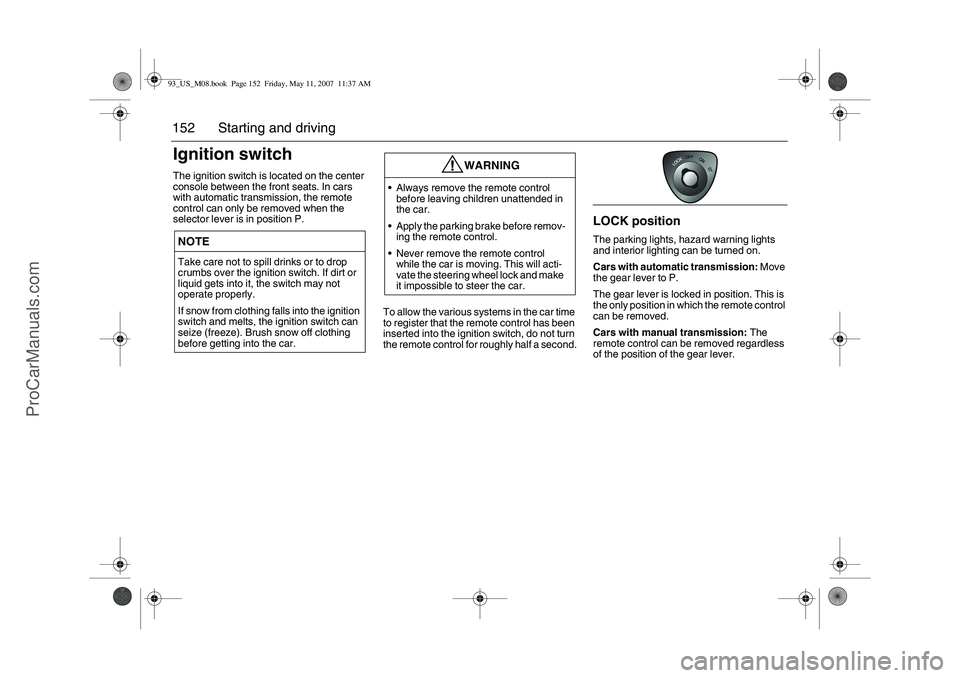
152 Starting and drivingIgnition switchThe ignition switch is located on the center
console between the front seats. In cars
with automatic transmission, the remote
control can only be removed when the
selector lever is in position P.
To allow the various systems in the car time
to register that the remote control has been
inserted into the ignition switch, do not turn
the remote control for roughly half a second.
LOCK positionThe parking lights, hazard warning lights
and interior lighting can be turned on.
Cars with automatic transmission: Move
the gear lever to P.
The gear lever is locked in position. This is
the only position in which the remote control
can be removed.
Cars with manual transmission: The
remote control can be removed regardless
of the position of the gear lever.
NOTETake care not to spill drinks or to drop
crumbs over the ignition switch. If dirt or
liquid gets into it, the switch may not
operate properly.
If snow from clothing falls into the ignition
switch and melts, the ignition switch can
seize (freeze). Brush snow off clothing
before getting into the car.
WARNING
Always remove the remote control
before leaving children unattended in
the car.
Apply the parking brake before remov-
ing the remote control.
Never remove the remote control
while the car is moving. This will acti-
vate the steering wheel lock and make
it impossible to steer the car.
93_US_M08.book Page 152 Friday, May 11, 2007 11:37 AM
ProCarManuals.com
Page 155 of 320

155 Starting and driving
Starting the engineAvoid racing the engine or loading it heavily
before it has warmed up. Do not drive away
before the warning and indicator lights have
gone out.
The engine has an automatic choke and
should be started as follows:
Cars with manual transmission
To start the engine the clutch pedal must
be fully depressed.
1 Make sure the parking brake is applied.
2 Depress the clutch pedal but do not
touch the accelerator.
3 Start the engine. Let the ignition switch
spring back as soon as the engine has
started and is running smoothly.
Allow the engine to idle for about
10 seconds. Do not apply full throttle for at
least 3 minutes after starting.Cars with automatic transmission
The selector lever must be in the P or N
position.
1 The selector lever must be in the P or N
position.
2 Keep your foot on the brake pedal.
Note! Once the engine has started, the
brake pedal will sink. This is perfectly
normal.
3 Start the engine. Let the ignition switch
spring back as soon as the engine has
started and is running smoothly.
Allow the engine to idle for about
10 seconds. Do not apply full throttle for at
least 3 minutes after starting.
Useful tips on starting the engineIf the engine has failed to start after several
attempts in very cold weather, proceed as
follows:
1 Turn the ignition switch to ON (it is
essential that you turn the ignition to
ON before depressing the accelerator).
2 Press the accelerator to the floor and run
the starter motor for 5-10 seconds. This
will prevent the engine being flooded
(fully depressed accelerator cuts off the
fuel supply).
3 Now start the engine in the normal way
- do not touch the accelerator.
If the engine stalls immediately after starting
(e.g. if the clutch was released too quickly),
do not touch the accelerator when restarting
the engine.
93_US_M08.book Page 155 Friday, May 11, 2007 11:37 AM
ProCarManuals.com
Page 163 of 320

163 Starting and driving
gasoline whether the fuel contains MMT.
Saab does not recommend the use of such
gasolines.
Fuels containing MMT can reduce the life of
spark plugs and the performance of the
emission control system may be affected.
The malfunction indicator lamp may turn on.
If this occurs, return to your authorized Saab
dealer for service.
Fuels in Foreign Countries
If you plan on driving in another country out-
side the United States or Canada, the
proper fuel may be hard to find. Never use
leaded gasoline or any other fuel not recom-
mended in the previous text on fuel. Costly
repairs caused by use of improper fuel
would not be covered by your warranty.
To check the fuel availability, ask an auto
club, or contact a major oil company that
does business in the country where you will
be driving.
Engine Break-in PeriodPistons, cylinder bores and bearings need
time to obtain uniform, wear-resistant
surfaces.
If a new engine is driven too hard, this grad-
ual process of bedding-in will not be possi-
ble and the life of the engine will be short-
ened.
During the first 1,200 miles (2,000 km),
do not exceed 5,000 rpm.
In addition, refrain from driving the car at full
throttle, other than for brief instances,
during the first 1,800 miles (3,000 km).
Wearing in new brake padsNew brake pads take time to bed in, about
90 miles (150 km) if the car is driven largely
under stop-and-go conditions or about
300 miles (500 km) of highway driving.
To extend the useful life of the pads, avoid
hard braking as much as possible.
93_US_M08.book Page 163 Friday, May 11, 2007 11:37 AM
ProCarManuals.com
Page 165 of 320

165 Starting and driving
Automatic
transmission3
33 3The automatic transmission has an elec-
tronic control module. The control module
receives information including accelerator
position and road speed. Using this and
other information, it controls the hydraulic
pressure of the transmission to ensure that
gear changing is as smooth as possible.The remote control can only be removed
when the selector lever is in the P position.The engine can only be started when the
selector lever is in the P or N position.
When the car is stationary, the engine must
be idling when you move the selector lever
from one position to another. If not, the
transmission could be damaged.
WARNING
Depress the brake pedal when shifting
the selector lever from P or N.
The car must be at a standstill before
P, R or N is selected. You have to have
your foot on the brake pedal to move
the lever out of P. If the car is still
moving when a drive position is subse-
quently selected, this could cause a
crash or damage the automatic trans-
mission.
Never park the car with the selector
lever in a drive position, even if the
parking brake is on.
If you want to leave the car with the
engine running, move the selector
lever to P or N and apply the parking
brake.
NOTEAfter selecting a drive position, pause
briefly to allow the gear to engage (the car
starts to pull a little) before you acceler-
ate.
Selector lever1 Position for manual gear selection
Indication of gear position on main
instrument panel
93_US_M08.book Page 165 Friday, May 11, 2007 11:37 AM
ProCarManuals.com
Page 166 of 320

166 Starting and drivingPark Brake Shift LockThe transmission has a security function
known as Park Brake Shift Lock. To move
the gear selector lever out of the P or N posi-
tion, the gear selector lever detent (catch)
must be pressed in at the same time as the
brake pedal is held depressed.
The detent button on the selector lever has
to be pressed in before the lever can be
moved between certain positions.
Temporary override of Park Brake Shift
Lock, see page 168.
Adaptive gear change patternsThe adaptive gear change pattern function
adapts gear changing to the prevailing driv-
ing conditions. The transmission control
module senses the engine load, vehicle
speed and temperature of the transmission.
A suitable gear change pattern is then
selected automatically to avoid unneces-
sary gear changes and undesired increases
in transmission temperature.
Certain variants use a special change pat-
tern for the first few minutes after a cold start
so that the catalytic converter reaches its
working temperature more quickly.
Thermal transmission protectionThe transmission has built-in protection
against overheating. If the temperature of
the transmission fluid exceeds 302°F
(150°C), engine torque will be limited to
147 ft.lbs. (200 Nm).
The following message is shown on the SID:
If this message appears, stop the car as
soon as it is safe to do so and allow the
engine to idle until the message has gone
out. The selector lever should be in
position P.Gearbox too hot. Make a
safe stop. Open hood.
Selector lever detent93_US_M08.book Page 166 Friday, May 11, 2007 11:37 AM
ProCarManuals.com
Page 167 of 320

167 Starting and driving
Sport mode3
33 3
Sport mode is selected using the
button, while the word SPORT illuminates
on the SID . Changing up occurs later
and changing down occurs earlier at the
same accelerator pedal position.
Sport mode will be deselected if:
The Sport button is depressed again
the engine is switched off.
Lock-upThe transmission’s torque converter has a
lock-up function. This can lock the torque
converter, thus reducing the engine speed
and fuel consumption.Kick-downWhen the accelerator is pressed down fully,
a down change is made to optimize acceler-
ation, e.g. for overtaking.
Following this, the next higher gear will be
selected at the optimum engine speed,
unless you ease off the accelerator before
reaching this.Driving in hilly country with a
heavy loadThe transmission fluid can overheat when
the gearbox is strained, for example, when
driving with a trailer on hilly roads. To avoid
the transmission fluid overheating, always
drive with the selector lever in the D posi-
tion. The adaptive gear change patterns are
then active.
High air temperatures or a faulty oil cooler
can also cause the transmission fluid to
overheat. Overheating reduces the service
life of the fluid.
TowingTowing of cars with automatic transmission,
see page 197.Descending hillsIf the speed of the car increases while
descending a steep hill, despite the acceler-
ator being released, the control module will
change down. If you desire more powerful
engine braking, manually select a lower
gear (see page 170).
WARNING
Remember to use the braking effect of the
engine (1st, 2nd or 3rd gear) when you
are descending long or steep hills to
spare the brakes.
Overheating can cause the brakes to
fade!
93_US_M08.book Page 167 Friday, May 11, 2007 11:37 AM
ProCarManuals.com
Page 168 of 320

168 Starting and drivingLimp-homeIf the transmission malfunctions, the control
module will activate limp-home mode. Driv-
ability will be affected to varying degrees.
Cars with 5-speed transmission3
33 3
In this mode, only 2nd and 5th gears are
available. Select 2nd gear when driving at
low speeds and 5th gear at higher speeds.
2nd gear must be selected manually. Select
5th gear manually or move the selector
lever to D, see page 170.
Cars with 6-speed transmission3
33 3
The car may be totally powerless. If this is
case, have the car transported to a work-
shop to have the problem rectified.
The car may feel weak but can be driven
carefully to a workshop to have the prob-
lem rectified.
Drivability may barely be affected.
Irrespective of the drivability of the car, the
car must be taken to a workshop to have the
problem checked and rectified.Temporary override of Park Brake Shift
Lock
1 Apply the parking brake.
2 Lift up the rubber mat in the storage
compartment ahead of the selector
lever.
3 Under the floor of the storage compart-
ment is a yellow plastic lever. Use a thin
tool, such as a screwdriver, to press and
hold the plastic lever while moving the
selector lever from P to N.
4 Remove the tool.
5 Release the parking brake if the car is to
be moved immediately, otherwise it
should remain on.
Check fuse 6 in the engine bay fuse box.
If the fuse is OK the battery may be dead.
Contact a workshop to have the problem
checked and rectified. We recommend that
you contact a Saab dealer.NOTEDo not tow a trailer if limp-home mode is
engaged.
NOTEDue to electrical problems it may not be
possible to move the selector lever out of
the park position, even if the ignition is
ON. If for some reason the selector lever
has to be moved out of the park position
(i.e. to tow the car a short distance) do as
described below.
Temporary override of Park Brake Shift
Lock
93_US_M08.book Page 168 Friday, May 11, 2007 11:37 AM
ProCarManuals.com