2008 SAAB 9-3 driving lock
[x] Cancel search: driving lockPage 151 of 320

151 Starting and driving
Ignition switch ________ 152
Steering wheel lock ____ 154
Starting the engine ____ 154
Important considerations
for driving __________ 156
Refueling ____________ 159
Engine Break-in Period _ 163
Manual transmission___ 164
Automatic
transmission3
33 3______ 165
Cruise control ________ 171
Braking ______________ 172
Traction Control System
(TCS) ______________ 175
Electronic Stability
Program ESP
®
______ 177
Parking brake_________ 179
Parking ______________ 179
Saab Parking
Assistance3
33 3________ 182 Economical driving _____ 185
Driving in cold weather__ 187
Driving in hot climates __ 189
Towing a trailer3
33 3______ 190
Driving with a roof rack
load ________________ 194
Driving with a load _____ 196
Driving with the trunk lid
open________________ 196
Driving in deep water ___ 196
Driving at night ________ 197
Towing the car _________ 197
Jump starting _________ 200
For long trips __________ 202
Starting and driving
3Asterisk means: equipment not fitted in all cars
(can depend on model variant, engine variant,
market specification, options or accessories).93_US_M08.book Page 151 Friday, May 11, 2007 11:37 AM
ProCarManuals.com
Page 152 of 320
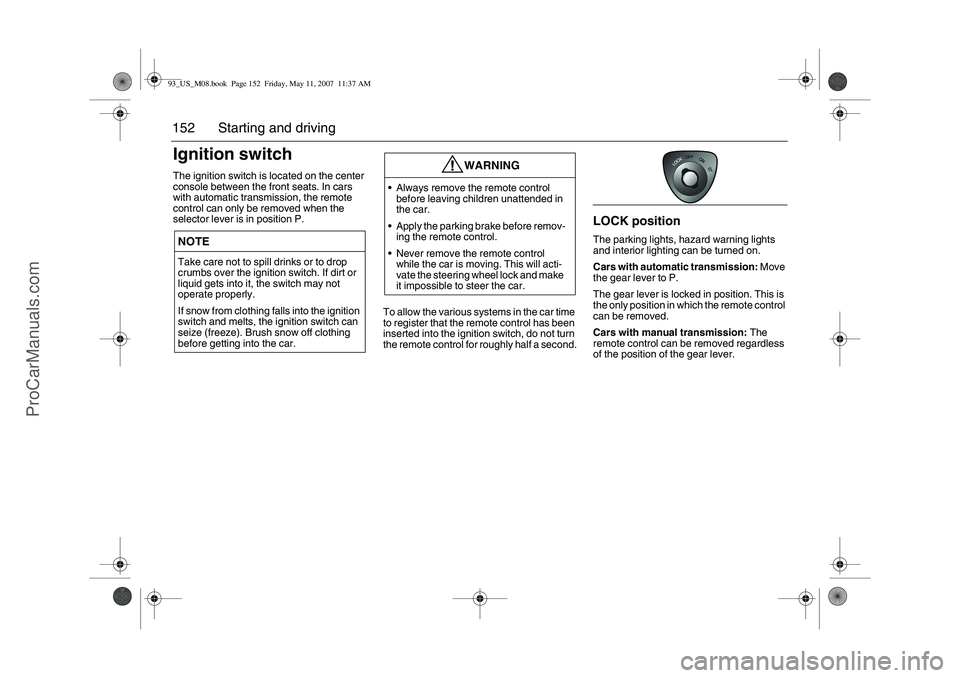
152 Starting and drivingIgnition switchThe ignition switch is located on the center
console between the front seats. In cars
with automatic transmission, the remote
control can only be removed when the
selector lever is in position P.
To allow the various systems in the car time
to register that the remote control has been
inserted into the ignition switch, do not turn
the remote control for roughly half a second.
LOCK positionThe parking lights, hazard warning lights
and interior lighting can be turned on.
Cars with automatic transmission: Move
the gear lever to P.
The gear lever is locked in position. This is
the only position in which the remote control
can be removed.
Cars with manual transmission: The
remote control can be removed regardless
of the position of the gear lever.
NOTETake care not to spill drinks or to drop
crumbs over the ignition switch. If dirt or
liquid gets into it, the switch may not
operate properly.
If snow from clothing falls into the ignition
switch and melts, the ignition switch can
seize (freeze). Brush snow off clothing
before getting into the car.
WARNING
Always remove the remote control
before leaving children unattended in
the car.
Apply the parking brake before remov-
ing the remote control.
Never remove the remote control
while the car is moving. This will acti-
vate the steering wheel lock and make
it impossible to steer the car.
93_US_M08.book Page 152 Friday, May 11, 2007 11:37 AM
ProCarManuals.com
Page 153 of 320

153 Starting and driving
OFF positionParts of the electrical system are operative.
Do not leave the remote control in the
OFF position with the engine not running
as this could cause the battery to run flat
in a matter of hours.
Cars with automatic transmission: The
gear lever is not locked. See also page 166.
If the ignition switch is turned from ON to
OFF before the car is stationary then turning
to LOCK may not be possible. In which case
turn the ignition switch to the ON position
until the ABS lamp goes out,
approx. 2 seconds. Following which, turn it
back to OFF.
ON positionThe entire electrical system is operative.
Do not leave the remote control in the ON
position when the engine is not running.
Turn the ignition switch to the OFF position
to disconnect the electrical system.
When you turn the ignition switch to ON,
some indicator and warning lights will come
on in the main instrument panel. These
should go out after about 3 seconds.
ST - starter positionThe starter motor operates (automatic
transmission: selector lever must be in P or
N) when the ignition switch is turned to this
position. When released, the ignition switch
will spring back to the ON position.
The car has an electronic restart lock. If the
engine fails to start, the ignition switch must
first be turned back to a position between
OFF and LOCK before the starter motor can
be operated again.
93_US_M08.book Page 153 Friday, May 11, 2007 11:37 AM
ProCarManuals.com
Page 154 of 320
154 Starting and drivingSteering wheel lockThe steering wheel lock is electronic. The
lock engages when the remote control is
removed from the ignition and unlocks when
the remote control is inserted. A click can be
heard when the steering wheel lock locks
and unlocks.
If the car is parked with one front wheel
touching the curb, for example, you may
need to turn the steering wheel slightly
when you insert the remote control to allow
the steering wheel lock to unlock. If you do
not succeed on first attempt you must
remove the remote control before trying
again. Turn the steering wheel and insert
the remote control into the ignition switch.
If the steering wheel lock does not disen-
gage it will not be possible to turn the remote
control in the ignition switch.
The following message is shown on the SID:If a fault arises affecting the steering wheel
lock, the following message will be
displayed on the SID:
If the steering wheel lock malfunctions while
the remote control is in the ignition switch,
this may prevent the removal of the remote
control or prevent the car from being
restarted once the engine has been
switched off.
If you have to leave the car, lock the car by
pressing down the lock buttons on the
doors. Lock the front left door from outside
with the traditional key (see page 50). The
car is now locked but the alarm is inactive.
Starting the engine
Pull out key, turn
steering wheel. Restart.
Steering lock malfunc.
Make a safe stop.
WARNING
When starting the engine:
–Sit down in the driver’s seat.
–Depress the clutch pedal fully (M/T). If
the gear lever is not in the neutral posi-
tion, the clutch pedal must be fully
depressed or the car will jump for-
wards or backwards, which may
cause a crash.
–Never start the car from outside the
vehicle, e.g. through a window that is
down. This could lead to serious per-
sonal injury.
Cars with automatic transmission:
select position P to remove the ignition
key. The key can only be removed in
this gear position.
Carbon monoxide (CO) is a colorless,
odorless, poisonous gas. Be alert to
the danger of CO – always open the
garage doors before starting the
engine in the garage.
Do not rest or sleep in the car when
parked with the engine running. There
is a risk of depressing the accelerator
which could lead to engine damage.
There is also a danger of CO poison-
ing if the exhaust system is leaking.
93_US_M08.book Page 154 Friday, May 11, 2007 11:37 AM
ProCarManuals.com
Page 160 of 320

160 Starting and drivingRefueling1 Switch off the engine.
2 Open the fuel cap, located in the
right-hand rear fender.
3 Insert the fuel pump nozzle beyond the
flange on the filler pipe and let the first
mark (a ring, a pimple or the first
spring-coil) rest on the flange. Do not
withdraw the nozzle while filling is in
progress.
4 Cease refueling the first time the pump
stops, and wait a few seconds after
you’ve finished pumping before you
remove the nozzle.Fuel cap
To remove the fuel cap, turn it slowly to the
left (counterclockwise). The fuel cap has a
spring in it; if you let go of the cap too soon,
it will spring back to the right.
When you put the fuel cap back on, turn it to
the right (clockwise) until you hear three
clicks. Make sure the cap is fully installed.
The diagnostic system can determine if the
fuel cap has been left off or is improperly
installed. See Engine malfunction (CHECK
ENGINE) on page 83.
The most effective way to prevent conden-
sation forming in the tank (and thus avoid
possible running problems) is to keep the
tank full.
WARNING
If a fire starts while you are refueling, do
not remove the nozzle. Shut off the flow of
fuel by shutting off the pump or by notify-
ing the station attendant. Leave the area
immediately.
NOTEDo not overfill. Fuel should not come right
up the filler pipe as expansion room is
needed when the temperature rises.
Fill to maximum filling capacity.
Stop filling after the first time that the
nozzle trips to shut off the flow of fuel.
Filling capacity can differ between dif-
ferent fuel stations and outside tem-
perature. Fuel tank volume when
nozzle trips to shut off, may vary by
0.5 gal. (2 liters).
Do not fill fuel all the way up the filler
pipe. The gasoline must be allowed
room for expansion especially during
hot weather.
Fuel cap
93_US_M08.book Page 160 Friday, May 11, 2007 11:37 AM
ProCarManuals.com
Page 164 of 320

164 Starting and drivingManual transmissionClutch interlockTo start the car, the clutch pedal must be
depressed.
When changing gear, fully depress the
clutch pedal and then release it smoothly. It
is inadvisable to drive with your hand resting
on the gear lever, as this can increase the
wear on the gearbox.
Before reverse (R) can be engaged, you
must lift the ring underneath the gear knob.NOTEWhen reverse gear is to be engaged,
the car must be at a standstill with
the accelerator fully released.
Gear positions, 6-speed
93_US_M08.book Page 164 Friday, May 11, 2007 11:37 AM
ProCarManuals.com
Page 166 of 320

166 Starting and drivingPark Brake Shift LockThe transmission has a security function
known as Park Brake Shift Lock. To move
the gear selector lever out of the P or N posi-
tion, the gear selector lever detent (catch)
must be pressed in at the same time as the
brake pedal is held depressed.
The detent button on the selector lever has
to be pressed in before the lever can be
moved between certain positions.
Temporary override of Park Brake Shift
Lock, see page 168.
Adaptive gear change patternsThe adaptive gear change pattern function
adapts gear changing to the prevailing driv-
ing conditions. The transmission control
module senses the engine load, vehicle
speed and temperature of the transmission.
A suitable gear change pattern is then
selected automatically to avoid unneces-
sary gear changes and undesired increases
in transmission temperature.
Certain variants use a special change pat-
tern for the first few minutes after a cold start
so that the catalytic converter reaches its
working temperature more quickly.
Thermal transmission protectionThe transmission has built-in protection
against overheating. If the temperature of
the transmission fluid exceeds 302°F
(150°C), engine torque will be limited to
147 ft.lbs. (200 Nm).
The following message is shown on the SID:
If this message appears, stop the car as
soon as it is safe to do so and allow the
engine to idle until the message has gone
out. The selector lever should be in
position P.Gearbox too hot. Make a
safe stop. Open hood.
Selector lever detent93_US_M08.book Page 166 Friday, May 11, 2007 11:37 AM
ProCarManuals.com
Page 167 of 320

167 Starting and driving
Sport mode3
33 3
Sport mode is selected using the
button, while the word SPORT illuminates
on the SID . Changing up occurs later
and changing down occurs earlier at the
same accelerator pedal position.
Sport mode will be deselected if:
The Sport button is depressed again
the engine is switched off.
Lock-upThe transmission’s torque converter has a
lock-up function. This can lock the torque
converter, thus reducing the engine speed
and fuel consumption.Kick-downWhen the accelerator is pressed down fully,
a down change is made to optimize acceler-
ation, e.g. for overtaking.
Following this, the next higher gear will be
selected at the optimum engine speed,
unless you ease off the accelerator before
reaching this.Driving in hilly country with a
heavy loadThe transmission fluid can overheat when
the gearbox is strained, for example, when
driving with a trailer on hilly roads. To avoid
the transmission fluid overheating, always
drive with the selector lever in the D posi-
tion. The adaptive gear change patterns are
then active.
High air temperatures or a faulty oil cooler
can also cause the transmission fluid to
overheat. Overheating reduces the service
life of the fluid.
TowingTowing of cars with automatic transmission,
see page 197.Descending hillsIf the speed of the car increases while
descending a steep hill, despite the acceler-
ator being released, the control module will
change down. If you desire more powerful
engine braking, manually select a lower
gear (see page 170).
WARNING
Remember to use the braking effect of the
engine (1st, 2nd or 3rd gear) when you
are descending long or steep hills to
spare the brakes.
Overheating can cause the brakes to
fade!
93_US_M08.book Page 167 Friday, May 11, 2007 11:37 AM
ProCarManuals.com