2008 PONTIAC G8 change time
[x] Cancel search: change timePage 156 of 334

Sport Shift Mode
The automatic transmission has a
Sport Shift Mode. When you
are in the Sport Shift Mode the
vehicle will still shift automatically.
The transmission may remain
in a gear longer than it would in the
normal driving mode based on
braking, throttle input, and vehicle
lateral acceleration. To use this
feature, move the shift lever
over from D (Drive) to the right
quadrant. The Sport Shift message
in the DIC displays. If the shift
lever is not moved forward or
rearward, the vehicle remains in
sport mode.
Performance Mode Lift Foot Mode
Within Sport Shift Mode there is
a further performance feature called
Performance Mode Lift Foot (PMLF)
Mode. The feature is activated
automatically when sports oriented
driving is detected, based on
cornering and on/off throttleapplication. PMLF allows the
transmission to hold the current
gear instead of upshifting when the
throttle is lifted.
Driver Shift Control (DSC)
Notice:If you drive your vehicle
at high RPMs without upshifting
while using DSC, you could
damage the vehicle. Always
upshift when necessary while
using DSC.
The automatic transmission has
DSC that allows gear changes
similar to a manual transmission.
To use this feature:
1. Move the shift lever over from
D (Drive) to the right quadrant.
The Sport Shift message in
the DIC displays.
2. To enter DSC, press the shift
lever forward to upshift or
rearward to downshift. The Active
Select On message in the DIC
will come on.The DIC will indicate the requested
gear range when moving the
shift lever forward or rearward.
While using DSC, the vehicle has
rmer shifting and increased
performance. This can be used for
sport driving or when climbing
or descending hills, to stay in gear
longer, or to down shift for more
power or engine braking.
The transmission will only allow the
driver to shift into gears appropriate
for the vehicle speed and engine
Revolutions Per Minute (RPM).
The transmission will not
automatically shift to the next lower
gear if the engine RPM is too high.
If shifting is prevented for any
reason, the currently selected gear
will ash multiple times, indicating
that the transmission has not
shifted gears.
While in DSC, the transmission
automatically downshifts when the
vehicle comes to a stop.
8-8 Driving and Operating
2008 - Pontiac G8 Owner Manual
Page 164 of 334

You slam on the brakes and
continue braking. Here is what
happens with ABS:
A computer senses that wheels
are slowing down. If one of
the wheels is about to stop rolling,
the computer will separately
work the brakes at each wheel.
ABS can change the brake pressure
faster than any driver could.
The computer is programmed to
make the most of available tire and
road conditions. This can help
you steer around the obstacle while
braking hard.
As you brake, the computer keeps
receiving updates on wheel speed
and controls braking pressure
accordingly.Remember: ABS does not change
the time you need to get your
foot up to the brake pedal or always
decrease stopping distance.
If you get too close to the vehicle in
front of you, you will not have
time to apply the brakes if that
vehicle suddenly slows or stops.
Always leave enough room up
ahead to stop, even though
you have ABS.
Using ABS
Do not pump the brakes. Just hold
the brake pedal down rmly and
let antilock work for you. You might
hear the antilock pump or motor
operate, and feel the brake
pedal pulsate, but this is normal.
Braking in Emergencies
With ABS, you can steer and
brake at the same time. In many
emergencies, steering can help
you more than even the very
best braking.
Electronic Stability
Program
The vehicle has the Electronic
Stability Program (ESP®) that
assists with directional control of the
vehicle in difficult driving conditions
by reducing engine power and
applying the brakes to individual
wheels. This is especially useful
in slippery road conditions.
The system operates if it senses
that the rear wheels are spinning
too much, are beginning to lose
traction or if it senses that the
vehicle is not moving in its intended
direction. It turns on automatically
every time the vehicle is started.
When ESP is working, this light
and the STABILITY CONTROL
ASSISTANCE message will come
8-16 Driving and Operating
2008 - Pontiac G8 Owner Manual
Page 170 of 334

While driving on a surface with
reduced traction, try your best to
avoid sudden steering, acceleration,
or braking, including reducing
vehicle speed by shifting to a lower
gear. Any sudden changes could
cause the tires to slide. You
might not realize the surface is
slippery until your vehicle is
skidding. Learn to recognize warning
clues — such as enough water,
ice, or packed snow on the road to
make a mirrored surface — and
slow down when you have any
doubt.
Remember: Any Antilock Brake
System (ABS) helps avoid only the
braking skid.Driving at Night
Night driving is more dangerous than
day driving because some drivers
are likely to be impaired — by alcohol
or drugs, with night vision problems,
or by fatigue.
Night driving tips include:
Drive defensively.
Do not drink and drive.
Reduce headlamp glare by
adjusting the inside rearview
mirror.
Slow down and keep more space
between you and other vehicles
because headlamps can only
light up so much road ahead.
Watch for animals.
When tired, pull off the road.
Do not wear sunglasses.
Avoid staring directly into
approaching headlamps.
Keep the windshield and all glass
on your vehicle clean — inside
and out.
Keep your eyes moving,
especially during turns or curves.
No one can see as well at night as
in the daytime. But, as we get
older, these differences increase.
A 50-year-old driver might need
at least twice as much light to see
the same thing at night as a
20-year-old.
8-22 Driving and Operating
2008 - Pontiac G8 Owner Manual
Page 194 of 334
If you are in an area of extreme
cold, where the temperature
falls below−20°F (−29°C), it is
recommended that you use either
an SAE 5W-30 synthetic oil or
an SAE 0W-30 oil. Both provide
easier cold starting and better
protection for the engine at
extremely low temperatures.
Engine Oil Additives
Do not add anything to the oil. The
recommended oils with the
starburst symbol that meet GM
Standard GM6094M are all
you need for good performance and
engine protection.
Engine Oil Life System
When to Change Engine Oil
Your vehicle has a computer system
that lets you know when to change
the engine oil and lter. This is based
on engine revolutions and engine
temperature, and not on mileage.
Based on driving conditions, themileage at which an oil change will
be indicated can vary considerably.
For the oil life system to work
properly, you must reset the system
every time the oil is changed.
When the system has calculated that
oil life has been diminished, it will
indicate that an oil change is
necessary. The Service Engine Oil
message will be displayed. Change
the oil as soon as possible within the
next 600 miles (1 000 km). It is
possible that, if you are driving under
the best conditions, the oil life system
might not indicate that an oil change
is necessary for over a year.
However, the engine oil and lter
must be changed at least once a
year and at this time the system must
be reset. Your dealer/retailer has
trained service people who will
perform this work using genuine
parts and reset the system. It is also
important to check the oil regularly
and keep it at the proper level.If the system is ever reset
accidentally, you must change the
oil at 3,000 miles (5 000 km)
since your last oil change.
Remember to reset the oil life
system whenever the oil is changed.
How to Reset the Engine Oil
Life System
The Engine Oil Life System
calculates when to change the
engine oil and lter based on vehicle
use. Whenever the oil is changed,
reset the system so it can calculate
when the next oil change is
required. If a situation occurs where
you change the oil prior to the
Service Engine Oil message being
displayed, reset the system.
9-10 Vehicle Service and Care
2008 - Pontiac G8 Owner Manual
Page 195 of 334

After changing the engine oil, reset
the system:
1. Turn the ignition key to ON/RUN
with the engine off.
2. Fully press and release the
accelerator pedal three times
within ve seconds.
If the Service Engine Oil
message does not appear, the
system is reset.
If the Service Engine Oil message
displays, you will need to reset
the system again.
What to Do with Used Oil
Used engine oil contains certain
elements that can be unhealthy for
your skin and could even cause
cancer. Do not let used oil stay on
your skin for very long. Clean
your skin and nails with soap andwater, or a good hand cleaner.
Wash or properly dispose of clothing
or rags containing used engine
oil. See the manufacturer’s warnings
about the use and disposal of oil
products.
Used oil can be a threat to the
environment. If you change your
own oil, be sure to drain all the oil
from the lter before disposal.
Never dispose of oil by putting it in
the trash, pouring it on the
ground, into sewers, or into streams
or bodies of water. Instead,
recycle it by taking it to a place that
collects used oil. If you have a
problem properly disposing of used
oil, ask your dealer/retailer, a
service station, or a local recycling
center for help.
Engine Air Cleaner/Filter
SeeEngine Compartment
Overview on page 9-6for the
location of the engine air
cleaner/lter.
When to Inspect the Engine
Air Cleaner/Filter
Inspect the air cleaner/lter at the
MaintenanceIIintervals and replace
it at the rst oil change after each
50,000 mile (83 000 km) interval.
See “Schedule Maintenance”
in Service and Maintenance for
more information. If you are driving
in dusty/dirty conditions, inspect
the lter at each engine oil change.
Vehicle Service and Care 9-11
2008 - Pontiac G8 Owner Manual
Page 210 of 334

Replacing Brake System Parts
The braking system on a vehicle
is complex. Its many parts have to
be of top quality and work well
together if the vehicle is to have
really good braking. Your vehicle
was designed and tested with
top-quality brake parts. When you
replace parts of the braking
system — for example, when the
brake linings wear down and
you need new ones put in — be
sure you get new approved
replacement parts. If you do not, the
brakes might not work properly.
For example, if someone puts
in brake linings that are wrong for
your vehicle, the balance between
the front and rear brakes can
change — for the worse. The
braking performance you have come
to expect can change in many
other ways if someone puts in the
wrong replacement brake parts.
Battery
Your vehicle has a maintenance
free battery. When it is time
for a new battery, see your
dealer/retailer for one that has the
replacement number shown on
the original battery’s label.
The battery is located in the trunk
behind a trim panel on the
driver’s side.
Warning:Battery posts, terminals,
and related accessories contain
lead and lead compounds,
chemicals known to the State of
California to cause cancer and
reproductive harm. Wash hands
after handling.
Vehicle Storage
{CAUTION
Batteries have acid that can
burn you and gas that can
explode. You can be badly hurt
if you are not careful. SeeJump
Starting on page 9-80for tips
on working around a battery
without getting hurt.
Infrequent Usage: If you drive your
vehicle infrequently, remove the
black, negative (−) cable from
the battery. This will help keep the
battery from running down.
Extended Storage: For extended
storage of your vehicle, remove the
black, negative (−) cable from
the battery or use a battery trickle
charger. This will help maintain
the charge of the battery over an
extended period of time.
9-26 Vehicle Service and Care
2008 - Pontiac G8 Owner Manual
Page 235 of 334

The TPMS operates on a radio
frequency and complies with
RSS-210 of Industry and Science
Canada. Operation is subject to the
following two conditions:
1. This device may not cause
interference.
2. This device must accept any
interference received, including
interference that may cause
undesired operation of the
device.
Changes or modications to this
system by other than an authorized
service facility could void
authorization to use this equipment.Tire Pressure Monitor
Operation
The Tire Pressure Monitor System
(TPMS) is designed to warn the
driver when a low tire pressure
condition exists. TPMS sensors are
mounted onto each tire and
wheel assembly, excluding the
spare tire and wheel assembly. The
TPMS sensors monitor the air
pressure in the vehicle’s tires and
transmit the tire pressure readings to
a receiver located in the vehicle.
When a low tire pressure condition is
detected, the TPMS turns on the
7
low tire pressure warning light.
At the same time a message to
check the pressure in a specic tire
appears on the Driver Information
Center (DIC) display. The low
tire pressure warning light and the
DIC warning message come on
at each ignition cycle until the tires
are inated to the correct ination
pressure. Using the DIC, tire
pressure levels can be viewed bythe driver. For additional information
and details about the DIC operation
and displays seeDIC Operation
and Displays on page 4-23andDIC
Warnings and Messages on
page 4-27.
The low tire pressure warning light
may come on in cool weather
when the vehicle is rst started, and
then turn off as you start to drive.
This could be an early indicator that
the air pressure in the tire(s) are
getting low and need to be inated
to the proper pressure.
A Tire and Loading Information label
shows the size of the vehicle’s
original equipment tires and
the correct ination pressure for the
vehicle’s tires when they are
cold. SeeLoading the Vehicle on
page 8-28, for an example of
the Tire and Loading Information
label and its location on the vehicle.
Also seeInflation - Tire Pressure
on page 9-46.
Vehicle Service and Care 9-51
2008 - Pontiac G8 Owner Manual
Page 239 of 334
Any time you notice unusual
wear, rotate the tires as soon
as possible and check wheel
alignment. Also check for
damaged tires or wheels.
SeeWhen It Is Time for New
Tires on page 9-56andWheel
Replacement on page 9-61.
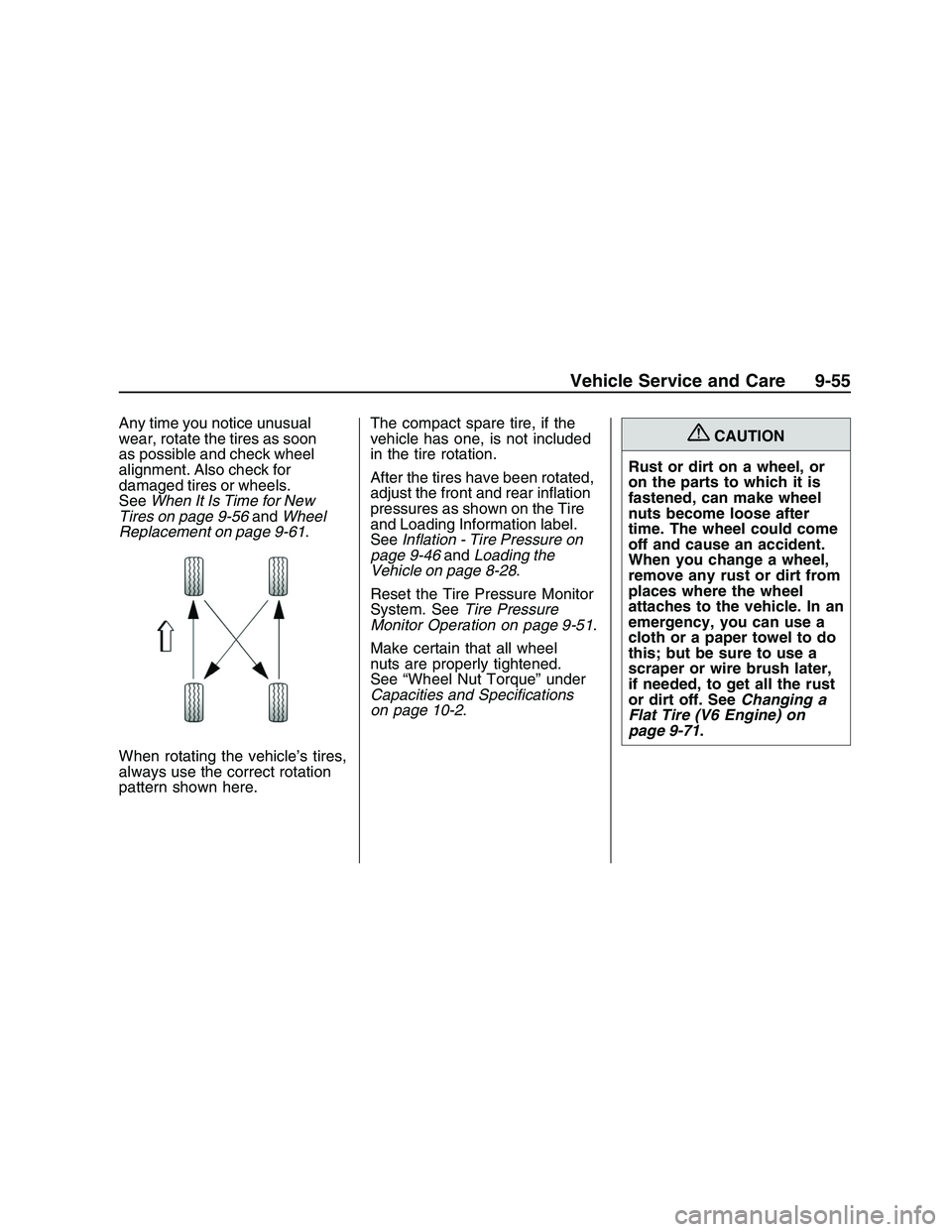
When rotating the vehicle’s tires,
always use the correct rotation
pattern shown here.The compact spare tire, if the
vehicle has one, is not included
in the tire rotation.
After the tires have been rotated,
adjust the front and rear ination
pressures as shown on the Tire
and Loading Information label.
SeeInflation - Tire Pressure on
page 9-46andLoading the
Vehicle on page 8-28.
Reset the Tire Pressure Monitor
System. SeeTire Pressure
Monitor Operation on page 9-51.
Make certain that all wheel
nuts are properly tightened.
See “Wheel Nut Torque” under
Capacities and Specifications
on page 10-2.{CAUTION
Rust or dirt on a wheel, or
on the parts to which it is
fastened, can make wheel
nuts become loose after
time. The wheel could come
off and cause an accident.
When you change a wheel,
remove any rust or dirt from
places where the wheel
attaches to the vehicle. In an
emergency, you can use a
cloth or a paper towel to do
this; but be sure to use a
scraper or wire brush later,
if needed, to get all the rust
or dirt off. SeeChanging a
Flat Tire (V6 Engine) on
page 9-71.
Vehicle Service and Care 9-55
2008 - Pontiac G8 Owner Manual