2008 PONTIAC G8 lock
[x] Cancel search: lockPage 221 of 334

Fuses Usage
F10Driver Side
Low-Beam
Headlamp
F11 Spare
F12Passenger Side
Low-Beam
Headlamp
F13 Spare
F14 Spare
F15 Front Wiper
F16 Spare
F17 Theft Horn
F18 Spare
F19Passenger Side
High-Beam
Headlamp
F20 Spare
F21 Windshield Washer
F22Canister Vent
Solenoid
F23Driver Side
High-Beam
Headlamp
F24 SpareFuses Usage
F25 Reverse Lockout
F26 Spare
F27 Spare
F28Engine Control
Module 1
F29 Even Coils/Injectors
F30 Spare
F31 Spare
F32 Emission 2
F33 Emission 1
F34 Spare
F35 Odd Coils/Injectors
F36 Spare
F37 HVAC Ignition
F38Heated
Seats/OnStar
®
Ignition
F39 Engine Ignition
F40 Airbags
F41 Spare
F42Passenger Side
Park Lamp
Fuses Usage
F43Driver Side
Park Lamp
FUSE
PULLERFuse Puller
Relays Usage
R1 Spare
R2 Comm Enable
R3 Spare
R4 Back-up Lamps
R5 Fog Lamp
R6Low-Beam
Headlamps
R7 Spare
R8 Defogger
R9Windshield
Wiper High
R10Windshield
Wiper Low
R11High-Beam
Headlamps
R12 Crank
R13 Powertrain
R14 Ignition Main
Vehicle Service and Care 9-37
2008 - Pontiac G8 Owner Manual
Page 222 of 334

Relays Usage
R15 Windshield Wiper
R16 Horn
R17Fan 1 (Engine
Cooling)
R18 Parking Lamps
R19Fan 2 (Engine
Cooling)
R20Fan 3 (Engine
Cooling)
Rear Compartment Fuse
Block
The rear compartment fuse block is
located on the left side of the
trunk behind a cover.Use the fuse puller, to remove and
replace fuses.
Fuses Usage
F1 Spare
F2 Amplier
F3 XM Radio™
F4 Radio
F5Instrument/Display/
Remote Function
Actuator/Data Link
Connection
F6 Spare
F7 Spare
Fuses Usage
F8 OnStar™
F9 Spare
F10 ECM Battery
F11Regulated Voltage
Control Sensor
F12 Fuel Pump
Relays Usage
R1 Spare
R2 Spare
9-38 Vehicle Service and Care
2008 - Pontiac G8 Owner Manual
Page 237 of 334

If the TPMS is not functioning it
cannot detect or signal a low
tire condition. See the dealer/retailer
for service if the TPMS malfunction
light and DIC message comes
on and stays on.
TPMS Sensor Matching
Process
Each TPMS sensor has a unique
identication code. Any time one or
more of the TPMS sensors are
replaced or the vehicle’s tires are
rotated, the identication codes
need to be matched to the
new tire/wheel location. The sensors
are matched, to the tire/wheel
locations, in the following order:
driver side front tire, passenger side
front tire, passenger side rear
tire, and driver side rear tire using a
TPMS diagnostic tool. See your
dealer/retailer for service.The TPMS sensors can also be
matched to each tire/wheel position
by increasing or decreasing the
tire’s air pressure. When increasing
the tire’s pressure, do not exceed
the maximum ination pressure
indicated on the tire’s sidewall. To
decrease the tire’s air-pressure
use the pointed end of the valve
cap, a pencil-style air pressure
gage, or a key.
You have two minutes to match
each tire and wheel position.
If it takes longer than two minutes to
match any tire and wheel position,
the matching process stops and you
need to start over.The TPMS matching process is
outlined below:
1. Set the parking brake.
2. Turn the ignition switch to
ON/RUN with the engine off.
3. Press and hold the Remote
Keyless Entry (RKE) transmitter’s
lock and unlock buttons, at the
same time, for about ve seconds
to start the TPMS learn mode.
The horn chirps two times
indicating the TPMS receiver is
ready and in learn mode.
4. Start with the driver side front
tire. The driver side front
indicator lamp also comes on to
indicate that corner’s sensor
is ready to be learned.
5. Remove the valve cap from the
tire’s valve stem. Activate the
TPMS sensor by increasing
or decreasing the tire’s air
pressure for about eight seconds.
The horn chirps one time to
conrm the sensor identication
code has been matched to
the tire/wheel position.
Vehicle Service and Care 9-53
2008 - Pontiac G8 Owner Manual
Page 238 of 334

6. The driver side front indicator
lamp turns off and the
passenger side front indicator
lamp comes on to indicate
that corner’s sensor is ready to
be learned. Proceed to the
passenger side front tire and
repeat the procedure in Step 5.
7. The passenger side front
indicator lamp turns off and the
passenger side rear indicator
lamp comes on to indicate that
corner’s sensor is ready to
be learned. Proceed to the
passenger side rear tire and
repeat the procedure in Step 5.
8. The passenger side rear indicator
lamp turns off and the driver side
rear indicator lamp comes on to
indicate that corner’s sensor is
ready to be learned. Proceed to
the driver side rear tire, and
repeat the procedure in Step 5.9. After the driver side rear TPMS
sensor has been learned the
horn chirps two times. The driver
side rear indicator lamp turns
off and the TPMS sensor
matching process is done. Turn
the ignition switch to LOCK/OFF.
If no tires are learned after
entering the TPMS learn mode,
or if communication with the
receiver stops, or if the time limit
has expired, turn the ignition
switch to LOCK/OFF and
start over beginning with Step 2.
10. Set all four tires to the
recommended air pressure level
as indicated on the Tire and
Loading Information label.
11. Put the valve caps back on the
valve stems.Tire Inspection and
Rotation
We recommend that you
regularly inspect the vehicle’s
tires, including the spare tire, for
signs of wear or damage.
SeeWhen It Is Time for New
Tires on page 9-56for more
information.
Tires should be rotated every
5,000 to 8,000 miles (8 000 to
13 000 km). SeeScheduled
Maintenance on page 11-4.
The purpose of a regular tire
rotation is to achieve a uniform
wear for all tires on the vehicle.
This will ensure that your vehicle
continues to perform most like it
did when the tires were new.
9-54 Vehicle Service and Care
2008 - Pontiac G8 Owner Manual
Page 242 of 334
Vehicles that have a tire pressure
monitoring system could give
an inaccurate low-pressure warning
if non-TPC Spec rated tires are
installed on your vehicle. Non-TPC
Spec rated tires may give a
low-pressure warning that is higher
or lower than the proper warning
level you would get with TPC Spec
rated tires. SeeTire Pressure
Monitor System on page 9-49.
Your vehicle’s original equipment
tires are listed on the Tire and
Loading Information Label. See
Loading the Vehicle on page 8-28,
for more information about the
Tire and Loading Information Label
and its location on your vehicle.Different Size Tires and
Wheels
If you add wheels or tires that are a
different size than your original
equipment wheels and tires,
this may affect the way your vehicle
performs, including its braking,
ride and handling characteristics,
stability, and resistance to rollover.
Additionally, if your vehicle has
electronic systems such as, antilock
brakes, traction control, and
electronic stability control, the
performance of these systems can
be affected.
{CAUTION
If you add different sized
wheels, your vehicle may not
provide an acceptable level of
performance and safety if tires
not recommended for those
wheels are selected. You may
increase the chance that you
will crash and suffer serious
injury. Only use GM specic
wheel and tire systems
developed for your vehicle, and
have them properly installed by
a GM certied technician.
SeeBuying New Tires on page 9-56
andAccessories and Modifications
on page 9-3for additional
information.
9-58 Vehicle Service and Care
2008 - Pontiac G8 Owner Manual
Page 249 of 334

Using the Tire Sealant and
Compressor Kit to
Temporarily Seal and Inate a
Punctured Tire
Follow these directions closely for
correct sealant usage.
A. On/Off Switch
B. Air Compressor Accessory Plug
C. Air Compressor
D. Sealant Canister
E. Sealant/Air Hose
F. Air-only Hose
G. Pressure GageDo a safety check before
proceeding. SeeIf a Tire Goes Flat
on page 9-62.
Inspect the damaged tire.
The sealant cannot seal sidewall
damage, large punctures, or a
tire that has unseated from
the wheel. SeeRoadside Assistance
Program on page 12-6.
Do not remove any objects that
have penetrated the tire.
1. Place the tire sealant and
compressor kit on the ground and
unwrap the sealant/air hose (E)
from the side of the compressor.
2. Remove the air compressor
accessory plug (B) from the unit.
Do not plug the plug in yet.
3. Turn the tire valve stem cap
counterclockwise to remove.
4. Attach the sealant/air hose (E)
onto the tire valve stem. Turn
it clockwise until tight.5. Make sure the sealant and
compressor kit on/off switch (A) is
in the O (off) position.
Plug the air compressor
accessory plug (B) into an
accessory power outlet in the
vehicle. SeeAccessory Power
Outlet(s) on page 4-9for
more information.
Do not slam door or close
window on the compressor
accessory plug cord.
{CAUTION
Idling the engine in a closed-in
place or with the climate
control system off can cause
deadly carbon monoxide (CO).
SeeEngine Exhaust on
page 8-12.
6. Start the vehicle. The vehicle
must be running while using
the air compressor.
Vehicle Service and Care 9-65
2008 - Pontiac G8 Owner Manual
Page 251 of 334
11. Unplug the air compressor
accessory plug (B) from the
accessory power outlet in
the vehicle.
12. Turn the sealant/air hose (E)
counterclockwise to remove.
13. Replace the tire valve
stem cap.
14. Stow the sealant/air hose (E)
and air compressor accessory
plug (B) in their original
locations.
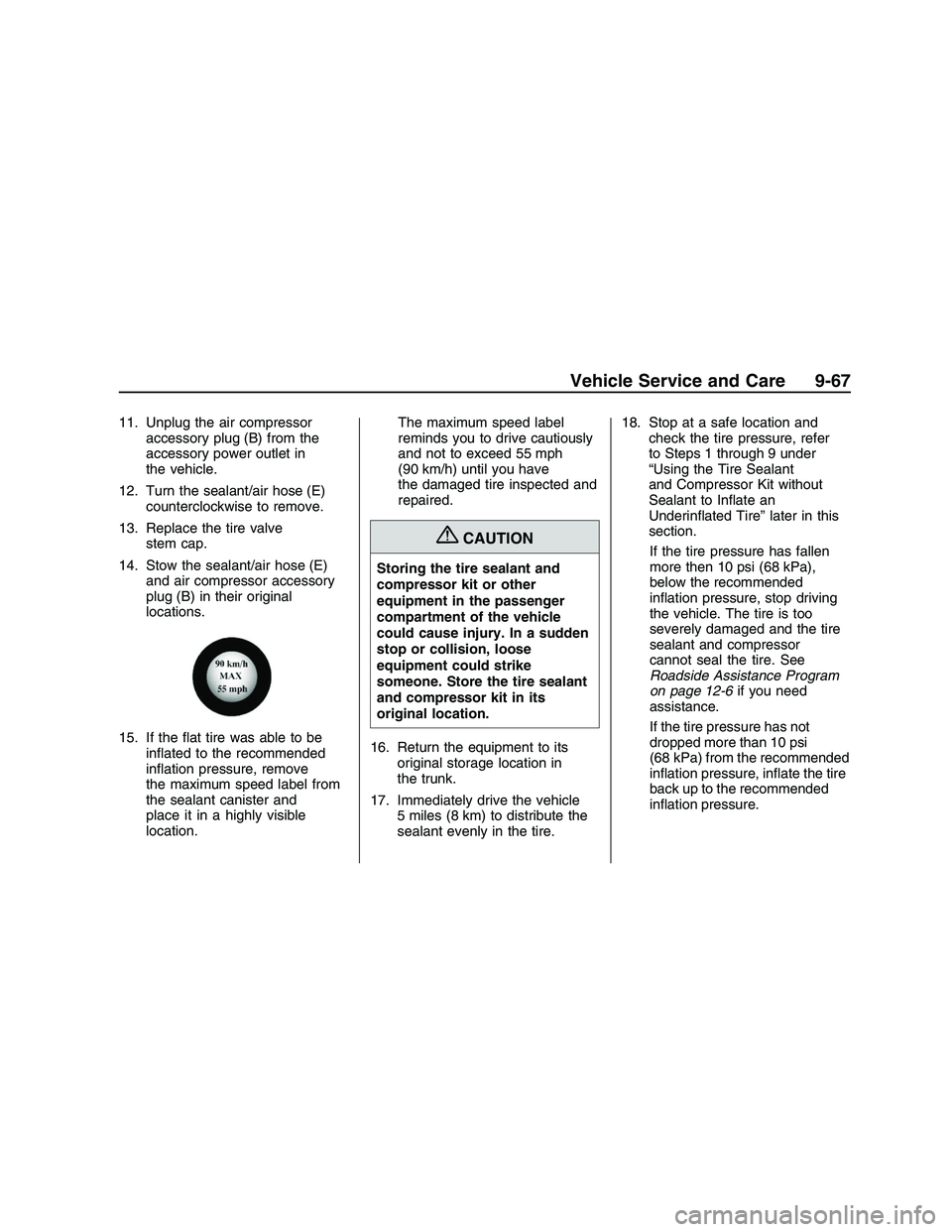
15. If the at tire was able to be
inated to the recommended
ination pressure, remove
the maximum speed label from
the sealant canister and
place it in a highly visible
location.The maximum speed label
reminds you to drive cautiously
and not to exceed 55 mph
(90 km/h) until you have
the damaged tire inspected and
repaired.
{CAUTION
Storing the tire sealant and
compressor kit or other
equipment in the passenger
compartment of the vehicle
could cause injury. In a sudden
stop or collision, loose
equipment could strike
someone. Store the tire sealant
and compressor kit in its
original location.
16. Return the equipment to its
original storage location in
the trunk.
17. Immediately drive the vehicle
5 miles (8 km) to distribute the
sealant evenly in the tire.18. Stop at a safe location and
check the tire pressure, refer
to Steps 1 through 9 under
“Using the Tire Sealant
and Compressor Kit without
Sealant to Inate an
Underinated Tire” later in this
section.
If the tire pressure has fallen
more then 10 psi (68 kPa),
below the recommended
ination pressure, stop driving
the vehicle. The tire is too
severely damaged and the tire
sealant and compressor
cannot seal the tire. See
Roadside Assistance Program
on page 12-6if you need
assistance.
If the tire pressure has not
dropped more than 10 psi
(68 kPa) from the recommended
ination pressure, inate the tire
back up to the recommended
ination pressure.
Vehicle Service and Care 9-67
2008 - Pontiac G8 Owner Manual
Page 252 of 334
19. Wipe off any sealant from the
wheel, tire or vehicle.
20. Dispose of the used sealant
canister at a local dealer/retailer
or in accordance with local
state codes and practices.
After using the sealant canister,
replace it with a new canister
available from your
dealer/retailer.
This is a temporary repair. Take
the vehicle to your dealer/retailer
to have the tire repaired or
replaced as soon as possible.Using the Air Compressor
without Sealant to Inate an
Underinated Tire
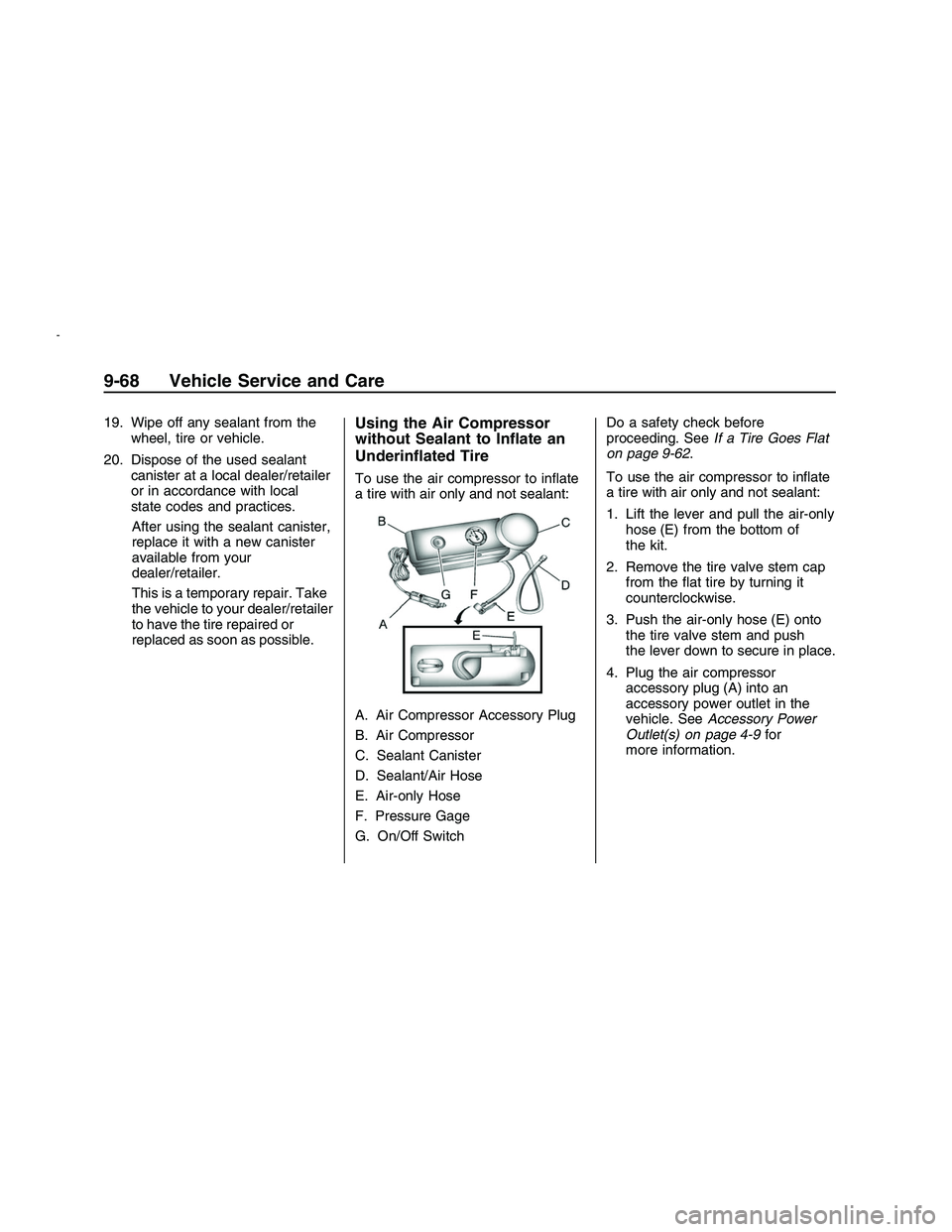
To use the air compressor to inate
a tire with air only and not sealant:
A. Air Compressor Accessory Plug
B. Air Compressor
C. Sealant Canister
D. Sealant/Air Hose
E. Air-only Hose
F. Pressure Gage
G. On/Off SwitchDo a safety check before
proceeding. SeeIf a Tire Goes Flat
on page 9-62.
To use the air compressor to inate
a tire with air only and not sealant:
1. Lift the lever and pull the air-only
hose (E) from the bottom of
the kit.
2. Remove the tire valve stem cap
from the at tire by turning it
counterclockwise.
3. Push the air-only hose (E) onto
the tire valve stem and push
the lever down to secure in place.
4. Plug the air compressor
accessory plug (A) into an
accessory power outlet in the
vehicle. SeeAccessory Power
Outlet(s) on page 4-9for
more information.
9-68 Vehicle Service and Care
2008 - Pontiac G8 Owner Manual