Page 73 of 241

EMISSION CONTROL
ENGINE AND EMISSION CONTROL17-11
POSITIVE CRANKCASE VENTILATION (PCV)
VA LV E
PCV valve lifts the plunger according to negative pressure in
the intake manifold to create appropriate ventilation for the
crankcase.
EVAPORATIVE EMISSION CONTROL SYSTEMM2171000200147
HC (hydrocarbon) generated in the fuel tank are
adsorbed by the active carbon in the canister and
stored. HC stored in the canister is introduced to the
intake manifold when engine is in operation where it
is mixed with intake air and combusted. ECM intro
-
duces optimum HC amount according to driving con-
ditions and so performs duty control on the
evaporative emission purge solenoid. Also, the evap
-
orative emission purge solenoid is closed during
deceleration or immediately after engine start to
restrict change in air-fuel ratio and prevent engine
from stalling.
AK602324AC
Plunger
From
rocker
coverTo intake
manifold
Spring
AK604143
Evaporative emission
purge solenoid
Mass airflow sensor
ECM Intake air temperature sensor
Manifold absolute pressure
sensor
Engine coolant temperature
sensor
Throttle position sensor
Crankshaft position sensorEvaporative emission
canister
AB
MFI relay
Battery
Page 74 of 241

EMISSION CONTROL
ENGINE AND EMISSION CONTROL17-12
EVAPORATIVE EMISSION PURGE SOLENOID
An evaporative emission purge solenoid is installed in the
intake manifold.The evaporative emission purge solenoid con
-
trols the intake volume of fuel vapor gas from the canister. The
evaporative emission purge solenoid is a duty control type
solenoid valve. When current is not passing through the coil,
nipple A is kept airtight and fuel vapor gas cannot be sucked in.
When current passes through the coil, air can pass between
nipple A and B and fuel vapor gas is sucked in. ECM changes
the ON duty ratio according to engine's operating condition to
control the intake volume of fuel vapor gas.
EXHAUST GAS RECIRCULATION (EGR) SYSTEM M2171000300122
When the combustion gas temperature becomes
high, generation of the environment polluting NOx
(nitrogen oxides) increases rapidly. EGR system is
used to decrease the volume of NOx generated.
EGR system re-circulates exhaust gas inside the
intake manifold. It increases specific heat of the com
-
bustion gases and reduces combustion speed to lower the combustion temperature and reduce the
volume of NOx generated. ECM calculates the EGR
introduction volume according to engine operating
conditions and controls the EGR valve opening angle
at optimum. Also, immediately after the ignition
switch ON signal is input, it drives fully closed step
-
per motor and performs initialization.
AK604745AC
B To canister
To intake manifoldA
AK602245AD
12V
ONOFF
0V100 ms
Evaporative
emission
purge solenoidFrom MFI relay
ECM
AK502987AE
ECMMass airflow sensor
Intake air temperature sensor
Manifold absolute
pressure sensor
Engine coolant
temperature sensor
Throttle position sensor
Crankshaft position sensor BatteryEGR valve
(stepper motor)
Page 75 of 241

EMISSION CONTROL
ENGINE AND EMISSION CONTROL17-13
EXHAUST GAS RECIRCULATION (EGR) VALVE
An EGR valve is installed in the EGR valve support.The EGR
valve controls EGR flow volume using the stepper motor
method and reduces exhaust gas (NOx) and fuel consumption.
The EGR valve drives the stepper motor based on the signal
from ECM. When stepper motor rotor turns in clockwise or
anti-clockwise direction, the shaft fitted with a rotor and a screw
expands and contracts and the movement of the shaft causes
the valve to go up and down. Thus, EGR path gap is controlled
minutely. The stepper motor turns 15
° per step. The stepper
motor turns forward or back only up to the angle dictated by the
number of pulse signals (number of steps) from the ECM. In
other words, increase and decrease of the EGR flow volume
depends on the number of signals (number of steps) from
ECM. ECM changes current flow to the 4 coils (A, B, C, D) in
the stepper motor in sequence according to the phase pattern
in the following chart in order to turn the stepper motor rotor.
Open valve changes phase in order of 0
→ 1 → 2 → 3 → 0. Close
valve changes phase in order of 3
→ 2 → 1 → 0 → 3.
Phase
numberStepper motor coil
Coil ACoil BCoil CCoil D
0ONOFFOFFON
1ONOFFONOFF
2OFFONONOFF
3OFFONOFFON
AK604144
Coil
Shaft
Valve Outlet
Inlet
Rotor
Magnet
AB
AK604145
From MFI relay
EGR valve
(stepper motor)
ECM Coil
ACoil
BCoil
CCoil
DFlow rate
Step
AB
Page 76 of 241

EMISSION CONTROL
ENGINE AND EMISSION CONTROL17-14
EMISSION REDUCTION SYSTEMSM2171000800064
These decrease CO, HC and NOx in the exhaust
gases and consist of air-fuel ratio feedback control
and catalytic converter.
1. AIR-FUEL RATIO FEEDBACK CONTROL
Refer to GROUP 13A − Fuel Injection Control P.13A-29.
2. CATALYTIC CONVERTER
Catalytic converter is installed in the center of exhaust pipe
below the floor and in the front of exhaust pipe .
Based on appropriate air-fuel ratio feedback from oxygen sen
-
sor, CO and HC are oxidized and NOx is reduced. Catalytic
converter is a monolith with beehive design with catalysts on
the unit surface. It is protected by a thermally insulating mat
and enclosed in a shell.
3. HC TRAP CATALYTIC CONVERTER
The HC trap catalytic converter is installed in the center of
exhaust pipe below the floor. The HC trap catalytic converter
consists of the HC trap catalyst and the three-way catalysts,
which are the monolith type; the catalyst element is attached to
the honeycomb catalyst surface. The HC trap catalyst and the
three-way catalysts are held by the heat-insulating mat and
installed in the shell. The HC trap catalyst temporarily absorbs
the exhaust HC from the engine within the temperature range
in which the three-way catalyst is not activated, and prevents
the exhaust HC from releasing outside the vehicle. After that,
the HC trap catalyst temperature rises and releases the
absorbed HC. The released HC is burnt out in the downstream
three-way catalyst.
AK604146
Catalytic converter
Catalytic converter
AB
AK604147
Three-way catalyst HC trap catalyst
Exhaust
gas
AB
Page 91 of 241
13B-1
GROUP 13B
FUEL SUPPLY
CONTENTS
GENERAL INFORMATION . . . . . . . .13B-2FUEL TANK . . . . . . . . . . . . . . . . . . . .13B-3
Page 92 of 241

GENERAL INFORMATION
FUEL SUPPLY13B-2
GENERAL INFORMATIONM2134000100833.The fuel system consists of the following compo-
nents:
•Fuel injector
•Fuel rail
•Fuel pipe
•Fuel tank
•Fuel pump module
•Evaporative emission canister
SPECIFICATIONS
CONSTRUCTION DIAGRAM
This fuel system is designed with consideration for
global environment protection to ensure safety at a
collision, reduce weight, and improve reliability and
quality. This system has the following features:
•A quick-joint connector of a plastic tube is used
for the fuel high-pressure hoses in the engine
compartment to reduce the permeation of fuel
evaporative emission.
•The surface of underfloor fuel pipes is coated
with 1-mm thickness of plastic to improve resis
-
tance to corrosion and chipping.
•A returnless fuel system eliminates returned fuel
from the engine. The heat that fuel receives from
the engine is reduced, minimizing fuel tempera
-
ture in the fuel tank and controlling the amount of
evaporated gas.
ItemSpecification
Fuel tank capacity dm3 (gal)59 (15.5)
Fuel pump typeElectric
Fuel filter typeCartridge (incorporates fuel pump module)
Fuel return systemReturnless
Fuel pump pressure regulator pressure kPa (psi)324 (46)
Fuel injectorTy p eElector-magnetic
Quantity4
Evaporative emission control systemCanister
AC610224
Fuel rail
Fuel injector
Fuel pipeFuel pump moduleEvaporative
emission
canister Fuel tank
AB
Page 93 of 241
FUEL TANK
FUEL SUPPLY13B-3
FUEL TANKM2134001000817.The fuel tank assembly consists of the fuel pump
module, the fuel tank, and so on, and features the
following characteristics:
•The fuel tank is mounted underneath the second
seat to improve safety at a collision.
•The fuel tank itself is made of a pre-coat zinc
alloy galvanised steel sheet that contains no
lead.
•The capacity of the fuel tank is 59 dm3 (15.5 gal)
to meet long-distance drives.
•The fuel cut-off valve, fuel tank leveling valve and
fuel tube have been installed using in-tank con
-
struction to reduce the amount of evaporated fuel
from hoses.
The fuel pump module consists of the following com-
ponents:
•Fuel pump
•Fuel level sensor
•Fuel filter
•Fuel pump pressure regulator
•Fuel tank differential pressure sensor
•Fuel tank temperature sensor
CONSTRUCTION DIAGRAM
AC610225AB
Fuel pump module
Fuel tank
AC610226
Fuel cut-off valve
Fuel check valve
Leveling valve
AC
Page 95 of 241
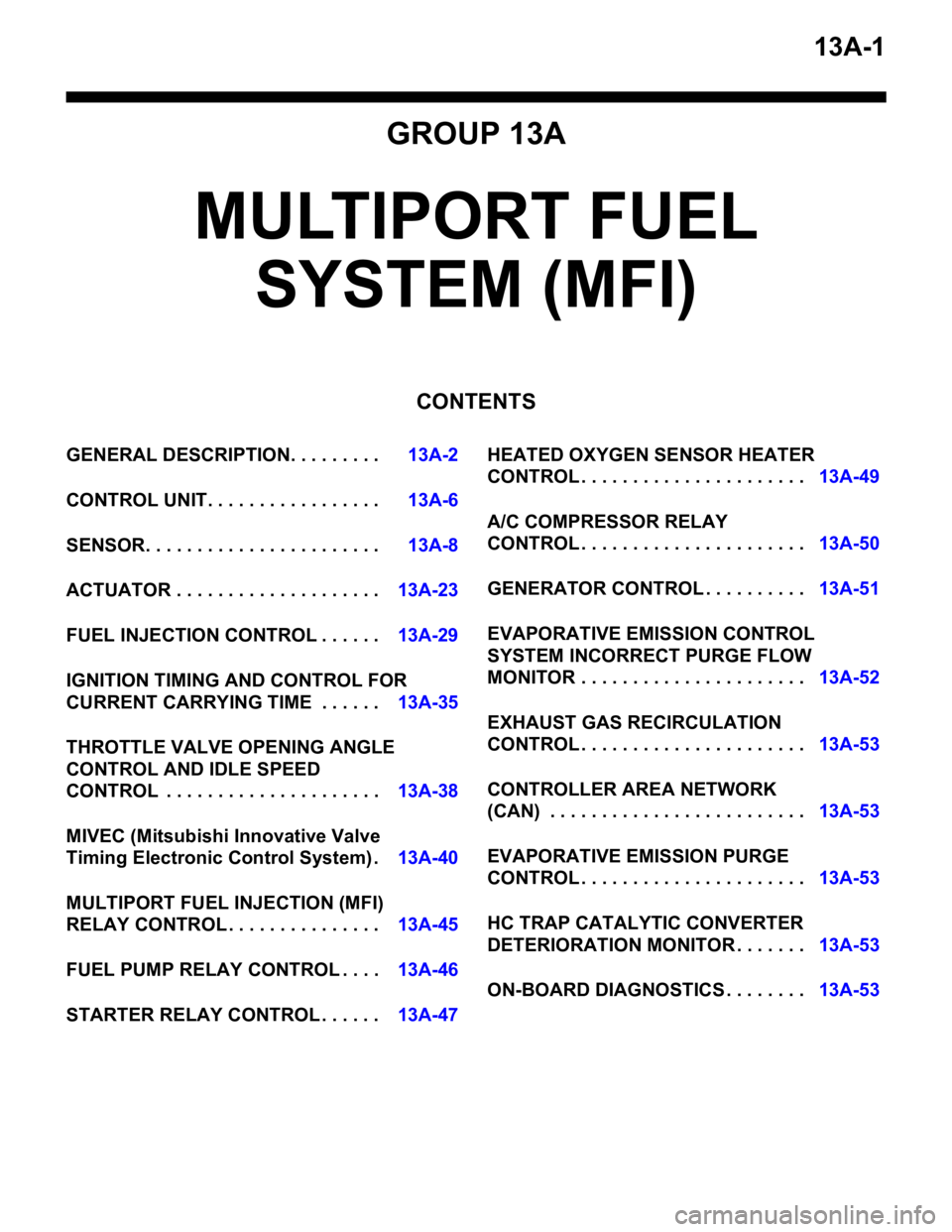
13A-1
GROUP 13A
MULTIPORT FUEL
SYSTEM (MFI)
CONTENTS
GENERAL DESCRIPTION. . . . . . . . .13A-2
CONTROL UNIT. . . . . . . . . . . . . . . . .13A-6
SENSOR. . . . . . . . . . . . . . . . . . . . . . .13A-8
ACTUATOR . . . . . . . . . . . . . . . . . . . .13A-23
FUEL INJECTION CONTROL . . . . . .13A-29
IGNITION TIMING AND CONTROL FOR
CURRENT CARRYING TIME . . . . . .13A-35
THROTTLE VALVE OPENING ANGLE
CONTROL AND IDLE SPEED
CONTROL . . . . . . . . . . . . . . . . . . . . .13A-38
MIVEC (Mitsubishi Innovative Valve
Timing Electronic Control System) .13A-40
MULTIPORT FUEL INJECTION (MFI)
RELAY CONTROL . . . . . . . . . . . . . . .13A-45
FUEL PUMP RELAY CONTROL . . . .13A-46
STARTER RELAY CONTROL . . . . . .13A-47
HEATED OXYGEN SENSOR HEATER
CONTROL . . . . . . . . . . . . . . . . . . . . . .13A-49
A/C COMPRESSOR RELAY
CONTROL . . . . . . . . . . . . . . . . . . . . . .13A-50
GENERATOR CONTROL . . . . . . . . . .13A-51
EVAPORATIVE EMISSION CONTROL
SYSTEM INCORRECT PURGE FLOW
MONITOR . . . . . . . . . . . . . . . . . . . . . .13A-52
EXHAUST GAS RECIRCULATION
CONTROL . . . . . . . . . . . . . . . . . . . . . .13A-53
CONTROLLER AREA NETWORK
(CAN) . . . . . . . . . . . . . . . . . . . . . . . . .13A-53
EVAPORATIVE EMISSION PURGE
CONTROL . . . . . . . . . . . . . . . . . . . . . .13A-53
HC TRAP CATALYTIC CONVERTER
DETERIORATION MONITOR . . . . . . .13A-53
ON-BOARD DIAGNOSTICS . . . . . . . .13A-53

