2008 MITSUBISHI COLT child seat
[x] Cancel search: child seatPage 101 of 450
Seat and seat belts2-53
2
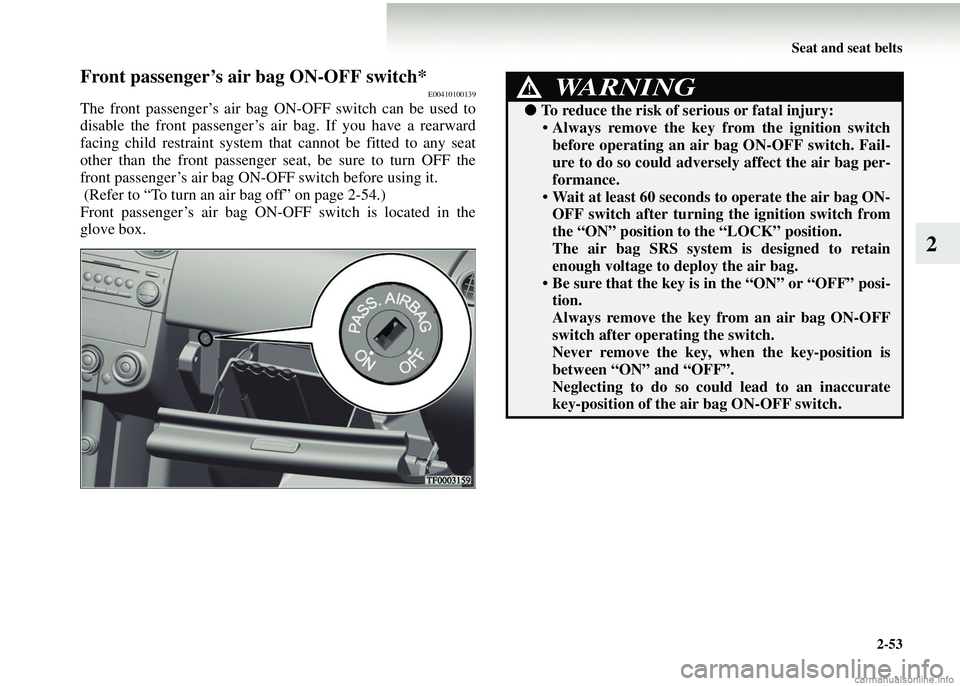
Front passenger’s air bag ON-OFF switch*E00410100139
The front passenger’s air bag ON-OFF switch can be used to
disable the front passenger’s air bag. If you have a rearward
facing child restraint system that cannot be fitted to any seat
other than the front passenger seat, be sure to turn OFF the
front passenger’s air bag ON-OFF switch before using it.
(Refer to “To turn an air bag off” on page 2-54.)
Front passenger’s air bag ON-OFF switch is located in the
glove box.
WARNING!
●To reduce the risk of serious or fatal injury:
• Always remove the key from the ignition switch
before operating an air bag ON-OFF switch. Fail-
ure to do so could adversely affect the air bag per-
formance.
• Wait at least 60 seconds to operate the air bag ON- OFF switch after turning the ignition switch from
the “ON” position to the “LOCK” position.
The air bag SRS system is designed to retain
enough voltage to deploy the air bag.
• Be sure that the key is in the “ON” or “OFF” posi- tion.
Always remove the key from an air bag ON-OFF
switch after operating the switch.
Never remove the key, when the key-position is
between “ON” and “OFF”.
Neglecting to do so coul d lead to an inaccurate
key-position of the air bag ON-OFF switch.
Page 102 of 450

2-54 Seat and seat belts
2
To turn an air bag offE00410600121
To turn an air bag off, follow these steps:1. Insert the key into the key opening of the air bag ON-OFF
switch, push the key inwards until stopped by a touch and
then turn the key from the “ON” to the “OFF” position
(anticlockwise).
2. Be sure that the key is in the “OFF” position before removing the key from the key opening of the air bag ON-
OFF switch.
3. Insert the key into the ignition switch, and turn the igni- tion to the “ON” position.
The air bag off indicator lamp, with the word “OFF PASS AIR
BAG” (depending on which air bag has been turned off) should
illuminate. This tells you that the air bag is OFF and will NOT
deploy. (Refer to “Front passenger’s air bag off indicator lamp”
on page 2-56.) The air bag will remain OFF, and will NOT deploy, until it is
turned ON again.
WARNING!
●
To reduce the risk of serious or fatal injury:
• If the indicator does not come on when the front
passenger’s air bag ON-OFF switch is turned OFF,
do not fit a rearward facing child restraint system
to the front passenger seat.
• Do not turn OFF the fron t passenger’s air bag ON-
OFF switch except when a rearward facing child
restraint system is fitt ed to the front passenger
seat.
Page 103 of 450

Seat and seat belts2-55
2
To turn an air bag onE00410700092
To turn an air bag on, follow these steps:1. Insert the key into the key opening of the air bag ON-OFF
switch, push the key inwards until stopped by a touch and
then turn the key from the “OFF” to the “ON” position
(clockwise).
2. Be sure that the key is in the “ON” position before remov- ing the key from the key opening of the air bag ON-OFF
switch.
3. Insert the key into the ignition switch and turn the ignition to the “ON” position.
The air bag off indicator lamp, with the word “OFF PASS AIR
BAG” (depending upon which air bag has been turned back
on) should not illuminate. The air bag will remain ON, and will be ready to deploy, until
it is turned OFF again.
WARNING!
●
To reduce the risk of serious or fatal injury:
• Turn ON the front passenger’s air bag ON-OFF
switch immediately after removing a rearward
facing child restraint sy stem from the front pas-
senger seat.
• If the indicator remains on when the front passen- ger’s air bag ON-OFF switch is turned ON, do not
allow anyone to sit on the front passenger seat.
Page 116 of 450

2-68 Seat and seat belts
2
WARNING!
●Do not allow a child to kn eel on the passenger seat
facing the passenger’s side door, since the side air
bags and curtain air bags inflate with great force.
Otherwise, the child may be killed or seriously
injured.
WARNING!
● Do not allow any rear seat occupant to hold onto the
seatback of either front seat, in order to reduce the
risk of injury from the deploying side air bags. Spe-
cial care should be taken with children.
●Do not place any objects near or in front of the seat-
back of either front seat. They could interfere with
proper side air bag inflation, and also cause injury if
thrown free by side air bag deployment.
● Do not place stickers, labels or additional trim on
the seatback of either fron t seat. They could inter-
fere with proper side air bag inflation.
● Do not install seat covers on seats with side air bags.
Do not re-cover seats that have side air bags. This
could interfere wi th proper side air bag inflation.
Page 117 of 450

Seat and seat belts2-69
2
WARNING!
●Do not attach a microphone (A) or any other device
or object around the part where the curtain air bags
activate, such as on the wi ndscreen, side door glass,
front and rear pillars and roof side or assist grips.
When the curtain air bags inflate, the microphone
or other device or object wi ll be hurled with great
force or the curtain air bags may not activate cor-
rectly, resulting in de ath or serious injury.
WARNING!
●Do not put a hanger or any heavy or pointed object
on the coat hook. If the cu rtain air bag is activated,
such items could be propel led away with great force
and prevent the curtain air bag from inflating cor-
rectly. Hang clothes directly on the coat hook (with-
out the use of a hanger). Make sure there are no
heavy or sharp objects in the pockets of clothes that
you hang on the coat hook.
● Do not allow children close to or to lean against the
front door, even if the ch ild is seated in a child
restraint system.
The child’s head should also not be leaned against or
be close to the area where the side air bags and cur-
tain air bags are located. This is dangerous if the
side air bags and curtain air bags inflate.
Failure to follow all these instructions could lead to
serious or fatal injury to the child.
● We recommend work around and on the side air
bags and curtain air bags system to be carried out
by a MITSUBISHI MOTORS Authorized Service
Point. Improper work coul d result in inadvertent
deployment of side air bags and curtain air bags, or
could render side air bags and curtain air bags inop-
erative; either situation co uld result in serious
injury.
Page 170 of 450

4-4 Starting and driving
4
Floor matsCarrying children in the vehicle
●Never leave your vehicle un attended with the key and
children inside the vehicle. Children may play with the
driving controls and this could lead to an accident.
● Make sure that infants and small children are properly
restrained in accordance with applicable laws and regula-
tions, and for maximum protecti on in the event of an acci-
dent.
● Prevent children fr om playing in the luggage compart-
ment. It is highly dangerous to allow children to play there
while the vehicle is moving.
Loading luggage
When loading luggage, be careful not to load above the height
of the seats. This is dange rous not only because rearward
vision will be obstru cted, but also because the luggage may be
projected into the passenger compartment under hard braking.
WARNING!
● Keep floor mats clear of th e pedals by correctly lay-
ing floor mats that are suitable for the vehicle.
To prevent the floor mats from slipping out of posi-
tion, securely retain th em using the hook, etc.
Note that laying a floor mat over a pedal or laying
one floor mat on top of an other can obstruct pedal
operation and lead to a serious accident.
Page 438 of 450

Alphabetical index
2
Combination headlamps and dipper switch 3-31
Compact spare wheel 6-25
Cool box 5-66
Coolant (engine) 8-11, 9-21
Cup holder 5-69
D
Dead Lock System 1-10
Demister (rear window) 3-45
Diesel preheat indication lamp 3-9
Dipper (High/Low beam change) 3-33
Door-ajar warning lamp 3-13
Doors Central door locks 1-9
Child-protection 1-13
Dead Lock System 1-10
Lock and unlock 1-7
Driving, alcohol and drugs 4-3
E
Economical driving 4-2
Electric power steering system 4-40
Electric remote-controlled outside rear-view mirrors 4-12
Electric window control 1-18
Electrical system 9-14
Electronic immobilizer (Anti-theft starting system) 1-3
Emergency starting 6-2
Engine Coolant 8-11, 9-21 High coolant temperat
ure warning lamp 3-13
Number 9-4
Oil 8-7
Oil and oil filter 9-21
Overheating 6-6
Specifications 9-12
Used engine oils safety instructions and disposal
information 7
Error codes 5-54
Exterior and interior lamp operation 8-28
F
Fluid Brake fluid 8-14, 9-21
Clutch fluid 8-14, 9-21
Engine coolant 8-11, 9-21
Washer fluid 8-14, 9-21
Fluid capacities and lubricants 9-21
For cold and snow weather 8-29
Front fog lamps Bulb capacity 8-41
Indicator lamp 3-8
Replacement 8-50
Switch 3-37
Front seat 2-5
Front turn-signal lamps Bulb capacity 8-41
Replacement 8-49
Fuel
Page 441 of 450

Alphabetical index5
System 4-40
Precautions to observe when using wipers and washers 3-45
Pregnant women restraint 2-29
Puncture (Tyre changing) 6-28
R
Radio LW/MW/FM electronic tuning radio with CD player 5-24
Rear combination lamps Bulb capacity 8-41
Replacement 8-57
Rear fog lamp Bulb capacity 8-41
Indication lamp 3-8
Replacement 8-57, 8-62
Switch 3-38
Rear seat 2-8
Rear shelf panel 5-70
Rear turn-signal lamps Bulb capacity 8-41
Replacement 8-57
Rear window demister switch 3-45
Rear-view mirror Inside 4-10
Outside 4-10
Replacement of lamp bulbs 8-40
Reversing lamps Bulb capacity 8-41
Replacement 8-57, 8-62 Room lamp 5-62
Room lamps & map lamps
Bulb capacity 8-43
Replacement 8-68
Running-in recommendations 4-5S
Safe driving techniques 4-3
Seat Adjustment 2-4
Arrangement 2-3
Front seat 2-5
Head restraints 2-10
Heated seats 2-7
Rear seat 2-8
Seat belt 2-22 Adjustable seat belt anchor 2-26
Child restraint 2-31
Inspection 2-46
Pregnant women restraint 2-29
Pre-tensioner 2-29
Seat belt reminder/warning lamp 2-25
Service precaution 8-2
Side turn-signal lamps Bulb capacity 8-41
Replacement 8-49
Snow tyres 8-22
Spare wheel 6-25
Spark plug 9-14