2008 MINI COOPER CONVERTIBLE run flat
[x] Cancel search: run flatPage 5 of 176

3OVERVIEW REPAIRS OPERATION CONTROLS DATA INDEX
Driving:
Ignition lock 53
Starting the engine 53
Switching off the engine 54
Parking brake 54
Manual transmission 55
Automatic transmission with
Steptronic56
Parking lamps/Low beams 60
Turn signal indicator/Headlamp
flasher 61
Instrument lighting 62
Fog lamps 62
Interior lamps 62
Washer/wiper system 63
Washer fluid64
Cruise control65
Everything under control:
Odometer 67
Clock 67
Fuel gauge 67
Coolant temperature gauge 68
Tachometer 69
Service interval display 69
Onboard computer70Technology for safety and driving
convenience:
Driving stability control systems72
Flat Tire Monitor 74
Tire Pressure Monitor76
Airbags 79
Park Distance Control (PDC)81
Controlling the climate for pleasant
driving:
Air conditioning system82
Automatic climate control85
Interior conveniences:
Glove compartment 88
Center armrest89
Drinks holders, ashtray 89
Cigarette lighter, 12 V power supply 90
Integrated universal remote control91
Loading and transporting cargo:
Luggage compartment in the MINI 93
Luggage compartment in the MINI
Convertible 94
Loading cargo 95
Roof-mounted luggage rack98
OPERATION, CARE, MAINTENANCESpecial operating instructions:
Break-in procedures 102
General driving notes 102
Refueling105
Wheels and tires:
Tire inflation pressure 108
Tire coding 112
Tire condition 113
Run-Flat Tires115
New wheels and tires 116
Snow chains117
Page 44 of 176
42
SAFE SEATING POSITIONThe ideal seating position can make a vital
contribution to relaxed, relatively fatigue-
free driving. Together with the safety belts
and airbags, the seating position also plays
an important role in providing occupants
with maximum levels of passive safety in
an accident. To ensure that the safety sys-
tems operate with optimal efficiency, we
strongly urge you to observe the instruc-
tions contained in the following section.
For additional information about trans-
porting children safely, refer to page50.Airbags
Always maintain an adequate dis-
tance between yourself and all of the
airbags. Always hold the steering wheel by
the rim with the hands at the 9 and
3 o'clock positions to keep any chance of
injury to hands or arms to an absolute min-
imum, should the airbag be deployed.
No one and nothing is to come between
the airbags and the seat occupant. Do not
use the front passenger airbag cover as a
storage surface for objects of any kind.
Ensure that the front passenger is correctly
seated, e.g. that no feet or legs are propped
against the dashboard. Otherwise, leg
injury could result if the front passenger
airbag suddenly deployed.
Make sure that passengers do not lean
their heads against the side or head airbag,
as injuries could result if the side airbags
were triggered.<
Even if all these instructions are followed, it
cannot entirely be ruled out that in some
circumstances injury may result from con-
tact with the airbags. In sensitive individu-
als, the ignition and inflation noise may
induce a mild hearing loss that is usually
temporary.
For airbag locations and additional infor-
mation on airbags, refer to page79.Head restraintA correctly adjusted head restraint reduces
the risk of injury to the cervical spine in the
event of an accident.
Adjust the head restraint in such a
way that it is centered roughly at ear
level. Otherwise, there is an increased risk
of injury in the event of an accident.
work in conjunction with the safety belts,
but do not replace them. Your vehicle is
equipped with four seats, each of which is
provided with a safety belt.
Never allow more than one person to
wear a single safety belt. Never allow
infants or small children to ride in a passen-
ger's lap. Make sure that the belt in the lap
area sits low across the hips and does not
press against the abdomen. The safety belt
must not rest against the throat, run across
sharp edges, pass over hard or fragile
objects or be pinched. Fasten the safety
belt so that it is not twisted and sits as
snugly as possible against the lap and
shoulder. Otherwise the belt could slide
over the hips and injure the abdomen in
the event of a frontal collision. Avoid wear-
ing bulky clothing and pull the belt in the
upper-body area upward periodically to
retension it. Otherwise, the restraining
effect of the safety belt could be dimin-
ished.<
For information on using the safety belts,
refer to page46.
Page 77 of 176

75
OVERVIEW REPAIRS OPERATIONCONTROLS DATA INDEX
FLAT TIRE MONITORFlat tire warning
The warning lamp lights up in yel-
low. An acoustic signal also sounds.
There is a flat tire or a significant
loss of pressure in a tire.
1. Reduce speed and stop the vehicle with
caution. Avoid hard brake applications
and steering maneuvers.
2. Determine which tire is damaged.
If this cannot be determined, con-
tact your MINI Dealer.<
3. Repair the flat tire, refer to page137.
Vehicles with Run-Flat Tires:
1. Reduce vehicle speed carefully to under
50 mph / 80 km/h. Avoid hard brake
applications and steering maneuvers. Do
not exceed a speed of 50 mph /
80 km/h.
Do not continue driving if the vehi-
cle is not equipped with Run-Flat
Tires, refer to page115. If you continue
to drive with a flat tire, a serious acci-
dent could result.<
2. Check the tire inflation pressure in all
four tires at the earliest opportunity.
If the tire inflation pressure is cor-
rect in all four tires, it is possible
that the Flat Tire Monitor was not initial-
ized. In this case, initialize the system.<
3. If there is a total loss of tire inflation
pressure, 0 psi/0 kPa, or obvious tire
damage, you can gauge the mileage for
continued driving on the basis of the fol-
lowing indications:
>With a light load:
1 to 2 persons without luggage:
approx. 155 miles/250 km
>With a medium load:
2 persons, luggage compartment full,
or 4 persons without luggage:
approx. 90 miles/150 km
>With a full load:
4 or more persons, luggage compart-
ment full:
approx. 30 miles/50 km.
Drive cautiously. Do not exceed a
speed of 50 mph / 80 km/h. In case of
tire pressure loss you must expect changes
in vehicle handling such as lower track sta-
bility during braking, longer braking dis-
tances and changes in self-steering proper-
ties when close to the handling limit.
For safety reasons, the manufacturer of
your MINI recommends not having dam-
aged Run-Flat Tires repaired, but to consult
a MINI Dealer in such cases.<
Malfunction
The warning lamp lights up in yel-
low. There is a malfunction in the
Flat Tire Monitor or the system has
failed. Have the system checked as soon as
possible.
Page 79 of 176

77
OVERVIEW REPAIRS OPERATIONCONTROLS DATA INDEX
TIRE PRESSURE MONITOR
*
Message for low tire inflation pressure
The warning lamp lights up in yel-
low. An acoustic signal also sounds.
A flat tire or a severe loss in pres-
sure has occurred in one or more tires.
1. Reduce speed and stop the vehicle with
caution. Avoid hard brake applications
and steering maneuvers.
2. Identify the damaged wheel or wheels.
If this cannot be determined, con-
tact your MINI Dealer.<
3. Replace the damaged wheel, refer to
Wheel change on page139.
4. Check the tire inflation pressure and cor-
rect it if necessary.
The compact wheel is not equipped with
the necessary TPM electronics and is not
monitored after it is mounted. When driv-
ing with a compact wheel, the system indi-
cates that a malfunction is occurring.
Vehicles with Run Flat tires:
1. Reduce vehicle speed carefully to under
50 mph / 80 km/h. Avoid hard brake
applications and steering maneuvers.
Do not exceed a speed of 50 mph /
80 km/h.
Do not continue driving if the vehi-
cle is not equipped with Run Flat
tires, refer to page115. If you continue
to drive with a flat tire, a serious acci-
dent could result.<
2. Check the tire inflation pressure in all
four tires at the earliest opportunity.
If the tire inflation pressure is cor-
rect in all four tires, it is possible
that the Tire Pressure Monitor was not
initialized. In this case, initialize the sys-
tem.<
3. If there is a total loss of tire inflation
pressure, 0 psi/0 kPa, or obvious tire
damage, you can gauge the mileage for
continued driving on the basis of the fol-
lowing indications:
>With a light load:
1 to 2 persons without luggage:
approx. 155 miles/250 km
>With a medium load:
2 persons, luggage compartment full, or
4 persons without luggage:
approx. 90 miles/150 km
>With a full load:
4 or more persons, luggage compart-
ment full:
ca. 30 miles/50 km.
Drive cautiously. Do not exceed a
speed of 50 mph / 80 km/h. In case of
tire pressure loss you must expect changes
in vehicle handling such as lower track sta-
bility during braking, longer braking dis-
tances and changes in self-steering proper-
ties when close to the handling limit.
For safety reasons, the manufacturer of
your MINI recommends not having dam-
aged Run Flat tires repaired, but to consult
a MINI Dealer in such cases.
and then lights up permanently.
No punctures can be detected.
This type of message is shown in the fol-
lowing situations:
>If there is a malfunction
Have the system checked.
>If a wheel without TPM electronics is
mounted, e.g. a compact wheel.
Page 110 of 176

108
TIRE INFLATION PRESSURE Information for your safetyIt is not merely the tire's service life, but
also driving safety and driving comfort that
depend on the condition of the tires and
the maintenance of the specified tire pres-
sure.Checking tire inflation pressuresCheck the tire inflation pressures only on
cold tires. This means after driving a maxi-
mum of 1.25 miles/2 km or when the vehi-
cle has been parked for at least 2 hours.
Warm tires have higher pressures.
Check the tire inflation pressures reg-
ularly and correct them, if necessary,
including the space-saver spare tire: at
least twice a month and before an
extended trip. Otherwise, incorrect tire
pressures can cause driving instability or
tire damage, ultimately resulting in acci-
dents. Do not drive with deflated, i.e. flat,
tires except if Run-Flat Tires are fitted. A
flat tire greatly impairs steering and brak-
ing response, and can lead to complete loss
of control over the vehicle.<
After correcting the tire inflation
pressure, reinitialize the Flat Tire
Monitor
*, refer to page74 or reset the Tire
Pressure Monitor
*, page 76.<
Tire inflation pressures for original
tiresThe tire inflation pressures for your stan-
dard tires are shown on the driver's-side
door post, visible when the door is open.Tire inflation pressures for other tire
sizesIn the following tire pressure table, all pres-
sures are given for the specified tire sizes at
ambient temperature.
In order to determine the correct
inflation pressures for your tires,
refer to the values for the tire size in ques-
tion.<
Checking the inflation pressure on the
space-saver spare tireBehind the bumper there is a valve exten-
sion accessible from the outside for check-
ing the inflation pressure.Tire sizeThe tire inflation pressures apply to the tire
sizes approved and the tire brands recom-
mended by the manufacturer of your MINI.
Your MINI Dealer will be glad to advise you.
Page 115 of 176
113
OVERVIEW REPAIRSOPERATIONCONTROLS DATA INDEX
TIRE CODING TIRE CONDITION Traction The traction grades, from highest to low-
est, are AA, A, B, and C.
Those grades represent the tire‘s ability to
stop on wet pavement as measured under
controlled conditions on specified govern-
ment test surfaces of asphalt and concrete.
A tire marked C may have poor traction per-
formance.
The traction grade assigned to this
tire is based on straight-ahead brak-
ing traction tests, and does not include
acceleration, cornering, hydroplaning, or
peak traction characteristics.
to the generation of heat and its ability to
dissipate heat when tested under con-
trolled conditions on a specified indoor lab-
oratory test wheel.
Sustained high temperature can cause the
material of the tire to degenerate and
reduce tire life, and excessive temperature
can lead to sudden tire failure. The grade C
corresponds to a level of performance
which all passenger car tires must meet
under the Federal Motor Vehicle Safety
Standard No. 109. Grades B and A represent
higher levels of performance on the labora-
tory test wheel than the minimum required
by law.
The temperature grade for this tire is
established for a tire that is properly
inflated and not overloaded. Excessive
speed, underinflation, or excessive loading,
either separately or in combination, can
cause heat buildup and possible tire fail-
ure.
the side of the tire, refer to page115.M+SWinter and all-season tires.
These have better winter performance
properties than summer tires.
Inspect your tires frequently for tread wear,
signs of damage and for foreign objects
lodged in the tread. Check the tread depth.Tire treadTread depth should not be allowed to go
below 1/8 in/3 mm even though in Europe,
for example, the legally specified minimum
tread depth is only 1/16 in/1.6 mm.
Below 1/8 in/3 mm tread depth, there is a
very high danger of hydroplaning at higher
speeds, even with only small amounts of
water on the road.
At tread depths below approx. 1/6 in/
4 mm, the ability of winter tires to cope
with winter driving conditions decreases
perceptibly. For safety reasons, new tires
should be mounted.
Page 117 of 176
115
OVERVIEW REPAIRSOPERATIONCONTROLS DATA INDEX
RUN-FLAT TIRES
*
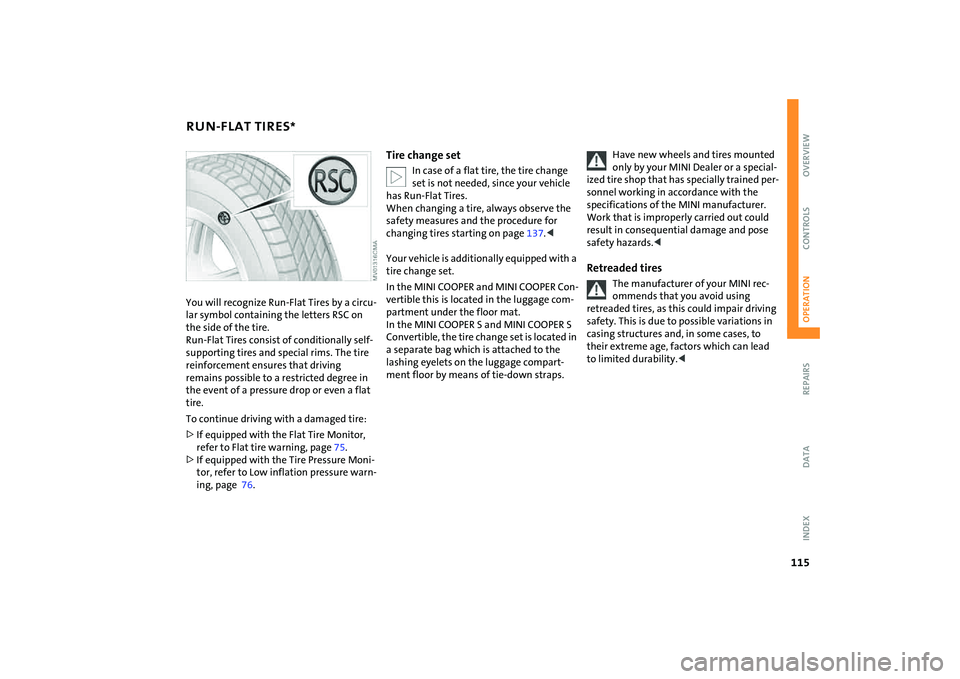
You will recognize Run-Flat Tires by a circu-
lar symbol containing the letters RSC on
the side of the tire.
Run-Flat Tires consist of conditionally self-
supporting tires and special rims. The tire
reinforcement ensures that driving
remains possible to a restricted degree in
the event of a pressure drop or even a flat
tire.
To continue driving with a damaged tire:
>If equipped with the Flat Tire Monitor,
refer to Flat tire warning, page75.
>If equipped with the Tire Pressure Moni-
tor, refer to Low inflation pressure warn-
ing, page 76.
Tire change set
In case of a flat tire, the tire change
set is not needed, since your vehicle
has Run-Flat Tires.
When changing a tire, always observe the
safety measures and the procedure for
changing tires starting on page137.<
Your vehicle is additionally equipped with a
tire change set.
In the MINI COOPER and MINI COOPER Con-
vertible this is located in the luggage com-
partment under the floor mat.
In the MINI COOPER S and MINI COOPER S
Convertible, the tire change set is located in
a separate bag which is attached to the
lashing eyelets on the luggage compart-
ment floor by means of tie-down straps.
Have new wheels and tires mounted
only by your MINI Dealer or a special-
ized tire shop that has specially trained per-
sonnel working in accordance with the
specifications of the MINI manufacturer.
Work that is improperly carried out could
result in consequential damage and pose
safety hazards.<
Retreaded tires
The manufacturer of your MINI rec-
ommends that you avoid using
retreaded tires, as this could impair driving
safety. This is due to possible variations in
casing structures and, in some cases, to
their extreme age, factors which can lead
to limited durability.<
Page 118 of 176

116
NEW WHEELS AND TIRESThe correct wheels and tires
The manufacturer of your MINI rec-
ommends mounting only wheels and
tires that it has specifically approved for
use on your particular model. Although
other wheels and tires may theoretically
have the same dimensions, variations in
factors such as manufacturing tolerances
can result in contact between tire and
bodywork, ultimately leading to serious
accidents. The manufacturer of your MINI
cannot evaluate non-approved wheels and
tires to determine if they are suited for use,
and therefore cannot ensure the operating
safety of the vehicle if they are mounted.<
Your MINI Dealer will be glad to inform you
about the correct wheel and tire combina-
tion for your vehicle.
The correct wheel and tire combination is
also important for various systems that
would otherwise be impaired, e.g. ABS or
DSC.
To maintain good handling and vehicle
response, use only tires of a single brand
and tread configuration. In the event of tire
damage, remount the previous wheel and
tire combination as soon as possible.
Wheels with Tire Pressure Monitor
TPM electronicsWhen mounting new tires or changing over
from summer to winter tires, or vice versa,
only use wheels with TPM electronics; oth-
erwise the Tire Pressure Monitor may not
be able to detect a puncture, refer to
page76. Your MINI Dealer will be glad to
advise you.Run-Flat TiresFor your own safety, use Run-Flat Tires
when mounting new tires or replacing
summer tires with winter tires or vice
versa. Keep in mind that no spare wheel is
available in the event of a flat. Your MINI
Dealer will be glad to advise you.
For safety reasons, the manufacturer
of your MINI recommends having
Run-Flat Tires replaced, not repaired, if they
are damaged.<
Tire designationFor each tire size, the manufacturer of your
MINI recommends certain tire brands. You
can recognize these by the clearly visible
designation on the tire's sidewall.
When used properly these tires meet the
highest standards regarding safety and
handling characteristics.