2008 MERCEDES-BENZ SL ROADSTER brake
[x] Cancel search: brakePage 280 of 317
Battery
277step ou
tofthe vehicl efirst and touch the
bodywork.
R Do not wipe the battery using acloth. The
battery ma yexplode as aresul tofe lec-
trostati ccharge or du etoflying sparks.
! Switch the engine off and remove the key
befor eunscrewing or disconnecting the
termina lclamps fro mthe battery .You may
otherwis edestro ye lectronic components
such as the alternator.
i Mercedes-Benz recommends tha tyou
have al lworki nvolving the battery ,e.g.
removing, charging and replacing ,carried
ou tata qualified specialis tworkshop ,e.g.
aM ercedes-Benz Service Centre.
Installation locatio nofthe battery Your vehicl
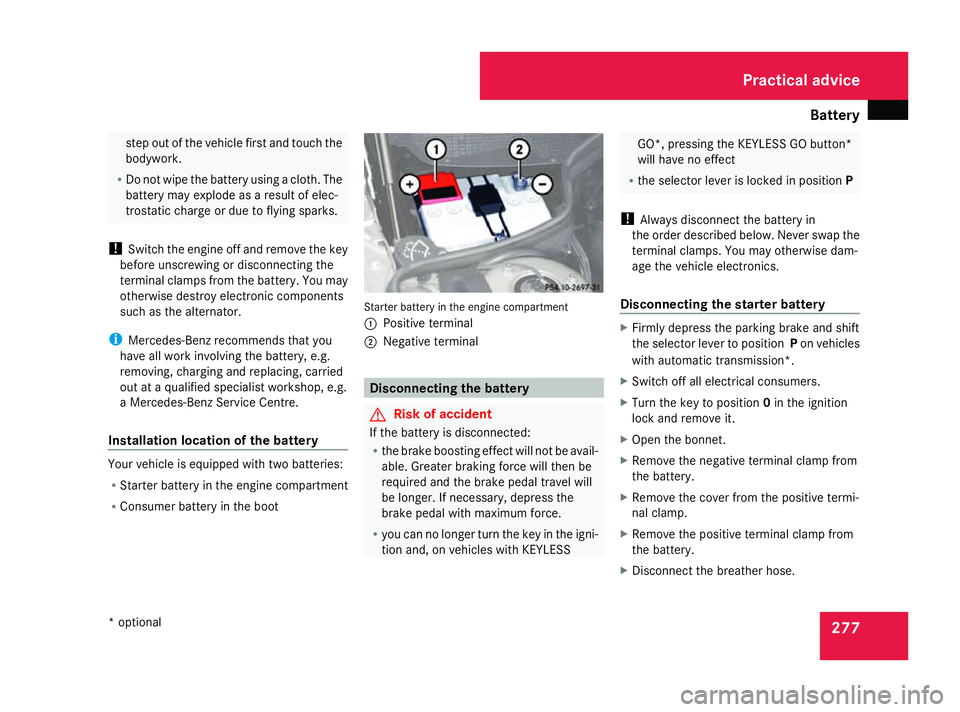
eisequippe dwitht wo batteries:
R Starter battery in the engine compartment
R Consumer battery in the boot Starter battery in the engine compartment
1 Positive terminal
2 Negative terminal Disconnecting the battery
G
Ris
kofa ccident
If the battery is disconnected:
R the brake boosting effect will not be avail-
able .Greate rbraking force will then be
required and the brake peda ltravel will
be longer. If necessary ,depress the
brake peda lwithm aximum force.
R yo uc an no longe rturnt he key in the igni-
tio na nd,onv ehicles with KEYLESS GO*, pressing the KEYLESS GO button*
will have no effect
R the selector lever is locked in position P
! Alway sdisconnect the battery in
the order describe dbelow .Never swap the
termina lclamps .You mayotherwis edam-
ag et he vehicl eelectronics.
Disconnecting the starte rbattery X
Firmly depress the parking brake and shift
the selector lever to position Pon vehicles
with automatic transmission*.
X Switch off al lelectrical consumers.
X Turn the key to position 0in the ignition
lock and remove it.
X Open the bonnet.
X Remov ethe negative termina lclamp from
the battery.
X Remov ethe cove rfromt he positive termi-
nal clamp.
X Remov ethe positive termina lclamp from
the battery.
X Disconnect the breather hose. Practical advice
*o ptional
230_AKB; 5; 4, en-GB
bjanott,
Version: 2.9.6 2008-04-08T15:09:54+02:00-Seite 277 ZDateiname: 6515_3089_02_buchblock.pdf; preflight
Page 282 of 317
Battery
279
i
If the battery powe rsuppl yhasbeen inter-
rupte d(e.g. if it ha sbeenr econnected) ,you
must carry ou tthe following tasks:
R Set the time (see the COMAND operating
instructions)
R Reset the functio nfor folding the exterior
mirror sin/out automatically* by folding
the mirror soutonce ( Ypage 80). Jump-starting
If your vehicle's battery is discharged, the
engine can be jump-started fro manother
vehicl eorfromane xternalbattery using jump
leads.
Observe the following points:
R Jump-starting ma yonlybep erforme dwhen
the engine and catalytic converter ar ecold.
R Do not start the engine if the battery is fro-
zen. Let the battery tha wfirst.
R Jump-starting ma yonlybep erforme dfrom
batteries with anominal voltag eof12V.
R Onl yusejum pleads which ar eprotected
against polarity reversal and which have a
sufficient cross-sectio nand insulate dter-
minal clamps. i
Jump lead swhich ar eprotecte dagain st
polarity reversal and furthe rinformation
abou tjump-starting can be obtained from
any Mercedes-Benz Service Centre.
! Avoi drepeated and lengthy starting
attempts .Onlyu sethe jump-starting pro-
cedur efor the battery in the engine com-
partment.
Do not us earapid- charging devic etostart
the engine. G
Ris
kofi njury
There is ariskofa cidb urns when jump-
starting avehicl edueto the gases which
escap efromt he battery .Donot lean over
the battery whil ethe engine is being jump-
started. G
Ris
kofe xplosion
Gase sescapin gfromt he battery during
jump-starting ma ycause minor explosions.
Avoi dcreating sparks. Kee pnake dflames
away fro mthe battery ,and do not smoke.
Compl ywiths afety precautions and take
protective measures when handling batter-
ies. Yo uwillf ind thes eunder "Battery "in
the index. X
Make sure tha tthe two vehicles do not
touch.
X Depres sthe parking brake.
X Mov ethe selector lever to P.
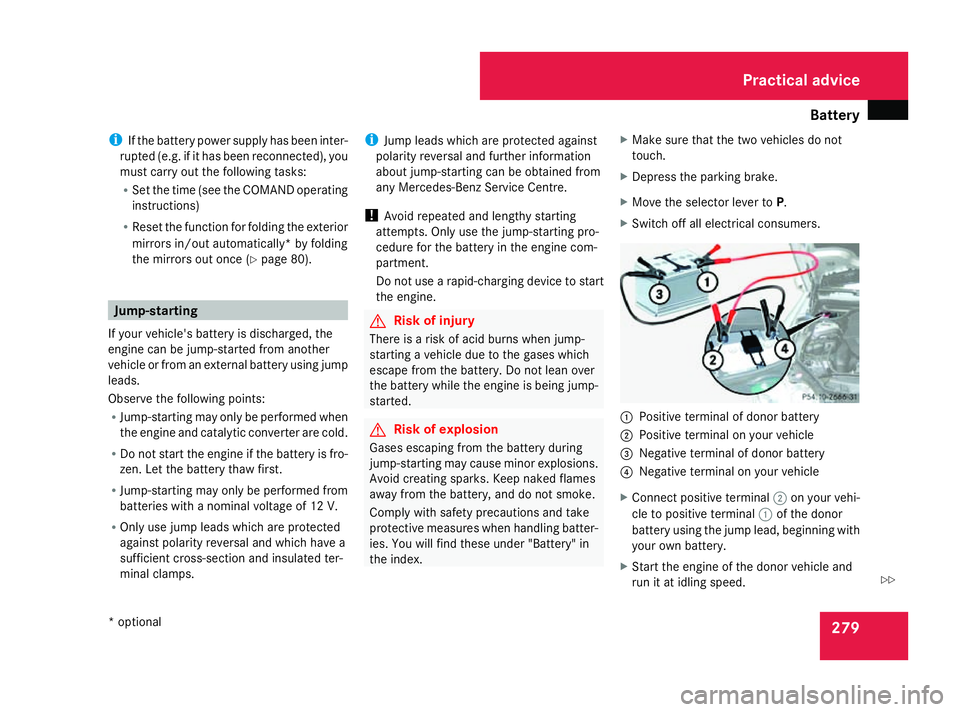
X Switch off al lelectrical consumers. 1
Positiv etermina lofdonor battery
2 Positiv etermina lonyourv ehicle
3 Negativ etermina lofdonor battery
4 Negativ etermina lonyourv ehicle
X Connect positiv eterminal 2onyour vehi-
cle to positiv eterminal 1of the donor
batter yusing the jump lead ,begin ning with
your ownb atter y.
X Start the engine of the donor vehicle and
runitati dlingspeed. Pra
ctical advice
*o ptional
230_AKB; 5; 4, en-GB
bjanott
,V ersion: 2.9.6
2008-04-08T15:09:54+02:00
-Seite 279 ZDateiname: 6515_3089_02_buchblock.pdf; preflight
Page 283 of 317
Towin
gand tow-starting 280
X
Connect negative terminal 3of the donor
battery to negative terminal 4of your
vehicle' sbattery using the jum plead, con-
necting the jum pleadtot he donor battery
first.
X Star tthe engine.
X Electrical consumers can be switched on
again. Do not switch the lights on, however,
as thi swillo verloa dthe battery.
X Remov ethe jum pleadf rome arth
point 4and negative terminal 3first,
the nfromp ositivet erminals 1and 2,
each tim edisconnecting fro mthe battery
on your ow nvehicl efirst.
X Have the battery checked at aqualified
specialis tworkshop ,e.g.aM ercedes-Benz
Service Centre. Towin
gand tow-starting Points to remember
G
Ris
kofa ccident
If yo utow the vehicle, yo umustu se arigid
towing ba rif:
R the engine is not running
R there is abrake syste mmalfunction
R the voltag esuppl yort he vehicle' selec-
trica lsystemisd amaged
Th ee lectric powe rsteering and the brake
force booster do not work when the engine
is not running .Greate rbraking force will
the nberequired and the brake peda ltravel
will be longer. If necessary ,depress the
brake peda lwithm aximum force.
Do not tow the vehicl eifthe key cannot be
turned in the ignition lock. If thi sisthe case,
the steering is locked and the vehicl ecan-
not be steered.
If yo utow or tow-start anothe rvehicle, its
weight must not exceed the maximum per-
missibl egross vehicl eweigh tofy ourv ehi-
cle. G
Ris
kofa ccident
Th eS BC®
brake syste mrequires electrical
power. Th eSBC®
brake syste menters
emergency mod eifthere ar efaults in the
powe rsuppl yort he vehicle' selectrica lsys-
tem. Greater braking force will the nbe
required and the brake peda ltravel and
braking distance will be longer. If neces-
sary ,depress the brake peda lwithm axi-
mu mf orce.
Th ev ehicl eisb raked if SBC ®
HOL Disa cti-
vated .The refore, deactivate SBC ®
HOL Dif
the vehicl eistobet owed.
If yo utow or tow-start anothe rvehicle, its
weight must not exceed the maximum per-
missibl egross vehicl eweigh tofy ourv ehi-
cle.
It is better to have the vehicl etransported
tha ntoh aveitt owed.
When towing ,obser ve the lega lrequirements
in al lcountries concerned.
! When towing ,pulla wa yslowl yand with-
ou tjerking. If the tractiv epower is too high,
the vehicles could be damaged. Do not use
the towing ey efor recovery. Practical advice
230_AKB; 5; 4, en-GB
bjanott,
Version: 2.9.6 2008-04-08T15:09:54+02:00-Seite 280 Dateiname: 6515_3089_02_buchblock.pdf; preflight
Page 284 of 317
Towin
gand tow-starting 281
!
Youm aytow the vehicl efor am aximum
of 50 km. Atowing spee dof50k m/h must
not be exceeded.
With towing distances ove r50km, the
entire vehicl eneeds to be lifted up and
transported.
! Onlysecur ethe tow cable or towing bar
to the towing eyes .You mayotherwise
damage the vehicle.
R Vehicle swithana utomatic transmission
must not be tow-started.
R If the engine does not start, try jum pstart-
ing (Y page 279).
R If it is not possibl etojump-star tthe vehicle,
have it towed to the neares tqualified spe-
cialist workshop ,e.g.aM ercedes-Benz
Service Centre.
R If the vehicl ehassuffered transmission
damage ,onlyt ow it with the propeller shaft
disconnected.
R Th es elect or lever must be in position Non
vehicles with automatic transmission.
R If yo uaretowing the vehicl eoverac onsid-
erabl edistance, thi smayonl ybed onew ith
the rea raxler aised. R
Th eign ition must be switched off if yo uare
towing the vehicl ewitht he front/rear axle
raised .Interventio nbyESP®
could other-
wise damage the brake system.
R Before towing the vehicle, make sure that
the battery is connected and charged. Oth-
erwise:
-Yo uc ann ot switch on the ignition
- Yo uc ann ot mov ethe selector lever to N
- Yo uh avenos upport when braking
i Switch off the automatic locking feature
befor ethe vehicl eistowed (Y page 120).
Yo uc ould otherwis ebelocked ou twhen
pushing or towing the vehicle. Fittin
gthe towin geye
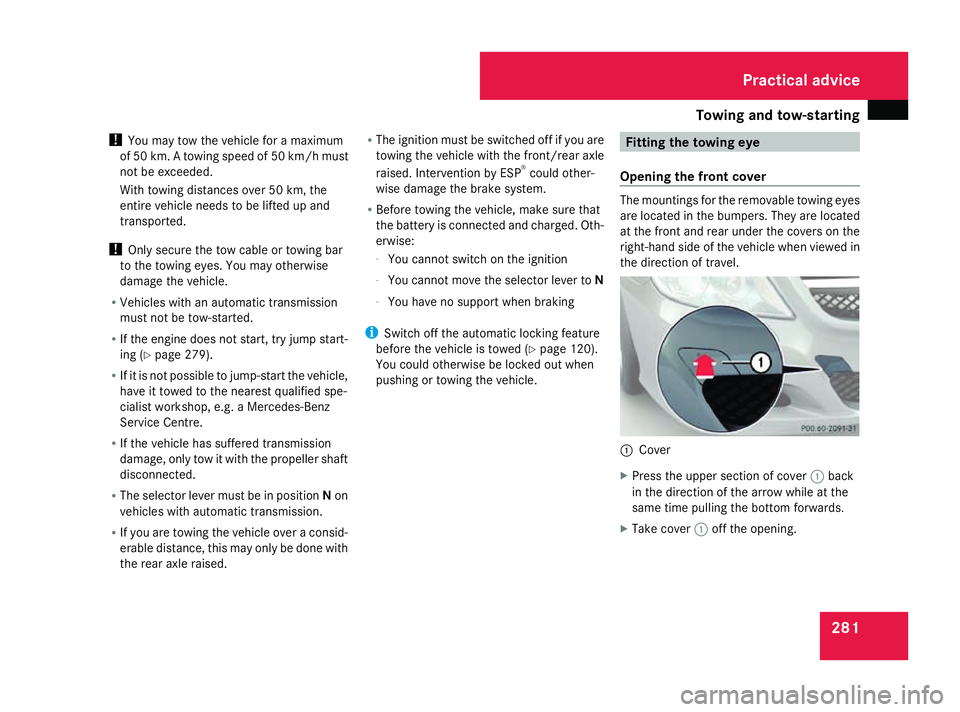
Opening the front cover Th
em ounting sfor the removabl etowing eyes
ar el ocat ed in the bumpers. They ar eloc ated
at the front and rea runder the covers on the
right-hand side of the vehicl ewhenv iewed in
the directio noftravel. 1
Cover
X Press the uppe rsectio nofc over1back
in the directio nofthe arrow whil eatthe
same tim epulling the bottom forwards.
X Take cover 1off the opening. Practical advice
230_AKB; 5; 4, en-GB
bjanott,
Version: 2.9.6
2008-04-08T15:09:54+02:0
0-Seite 281 ZDateiname: 6515_3089_02_buchblock.pdf; preflight
Page 285 of 317
Towin
gand tow-starting 282
Opening the rea
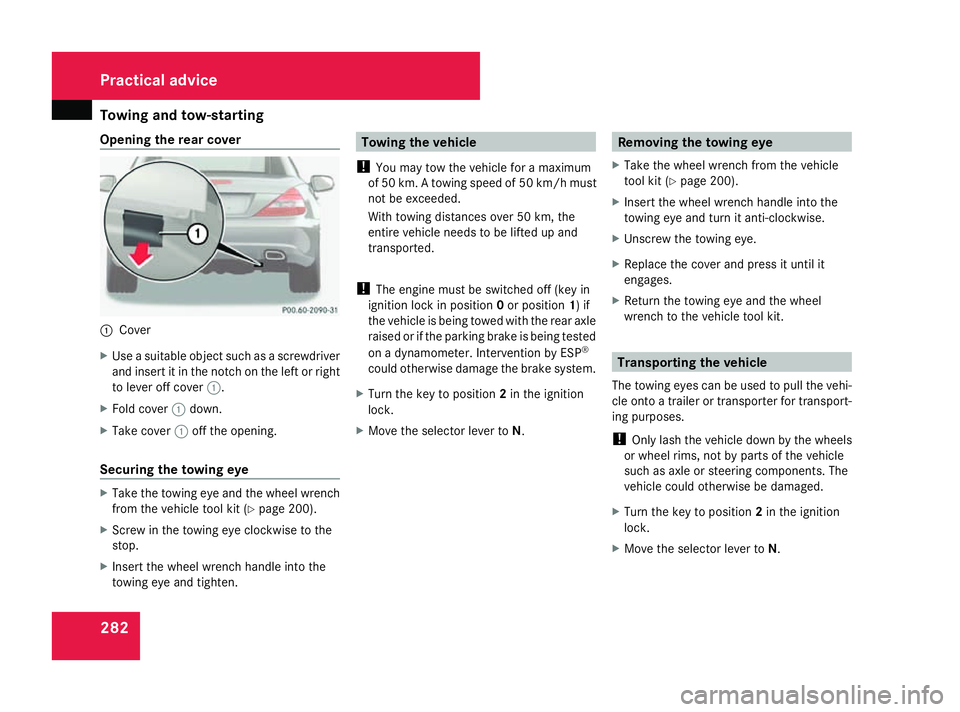
rcover 1
Cover
X Use asuitabl eobject such as ascrewdriver
and insert it in the notch on the left or right
to lever off cover 1.
X Fol dc over 1down.
X Take cover 1off the opening.
Securin gthe towin geye X
Take the towing ey eand the whee lwrench
fro mt he vehicl etoolkit ( Ypage 200).
X Scre wint he towing ey eclockwise to the
stop.
X Insert the whee lwrench handl einto the
towing ey eand tighten. Towin
gthe vehicle
! Youm aytow the vehicl efor am aximum
of 50 km. Atowing spee dof50k m/h must
not be exceeded.
With towing distances ove r50km, the
entire vehicl eneeds to be lifted up and
transported.
! Thee ngine must be switched off (ke yin
ignition lock in position 0or position 1)if
the vehicl eisbeing towed with the rea raxle
raised or if the parking brake is being tested
on adynamometer. Interventio nbyESP®
could otherwis edamag ethe brake system.
X Turn the key to position 2in the ignition
lock.
X Move the selector lever to N. Removing the towin
geye
X Take the whee lwrench fro mthe vehicle
too lkit ( Ypage 200).
X Insert the whee lwrench handl einto the
towing ey eand tur nitanti-clockwise.
X Unscrew the towing eye.
X Replac ethe cover and press it unti lit
engages.
X Retur nthe towing ey eand the wheel
wrench to the vehicl etoolkit. Transporting the vehicle
Th et owing eyes ca nbeusedtop ullt he vehi-
cle onto atrailer or transporte rfor transport-
ing purposes.
! Onlylas ht he vehicl edownbyt he wheels
or whee lrim s, not by parts of the vehicle
such as axl eorsteering components .The
vehicl ecould otherwis ebedamaged.
X Turn the key to position 2in the ignition
lock.
X Move the selector lever to N.Practical advice
230_AKB; 5; 4, en-GB
bjanott,
Version: 2.9.6 2008-04-08T15:09:54+02:00-Seite 282 Dateiname: 6515_3089_02_buchblock.pdf; preflight
Page 303 of 317
Service products and capacities
300 Service products and capacities
Notes on service products and capaci-
ties
Service products are:
R fuels
R lubricants (e.g. engine oil, transmission oil)
R coolant
R brake fluid
R windscreen washer fluid
Mercedes-Benz recommends that you only
use those products which have been tested
and specially approved by Mercedes-Benz for
your vehicle and are listed in the Mercedes-
Benz Owner's Manual in the relevant chapter
since:
R parts and service products are matched
R damage caused by the use of non-approved
service products is not covered by the war-
ranty
You can recognise service products approved
by Mercedes-Benz by the following inscrip-
tion on the containers:
R MB-Freigabe (e.g. MB-Freigabe 229.51)
R MB Approval (e.g. MB Approval 229.51) Other designations or recommendations that
relate to
alevel of quality or aspecification in
accordanc ewith an MB Approval have not
necessarily been approved by Mercedes-
Benz.
You can obtain further information from any
Mercedes-Benz Service Centre. G
Risk of injury
When handling, storing and disposing of
any service products, please observe the
relevant regulations, as you could other-
wise endanger yourself and others.
Keep service products away from children.
To protect your health, do not allow service
products to come into contact with your
eyes or open wounds. See adoctor imme-
diately if any service product is swallowed. H
Environmental note
Dispose of service products in an environ-
mentally-responsible manner. Fuels
G
Risk of explosion
Fuel is highly flammable. Fire, naked flames
and smoking are therefore prohibited when
handling fuels.
Switch off the engine before refuelling. G
Risk of injury
Do not allow fuel to come into contact with
skin or clothing.
Allowing fuels to come into direct contact
with your skin or inhaling fuel vapours is
damaging to your health.
Tank capacity Total capacity 80 l
Of which reserve
fuel Approximately 10 l
Of which reserve
fuel on AMG vehi-
cles Approximately 14 l
!
Do not use diesel to refuel vehicles with a
petrol engine. Never mix petrol with diesel. Technical data
230_AKB; 5; 4, en-GB
bjanott
,V ersion: 2.9.6
2008-04-08T15:09:54+02:00
-Seite 300 Dateiname: 6515_3089_02_buchblock.pdf; preflight
Page 309 of 317
Service products and capacities
306
Capacities The following values indicate the total cooling system capacities.
SL 280 SL 350 SL 500 SL 600 SL 63 AMG SL 65 AMG
Coolant 11.0 l 10.8 l 11.6 l 15 l 11.3 l 17.2 l
Amount of antifreeze/corrosion inhibitor required for antifreeze protection
Downto
–37 °C
(approx. 50%) 5.5 l 5.4 l 5.8 l 7.5 l 5.6 l 8.6 l
Downto
–45 °C
(approxi-
mately 55%) 6.0 l 5.9 l 6.4 l 8.3 l 6.2 l 9.5 l
Brake fluid
Over aperiod of time, the brake fluid absorbs
moisture from the air; this lowers its boiling
point. G
Risk of accident
If the boiling point of the brake fluid is too
low, vapour pocketsm ay form in the brake
system when the brakes are appliedh ard
(e.g. when driving downhill). This would
impair braking efficiency. Have the brake fluid renewed every two
years with
abrake fluid that has been
approved by Mercedes-Benz and have this
confirmed in the Service Booklet.
i There is usually anotic eint he engine
compartment to remind you when the next
brake fluid change is due. Windscreen washer system
The washer fluid reservoir holds approxi-
mately 7litres.
The headlamp cleaning system* and the
windscreen washer system are both supplied
from the washer fluid reservoir.
X At temperatures above freezing point:
top up the washer fluid reservoir with a
mixture of water and windscreen washer
concentrate (Y page 181).
X At temperatures below freezing point: Technical data
*optional
230_AKB; 5; 4, en-GB
bjanott
,V ersion: 2.9.6
2008-04-08T15:09:54+02:00
-Seite 306 Dateiname: 6515_3089_02_buchblock.pdf; preflight