2008 MERCEDES-BENZ GLK SUV seats
[x] Cancel search: seatsPage 41 of 261
R
make sure that there are no people, ani-
mals or objects between the vehicle occu-
pants and the area of deployment of the
airbag.
R do not place any objects between the seat
backrest and the door.
R do not hang any hard objects, for example,
coat hangers, on the grab handles or coat
hooks.
R do not attach accessories, e.g. cup holders,
to the doors.
It is not possible to rule out a risk of injuries
caused by an airbag due to the high speed at
which the airbag is required to deploy. G
Risk of injury
The airbag's functionality can only be guaran-
teed if the following parts are not covered and
no badges or stickers are attached to them:
R padded steering wheel boss
R knee airbag cover below the steering col-
umn
R front-passenger front airbag cover
R outer side of front seats
R side panel next to the rear seat backrest G
Risk of injury
When an airbag deploys, a small amount of
powder is released. The powder may cause
short-term breathing difficulties to persons
suffering from asthma or other pulmonary
conditions.
In order to prevent potential breathing diffi-
culties, you should leave the vehicle as soon
as it is safe to do so. You can also open the
window to allow fresh air to enter the interior.
The powder generally does not constitute a
health hazard and does not indicate that there
is a fire in the vehicle. G
Risk of injury
The airbag parts are hot after the airbag has
been deployed. Do not touch them; other-
wise, you may burn yourself.
Have the airbags checked at a qualified spe-
cialist workshop. Otherwise, occupants are
not protected by the airbags in the event of
another accident.
Front airbags
The front airbags are designed to increase
protection for the driver's and front passeng-
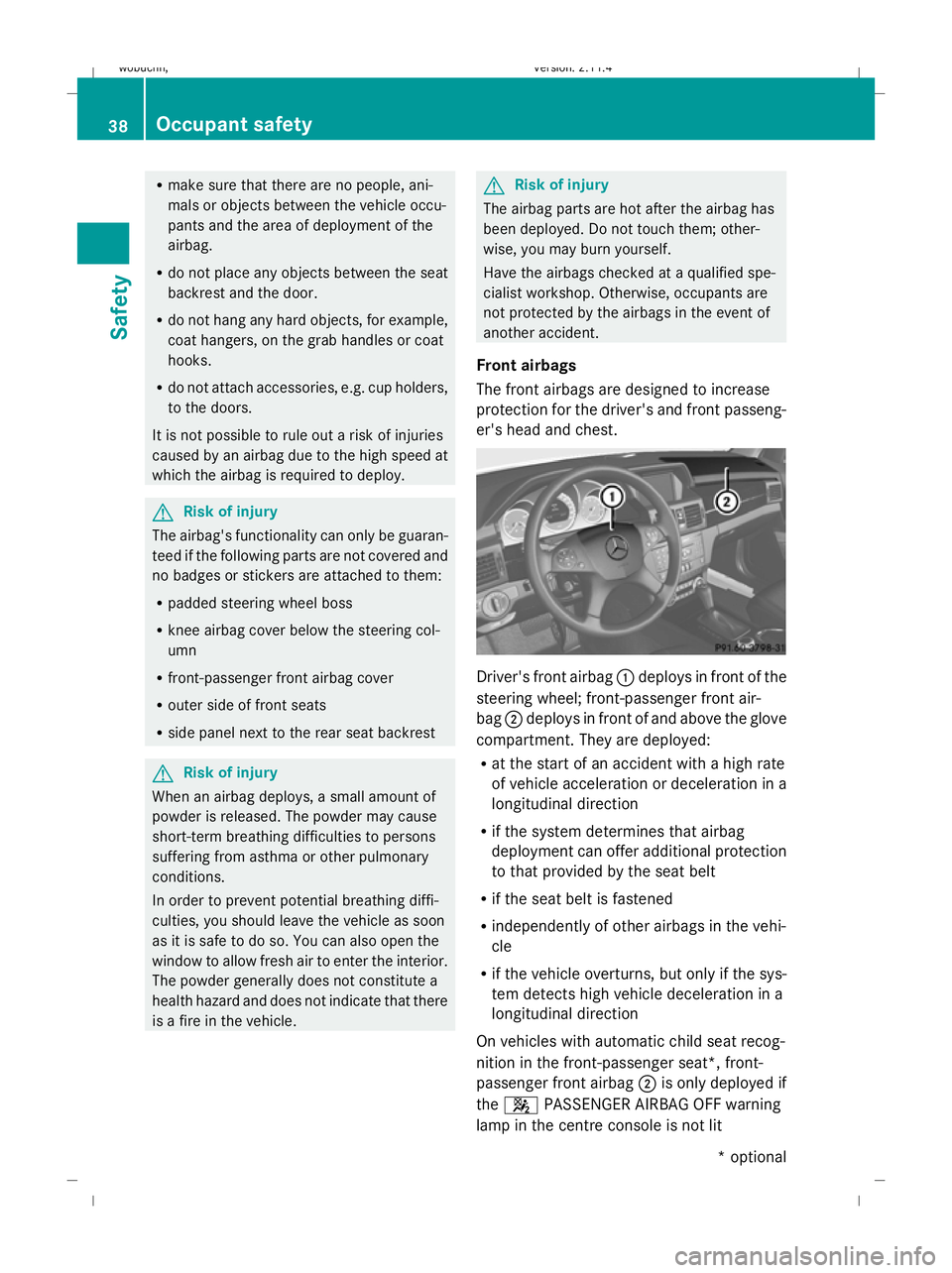
er's head and chest. Driver's front airbag
:deploys in front of the
steering wheel; front-passenger front air-
bag ;deploys in front of and above the glove
compartment. They are deployed:
R at the start of an accident with a high rate
of vehicle acceleration or deceleration in a
longitudinal direction
R if the system determines that airbag
deployment can offer additional protection
to that provided by the seat belt
R if the seat belt is fastened
R independently of other airbags in the vehi-
cle
R if the vehicle overturns, but only if the sys-
tem detects high vehicle deceleration in a
longitudinal direction
On vehicles with automatic child seat recog-
nition in the front-passenger seat*, front-
passenger front airbag ;is only deployed if
the 4 PASSENGER AIRBAG OFF warning
lamp in the centre console is not lit 38 Occupant safetySafety
* optional
X204_AKB; 1; 5, en-GB
wobuchh,
Version: 2.11.4 2008-10-15T13:20:56+02:00 - Seite 38Dateiname: 6515_0671_02_buchblock.pdf; preflight
Page 43 of 261
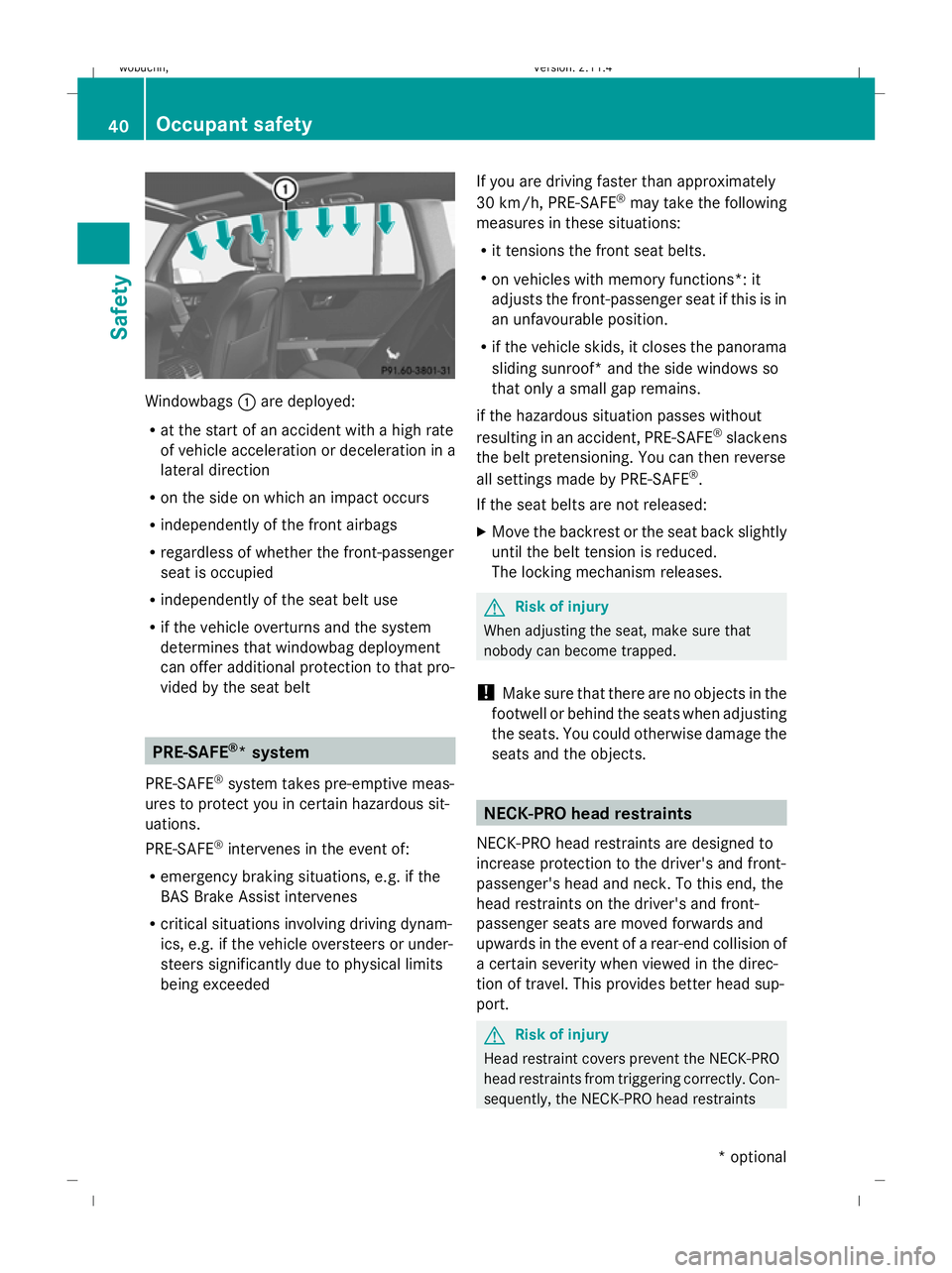
Windowbags
:are deployed:
R at the start of an accident with a high rate
of vehicle acceleration or deceleration in a
lateral direction
R on the side on which an impact occurs
R independently of the front airbags
R regardless of whether the front-passenger
seat is occupied
R independently of the seat belt use
R if the vehicle overturns and the system
determines that windowbag deployment
can offer additional protection to that pro-
vided by the seat belt PRE-SAFE
®
* system
PRE-SAFE ®
system takes pre-emptive meas-
ures to protect you in certain hazardous sit-
uations.
PRE-SAFE ®
intervenes in the event of:
R emergency braking situations, e.g. if the
BAS Brake Assist intervenes
R critical situations involving driving dynam-
ics, e.g. if the vehicle oversteers or under-
steers significantly due to physical limits
being exceeded If you are driving faster than approximately
30 km/h, PRE-SAFE
®
may take the following
measures in these situations:
R it tensions the front seat belts.
R on vehicles with memory functions*: it
adjusts the front-passenger seat if this is in
an unfavourable position.
R if the vehicle skids, it closes the panorama
sliding sunroof* and the side windows so
that only a small gap remains.
if the hazardous situation passes without
resulting in an accident, PRE-SAFE ®
slackens
the belt pretensioning. You can then reverse
all settings made by PRE-SAFE ®
.
If the seat belts are not released:
X Move the backrest or the seat back slightly
until the belt tension is reduced.
The locking mechanism releases. G
Risk of injury
When adjusting the seat, make sure that
nobody can become trapped.
! Make sure that there are no objects in the
footwell or behind the seats when adjusting
the seats. You could otherwise damage the
seats and the objects. NECK-PRO head restraints
NECK-PRO head restraints are designed to
increase protection to the driver's and front-
passenger's head and neck. To this end, the
head restraints on the driver's and front-
passenger seats are moved forwards and
upwards in the event of a rear-end collision of
a certain severity when viewed in the direc-
tion of travel. This provides better head sup-
port. G
Risk of injury
Head restraint covers prevent the NECK-PRO
head restraints from triggering correctly. Con-
sequently, the NECK-PRO head restraints 40 Occupant safetySafety
* optional
X204_AKB; 1; 5, en-GB
wobuchh,
Version: 2.11.4 2008-10-15T13:20:56+02:00 - Seite 40Dateiname: 6515_0671_02_buchblock.pdf; preflight
Page 44 of 261
cannot provide the intended level of protec-
tion. Do not use head restraint covers.
If the NECK-PRO head restraints are triggered
in an accident, you must reset the head
restraints on the driver's and front-passenger
seats (Y page 215). Head restraints that have
been triggered are tilted forwards. Children in the vehicle
If a child is travelling in your vehicle, secure
the child using a child restraint system which
is appropriate to the size and age of the child
and is recommended for Mercedes-Benz
vehicles. You should fit the restraint system
to a suitable rear seat. Ensure that the child
is secured throughout the trip.
You can obtain information about the correct
child restraint system from any Mercedes-
Benz Service Centre.
i It is advisable to use Mercedes-Benz care
products to clean child restraint systems.
Information about this can be obtained
from any Mercedes-Benz Service Centre. G
Risk of injury
Do not leave children unsupervised in the
vehicle, even if they are secured in a child
restraint system. Children could injure them-
selves on parts of the vehicle. They could also
be seriously or even fatally injured by pro-
longed exposure to extreme heat or cold.
Do not expose the child restraint system to
direct sunlight. Parts of the child restraint sys-
tem could heat up and the child could burn
herself/himself on them.
If a child opens a door, the child or other per-
sons could be injured as a result. The child
could get out and be injured in the process or
be injured by a passing vehicle. G
Risk of injury
An unsecured or an incorrectly positioned
load increases the risk of injury for the child
and all other occupants, during:
R an accident
R a braking manoeuvre
R a sudden change of direction
Do not carry heavy or hard objects inside the
vehicle unless they are secured. You will find
further information under "Loading guide-
lines" in the index.
Child restraint systems Mercedes-Benz recommends that you only
use the child restraint systems listed under
(Y
page 46). G
Risk of injury
To reduce the risk of serious or even fatal
injury to the child in the event of a sudden
change in direction, braking or an accident:
R children less than 1.50 m tall and under
twelve years of age must always be secured
in special child restraint systems on a suit-
able vehicle seat. This is necessary
because the seat belts are not designed for
children of this size.
R do not secure children less than 1.50 m tall
or under twelve years of age on the front-
passenger seat. Exception: the vehicle is
equipped with automatic child seat recog-
nition on the front-passenger seat* and the
child is secured in a child restraint system
with automatic child seat recognition.
R if you secure a forward-facing child
restraint system to the front-passenger
seat, you must move the front-passenger
seat as far back as possible.
R children must never travel sitting on the lap
of another occupant. Due to the forces
occurring in the event of a sudden change
of direction, heavy braking or an accident,
it would not be possible to restrain the Occupant safety
41Safety
* optional
X204_AKB; 1; 5, en-GB
wobuchh,
Version: 2.11.4 2008-10-15T13:20:56+02:00 - Seite 41 ZDateiname: 6515_0671_02_buchblock.pdf; preflight
Page 45 of 261
child. The child could be thrown against
parts of the vehicle interior and be seriously
or even fatally injured. G
Risk of injury
The child restraint system cannot perform its
protective function if is not correctly fitted to
a suitable vehicle seat. The child cannot be
restrained in the event of a sudden change of
direction, heavy braking or an accident. This
may lead to serious or even fatal injuries. For
this reason, when fitting a child restraint sys-
tem, observe the manufacturer's installation
instructions and the correct use of the child
restraint system.
Child restraint systems should be fitted to the
rear seats. Children are generally better pro-
tected there.
The entire base of the child restraint system
must always rest on the seat cushion. Never
place objects, e.g. a cushion, under the child
restraint system.
Only use child restraint systems with their
original covers. Only replace damaged covers
with genuine Mercedes-Benz covers.
For safety reasons, you should only use child
restraint systems which have been approved
for use in Mercedes-Benz vehicles.
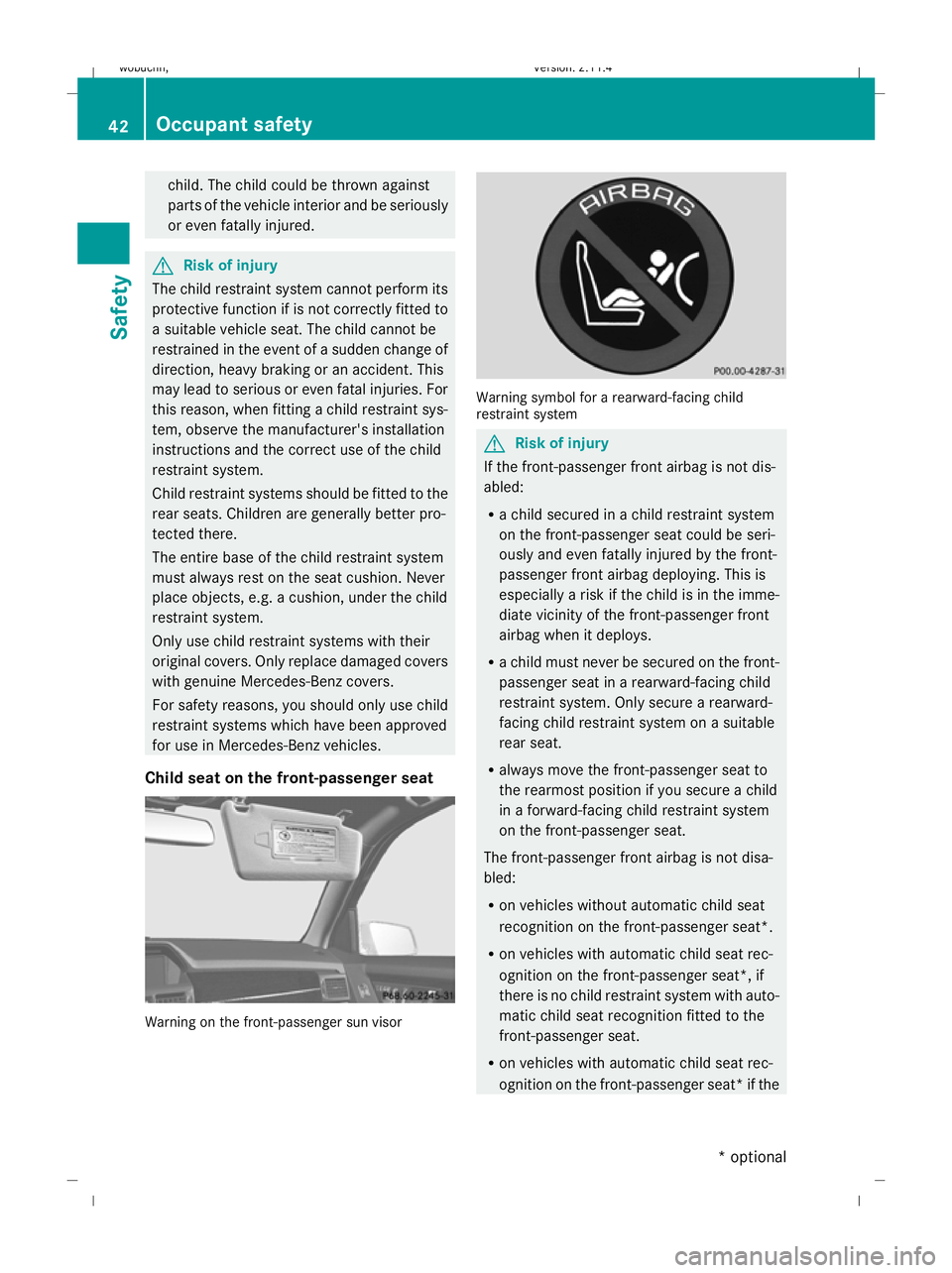
Child seat on the front-passenger seat Warning on the front-passenger sun visor Warning symbol for a rearward-facing child
restraint system
G
Risk of injury
If the front-passenger front airbag is not dis-
abled:
R a child secured in a child restraint system
on the front-passenger seat could be seri-
ously and even fatally injured by the front-
passenger front airbag deploying. This is
especially a risk if the child is in the imme-
diate vicinity of the front-passenger front
airbag when it deploys.
R a child must never be secured on the front-
passenger seat in a rearward-facing child
restraint system. Only secure a rearward-
facing child restraint system on a suitable
rear seat.
R always move the front-passenger seat to
the rearmost position if you secure a child
in a forward-facing child restraint system
on the front-passenger seat.
The front-passenger front airbag is not disa-
bled:
R on vehicles without automatic child seat
recognition on the front-passenger seat*.
R on vehicles with automatic child seat rec-
ognition on the front-passenger seat*, if
there is no child restraint system with auto-
matic child seat recognition fitted to the
front-passenger seat.
R on vehicles with automatic child seat rec-
ognition on the front-passenger seat* if the 42 Occupant safetySafety
* optional
X204_AKB; 1; 5, en-GB
wobuchh,
Version: 2.11.4 2008-10-15T13:20:56+02:00 - Seite 42Dateiname: 6515_0671_02_buchblock.pdf; preflight
Page 52 of 261
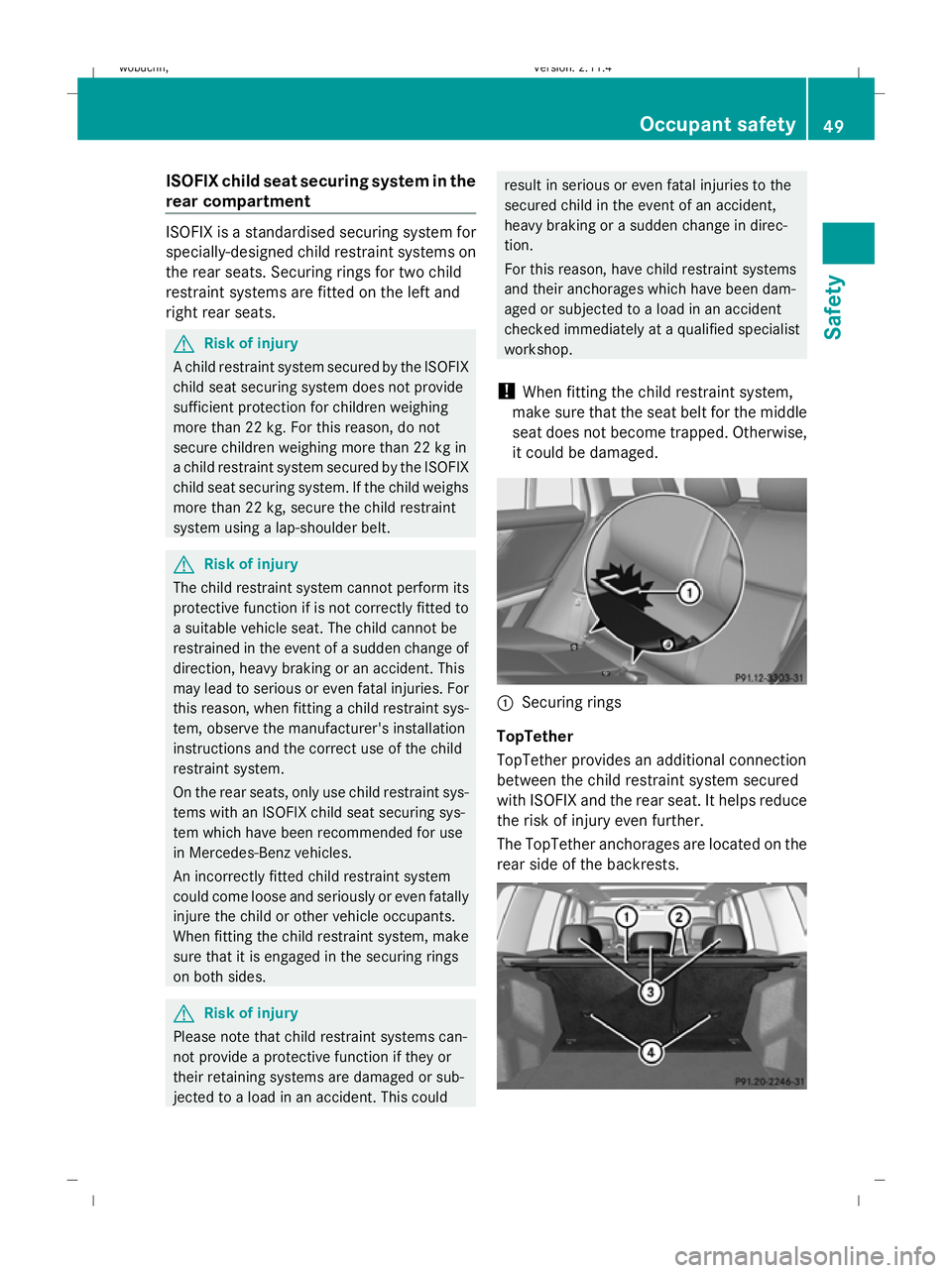
ISOFIX child seat securing system in the
rear compartment
ISOFIX is a standardised securing system for
specially-designed child restraint systems on
the rear seats. Securing rings for two child
restraint systems are fitted on the left and
right rear seats.
G
Risk of injury
A child restraint system secured by the ISOFIX
child seat securing system does not provide
sufficient protection for children weighing
more than 22 kg. For this reason, do not
secure children weighing more than 22 kg in
a child restraint system secured by the ISOFIX
child seat securing system. If the child weighs
more than 22 kg, secure the child restraint
system using a lap-shoulder belt. G
Risk of injury
The child restraint system cannot perform its
protective function if is not correctly fitted to
a suitable vehicle seat. The child cannot be
restrained in the event of a sudden change of
direction, heavy braking or an accident. This
may lead to serious or even fatal injuries. For
this reason, when fitting a child restraint sys-
tem, observe the manufacturer's installation
instructions and the correct use of the child
restraint system.
On the rear seats, only use child restraint sys-
tems with an ISOFIX child seat securing sys-
tem which have been recommended for use
in Mercedes-Benz vehicles.
An incorrectly fitted child restraint system
could come loose and seriously or even fatally
injure the child or other vehicle occupants.
When fitting the child restraint system, make
sure that it is engaged in the securing rings
on both sides. G
Risk of injury
Please note that child restraint systems can-
not provide a protective function if they or
their retaining systems are damaged or sub-
jected to a load in an accident. This could result in serious or even fatal injuries to the
secured child in the event of an accident,
heavy braking or a sudden change in direc-
tion.
For this reason, have child restraint systems
and their anchorages which have been dam-
aged or subjected to a load in an accident
checked immediately at a qualified specialist
workshop.
! When fitting the child restraint system,
make sure that the seat belt for the middle
seat does not become trapped. Otherwise,
it could be damaged. :
Securing rings
TopTether
TopTether provides an additional connection
between the child restraint system secured
with ISOFIX and the rear seat. It helps reduce
the risk of injury even further.
The TopTether anchorages are located on the
rear side of the backrests. Occupant safety
49Safety
X204_AKB; 1; 5, en-GB
wobuchh, Version: 2.11.4 2008-10-15T13:20:56+02:00 - Seite 49 ZDateiname: 6515_0671_02_buchblock.pdf; preflight
Page 60 of 261
Opening and closing...........................58
Tailgate ................................................ 59
Key positions ....................................... 61
Seats .................................................... 62
Steering wheel .................................... 66
Mirrors ................................................. 67
Memory functions* .............................69
Seat belts ............................................. 70
Lights ................................................... 74
Windscreen wipers .............................79
Side windows ...................................... 80
Driving and parking ............................83
Transmission ....................................... 85
Instrument cluster ..............................90
On-board computer (4-button
multi-function steering wheel) ..........91
On-board computer (12-button
multi-function steering wheel*) ........93
Off-road driving ................................. 105
Driving systems ................................ 108
Air conditioning ................................. 117
Sliding sunroof .................................. 127
Loading and stowing ........................129
Features ............................................. 137
57
Controls
X204_AKB; 1; 5, en-GB
wobuchh, Version: 2.11.4
2008-10-15T13:20:56+02:00 - Seite 57 Dateiname: 6515_0671_02_buchblock.pdf; preflight
Page 65 of 261
g
To remove the key
1 Power supply for some consumers, such
as the windscreen wipers
2 Ignition (power supply for all consumers)
and drive position
3 To start the engine
i Even if the key is not for the vehicle in
question, it will still turn in the ignition lock.
The ignition is not switched on. The engine
cannot be started. Seats
Points to remember
For information about folding the rear bench
seat forwards, see the "Luggage compart-
ment enlargement" section (Y page 132).
Depending on the vehicle's equipment, the
seats can adjusted either manually/electri-
cally or electrically*. G
Risk of injury
The seats can still be adjusted when there is
no key in the ignition lock. For this reason,
children should never be left unsupervised in
the vehicle. They could become trapped when
adjusting a seat. G
Risk of accident
Only adjust the driver's seat when the vehicle
is stationary. You will otherwise be distracted
from the road and traffic conditions and you
could lose control of the vehicle as a result of
the seat moving. This could cause an acci-
dent. G
Risk of injury
Make sure that nobody can become trapped
when you adjust the seat.
Observe the notes concerning the airbag sys-
tem.
Secure children as recommended; see "Chil-
dren in the vehicle" section. G
Risk of injury
Make sure that the central area of the head
restraint supports the back of your head at
about eye level. You could seriously injure
your neck if your head is not correctly sup-
ported by the head restraint in the event of an
accident. Never travel without a correctly
adjusted and engaged head restraint.
! When you move the seats, make sure that
there are no objects in the footwell or
behind the seats. Otherwise, you could
damage the seats and the objects.
i The head restraints in the front seats are
fitted with the NECK-PRO system
(Y page 40). For this reason, it is not pos-
sible to remove the head restraints from
the front seats.
The rear-compartment head restraints can
be removed (Y page 64).
Please contact a Mercedes-Benz Service
Centre for more information. Adjusting the seats manually and
electrically
Seat fore-and-aft adjustment
X
Lift handle ?and slide the seat forwards
or backwards.
X Release handle ?again.
Make sure that you hear the seat engage
into position. 62 SeatsControls
* optional
X204_AKB; 1; 5, en-GB
wobuchh,
Version: 2.11.4 2008-10-15T13:20:56+02:00 - Seite 62Dateiname: 6515_0671_02_buchblock.pdf; preflight
Page 66 of 261
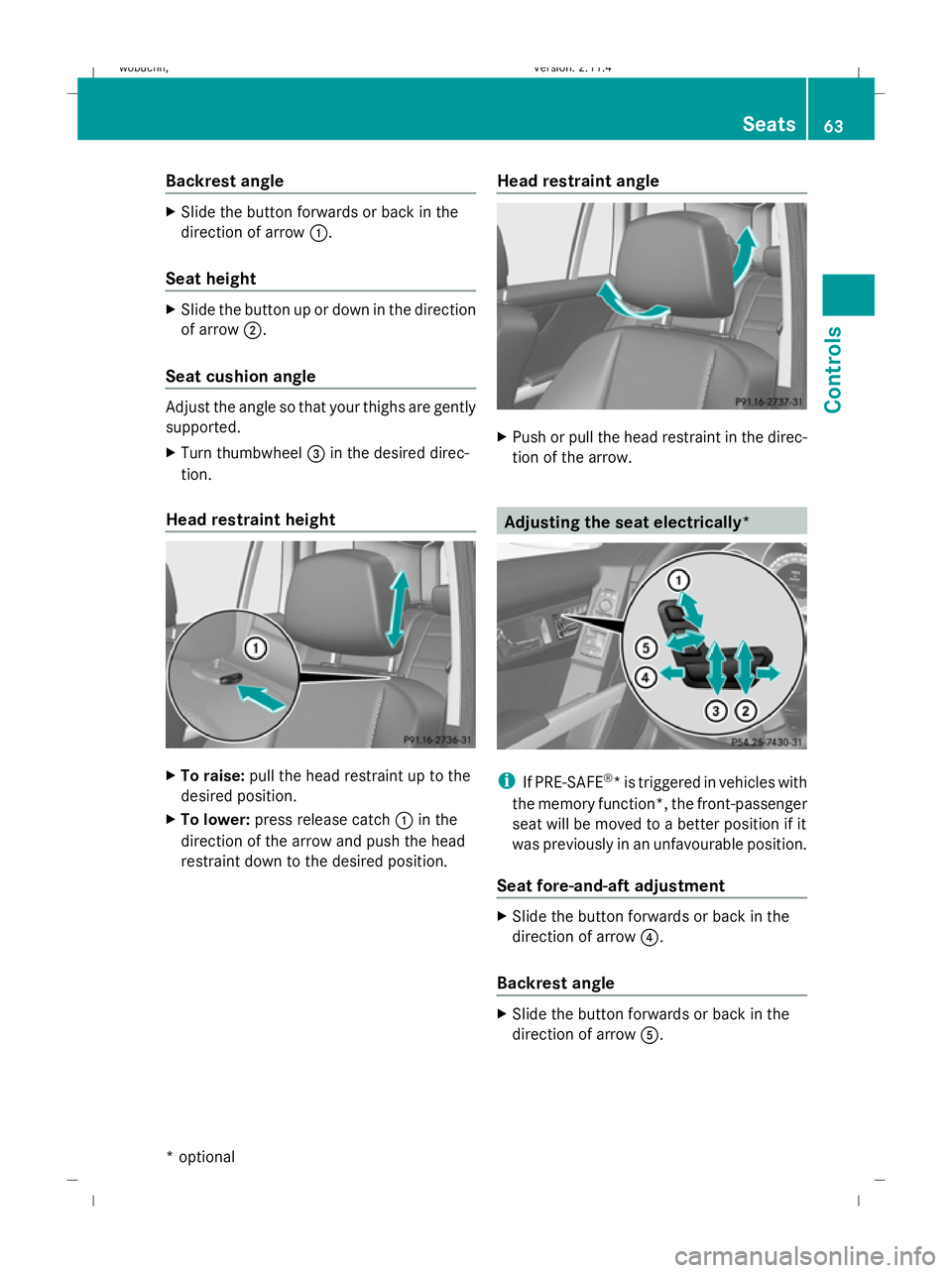
Backrest angle
X
Slide the button forwards or back in the
direction of arrow :.
Seat height X
Slide the button up or down in the direction
of arrow ;.
Seat cushion angle Adjust the angle so that your thighs are gently
supported.
X Turn thumbwheel =in the desired direc-
tion.
Head restraint height X
To raise: pull the head restraint up to the
desired position.
X To lower: press release catch :in the
direction of the arrow and push the head
restraint down to the desired position. Head restraint angle X
Push or pull the head restraint in the direc-
tion of the arrow. Adjusting the seat electrically*
i
If PRE-SAFE ®
*i s triggered in vehicles with
the memory function*, the front-passenger
seat will be moved to a better position if it
was previously in an unfavourable position.
Seat fore-and-aft adjustment X
Slide the button forwards or back in the
direction of arrow ?.
Backrest angle X
Slide the button forwards or back in the
direction of arrow A. Seats
63Controls
* optional
X204_AKB; 1; 5, en-GB
wobuchh,
Version: 2.11.4 2008-10-15T13:20:56+02:00 - Seite 63 ZDateiname: 6515_0671_02_buchblock.pdf; preflight