2008 MAZDA MODEL TRIBUTE tow
[x] Cancel search: towPage 117 of 288

WARNING: Follow all instructions provided by the
manufacturer of the booster seat.
WARNING: Never put the shoulder belt under a child’s arm or
behind the back because it eliminates the protection for the
upper part of the body and may increase the risk of injury or
death in a collision.
WARNING: Never use pillows, books, or towels to boost a
child. They can slide around and increase the likelihood of
injury or death in a collision.
SAFETY SEATS FOR CHILDREN
Child and infant or child safety seats
Use a safety seat that is recommended for the size and weight of the
child. Carefully follow all of the manufacturer’s instructions with the
safety seat you put in your vehicle. If you do not install and use the
safety seat properly, the child may be injured in a sudden stop or
collision.
When installing a child safety seat:
• Review and follow the information
presented in the Airbag
Supplemental Restraint System
section in this chapter.
• Use the correct seat belt buckle
for that seating position (the
buckle closest to the direction the
tongue is coming from).
• Insert the belt tongue into the
proper buckle until you hear a
snap and feel it latch. Make sure the tongue is securely fastened in the
buckle.
• Keep the buckle release button pointing up and away from the safety
seat, with the tongue between the child seat and the release button,
to prevent accidental unbuckling.
• Place seat back in upright position.
2008 Tribute (j14)
Owners Guide (post-2002-fmt)
USA (fus)
Seating and Safety Restraints
117
Page 120 of 288
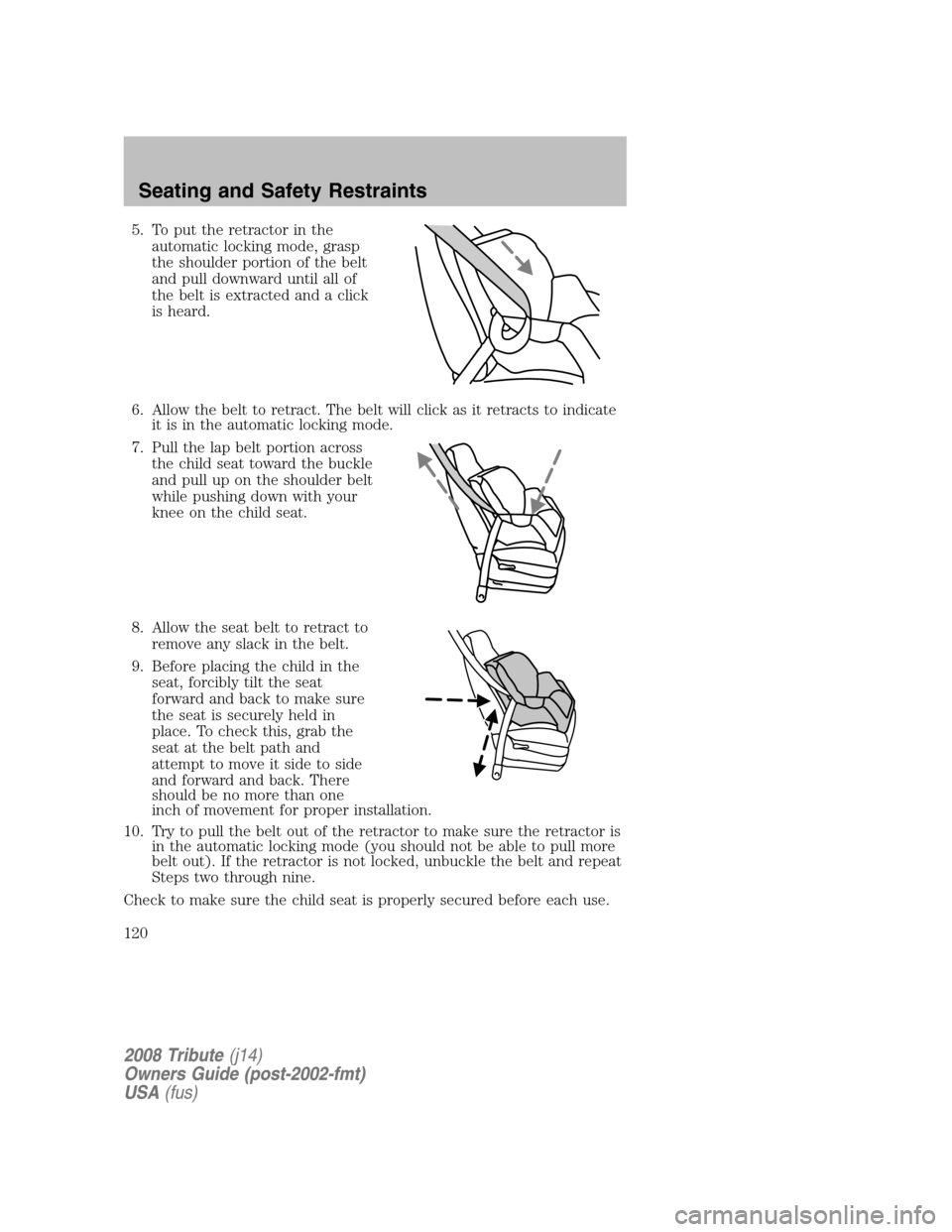
5. To put the retractor in the automatic locking mode, grasp
the shoulder portion of the belt
and pull downward until all of
the belt is extracted and a click
is heard.
6. Allow the belt to retract. The belt will click as it retracts to indicate it is in the automatic locking mode.
7. Pull the lap belt portion across the child seat toward the buckle
and pull up on the shoulder belt
while pushing down with your
knee on the child seat.
8. Allow the seat belt to retract to remove any slack in the belt.
9. Before placing the child in the seat, forcibly tilt the seat
forward and back to make sure
the seat is securely held in
place. To check this, grab the
seat at the belt path and
attempt to move it side to side
and forward and back. There
should be no more than one
inch of movement for proper installation.
10. Try to pull the belt out of the retractor to make sure the retractor is in the automatic locking mode (you should not be able to pull more
belt out). If the retractor is not locked, unbuckle the belt and repeat
Steps two through nine.
Check to make sure the child seat is properly secured before each use.
2008 Tribute (j14)
Owners Guide (post-2002-fmt)
USA (fus)
Seating and Safety Restraints
120
Page 122 of 288

3. Locate the correct anchor for the selected seating position.
NOTE: There are three tether
anchors located on the headliner at
the rear of the vehicle.
WARNING: If the tether strap
is clipped incorrectly, the child
safety seat may not be
retained properly in the event
of a collision. If the safety seat
is not anchored properly, the
risk of a child being injured in
a collision greatly increases.
4. Clip the tether strap to the anchor as shown.
The arrow in the above graphic
points toward the front of the
vehicle.
5. Refer to the Installing child
safety seats in combination
lap and shoulder belt seating
positions section of this chapter
for further instructions to
secure the child safety seat.
6. Tighten the child safety seat tether strap according to the
manufacturer’s instructions.
2008 Tribute (j14)
Owners Guide (post-2002-fmt)
USA (fus)
Seating and Safety Restraints
122
Page 136 of 288

If you feel a sudden vibration or ride disturbance while driving, or you
suspect your tire or vehicle has been damaged, immediately reduce your
speed. Drive with caution until you can safely pull off the road. Stop and
inspect the tires for damage. If a tire is under-inflated or damaged,
deflate it, remove wheel and replace it with your spare tire and wheel. If
you cannot detect a cause, have the vehicle towed to the nearest repair
facility or tire dealer to have the vehicle inspected.
Tire and wheel alignment
A bad jolt from hitting a curb or pothole can cause the front end of your
vehicle to become misaligned or cause damage to your tires. If your
vehicle seems to pull to one side, vibrate or shake when you’re driving,
the wheels may be out of alignment. Have a qualified technician at a
Mazda dealer check the wheel alignment periodically.
Wheel misalignment in the front or the rear can cause uneven and rapid
treadwear of your tires and should be corrected by a qualified technician
at a Mazda dealer. Front wheel drive (FWD) vehicles and those with an
independent rear suspension require alignment of all four wheels.
The tire should also be balanced periodically. An unbalanced tire and
wheel assembly may result in irregular tire wear.
NOTE: When it is time to replace front tires with new ones, this is an
ideal time to perform an alignment. New tires should be balanced at the
time they are installed.
Tire rotation
Rotating your tires at the recommended interval (as indicated in the
Scheduled maintenance section of theMaintenance and
Specifications chapter) will help your tires wear more evenly, providing
better tire performance and longer tire life.
2008 Tribute (j14)
Owners Guide (post-2002-fmt)
USA (fus)
Tires, Wheels and Loading
136
Page 150 of 288

Example only:
Cargo Weight – includes all weight added to the Base Curb Weight,
including cargo and optional equipment. When towing, trailer tongue load
or king pin weight is also part of cargo weight.
GAW (Gross Axle Weight) – is the total weight placed on each axle
(front and rear) – including vehicle curb weight and all payload.
2008 Tribute (j14)
Owners Guide (post-2002-fmt)
USA (fus)
Tires, Wheels and Loading
150
Page 151 of 288

GAWR (Gross Axle Weight Rating)– is the maximum allowable
weight that can be carried by a single axle (front or rear). These
numbers are shown on the Safety Compliance Certification Label
located on the B-Pillar or the edge of the driver’s door. The total
load on each axle must never exceed its GAWR.
Note: For trailer towing information refer to Trailer towingfound in
this chapter or the RV and Trailer Towing Guide provided by your
authorized dealer.
GVW (Gross Vehicle Weight) – is the Vehicle Curb Weight + cargo +
passengers.
GVWR (Gross Vehicle Weight
Rating) – is the maximum
allowable weight of the fully loaded
vehicle (including all options,
equipment, passengers and cargo).
The GVWR is shown on the
Safety Compliance Certification
Label located on the B-Pillar or
the edge of the driver’s door.
The GVW must never exceed the
GVWR.
WARNING: Exceeding the Safety Compliance Certification
Label vehicle weight rating limits could result in substandard
vehicle handling or performance, engine, transmission and/or
structural damage, serious damage to the vehicle, loss of
control and personal injury.
MFD. BY FORD MOTOR CO. IN U.S.A.
EXT PNT: XX RC: XXDSO:
WB BRK INT TR TP/PS R AXLE TR SPR XXXXX
XXX X XX X XX X XX XXX
XXXXXXXXXXXXX XXX XXXX-XXXXXXX-XX
THIS VEHICLE CONFORMS TO ALL APPLICABLE FEDERAL MOTOR
VEHICLE SAFETY AND THEFT PREVENTION STANDARDS IN
EFFECT ON THE DATE OF MANUFACTURE SHOWN ABOVE.
VIN: XXXXXXXXXXXXXXXXX XXXXX
TYPE: XXX XXXXX
DATE:
XX/XX GVWR: XXXXXLB/ XXXXX KG
FRONT GAWR: XXXXL REAR GAWR: XXXXLB
AT XXX kPa/XX PSI COLD AT XXX kPa/XX PSI COLD
XXXX
KG WITH
XXXX/XXXXXXX TIRES
XXXX.XX RIMS XXXX
KG WITH
XXXX/XXXXXXX TIRES
XXXX.XX RIMS
FOR MAZDA MOTOR CORPORATION
2008 Tribute(j14)
Owners Guide (post-2002-fmt)
USA (fus)
Tires, Wheels and Loading
151
Page 152 of 288

GCW (Gross Combined Weight)– is the weight of the loaded vehicle
(GVW) plus the weight of the fully loaded trailer.
GCWR (Gross Combined Weight Rating) – is the maximum allowable
weight of the vehicle and the loaded trailer – including all cargo and
passengers – that the vehicle can handle without risking damage.
(Important: The towing vehicle’s braking system is rated for operation at
GVWR, not at GCWR.) Separate functional brakes should be used for
safe control of towed vehicles and for trailers where the GCW of the
towing vehicle plus the trailer exceed the GVWR of the towing vehicle.
The GCW must never exceed the GCWR.
Maximum Loaded Trailer Weight – is the highest possible weight of a
fully loaded trailer the vehicle can tow. It assumes a vehicle with only
mandatory options, no cargo (internal or external), a tongue load of
10–15% (conventional trailer) or king pin weight of 15–25% (fifth wheel
trailer), and driver only (150 lb. [68 kg]). Consult your authorized
dealer (or the RV and Trailer Towing Guide provided by your
authorized dealer) for more detailed information.
Tongue Load or Fifth Wheel King Pin Weight – refers to the amount
of the weight that a trailer pushes down on a trailer hitch.
Examples: For a 5,000 lb. (2,268 kg) conventional trailer, multiply 5,000
by 0.10 and 0.15 to obtain a proper tongue load range of 500 to 750 lb.
(227 to 340 kg). For an 11,500 lb. (5,216 kg) fifth wheel trailer, multiply
by 0.15 and 0.25 to obtain a proper king pin load range of 1,725 to 2,875 lb.
(782 to 1,304 kg)
WARNING: Do not exceed the GVWR or the GAWR specified on
the Safety Compliance Certification Label.
WARNING: Do not use replacement tires with lower load
carrying capacities than the original tires because they may
lower the vehicle’s GVWR and GAWR limitations. Replacement
tires with a higher limit than the original tires do not increase
the GVWR and GAWR limitations.
2008 Tribute (j14)
Owners Guide (post-2002-fmt)
USA (fus)
Tires, Wheels and Loading
152
Page 153 of 288

WARNING: Exceeding any vehicle weight rating limitation
could result in serious damage to the vehicle and/or personal
injury.
Steps for determining the correct load limit: 1. Locate the statement “The combined weight of occupants and cargo should never exceed XXX kg or XXX lbs.” on your vehicle’s placard.
2. Determine the combined weight of the driver and passengers that will be riding in your vehicle.
3. Subtract the combined weight of the driver and passengers from XXX kg or XXX lbs.
4. The resulting figure equals the available amount of cargo and luggage load capacity. For example, if the “XXX” amount equals
1,400 lbs. and there will be five 150 lb. passengers in your vehicle,
the amount of available cargo and luggage load capacity is 650 lbs.
(1400-750 (5 x 150) = 650 lb.). In metric units (635-340 (5 x 68) =
295 kg.)
5. Determine the combined weight of luggage and cargo being loaded on the vehicle. That weight may not safely exceed the available
cargo and luggage load capacity calculated in Step 4.
6. If your vehicle will be towing a trailer, load from your trailer will be transferred to your vehicle. Consult this manual to determine how
this reduces the available cargo and luggage load capacity of your
vehicle.
The following gives you a few examples on how to calculate the available
amount of cargo and luggage load capacity:
• Another example for your vehicle with 1400 lb. (635 kg) of cargo and
luggage capacity. You decide to go golfing. Is there enough load
capacity to carry you, 4 of your friends and all the golf bags? You and
four friends average 220 lb. (99 kg) each and the golf bags weigh
approximately 30 lb. (13.5 kg) each. The calculation would be:
1400 - (5 x 220) - (5 x 30) = 1400 - 1100 - 150 = 150 lb. Yes, you
have enough load capacity in your vehicle to transport four friends
and your golf bags. In metric units, the calculation would be: 635 kg -
(5 x 99 kg) - (5 x 13.5 kg) = 635 - 495 - 67.5 = 72.5 kg.
2008 Tribute (j14)
Owners Guide (post-2002-fmt)
USA (fus)
Tires, Wheels and Loading
153