Page 357 of 459
5
When trouble arises
355
5-1. Essential information
ES350_U_(L/O_0708)
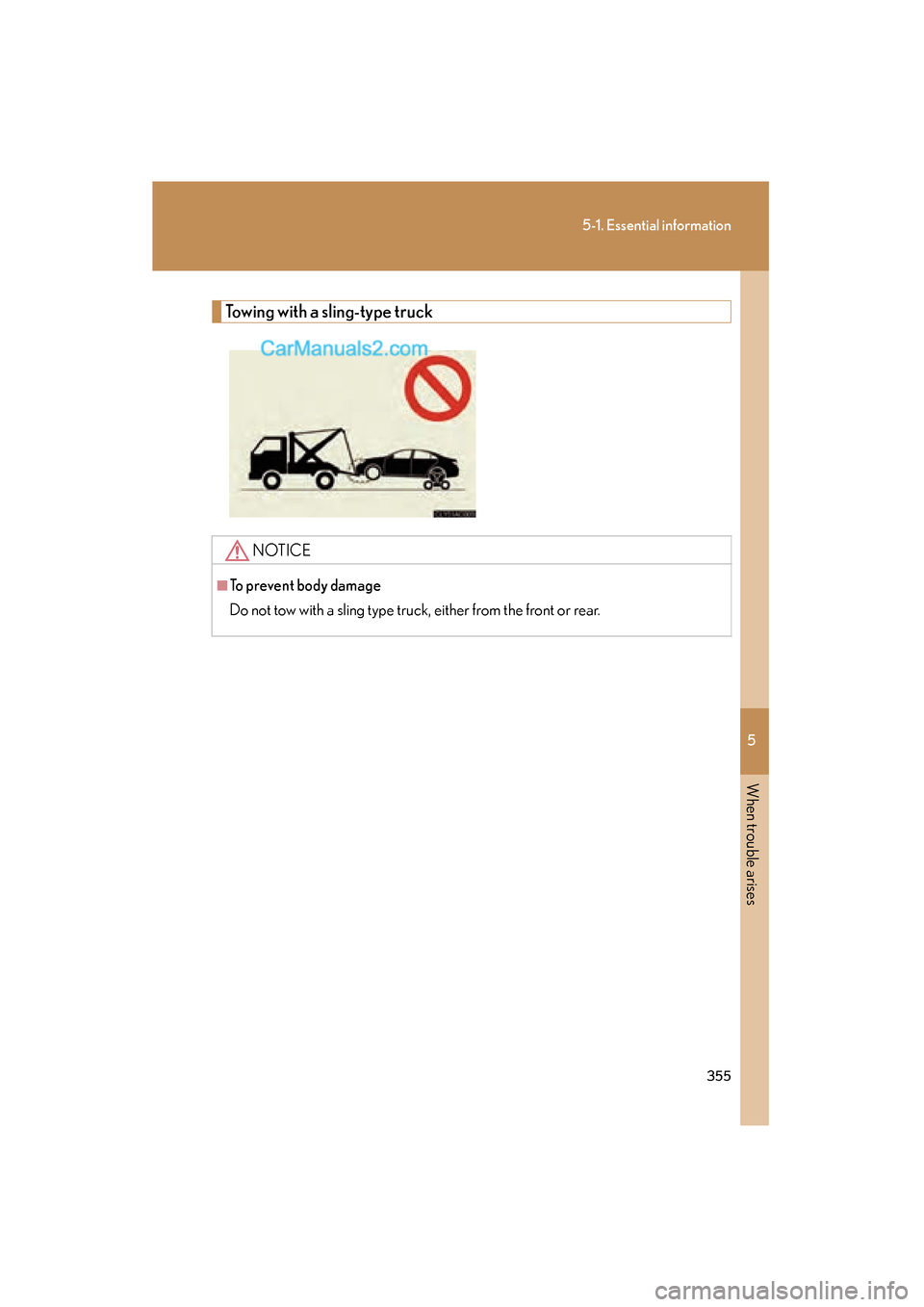
Towing with a sling-type truck
NOTICE
■To prevent body damage
Do not tow with a sling type truck, either from the front or rear.
Page 358 of 459
356
5-1. Essential information
ES350_U_(L/O_0708)
Towing with a wheel lift-type truckFrom the front Release the parking brake.
From the rear Use a towing dolly under the front
wheel.
NOTICE
■To prevent damaging the vehicle
When raising the vehicle, ensure adequate ground clearance for towing at the
opposite end of the raised vehicle. Without adequate clearance, the vehicle could
be damaged while being towed.
NOTICE
■To prevent causing serious damage to the transmission
Never tow this vehicle from the rear with the front wheels on the ground.
Page 386 of 459
384
5-2. Steps to take in an emergency
ES350_U_(L/O_0708)
If you have a flat tire
Remove the flat tire and replace it with the spare provided.
■Before jacking up the vehicle
● Stop the vehicle on a hard, flat surface.
● Set the parking brake.
● Shift the shift lever to P.
● Stop the engine.
● Turn on the emergency flashers.
■ Location of the spare tire, jack and tools
Jack
Jack handle
Spare tireCompact spare tire
Wr e n c h
Towing eyelet
Page 391 of 459
5
When trouble arises
389
5-2. Steps to take in an emergency
ES350_U_(L/O_0708)Install the spare tire and loosely
tighten each nut by hand to
approximately the same amount.
Turn the lug nuts until the washers
come into contact with the wheel.
Lower the vehicle.
Firmly tighten each nut two or
three times in the order shown in
the illustration.
Tightening torque:
10.5 kgf•m (103 N•m, 76 ft•lbf)
Stow the flat tire, tire jack and all tools.
STEP2
Wheel nut
Wa s h e r
Disc wheel
STEP3
STEP4
STEP5
Page 407 of 459

5
When trouble arises
405
5-2. Steps to take in an emergency
ES350_U_(L/O_0708)
If the vehicle becomes stuck
CAUTION
■When attempting to free a stuck vehicle
If you choose to rock the vehicle back and forth to free it, make sure the surround-
ing area is clear, to avoid striking other vehicles, objects or persons. The vehicle
may also lunge forward or lunge back suddenly as it becomes free. Use extreme
caution.
■When shifting the shift lever
Be careful not to shift the shift lever with the accelerator pedal depressed.
This may lead to unexpected rapid acceleration of the vehicle that may cause an
accident and result in death or serious injury.
NOTICE
■To avoid damaging the transmission and other components
●Avoid spinning the wheels and do not rev the engine.
●If the vehicle remains stuck after trying these procedures, the vehicle may require
towing to be freed.
Carry out the following procedures if the tires spin or the vehicle becomes
stuck in mud, dirt, or snow.
●Stop the engine. Set the parking brake and put the shift lever in P.
● Remove the mud, snow, or sand from around the stuck tire.
● Place wood, stones or some other material to help provide trac-
tion under the tires.
● Restart the engine.
● Carefully apply the accelerator to free the vehicle.
Page 410 of 459
408
ES350_U_(L/O_0708)
6-1. Specifications
Maintenance data (fuel, oil level, etc.)
Dimensions and weight
*: Unladen vehicle
Overall length191.1 in. (4855 mm)
Overall width71.7 in. (1820 mm)
Overall height *57.1 in. (1450 mm)
Wheelbase109.3 in. (2775 mm)
Tr e a dFront62.0 in. (1575 mm)
Rear61.6 in. (1565 mm)
Vehicle capacity weight
(Occupants + luggage)900 lb. (410 kg)
Towing capacity
(trailer weight + cargo weight)1000 lb. (450 kg)
Page 417 of 459
415
6-1. Specifications
6
Vehicle specifications
ES350_U_(L/O_0708)
Tires and wheelsType A
Ti r e s i z eP215/55R17 93V
Tire inflation pressure
(Recommended cold tire inflation
pressure)
Driving under normal conditions Front:
30 psi (210 kPa, 2.1 kgf/cm
2 or bar)
Rear:
30 psi (210 kPa, 2.1 kgf/cm
2 or bar)
Spare:
30 psi (210 kPa, 2.1 kgf/cm
2 or bar)
When driving at high speeds above 100 mph
(160 km/h), in countries where such speeds are
permitted by law, add 4.3 psi (30 kPa, 0.3 kgf/
cm
2 or bar) to the front tires and rear tires.
Never exceed the maximum cold tire inflation
pressure indicated on the tire sidewall.
Towing a trailer
Front:
32 psi (220 kPa, 2.1 kgf/cm
2 or bar)
Rear:
32 psi (220 kPa, 2.1 kgf/cm
2 or bar)
Spare:
32 psi (220 kPa, 2.1 kgf/cm
2 or bar)
Wheel size17 × 7J
Wheel nut torque76 ft•lbf (103 N•m, 10.5 kgf•m)
Page 418 of 459
416
6-1. Specifications
ES350_U_(L/O_0708)Ty p e B
Ti r e s i z eP215/55R17 93V,
T155/70D17 110M (spare)
Tire inflation pressure
(Recommended cold tire inflation
pressure)
Driving under normal conditions
Front:
30 psi (210 kPa, 2.1 kgf/cm
2 or bar)*
Rear:
30 psi (210 kPa, 2.1 kgf/cm
2 or bar)*
Spare:
60 psi (420 kPa, 4.2 kgf/cm
2 or bar)
*:When driving at high speeds above 100 mph (160 km/h), in countries where such
speeds are permitted by law, add 4.3 psi
(30 kPa, 0.3 kgf/cm
2 or bar) to the front
tires and rear tires. Never exceed the max-
imum cold tire inflation pressure indicated
on the tire sidewall.
Towing a trailer Front:
32 psi (220 kPa, 2.1 kgf/cm
2 or bar)
Rear:
32 psi (220 kPa, 2.1 kgf/cm
2 or bar)
Wheel size17 × 7J, 17 × 4T (spare)
Wheel nut torque76 ft•lbf (103 N•m, 10.5 kgf•m)