Page 282 of 459
280
3-6. Other interior features
ES350_U_(L/O_0708)
■Conditions unfavorable to correct operation
The compass may not show the correct direction in the following conditions:
●The vehicle is stopped immediately after turning.
●The vehicle is on an inclined surface.
●The vehicle is in a place where the earth's magnetic field is subject to interfer-
ence by artificial magnetic fields (underground car park/parking lot, under a
steel tower, between buildings, roof car park/parking lot, near an intersection,
near a large vehicle, etc.).
●The vehicle has become magnetized.
(There is a magnet or metal object near the inside rear view mirror.)
●The battery has been disconnected.
●A door is open.
CAUTION
■While driving the vehicle
Do not adjust the display. Be sure to adjust the display only when the vehicle is
stopped.
■When doing the circling calibration
Be sure to secure a wide space, and watch out for people and vehicles in the neigh-
borhood. Do not violate any local traffic rules while performing circling calibration.
NOTICE
■To avoid compass malfunctions
Do not place magnets or any metal objects near the inside rear view mirror.
Doing this may cause a malfunction of the compass sensor.
■To ensure normal operation of the compass
●Do not perform circling calibration of the compass in a place where the earth's
magnetic field is subject to interference by artificial magnetic fields.
●During calibration, do not operate electric systems (moon roof, power windows,
etc.) as they may interfere with the calibration.
Page 296 of 459
294
ES350_U_(L/O_0708)
4-3. Do-it-yourself maintenance
Do-it-yourself service precautions
If you perform maintenance yourself, be sure to follow the correct proce-
dure given in these sections.
ItemsParts and tools
Battery condition ( →P. 3 1 2)
• Warm water
• Baking soda
• Grease
• Conventional wrench
(for terminal clamp bolts)
Brake fluid level ( →P. 3 0 9 )
• FMVSS No.116 DOT 3 or SAE
J1703 brake fluid
• Rag or paper towel
• Funnel (used only for adding brake
fluid)
Engine coolant level ( →P. 3 0 7 )
• “Toyota Super Long Life Coolant”
or similar high quality ethylene gly-
col based non-silicate, non-amine,
non-nitrite and non-borate coolant
with long-life hybrid organic acid
technology.
For the USA:
“Toyota Super Long Life Coolant”
is pre-mixed with 50% coolant and
50% deionized water.
For Canada:
“Toyota Super Long Life Coolant”
is pre-mixed with 55% coolant and
45% deionized water.
• Funnel (used only for adding
engine coolant)
Page 297 of 459
295
4-3. Do-it-yourself maintenance
4
Maintenance and care
ES350_U_(L/O_0708)
ItemsParts and tools
Engine oil level (→P. 303)
• “Toyota Genuine Motor Oil” or
equivalent
• Rag or paper towel, funnel (used
only for adding engine oil)
Fuses (→ P. 3 3 4 )• Fuse with same amperage rating as
original
Tire inflation pressure ( →P. 3 2 4 )• Tire pressure gauge
• Compressed air source
Headlight aim ( →P. 3 4 2 )• Phillips-head screwdriver
Power steering fluid
level (→ P. 3 1 0 )
• Automatic transmission fluid
DEXRON II or III
• Rag or paper towel
• Funnel (used only for adding power steering fluid)
Radiator and condenser (→P. 3 0 9 )
Washer fluid ( →P. 3 1 5 )
• Water washer fluid containing anti-
freeze (for winter use)
• Funnel
Page 313 of 459
311
4-3. Do-it-yourself maintenance
4
Maintenance and care
ES350_U_(L/O_0708)■
Checking the fluid level
Make sure to check the fluid type and prepare the necessary items.
Clean all dirt off the reservoir.
Remove the reservoir cap by turning it counterclockwise and
wipe the dipstick clean.
Reinstall the reservoir cap.
Remove the reservoir cap again and look at the fluid level.
Fluid typeAutomatic transmission fluid DEXRON II or III
ItemsRag or paper towel and funnel (only for adding fluid)
CAUTION
■Checking the fluid level
Take care, as the reservoir may be hot.
NOTICE
■When adding fluid
Avoid overfilling, or the power steering may be damaged.
■After replacing the reservoir cap
Check the steering box case, vane pump and hose connections for leaks or dam-
age.
STEP1
STEP2
STEP3
STEP4
Page 353 of 459

When trouble arises5
351
ES350_U_(L/O_0708)
5-1. Essential information................... 352
If your vehicle needs to be towed ...................................... 352
If you think something is wrong ..................................... 358
Fuel pump shut off system ..................................... 359
Event data recorder .............. 360
5-2. Steps to take in an emergency.................... 362
If a warning light turns on or a warning buzzer
sounds... ................................. 362
If a warning message is displayed ................................ 373
If you have a flat tire .............. 384
If the engine will not start.......................................... 394
If the shift lever cannot be shifted from P........................ 396
If you lose your keys ............... 397
If the electronic key does not operate properly ......... 398
If the vehicle battery is discharged............................ 400
If your vehicle overheats ............................... 403 If the vehicle becomes
stuck........................................ 405
Page 354 of 459

352
ES350_U_(L/O_0708)
5-1. Essential information
If your vehicle needs to be towed
Before towingThe following may indicate a problem with your transmission. Contact
your Lexus dealer before towing.
● The engine is running, but the vehicle will not move.
● The vehicle makes an abnormal sound.
Emergency towing
If a tow truck is not available, in an emergency your vehicle may be tem-
porarily towed using a cable or chain secured to the emergency towing
eyelet. This should only attempted on hard, surfaced roads for short dis-
tances at low speeds.
A driver must be in the vehicle to steer and operate the brakes. The vehi-
cle’s wheels, drive train, axles, steer ing and brakes must be in good condi-
tion.
Towing eyelet
If towing is necessary, we recommend having your vehicle towed by your
Lexus dealer or a commercial towing se rvice, using a lift-type truck or a flat
bed truck.
Use a safety chain system for all towing, and abide by all state/provincial
and local laws.
If towing from the front, the vehicle’s rear wheels and axles must be in good
condition. ( →P. 3 5 6 )
If they are damaged, use a towing dolly or flat bed truck.
Page 355 of 459

5
When trouble arises
353
5-1. Essential information
ES350_U_(L/O_0708)
Installing towing eyeletRemove the eyelet cover using a
flat head screwdriver.
To protect the bodywork, place a
rag between the screwdriver and
the vehicle body, as shown in the
illustration.
■Emergency towing procedureRelease the parking brake.
Shift the shift lever to N.
Turn the “ENGINE START STOP” switch to ACCESSORY mode (engine
off) or IGNITION ON mode (engine running) position.
CAUTION
■Caution while towing
●Use extreme caution when towing the vehicle.
Avoid sudden starts or erratic driving maneuvers which place excessive stress on
the emergency towing eyelets and the cables or chains.
●If the engine is not running, the power assist for the brakes and steering will not
function, making steering and braking more difficult.
NOTICE
■To prevent causing serious damage to the transmission
Never tow this vehicle from the rear with front wheels on the ground.
This may cause serious damage to the transmission.
STEP1
STEP2
STEP3
STEP1
Page 356 of 459
354
5-1. Essential information
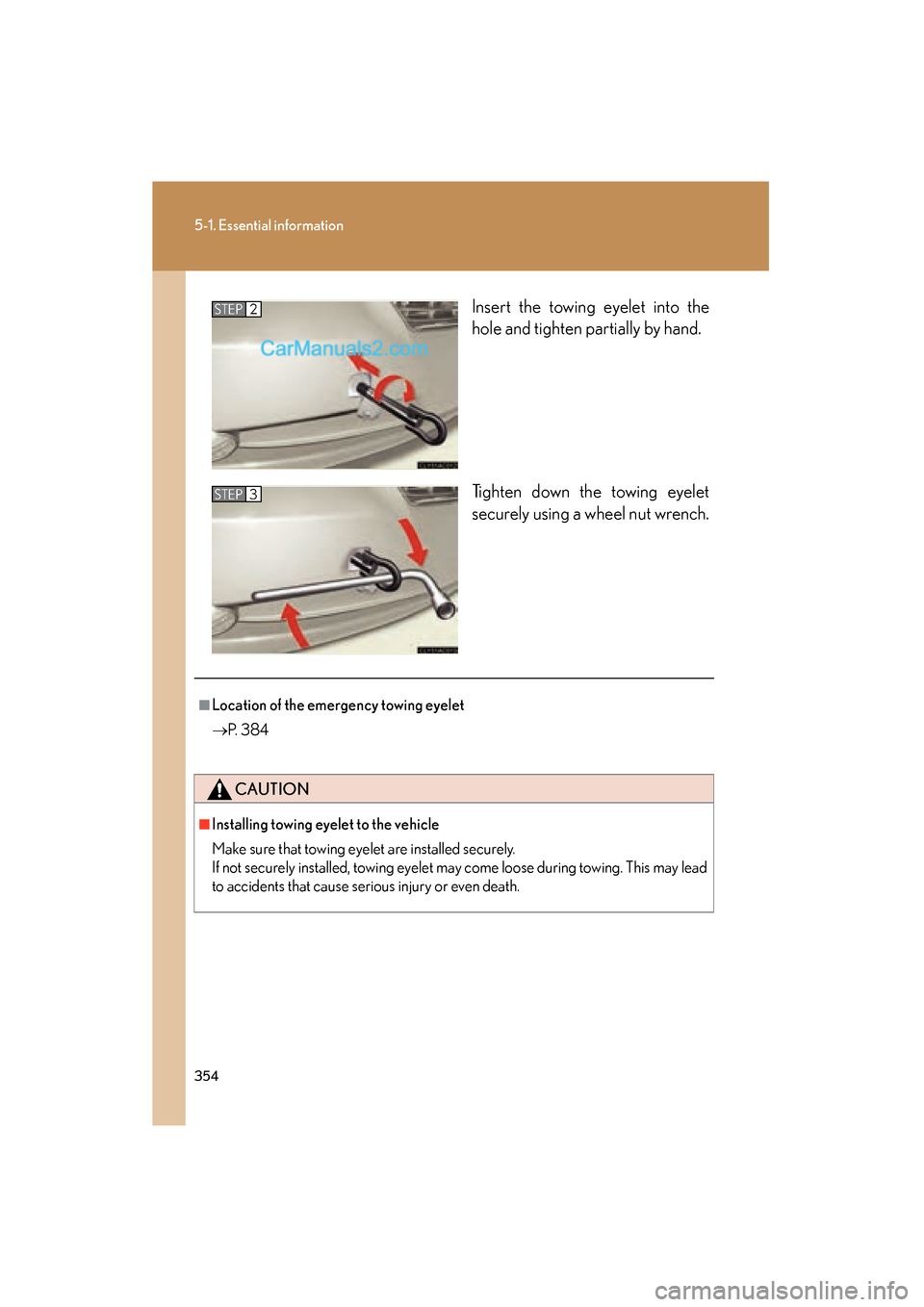
ES350_U_(L/O_0708)Insert the towing eyelet into the
hole and tighten partially by hand.
Tighten down the towing eyelet
securely using a wheel nut wrench.
STEP2
STEP3
■Location of the emergency towing eyelet
→
P. 3 8 4
CAUTION
■Installing towing eyelet to the vehicle
Make sure that towing eyelet are installed securely.
If not securely installed, towing eyelet may come loose during towing. This may lead
to accidents that cause serious injury or even death.