Page 166 of 350
Driving your vehicle
48 4
1
2
3
4
5
6
7
8
9
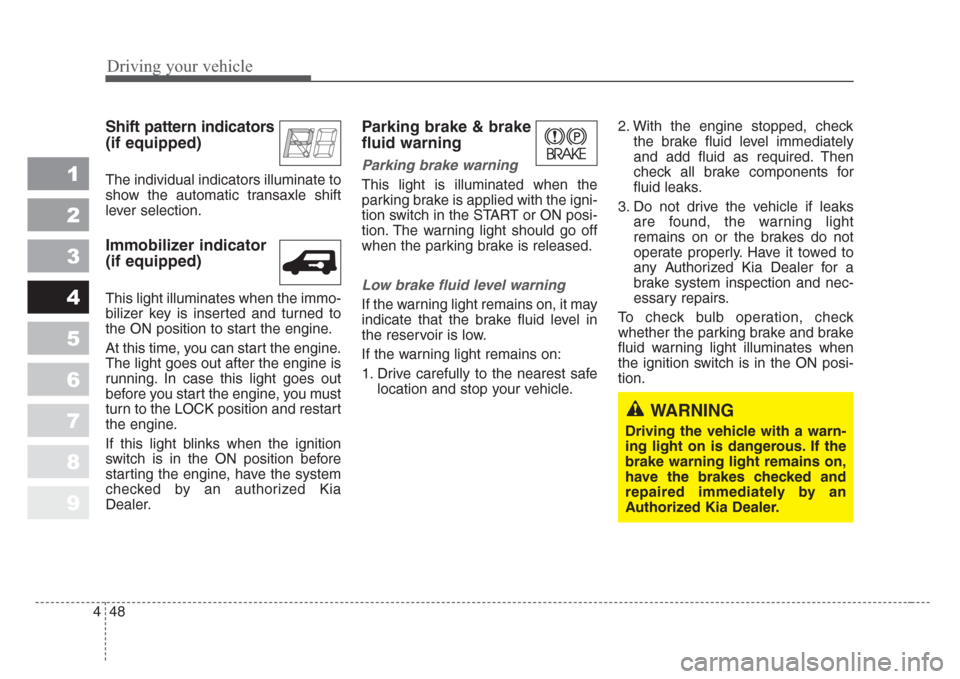
Shift pattern indicators
(if equipped)
The individual indicators illuminate to
show the automatic transaxle shift
lever selection.
Immobilizer indicator
(if equipped)
This light illuminates when the immo-
bilizer key is inserted and turned to
the ON position to start the engine.
At this time, you can start the engine.
The light goes out after the engine is
running. In case this light goes out
before you start the engine, you must
turn to the LOCK position and restart
the engine.
If this light blinks when the ignition
switch is in the ON position before
starting the engine, have the system
checked by an authorized Kia
Dealer.
Parking brake & brake
fluid warning
Parking brake warning
This light is illuminated when the
parking brake is applied with the igni-
tion switch in the START or ON posi-
tion. The warning light should go off
when the parking brake is released.
Low brake fluid level warning
If the warning light remains on, it may
indicate that the brake fluid level in
the reservoir is low.
If the warning light remains on:
1. Drive carefully to the nearest safe
location and stop your vehicle.2. With the engine stopped, check
the brake fluid level immediately
and add fluid as required. Then
check all brake components for
fluid leaks.
3. Do not drive the vehicle if leaks
are found, the warning light
remains on or the brakes do not
operate properly. Have it towed to
any Authorized Kia Dealer for a
brake system inspection and nec-
essary repairs.
To check bulb operation, check
whether the parking brake and brake
fluid warning light illuminates when
the ignition switch is in the ON posi-
tion.
WARNING
Driving the vehicle with a warn-
ing light on is dangerous.If the
brake warning light remains on,
have the brakes checked and
repaired immediately by an
Authorized Kia Dealer.
Page 171 of 350
453
Driving your vehicle
1
2
3
4
5
6
7
8
9
4WD LOCK indicator
light (if equipped)
4WD LOCK indicator light is illumi-
nated when the 4WD LOCK button is
pushed. The purpose of this 4WD
LOCK mode is to increase the drive
power when driving on dry road sur-
face, wet pavement, snow-covered
roads and/or off-road. 4WD LOCK
indicator light is turned off by push-
ing the button once again
Safety belt warning chime
If the driver's safety belt is not fas-
tened when the ignition key is turned
ON or if it is unfastened after the key
is ON, the safety belt warning chime
will sound for approximately 6 sec-
onds. At this time, if the safety belt is
fastened, the chime will stop at once.
Parking start warning chime
If you drive over 10 km/h (6.2 mph)
with the parking brake applied, the
parking start warning chime will
sound.
Key reminder warning chime
If the driver’s door is opened while
the ignition key is left in the ignition
switch, the key reminder warning
chime will sound. This is to prevent
you from locking your keys in the
vehicle.
4WD
LOCK
CAUTION
Do not use 4WD LOCK mode on
dry paved roads or highway,it
can cause noise, vibration or
damage of 4WD related parts.
Page 178 of 350
Driving your vehicle
60 4
1
2
3
4
5
6
7
8
9
✽
NOTICE
When in operation, the fog lights
consume large amounts of vehicle
electrical power. Only use the fog
lights when visibility is poor.
Unnecessary battery and generator
drain could occur if the fog lights
are used excessively.
Daytime running light
(if equipped)
Daytime Running Lights (DRL) can
make it easier for others to see the
front of your vehicle during the day.
DRL can be helpful in many different
driving conditions, and it is especial-
ly helpful after dawn and before sun-
set.
The DRL system will make your
high-beam headlights turn OFF
when:
1. The head light switch is ON.
2. The parking brake engaged.
3. Engine stops.
Page 215 of 350
55
Driving tips
BEFORE DRIVING
Before entering vehicle:
• Be sure that all windows, outside
mirror(s), and outside lights are
clean.
• Check the condition of the tires.
• Check under the vehicle for any
sign of leaks.
• Be sure there are no obstacles
behind you if you intend to back up.
Necessary inspections
Fluid levels, such as engine oil,
engine coolant, brake fluid, and
washer fluid should be checked on a
regular basis, with the exact interval
depending on the fluid. Further
details are provided in Section 7,
Maintenance.
Before starting
• Close and lock all doors.
• Position the seat so that all con-
trols are easily reached.
• Adjust the inside and outside
rearview mirrors.
• Be sure that all lights work.
• Check all gauges.
• Check the operation of warning
lights when the ignition switch is
turned to the ON position.
• Release the parking brake and
make sure the brake warning light
goes out.
For safe operation, be sure you are
familiar with your vehicle and its
equipment.
1
2
3
4
5
6
7
8
9
WARNING- Driving under
the influence of alcohol or
drugs
Drinking and driving is danger-
ous.Drunk driving is the num-
ber one contributor to the high-
way death toll each year.Even a
small amount of alcohol will
affect your reflexes, perceptions
and judgement.Driving while
under the influence of drugs is
as dangerous or more danger-
ous than driving drunk.
You are much more likely to
have a serious accident if you
drink or take drugs and drive.
If you are dr
inking or taking
drugs, don’t drive.Do not ride
with a driver who has been
drinking or taking drugs.
Choose a designated driver or
call a cab.
Page 221 of 350
511
Driving tips
1
2
3
4
5
6
7
8
9
• Use antifreeze-formulated wind-
shield washer fluid. (Do not use
engine coolant antifreeze.)
• Do not use the parking brake if it
might freeze. When parking, shift
to 1 (First) or R (Reverse) with a
manual transaxle or P (Park) with
an automatic transaxle and block
the rear wheels.Snow tires
If you mount snow tires on your Kia,
make sure they are radial tires of the
same size and load range as the
original tires. Mount snow tires on all
four wheels to balance your vehicle’s
handling in all weather conditions.
Keep in mind that the traction provid-
ed by snow tires on dry roads may
not be as high as your vehicle's orig-
inal equipment tires. You should drive
cautiously even when the roads are
clear. Check with the tire dealer for
maximum speed recommendations.
Do not install studded tires without
first checking local, state and munic-
ipal regulations for possible restric-
tions against their use.
WARNING- Snow tire
size
Snow tires should be equivalent
in size and type to the vehicle's
standard tires.Otherwise, the
safety and handling of your
vehicle may be adversely affect-
ed.
Page 233 of 350
523
Driving tips
1
2
3
4
5
6
7
8
9
Stalling while driving uphill
What should I do if my vehicle stalls,
or is about to stall, and I can’t make
it up the hill?
If your vehicle stalls, or is about to
stall while driving uphill, there are
some things you should do, and
there are some things you must not
do. First, here’s what you should do:
• Push the brake pedal to stop the
vehicle and keep it from rolling
backwards. Also, apply the parking
brake.
• If your engine is still running, shift
the transaxle into reverse, release
the parking brake, and slowly back
down the hill in reverse.• If your engine has stopped run-
ning, you’ll need to restart it. With
the brake pedal depressed and the
parking brake still applied, shift a
manual transaxle to N (Neutral), or
an automatic transaxle to P (Park)
and restart the engine. Then, shift
to reverse, release the parking
brake, and slowly back down the
hill in reverse.
• As you are backing down the hill,
put your left hand on the steering
wheel at the 12 o’clock position.
This way, you’ll be able to tell if
your wheels are straight or turned
to the left or right as you back
down.Here are some things you must not
do if you stall, or are about to stall,
when going up a hill.
• Never attempt to prevent a stall by
depressing the clutch or shifting to
N (Neutral) to “rev-up” the engine
and regain forward momentum.
This won’t work. Your vehicle will
roll backwards very quickly and
you could go out of control or roll
over.
Instead, apply the brake to stop the
vehicle. Then apply the parking
brake. Shift into reverse, release the
parking brake, and slowly back
down.
Page 234 of 350
Driving tips
24 5
1
2
3
4
5
6
7
8
9
Stalled on a steep uphill
If your vehicle stalls and you can’t
back down the hill, try this: Set the
parking brake, put your transaxle in 1
(First) gear or P (Park), and turn the
engine off. Leave the vehicle and get
some help. If your vehicle is at an
angle to the slope of the hill, exit the
vehicle on the uphill side and stay
clear of the path the vehicle would
take if it rolled downhill. Leave it in 1
(First) gear for manual transaxle or P
(Park) for automatic transaxle.CAUTION - Stalling
Never attempt to turn around if
you are about to stall when
going up a hill.If the hill is steep
enough to stall your vehicle,it’s
steep enough to cause you to
roll over if you turn around.If
you can’t make it up, you must
back down the hill.
WARNING- Exiting vehicle
Getting out on the downhill
(low) side of a vehicle stopped
across an incline is dangerous.
If the vehicle rolls over, you
could be crushed or fatally
injured.Always get out on the
uphill (high) side of the vehicle
and stay well clear of the
rollover path.
Page 235 of 350
525
Driving tips
1
2
3
4
5
6
7
8
9
Driving downhill
Going downhill can be considerably
more dangerous than driving uphill.
When off-roading takes you downhill,
you’ll want to consider many of the
same things you thought about
before you went uphill. As a brief
reminder, those include:
• How steep is the downhill? Will I be
able to maintain vehicle control?
• What’s the surface like? Smooth?
Rough? Slippery? Hard-packed
dirt? Gravel?
• Are there hidden surface obsta-
cles? Ruts? Logs? Boulders?
• What’s at the bottom of the hill? Is
there a hidden creek bank or even
a river bottom with large rocks?
• Have changes in the weather con-
ditions and their effect on the ter-
rain since you went uphill made
your task more difficult?Once you have decided that you can
go down a hill safely, try to keep your
vehicle headed straight down, and
use a low gear. This way, engine
braking can help your brakes so they
won’t have to do all the work.
Descend slowly, keeping your vehi-
cle under control at all times.WARNING- Leaving vehi-
cle
If you are going to leave your
vehicle,set the parking brake
and shift a manual transaxle to
1(First), or an automatic
transaxle to P (Park).