2008 KIA Sportage seats
[x] Cancel search: seatsPage 29 of 350
Knowing your vehicle
20 3
1
2
3
4
5
6
7
8
9
(Continued)
• Always drive and ride with
your seatback upright and the
lap portion of the safety belt
snug and low across the hips.
This is the best position to
protect you in case of an acci-
dent.
• In order to avoid unnecessary
and perhaps severe airbag
injuries,always sit as far back
as possible from the steering
wheel so that your chest is at
least 250 mm (10 inches) away
from the steer
ing wheel.
WARNING-Loose
objects
Loose objects in the driver’s
foot area could interfere with
the operation of the foot pedals,
possibly causing an accident.
Do not place anything under the
front seats.WARNING- Driver’s seat
• Never attempt to adjust seat
while the vehicle is moving.
This could result in loss of
control, and an accident caus-
ing death,serious injury, or
property damage.
• Do not allow anything to inter-
fere with the normal position
of the seatback.Storing items
against a seatback or in any
other way interfering with
proper locking of a seatback
could result in s
erious or fatal
injury in a sudden stop or col-
lision.
(Continued)
Page 32 of 350
323
Knowing your vehicle
1
2
3
4
5
6
7
8
9
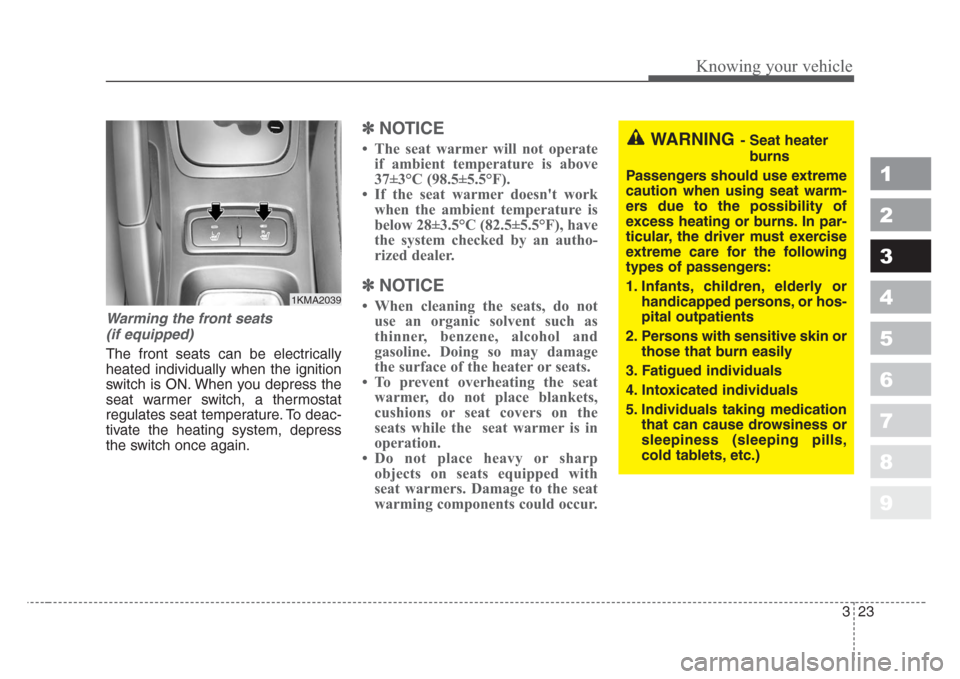
Warming the front seats
(if equipped)
The front seats can be electrically
heated individually when the ignition
switch is ON. When you depress the
seat warmer switch, a thermostat
regulates seat temperature. To deac-
tivate the heating system, depress
the switch once again.
✽
NOTICE
• The seat warmer will not operate
if ambient temperature is above
37±3°C (98.5±5.5°F).
• If the seat warmer doesn't work
when the ambient temperature is
below 28±3.5°C (82.5±5.5°F), have
the system checked by an autho-
rized dealer.
✽
NOTICE
• When cleaning the seats, do not
use an organic solvent such as
thinner, benzene, alcohol and
gasoline. Doing so may damage
the surface of the heater or seats.
• To prevent overheating the seat
warmer, do not place blankets,
cushions or seat covers on the
seats while the seat warmer is in
operation.
• Do not place heavy or sharp
objects on seats equipped with
seat warmers. Damage to the seat
warming components could occur.
WARNING- Seat heater
burns
Passengers should use extreme
caution when using seat warm-
ers due to the possibility of
excess heating or burns.In par-
ticular, the driver must exercise
extreme care for the following
types of passengers:
1.Infants,children, elderly or
handicapped persons, or hos-
pital outpatients
2.Persons with sensitive skin or
those that burn easily
3
.Fatigued individuals
4.Intoxicated individuals
5.Individuals taking medication
that can cause drowsiness or
sleepiness (sleeping pills,
cold tablets,etc.)
1KMA2039
Page 36 of 350
327
Knowing your vehicle
1
2
3
4
5
6
7
8
9
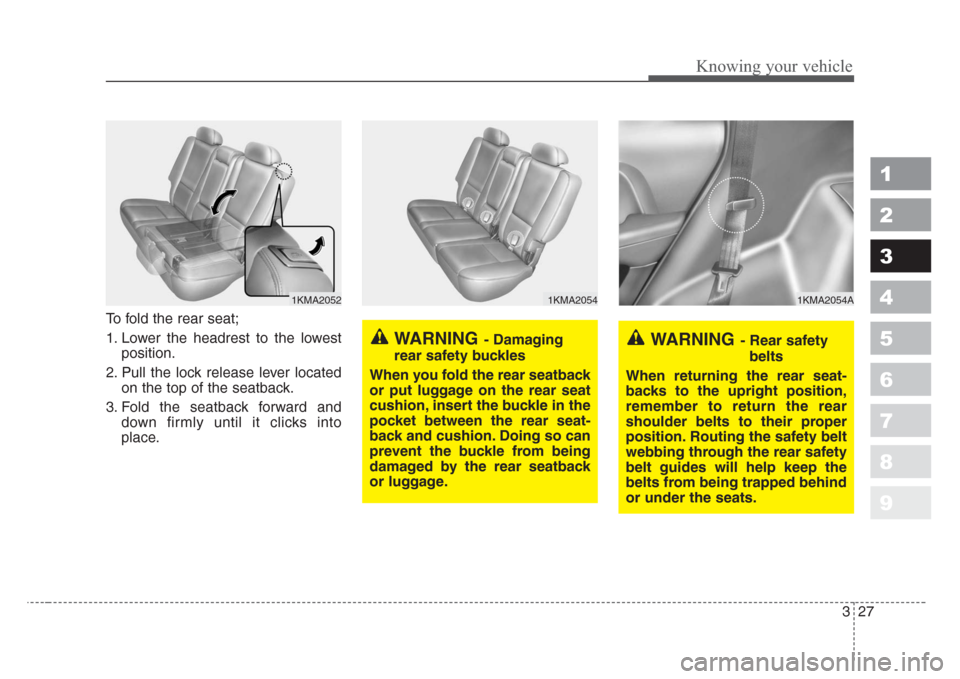
To fold the rear seat;
1. Lower the headrest to the lowest
position.
2. Pull the lock release lever located
on the top of the seatback.
3. Fold the seatback forward and
down firmly until it clicks into
place.
1KMA20521KMA20541KMA2054A
WARNING- Damaging
rear safety buckles
When you fold the rear seatback
or put luggage on the rear seat
cushion,insert the buckle in the
pocket between the rear seat-
back and cushion.Doing so can
prevent the buckle from being
damaged by the rear seatback
or luggage.WARNING- Rear safety
belts
When returning the rear seat-
backs to the upright position,
remember to return the rear
shoulder belts to their proper
position.Routing the safety belt
webbing through the rear safety
belt guides will help keep the
belts from being trapped behind
or under the seats.
Page 37 of 350
Knowing your vehicle
28 3
1
2
3
4
5
6
7
8
9
To unfold the rear seat;
1. Pull the lock release lever located
on the top of the seatback.
2. Lift and push the seatback back-
ward firmly until it clicks into place.
Make sure the seatback is locked
in place.
3. Return the rear safety belt to the
proper position.
WARNING- Cargo
Cargo should always be
secured to prevent it from being
thrown about the vehicle in a
collision and causing injury to
the vehicle occupants.Special
care should be taken of objects
placed in the rear seats,since
those may hit the front seat
occupants in a frontal collision.CAUTION - Cargo loading
Make sure the engine is off, the
transaxle is in P and the parking
brake is applied whenever load-
ing or unloading cargo.Failure
to take these steps may allow
the vehicle to move if shift lever
is inadvertently moved to anoth-
er position.
CAUTION - Rear floor
Do not remove the floor carpet
in your vehicle.Emission con-
trol system components in the
area of the rear seats cause
high exhaust temperatures
under the floor.
Page 39 of 350
Knowing your vehicle
30 3
1
2
3
4
5
6
7
8
9
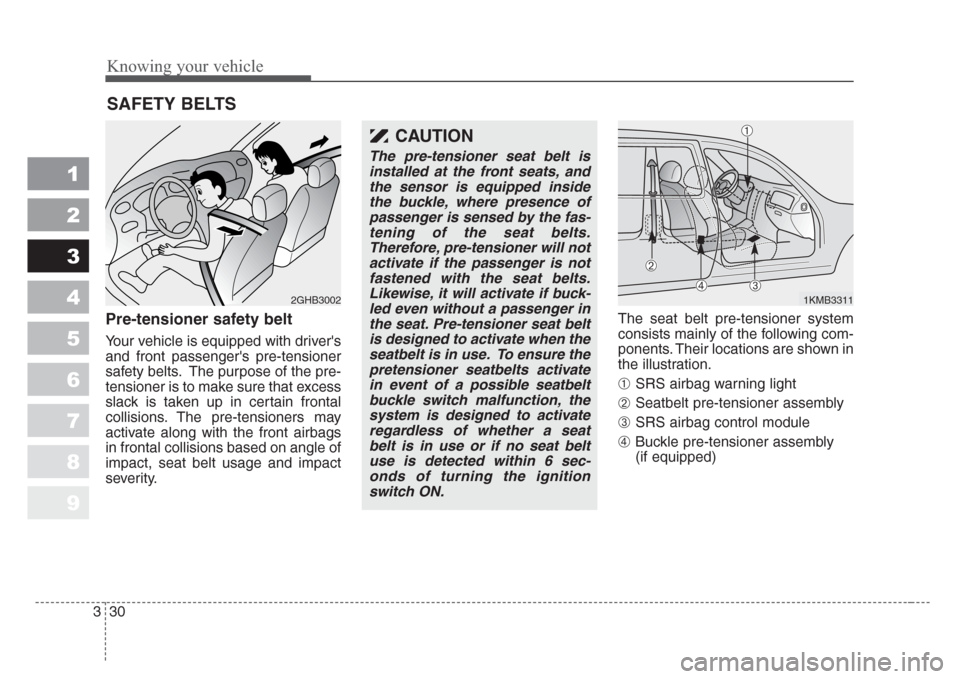
Pre-tensioner safety belt
Your vehicle is equipped with driver's
and front passenger's pre-tensioner
safety belts. The purpose of the pre-
tensioner is to make sure that excess
slack is taken up in certain frontal
collisions. The pre-tensioners may
activate along with the front airbags
in frontal collisions based on angle of
impact, seat belt usage and impact
severity.The seat belt pre-tensioner system
consists mainly of the following com-
ponents. Their locations are shown in
the illustration.
➀ SRS airbag warning light
➁ Seatbelt pre-tensioner assembly
➂ SRS airbag control module
➃ Buckle pre-tensioner assembly
(if equipped)
SAFETY BELTS
2GHB30021KMB3311
➀
➁
➂➃
CAUTION
The pre-tensioner seat belt is
installed at the front seats, and
the sensor is equipped inside
the buckle, where presence of
passenger is sensed by the fas-
tening of the seat belts.
Therefore, pre-tensioner will not
activate if the passenger is not
fastened with the seat belts.
Likewise,it will activate if buck-
led even without a passenger in
the seat.Pre-tensioner seat belt
is desi
gned to activate when the
seatbelt is in use.To e nsure the
pretensioner seatbelts activate
in event of a possible seatbelt
buckle switch malfunction, the
system is designed to activate
regardless of whether a seat
belt is in use or if no seat belt
use is detected within 6 sec-
onds of turning the ignition
switch ON.
Page 42 of 350
333
Knowing your vehicle
1
2
3
4
5
6
7
8
9
Safety belt restraint system We strongly recommend that the dri-
ver and all passengers be properly
restrained at all times by using the
safety belts provided with the vehi-
cle. Proper use of the safety belts
decreases the risk of severe injury or
death in accidents or sudden stops.
In most states, and in Canada, the
law requires their use.
All seats have lap/shoulder belts.
Inertial locks in the safety belt retrac-
tors allow all of the lap/shoulder safe-
ty belts to remain unlocked during
normal vehicle operation. This allows
the occupants some freedom of
movement and increased comfort
while using the safety belts. If a force
is applied to the vehicle, such as a
strong stop, a sharp turn, or a colli-
sion, the safety belt retractors will
automatically lock the safety belts.Since the inertial locks do not require
a collision in order to lock up, you
may become aware of the safety
belts locking while braking or going
around sharp corners.
Always use the rear seat position(s)
to install your child restraint(s).
WARNING- Safety belts
To minimize the risk of serious
or fatal injury in an accident, the
driver and all passengers
should use the appropriate
safety restraints for their age
and size.The presence of
airbags does not change the
need to be properly restrained
by a safety belt or size-appropri-
ate child restraint.In fact,
airbags are designed to work
the best when passengers are
correctly restrained
in the vehi-
cle.
• Be sure you are familiar with
the information in this section,
including the information on
infant and child restraints.
• Read the safety warnings on
the sun visors of your vehicle
also.
WARNING- Child
restraint in front seat
Never install a child restraint
system in the front passenger
position, as an inflating airbag
could cause serious or fatal
injury to a child in that position.
Page 52 of 350
343
Knowing your vehicle
1
2
3
4
5
6
7
8
9
Restraint of pregnant women
Pregnant women should wear
lap/shoulder belt assemblies when-
ever possible according to specific
recommendations by their doctors.
The lap portion of the belt should be
worn AS SNUGLY AND LOW AS
POSSIBLE.
Restraint of infants and small
children
To increase their safety, infants and
young children should always be
restrained by a restraint system
approved for their age and size.
Never allow a child to stand or kneel
on the seat of a moving vehicle.
Never allow a safety belt to be placed
around both a child and an adult or
around two children at the same
time.
It is best for children to be seated in
the rear seats.Many companies manufacture child
restraint systems (often called child
seats) for infants and small children.
An acceptable child restraint system
must always satisfy Canadian Motor
Vehicle Safety Standards. Make sure
that any child-restraint system you
use in your vehicle is labelled as
complying with Federal Safety
Standards.
The child-restraint system should be
chosen to fit both the size of the child
and the size of the vehicle seat. Be
sure to follow any instructions provid-
ed by the child-restraint system man-
ufacturer when installing the child-
restraint system.
WARNING - Pregnant
women
Pregnant women must never
place the lap portion of the safe-
ty belt over the area of the
abdomen where the fetus is
located or above the abdomen
where the belt could crush the
fetus during an impact.
Page 53 of 350
Knowing your vehicle
44 3
1
2
3
4
5
6
7
8
9
Restraint of larger children
As children grow, they may need to
use new child-restraint systems,
including larger child seats or boost-
er seats, which are appropriate for
their increased size.
A child who has outgrown available
child-restraint systems should use
the belts provided in the vehicle.
When seated in the rear outboard
seats, the child should be restrained
by the lap/shoulder belt.
If the shoulder belt portion slightly
touches the child’s neck or face, try
placing the child closer to the center
of the vehicle. If the shoulder belt still
touches their face or neck they need
to be returned to a child restraint sys-
tem. In addition, after-market devices
are available from independent man-
ufacturers which help pull the shoul-
der belt down and away from the
child’s face or neck.WARNING- Infants and
young children
• Infants and young children are
at much greater risk of serious
injury or death in an accident
or sudden stop if they are unre-
strained or restrained improp-
erly.Follow all instructions in
this section and the instruc-
tions that came with an
approved child safety system.
The child restraint must be cor-
rectly installed in the veh
icle,
and the child must be correctly
placed in the child restraint.
• All children under 12 are
safest in the back seat.
• Never install a child or infant
seat in the front passenger
position.The baby will be
injured or killed by the airbag
if it deploys.
•
Never allow a child to stand or
kneel on the seat of a moving
vehicle.
WARNING- Children on
laps
Never hold a child on your lap or
in your arms in a moving vehi-
cle.
Even a very strong person can-
not hold onto a child in the
event of even a minor collision.
CAUTION - Hot metal
parts
Safety belts and seats can
become hot in a vehicle that has
been closed during warm/hot
weather; they could burn a
child.Check seat covers and
buckles before you place a child
anywhere near them.