Page 113 of 350
Knowing your vehicle
104 3
1
2
3
4
5
6
7
8
9
3. Release the TILT UP button.
4. Press and hold the TILT UP button
once again until the sunroof has
returned to the original position of
TILT UP after it is raised a little
higher than the maximum TILT UP
position.
When this is complete, the sunroof
system is reset.
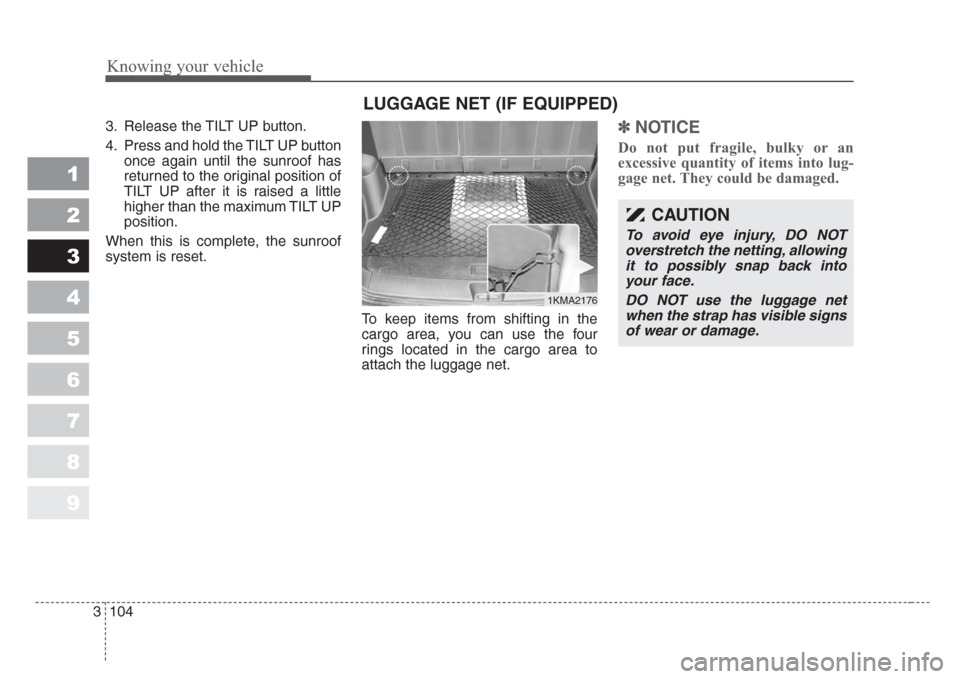
To keep items from shifting in the
cargo area, you can use the four
rings located in the cargo area to
attach the luggage net.✽
NOTICE
Do not put fragile, bulky or an
excessive quantity of items into lug-
gage net. They could be damaged.
1KMA2176
LUGGAGE NET (IF EQUIPPED)
CAUTION
To a v oid eye injury, DO NOT
overstretch the netting, allowing
it to possibly snap back into
your face.
DO NOT use the luggage net
when the strap has visible signs
of wear or damage.
Page 117 of 350
Knowing your vehicle
108 3
1
2
3
4
5
6
7
8
9
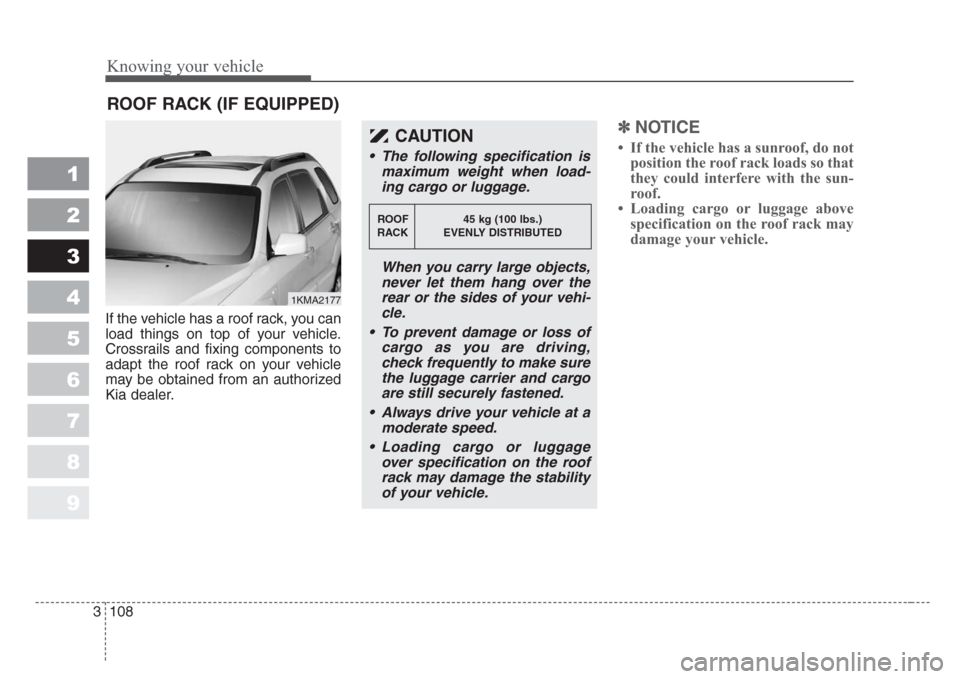
If the vehicle has a roof rack, you can
load things on top of your vehicle.
Crossrails and fixing components to
adapt the roof rack on your vehicle
may be obtained from an authorized
Kia dealer.
✽
NOTICE
• If the vehicle has a sunroof, do not
position the roof rack loads so that
they could interfere with the sun-
roof.
• Loading cargo or luggage above
specification on the roof rack may
damage your vehicle.
ROOF RACK (IF EQUIPPED)
1KMA2177
CAUTION
• The following specification is
maximum weight when load-
ing cargo or luggage.
When you carry large objects,
never let them hang over the
rear or the sides of your vehi-
cle.
• To prevent damage or loss of
cargo as you are driving,
check frequently to make sure
the luggage carrier and cargo
are still securely fastened.
•Always drive your vehicle at a
moderate speed.
• Loading cargo or luggage
over specification on the roof
rack may damage the stability
of your vehicle.
ROOF 45 kg (100 lbs.)
RACK EVENLY DISTRIBUTED
Page 118 of 350
3 109
1
2
3
4
5
6
7
8
9
Knowing your vehicle
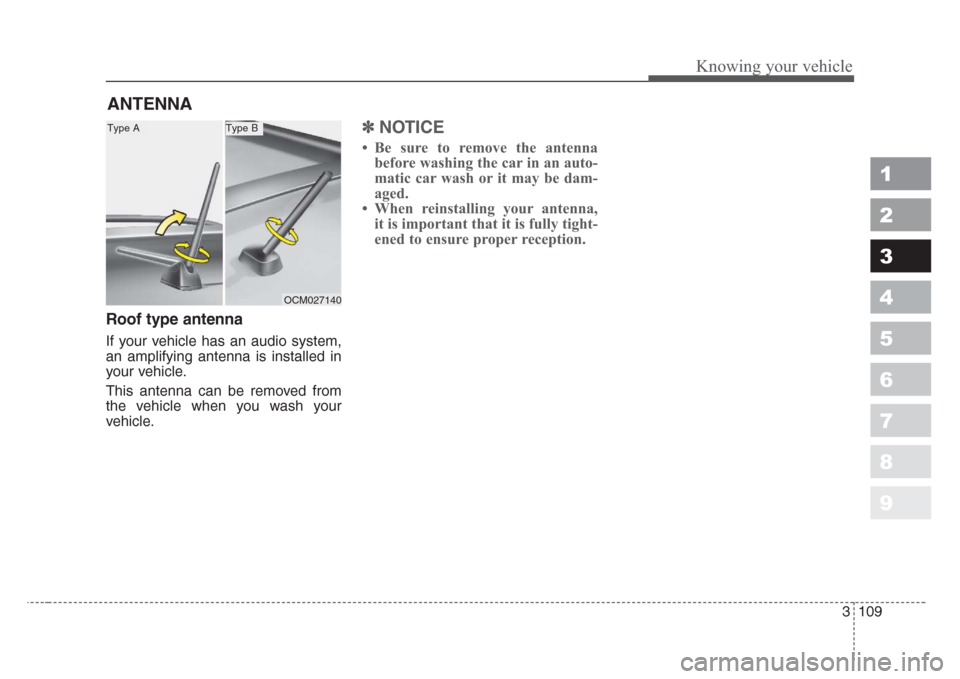
Roof type antenna
If your vehicle has an audio system,
an amplifying antenna is installed in
your vehicle.
This antenna can be removed from
the vehicle when you wash your
vehicle.
✽
NOTICE
• Be sure to remove the antenna
before washing the car in an auto-
matic car wash or it may be dam-
aged.
• When reinstalling your antenna,
it is important that it is fully tight-
ened to ensure proper reception.
ANTENNA
OCM027140
Type AType B
Page 173 of 350
455
Driving your vehicle
1
2
3
4
5
6
7
8
9
4) Make sure the vehicle windshield
wipers are turned off.
5) Drive your vehicle in at least 2
complete (either clockwise or
counter-clockwise) circles at less
than 8 km/h (5 mph) until the com-
pass heading appears. Driving in
a circle in right-handed direction
and opposite direction is possible
and if possible, stop the wiper
operation.
6) If the vehicle's compass headings
become inaccurate again, repeat
steps 1 through 6 above.
✽
NOTICE
If new vehicle is first driven or if the
battery has been disconnected, do
the calibration procedure as above.
Setting the compass zone
This compass must be set to com-
pensate for the variation between
true north and magnetic north. To set
variation:
1. Find your current location and
variance zone number on the zone
map.
2. Press and hold the ON/OFF but-
ton for 6~9 seconds. The current
zone number will appear in the
display.
3. Release and press the ON/OFF
button until the new zone number
appears in the display. After you
stop pressing the button in, the
display will show a compass direc-
tion within a few seconds.
✽
NOTICE
1. Do not install a ski rack, antenna,
etc. that are attached to the vehi-
cle using a magnet as anything
attached to the roof of the vehicle
with a magnet will effect compass
operation.
2. If the compass deviates from the
correct indication soon after
repeated adjustment, have the
compass checked at an authorized
dealer.
3. The compass may not indicate the
correct compass point in tunnels
or while driving up or down a
steep hill.
(The compass returns to the cor-
rect compass point when the vehi-
cle moves to an area where the
geomagnetism is stabilized.)
Page 222 of 350
Driving tips
12 5
1
2
3
4
5
6
7
8
9
Driving in flooded areas
Avoid driving through flooded areas
unless you are sure the water is no
higher than the bottom of the wheel
hub. Drive through any water slowly.
Allow adequate stopping distance
because brake performance may be
affected.
After driving through water, dry the
brakes by gently applying them sev-
eral times while the vehicle is moving
slowly.
Reducing the risk of a rollover
This multi-purpose passenger vehi-
cle is defined as a Sports Utility
Vehicle (SUV). SUV’s have higher
ground clearance and a narrower
track to make them capable of per-
forming in a wide variety of off-road
applications. Specific design charac-
teristics give them a higher center of
gravity than ordinary cars. An advan-
tage of the higher ground clearance
is a better view of the road, which
allows you to anticipate problems.
They are not designed for cornering
at the same speeds as conventional
passenger drive vehicles, any more
than low-slung sports cars are
designed to perform satisfactorily in
off-road conditions. Due to this risk,
driver and passengers are strongly
recommended to buckle their seat-
belts. In a rollover crash, an unbelt-
ed person is more likely to die than a
person wearing a seatbelt. There
are steps that a driver can make to
reduce the risk of a rollover. If at all
possible, avoid sharp turns or abrupt
maneuvers, do not load your roof
rack with heavy cargo, and never
modify your vehicle in any way.
Rollover warning label
To remind you of the danger of the
rollover, a rollover warning label
which is now required by the Federal
Safety regulations is adhered to the
driver’s sunvisor.
Page 227 of 350
517
Driving tips
1
2
3
4
5
6
7
8
9
Traveling to remote areas
It makes sense to plan your trip,
especially when going to a remote
area. Know the terrain and plan your
route. You are much less likely to
encounter unwanted surprises. Get
accurate maps of trails.
It’s also a good idea to travel with at
least one other vehicle. If something
happens to one of them, the other
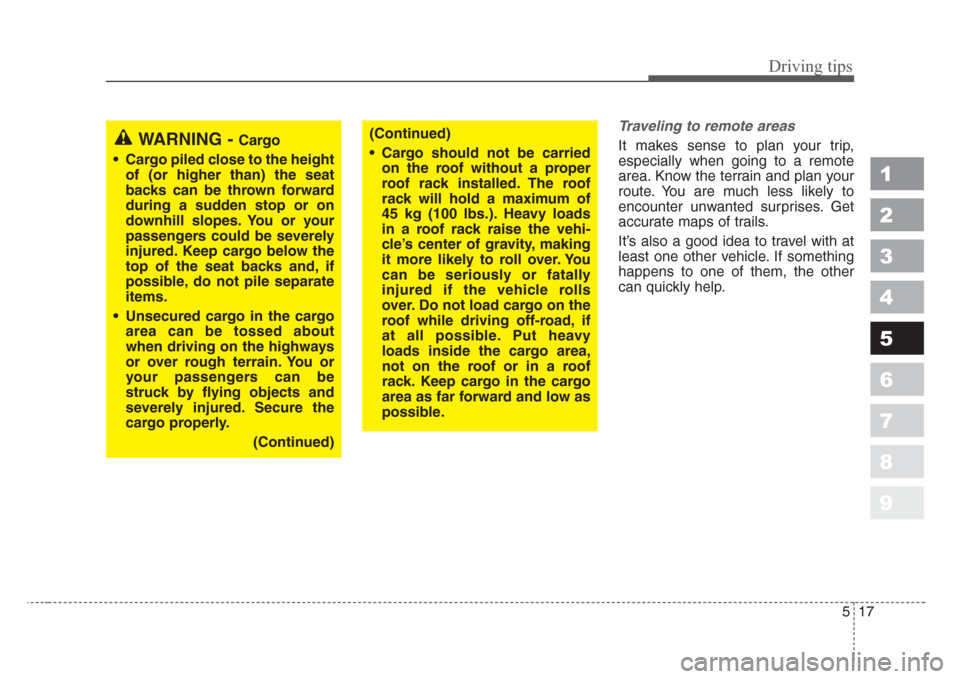
can quickly help.WARNING - Cargo
• Cargo piled close to the height
of (or higher than) the seat
backs can be thrown forward
during a sudden stop or on
downhill slopes.You or your
passengers could be severely
injured.Keep cargo below the
top of the seat backs and,if
possible, do not pile separate
items.
•Unsecured cargo in the cargo
area can be tossed about
when driving on the highways
or over rough terrain.You or
your passengers can be
struck by flying objects and
severely injured.
Secure the
cargo properly.
(Continued)
(Continued)
• Cargo should not be carried
on the roof without a proper
roof rack installed.The roof
rack will hold a maximum of
45 kg (100 lbs.).Heavy loads
in a roof rack raise the vehi-
cle’s center of gravity, making
it more likely to roll over.Yo u
can be seriously or fatally
injured if the vehicle rolls
over.Do not load cargo on the
roof while driving off-road,if
at all possible.Put heavy
loads inside the cargo area,
not on the roof or in a roof
rack.Keep cargo in the cargo
area as far forward and low as
po
ssible.
Page 273 of 350
611
In case of an emergency
1
2
3
4
5
6
7
8
9
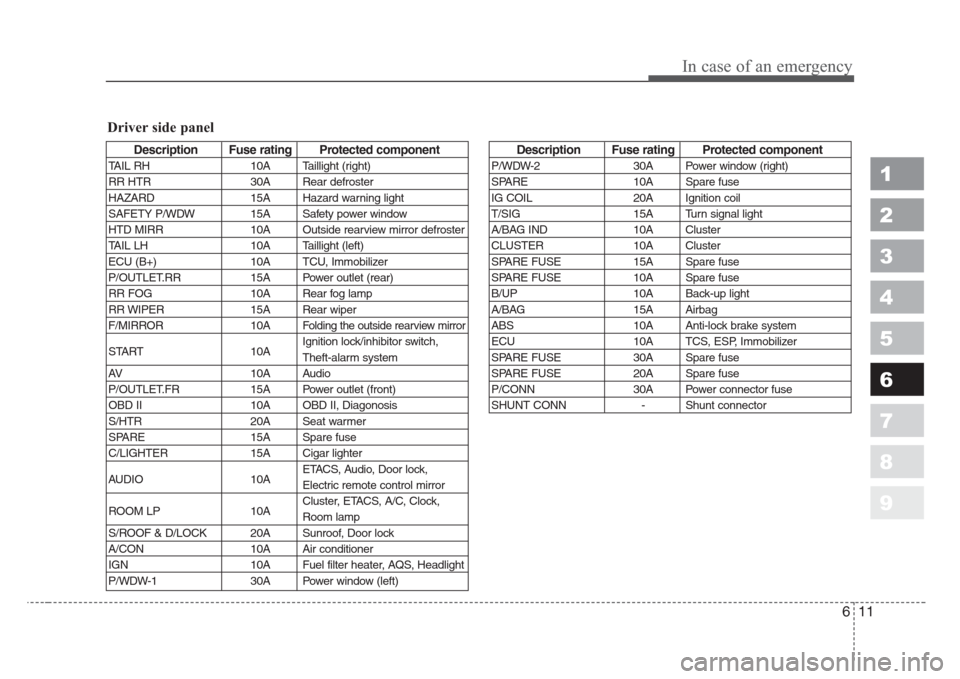
Description Fuse rating Protected component
TAIL RH 10A Taillight (right)
RR HTR 30A Rear defroster
HAZARD 15A Hazard warning light
SAFETY P/WDW 15A Safety power window
HTD MIRR 10A Outside rearview mirror defroster
TAIL LH 10A Taillight (left)
ECU (B+) 10A TCU, Immobilizer
P/OUTLET.RR 15A Power outlet (rear)
RR FOG 10A Rear fog lamp
RR WIPER 15A Rear wiper
F/MIRROR 10A
Folding the outside rearview mirror
START 10AIgnition lock/inhibitor switch,
Theft-alarm system
AV 10A Audio
P/OUTLET.FR 15A Power outlet (front)
OBD II 10A OBD II, Diagonosis
S/HTR 20A Seat warmer
SPARE 15A Spare fuse
C/LIGHTER 15A Cigar lighter
AUDIO 10AETACS, Audio, Door lock,
Electric remote control mirror
ROOM LP 10ACluster, ETACS, A/C, Clock,
Room lamp
S/ROOF & D/LOCK 20A Sunroof, Door lock
A/CON 10A Air conditioner
IGN 10A Fuel filter heater, AQS, Headlight
P/WDW-1 30A Power window (left)
Description Fuse rating Protected component
P/WDW-2 30A Power window (right)
SPARE 10A Spare fuse
IG COIL 20A Ignition coil
T/SIG 15A Turn signal light
A/BAG IND 10A Cluster
CLUSTER 10A Cluster
SPARE FUSE 15A Spare fuse
SPARE FUSE 10A Spare fuse
B/UP 10A Back-up light
A/BAG 15A Airbag
ABS 10A Anti-lock brake system
ECU 10A TCS, ESP, Immobilizer
SPARE FUSE 30A Spare fuse
SPARE FUSE 20A Spare fuse
P/CONN 30A Power connector fuse
SHUNT CONN - Shunt connector
Driver side panel
Page 319 of 350
Maintenance
32 7
1
2
3
4
5
6
7
8
9
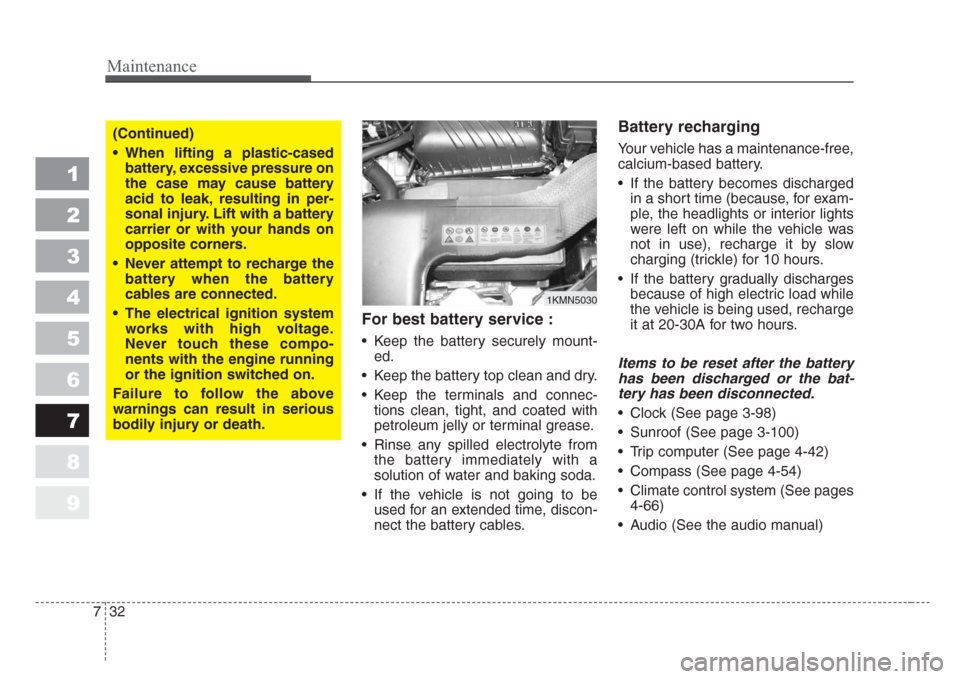
For best battery service :
• Keep the battery securely mount-
ed.
• Keep the battery top clean and dry.
• Keep the terminals and connec-
tions clean, tight, and coated with
petroleum jelly or terminal grease.
• Rinse any spilled electrolyte from
the battery immediately with a
solution of water and baking soda.
• If the vehicle is not going to be
used for an extended time, discon-
nect the battery cables.
Battery recharging
Your vehicle has a maintenance-free,
calcium-based battery.
• If the battery becomes discharged
in a short time (because, for exam-
ple, the headlights or interior lights
were left on while the vehicle was
not in use), recharge it by slow
charging (trickle) for 10 hours.
• If the battery gradually discharges
because of high electric load while
the vehicle is being used, recharge
it at 20-30A for two hours.
Items to be reset after the battery
has been discharged or the bat-
tery has been disconnected.
• Clock (See page 3-98)
• Sunroof (See page 3-100)
• Trip computer (See page 4-42)
• Compass (See page 4-54)
• Climate control system (See pages
4-66)
• Audio (See the audio manual)
1KMN5030
(Continued)
• When lifting a plastic-cased
battery, excessive pressure on
the case may cause battery
acid to leak, resulting in per-
sonal injury.Lift with a battery
carrier or with your hands on
opposite corners.
• Never attempt to recharge the
battery when the battery
cables are connected.
• The electrical ignition system
works with high voltage.
Never touch these compo-
nents with the engine running
or the ignition
switched on.
Failure to follow the above
warnings can result in serious
bodily injury or death.