2008 KIA Sedona interior lights
[x] Cancel search: interior lightsPage 11 of 339
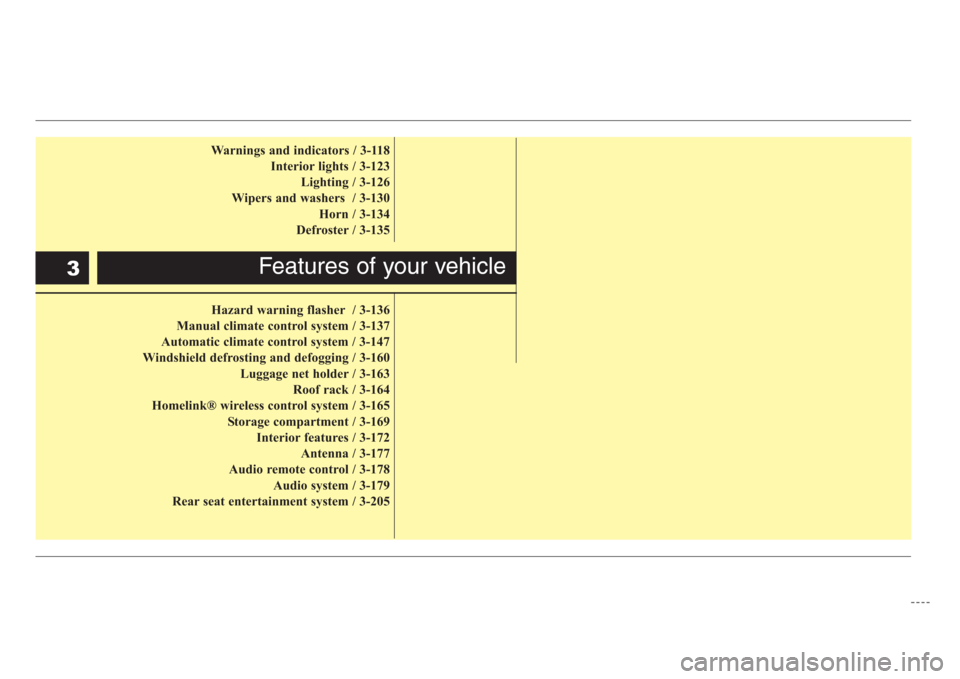
Warnings and indicators / 3-118
Interior lights / 3-123
Lighting / 3-126
Wipers and washers / 3-130
Horn / 3-134
Defroster / 3-135
Hazard warning flasher / 3-136
Manual climate control system / 3-137
Automatic climate control system / 3-147
Windshield defrosting and defogging / 3-160
Luggage net holder / 3-163
Roof rack / 3-164
Homelink® wireless control system / 3-165
Storage compartment / 3-169
Interior features / 3-172
Antenna / 3-177
Audio remote control / 3-178
Audio system / 3-179
Rear seat entertainment system / 3-205
Features of your vehicle3
Page 132 of 339
3 123
Features of your vehicle
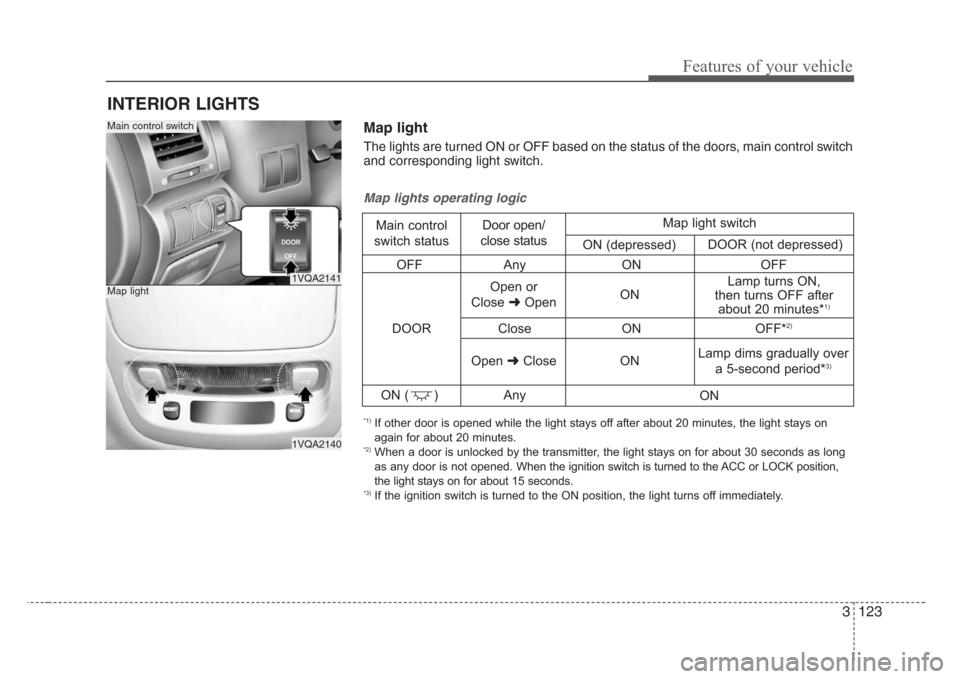
INTERIOR LIGHTS
1VQA2141
1VQA2140
Main control switch
Map light
OFF Any ON OFF
Close ON OFF*
2)
ON ( ) Any
Map lights operating logic
Main control
switch statusDoor open/
close status
DOOROpen or
Close➜OpenONLamp turns ON,
then turns OFF after
about 20 minutes*
1)
Open➜Close
ON
ON Lamp dims gradually over
a 5-second period*3)
Map light switch
ON (depressed)DOOR (not depressed)
*1)If other door is opened while the light stays off after about 20 minutes, the light stays on
again for about 20 minutes.
*2)When a door is unlocked by the transmitter, the light stays on for about 30 seconds as long
as any door is not opened. When the ignition switch is turned to the ACC or LOCK position,
the light stays on for about 15 seconds.
*3)If the ignition switch is turned to the ON position, the light turns off immediately.
Map light
The lights are turned ON or OFF based on the status of the doors, main control switch
and corresponding light switch.
Page 313 of 339
Maintenance
28 6
OVQ066018N
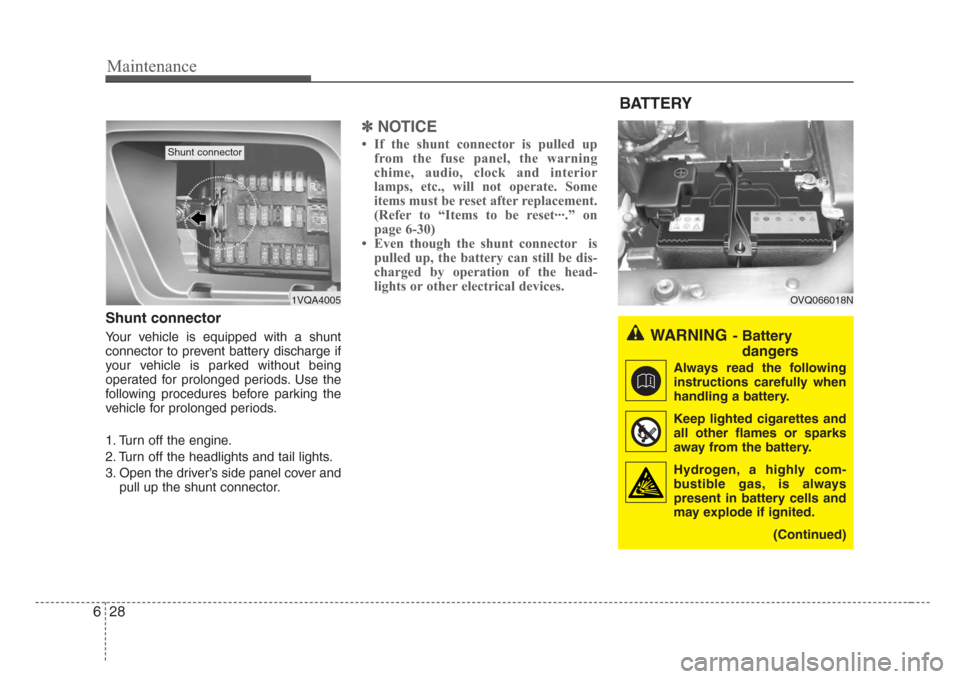
Shunt connector
Your vehicle is equipped with a shunt
connector to prevent battery discharge if
your vehicle is parked without being
operated for prolonged periods. Use the
following procedures before parking the
vehicle for prolonged periods.
1. Turn off the engine.
2. Turn off the headlights and tail lights.
3. Open the driver’s side panel cover and
pull up the shunt connector.
✽
NOTICE
• If the shunt connector is pulled up
from the fuse panel, the warning
chime, audio, clock and interior
lamps, etc., will not operate. Some
items must be reset after replacement.
(Refer to “Items to be reset···.” on
page 6-30)
• Even though the shunt connector is
pulled up, the battery can still be dis-
charged by operation of the head-
lights or other electrical devices.
1VQA4005
Shunt connector
BATTERY
WARNING- Battery
dangers
Always read the following
instructions carefully when
handling a battery.
Keep lighted cigarettes and
all other flames or sparks
away from the battery.
Hydrogen, a highly com-
bustible gas, is always
present in battery cells and
may explode if ignited.
(Continued)
Page 314 of 339
629
Maintenance
For best battery service:
• Keep the battery securely mounted.
• Keep the battery top clean and dry.
• Keep the terminals and connections
clean, tight, and coated with petroleum
jelly or terminal grease.
• Rinse any spilled electrolyte from the
battery immediately with a solution of
water and baking soda.
• If the vehicle is not going to be used for
an extended time, disconnect the bat-
tery cables.
Battery recharging
Your vehicle has a maintenance-free,
calcium-based battery.
• If the battery becomes discharged in a
short time (because, for example, the
headlights or interior lights were left on
while the vehicle was not in use),
recharge it by slow charging (trickle)
for 10 hours.
• If the battery gradually discharges
because of high electric load while the
vehicle is being used, recharge it at 20-
30A for two hours.
(Continued)
Keep batteries out of the
reach of children because
batteries contain highly
corrosive SULFURIC ACID.
Do not allow battery acid to
contact your skin, eyes,
clothing or paint finish.
If any electrolyte gets into
your eyes, flush your eyes
with clean water for at least
15 minutes and get immedi-
ate medical attention. If
possible, continue to apply
water with a sponge or
cloth until medical attention
is received. If electrolyte
gets on your skin, thor-
oughly wash the contacted
area. If you feel a pain or a
burning sensation, get med-
ical attention immediately.
Wear eye protection when
charging or working near a
battery. Always provide
ventilation when working in
an enclosed space.
(Continued)(Continued)
• When lifting a plastic-cased bat-
tery, excessive pressure on the
case may cause battery acid to
leak, resulting in personal injury.
Lift with a battery carrier or with
your hands on opposite corners.
• Never attempt to recharge the
battery when the battery cables
are connected.
• The electrical ignition system
works with high voltage. Never
touch these components with the
engine running or the ignition
switched on.
Failure to follow the above warn-
ings can result in serious bodily
injury or death.
Page 338 of 339
83
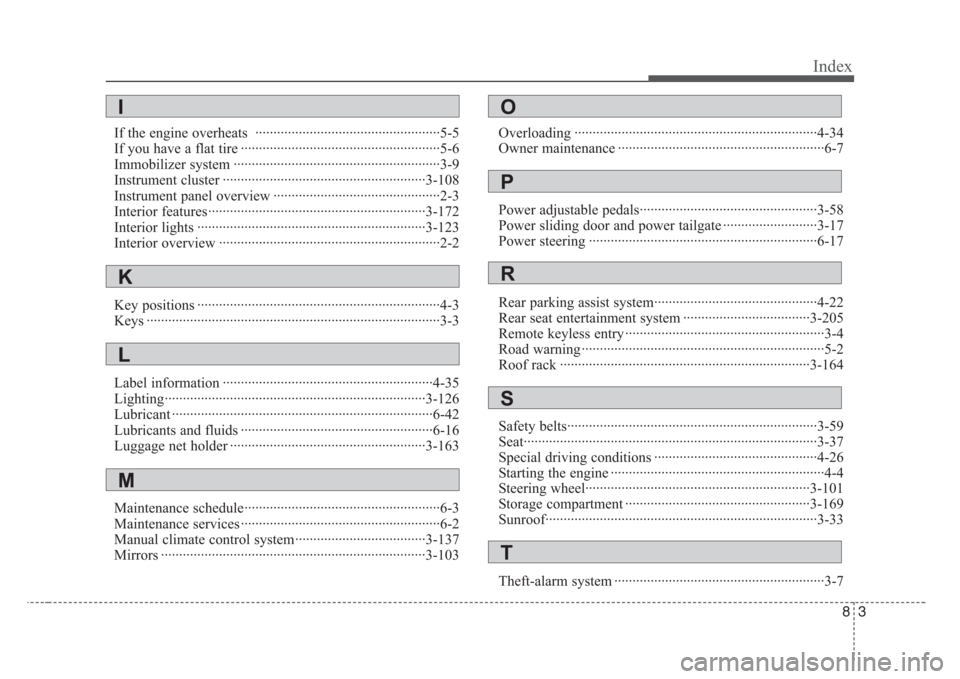
Index
If the engine overheats ···················································5-5
If you have a flat tire ·······················································5-6
Immobilizer system ·························································3-9
Instrument cluster ························································3-108
Instrument panel overview ··············································2-3
Interior features····························································3-172
Interior lights ·······························································3-123
Interior overview ·····························································2-2
Key positions ···································································4-3
Keys ·················································································3-3
Label information ··························································4-35
Lighting········································································3-126
Lubricant ········································································6-42
Lubricants and fluids ·····················································6-16
Luggage net holder ······················································3-163
Maintenance schedule······················································6-3
Maintenance services ·······················································6-2
Manual climate control system····································3-137
Mirrors ·········································································3-103Overloading ···································································4-34
Owner maintenance ·························································6-7
Power adjustable pedals·················································3-58
Power sliding door and power tailgate ··························3-17
Power steering ·······························································6-17
Rear parking assist system·············································4-22
Rear seat entertainment system ···································3-205
Remote keyless entry ·······················································3-4
Road warning ···································································5-2
Roof rack ·····································································3-164
Safety belts·····································································3-59
Seat·················································································3-37
Special driving conditions ·············································4-26
Starting the engine ···························································4-4
Steering wheel······························································3-101
Storage compartment ···················································3-169
Sunroof···········································································3-33
Theft-alarm system ··························································3-7
I
K
L
M
O
P
R
S
T