2008 KIA Sedona child seat
[x] Cancel search: child seatPage 10 of 339

3
Keys / 3-3
Remote keyless entry / 3-4
Theft-alarm system / 3-7
Immobilizer system / 3-9
Door locks / 3-11
Power sliding door and power tailgate / 3-17
Window / 3-26
Hood / 3-29
Fuel filler lid / 3-30
Sunroof / 3-33
Seat / 3-37
Driver position memory system / 3-57
Power adjustable pedals / 3-58
Safety belts / 3-59
Child restraint system / 3-71
Air bags-advanced restraint system / 3-78
Steering wheel / 3-101
Mirrors / 3-103
Instrument cluster / 3-108
Gauges / 3-109
Trip computer / 3-112
Features of your vehicle
Page 49 of 339
Features of your vehicle
40 3
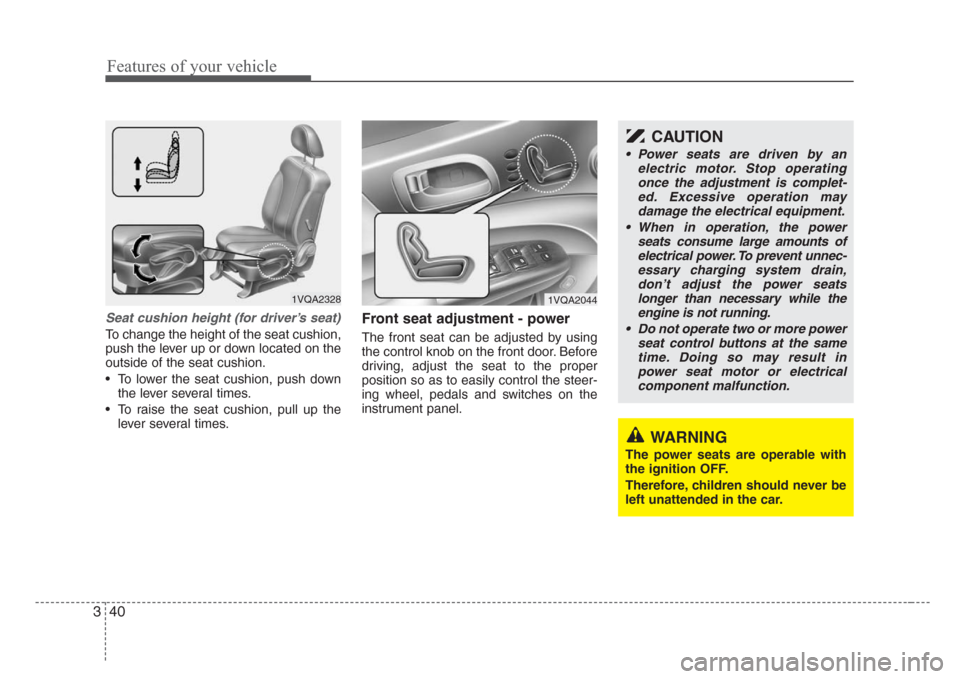
Seat cushion height (for driver’s seat)
To change the height of the seat cushion,
push the lever up or down located on the
outside of the seat cushion.
• To lower the seat cushion, push down
the lever several times.
• To raise the seat cushion, pull up the
lever several times.
Front seat adjustment - power
The front seat can be adjusted by using
the control knob on the front door. Before
driving, adjust the seat to the proper
position so as to easily control the steer-
ing wheel, pedals and switches on the
instrument panel.
1VQA2328
WARNING
The power seats are operable with
the ignition OFF.
Therefore, children should never be
left unattended in the car.
CAUTION
• Power seats are driven by an
electric motor. Stop operating
once the adjustment is complet-
ed. Excessive operation may
damage the electrical equipment.
• When in operation, the power
seats consume large amounts of
electrical power. To prevent unnec-
essary charging system drain,
don’t adjust the power seats
longer than necessary while the
engine is not running.
• Do not operate two or more power
seat control buttons at the same
time. Doing so may result in
power seat motor or electrical
component malfunction.
1VQA2044
Page 54 of 339
345
Features of your vehicle
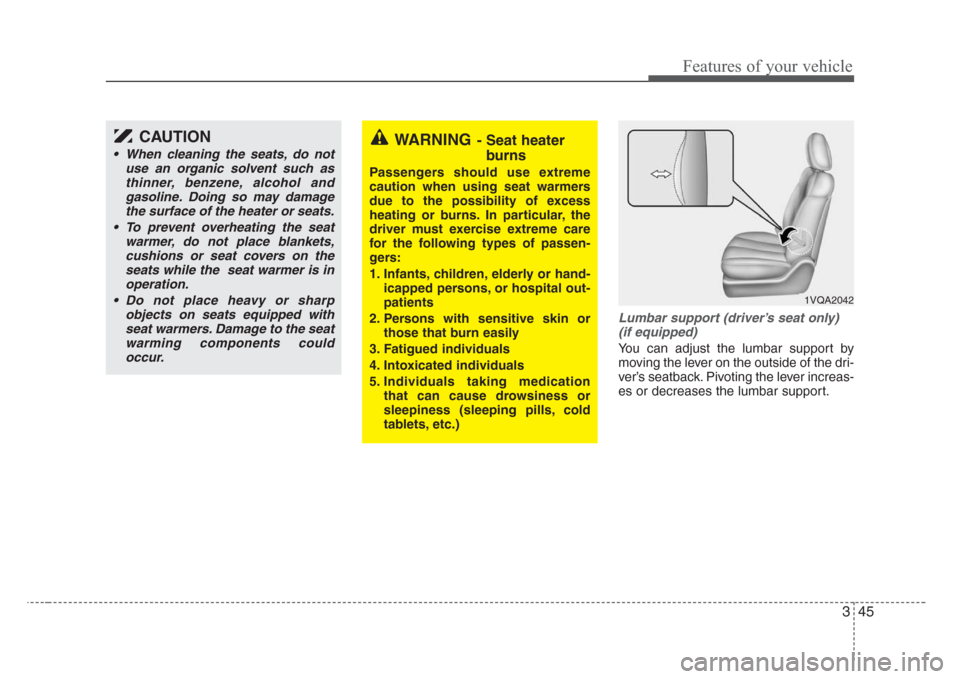
Lumbar support (driver’s seat only)
(if equipped)
You can adjust the lumbar support by
moving the lever on the outside of the dri-
ver’s seatback. Pivoting the lever increas-
es or decreases the lumbar support.
WARNING- Seat heater
burns
Passengers should use extreme
caution when using seat warmers
due to the possibility of excess
heating or burns. In particular, the
driver must exercise extreme care
for the following types of passen-
gers:
1. Infants, children, elderly or hand-
icapped persons, or hospital out-
patients
2. Persons with sensitive skin or
those that burn easily
3. Fatigued individuals
4. Intoxicated individuals
5. Individuals taking medication
that can cause drowsiness or
sleepiness (sleeping pills, cold
tablets, etc.)
CAUTION
• When cleaning the seats, do not
use an organic solvent such as
thinner, benzene, alcohol and
gasoline. Doing so may damage
the surface of the heater or seats.
• To prevent overheating the seat
warmer, do not place blankets,
cushions or seat covers on the
seats while the seat warmer is in
operation.
• Do not place heavy or sharp
objects on seats equipped with
seat warmers. Damage to the seat
warming components could
occur.
1VQA2042
Page 68 of 339

359
Features of your vehicle
Setting the adjustable pedal posi-
tion
1. Be sure the parking brake is engaged.
2. Move the accelerator and brake ped-
als to the front most position by push-
ing the ▼portion of the switch.
3. Adjust the seat position and the steer-
ing wheel angle properly.
4. Move the pedals toward you until you
can fully depress the brake pedal by
pushing the ▲portion of the switch.
5. Depress the pedals a few times to get
used to the feel after adjusting.
Safety belt restraint system
We strongly recommend that the driver
and all passengers be properly
restrained at all times by using the safety
belts provided with the vehicle. Proper
use of the safety belts decreases the risk
of severe injury or death in accidents or
sudden stops. In most states, and in
Canada, the law requires their use.All seats have lap/shoulder belts. Inertial
locks in the safety belt retractors allow all
of the lap/shoulder safety belts to remain
unlocked during normal vehicle opera-
tion. This allows the occupants some
freedom of movement and increased
comfort while using the safety belts. If a
force is applied to the vehicle, such as a
strong stop, a sharp turn, or a collision,
the safety belt retractors will automatical-
ly lock the safety belts.
Since the inertial locks do not require a
collision in order to lock up, you may
become aware of the safety belts locking
while braking or going around sharp cor-
ners.
Always use the rear seat position(s) to
install your child restraint(s).
WARNING- Safety belts
To minimize the risk of serious or
fatal injury in an accident, the driver
and all passengers should use the
appropriate safety restraints for
their age and size. The presence of
air bags does not change the need
to be properly restrained by a safe-
ty belt or size-appropriate child
restraint. In fact, air bags are
designed to work the best when
passengers are correctly restrained
in the vehicle.
• Be sure you are familiar with the
information in this section,
including the information on
infant and child restraints.
• Read the safety warnings on the
sun visors of your vehicle also.
WARNING- Child restraint
in front seat
Never install a child restraint sys-
tem in the front passenger position,
as an inflating air bag could cause
serious or fatal injury to a child in
that position.
WARNING
• Adjust the pedals after parking
the vehicle on level ground. Never
attempt to adjust the pedals while
the vehicle is moving.
• Never adjust the pedals with your
foot on the accelerator pedal as
this may result in increasing the
engine speed and acceleration.
• Make sure that you can fully
depress the brake pedal before
driving. Otherwise, you may not
be able to hold down the brake
pedal firmly in an emergency
stop.
SAFETY BELTS
Page 69 of 339

Features of your vehicle
60 3
WARNING- Belt use
Safety belts must be used correctly
to work properly in an accident.
Each seating position in your vehi-
cle has a specific safety belt assem-
bly that includes a buckle and
tongue designed to be used togeth-
er.
Failure to heed these warnings and
follow these instructions will
increase the risk and severity of
injuries and the likelihood of death
in an accident.
(Continued)
WARNING- Twisted belts
A twisted or jammed safety belt
cannot restrain you properly. If you
cannot untwist or unjam the safety
belt, have an authorized Kia dealer
service it immediately. Never drive
or ride with a twisted or jammed
safety belt.
The rear (or front passenger) safety belts
use a special auto-lock feature designed
to allow a child restraint to be used in
these positions without an added locking
clip. They normally lock only under
extreme or emergency conditions (emer-
gency lock mode). However they can be
adjusted so that they remain fixed and
locked when a child restraint system is
placed in these positions. (Use this auto-
lock mode only to secure a child
restraint, never for passengers restrained
by the safety belts.)
The drivers safety belt can only operate
in the emergency lock mode.
Safety belts provide the best restraint
when:
• The seatback is upright.
• The occupant is sitting upright (not
slouched).
• The lap belt is snug across the hips.
• The shoulder belt is snug across the
chest.
• The knees are straight forward.
WARNING- After a colli-
sion
• Lap/shoulder belt assemblies
may be stretched or damaged
when subjected to the stress and
forces of a collision.
• The entire restraint system
should be inspected following
any collision. All belts, retractors,
anchors and hardware damaged
by a collision should be replaced
before the vehicle is operated
again.
WARNING - Cargo area
Passengers should never be
allowed to ride in the cargo area of
a vehicle. No safety belts are pro-
vided for the cargo area. Persons
riding in the vehicle without a fas-
tened safety belt are much more
likely to suffer serious bodily injury
or death during an accident.
Page 76 of 339

367
Features of your vehicle
Restraint women
Pregnant women should wear lap/shoul-
der belt assemblies whenever possible
according to specific recommendations
by their doctors. The lap portion of the
belt should be worn AS SNUGLY AND
LOW AS POSSIBLE.
Infants and small children
To increase their safety, infants and
young children should always be
restrained by a restraint system
approved for their age and size.
Never allow a child to stand or kneel on
the seat of a moving vehicle. Never allow
a safety belt to be placed around both a
child and an adult or around two children
at the same time.
It is best for children to be seated in the
rear seats.
Many companies manufacture child
restraint systems (often called child
seats) for infants and small children. An
acceptable child restraint system must
always satisfy Canadian Motor Vehicle
Safety Standards. Make sure that any
child-restraint system you use in your
vehicle is labelled as complying with
Federal Safety Standards.
The child-restraint system should be
chosen to fit both the size of the child and
the size of the vehicle seat. Be sure to fol-
low any instructions provided by the
child-restraint system manufacturer
when installing the child-restraint system.
WARNING - Pregnant
women
Pregnant women must never place
the lap portion of the safety belt
over the area of the abdomen where
the fetus is located or above the
abdomen where the belt could
crush the fetus during an impact.
WARNING -Belt cleaning
Do not bleach or dye the webbing
because this may weaken the web-
bing fibers and cause them to fail
when restraining an occupant in a
collision.
WARNING- Children on
laps
Never hold a child on your lap or in
your arms in a moving vehicle.
Even a very strong person cannot
hold onto a child in the event of
even a minor collision.
WARNING - Hot metal
parts
Safety belts and seats can become
hot in a vehicle that has been
closed during warm/hot weather;
they could burn a child. Check seat
covers and buckles before you
place a child anywhere near them.
Page 77 of 339

Features of your vehicle
68 3
Larger children
As children grow, they may need to use
new child-restraint systems, including
larger child seats or booster seats, which
are appropriate for their increased size.
A child who has outgrown available child-
restraint systems should use the belts
provided in the vehicle. When seated in
the rear outboard seats, the child should
be restrained by the lap/shoulder belt.
If the shoulder belt portion slightly touch-
es the child’s neck or face, try placing the
child closer to the center of the vehicle. If
the shoulder belt still touches their face
or neck they need to be returned to a
child restraint system. In addition, after-
market devices are available from inde-
pendent manufacturers which help pull
the shoulder belt down and away from
the child’s face or neck.
Pre-tensioner safety belt
Your vehicle is equipped with driver's and
front passenger's pre-tensioner safety
belts. The purpose of the pre-tensioner is
to make sure that excess slack is taken
up in certain frontal collisions. The pre-
tensioners may activate along with the
front air bags in frontal collisions based
on angle of impact, seat belt usage and
impact severity.
WARNING- Infants and
young children
• Infants and young children are at
much greater risk of serious injury
or death in an accident or sudden
stop if they are unrestrained or
restrained improperly. Follow all
instructions in this section and the
instructions that came with an
approved child safety system. The
child restraint must be correctly
installed in the vehicle, and the
child must be correctly placed in
the child restraint.
• All children under 12 are safest in
the back seat.
• Never install a rear facing infant
seat in the front passenger posi-
tion. The baby will be injured or
killed by the air bag if it deploys.
•
Never allow a child to stand or
kneel on the seat of a moving vehi-
cle.
2GHB3002
WARNING- Shoulder belts
on small children
• Never allow a shoulder belt to be
in contact with a child’s neck or
face while the vehicle is in
motion.
• If safety belts are not properly
worn and adjusted on children,
there is a risk of death or serious
injury.
Page 80 of 339

371
Features of your vehicle
We strongly recommend the use of a
child seat or infant seat for small children
and babies, and it is required by law in
almost all states. This child seat or infant
seat should be of appropriate size for the
child and should be installed in accor-
dance with the manufacturer's instruc-
tions.
Children riding in the car should sit on
the rear seat and must always be proper-
ly restrained to minimize the risk of injury
in an accident, sudden stop or sudden
maneuver. According to accident statis-
tics, children are safer when properly
restrained in the rear seats than in the
front seat.
Children could be injured or killed in a
crash if their restraints are not properly
secured. For small children and babies, a
child seat or infant seat must be used.
Before buying a particular child restraint
system, make sure it fits your car and
seat belts, and fits your child. Follow all
the instructions provided by the child
seat manufacturer when installing the
child restraint system.
CHILD RESTRAINT SYSTEM
WARNING-Child
restraints
• A child restraint system must be
placed in the rear seat. Never
install a child or infant seat on the
front passenger's seat.
Should an accident occur and
cause the passenger air bag to
deploy, it could severely injure or
kill an infant or child seated in the
front seat.
• Since a safety belt or child
restraint system can become very
hot if it is in a closed vehicle, be
sure to check the seat cover and
buckles before placing a child
there.
(Continued)
(Continued)
• When the child restraint system
is not in use, store it in the lug-
gage area or fasten it with a safe-
ty belt so that it will not be thrown
forward in the case of a sudden
stop or an accident.
• Children who are too large to be
in a child restraint should sit in
the rear seat and be restrained
with the available lap/shoulder
belts.
• When using the vehicles
lap/shoulder safety belts, always
make sure that the shoulder belt
portion is positioned midway
over the shoulder, never across
the neck or behind the back. The
lap belt portion of the lap/shoul-
der belt must always be posi-
tioned as low as possible on the
child's hips and as snug as pos-
sible.
• If the vehicle’s safety belt will not
properly fit the child, you must
use an appropriate child restraint
or booster seat in the rear.
(Continued)
1JBH3051