2008 KIA Sedona 87 AKI
[x] Cancel search: 87 AKIPage 5 of 339

Introduction
2 1
We want to help you get the greatest
possible driving pleasure from your vehi-
cle. Your Owner’s Manual can assist you
in many ways. We strongly recommend
that you read the entire manual. In order
to minimize the chance of death or injury,
you must read the WARNING and CAU-
TION sections spread throughout the
manual.
Illustrations complement the words in this
manual to best explain how to enjoy your
vehicle. By reading your manual, you
learn about features, important safety
information, and driving tips under vari-
ous road conditions.
The general layout of the manual is pro-
vided in the Table of Contents. A good
place to start is the index; it has an alpha-
betical listing of all information in your
manual.
Sections: This manual has seven sec-
tions plus an index. Each section begins
with a brief list of contents so you can tell
at a glance if that section has the infor-
mation you want.You’ll find various WARNING’s,
CAUTION’s, and NOTICE’s in this manu-
al. These were prepared to enhance your
personal safety. You should carefully read
and follow ALL procedures and recom-
mendations provided in these
WARNING’s, CAUTION’s and NOTICE’s.
✽
NOTICE
A NOTICE indicates interesting or help-
ful information is being provided.
Your new Kia vehicle is designed to use
only unleaded fuel with a minimum
Octane Rating of 87 Anti-Knock Index
(AKI).
For improved vehicle performance, pre-
mium unleaded fuel with an octane rating
of AKI 91 or higher is recommended.
HOW TO USE THIS MANUAL
WARNING
A WARNING indicates a situation in
which harm, serious bodily injury or
death could result if the warning is
ignored.
CAUTION
A CAUTION indicates a situation in
which damage to your vehicle could
result if the caution is ignored.
CAUTION
NEVER USE LEADED FUEL. The
use of leaded fuel is detrimental to
the catalytic converter and will
damage the engine control sys-
tem’s oxygen sensor and affect
emission control.
Never add any fuel system cleaning
agents to the fuel tank other than
what Kia has specified. (Consult an
Authorized Kia Dealer for details.)
FUEL REQUIREMENTS
Page 54 of 339
345
Features of your vehicle
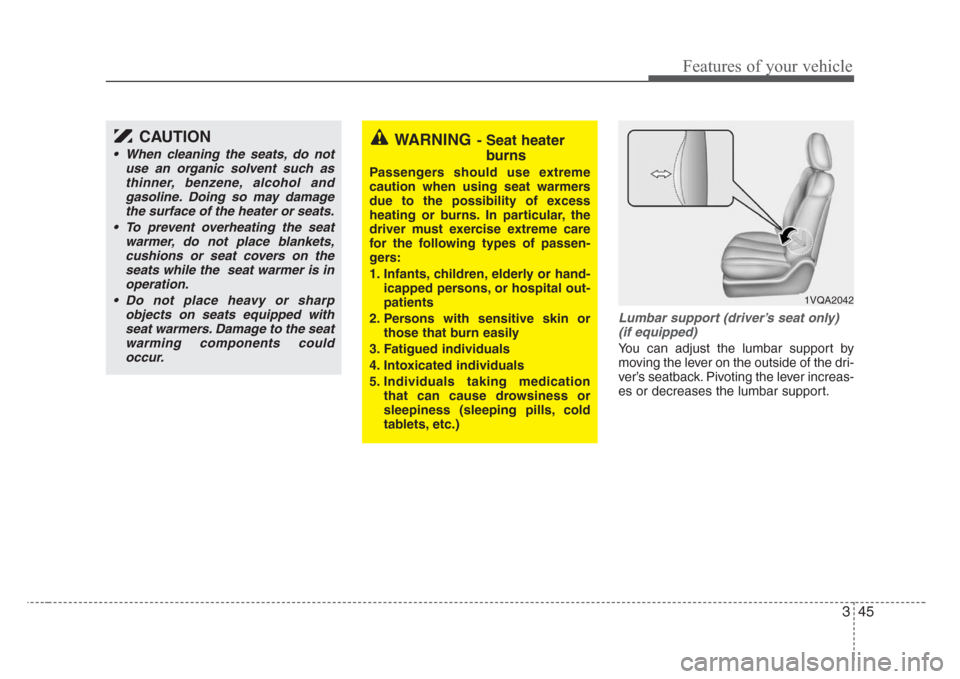
Lumbar support (driver’s seat only)
(if equipped)
You can adjust the lumbar support by
moving the lever on the outside of the dri-
ver’s seatback. Pivoting the lever increas-
es or decreases the lumbar support.
WARNING- Seat heater
burns
Passengers should use extreme
caution when using seat warmers
due to the possibility of excess
heating or burns. In particular, the
driver must exercise extreme care
for the following types of passen-
gers:
1. Infants, children, elderly or hand-
icapped persons, or hospital out-
patients
2. Persons with sensitive skin or
those that burn easily
3. Fatigued individuals
4. Intoxicated individuals
5. Individuals taking medication
that can cause drowsiness or
sleepiness (sleeping pills, cold
tablets, etc.)
CAUTION
• When cleaning the seats, do not
use an organic solvent such as
thinner, benzene, alcohol and
gasoline. Doing so may damage
the surface of the heater or seats.
• To prevent overheating the seat
warmer, do not place blankets,
cushions or seat covers on the
seats while the seat warmer is in
operation.
• Do not place heavy or sharp
objects on seats equipped with
seat warmers. Damage to the seat
warming components could
occur.
1VQA2042
Page 68 of 339

359
Features of your vehicle
Setting the adjustable pedal posi-
tion
1. Be sure the parking brake is engaged.
2. Move the accelerator and brake ped-
als to the front most position by push-
ing the ▼portion of the switch.
3. Adjust the seat position and the steer-
ing wheel angle properly.
4. Move the pedals toward you until you
can fully depress the brake pedal by
pushing the ▲portion of the switch.
5. Depress the pedals a few times to get
used to the feel after adjusting.
Safety belt restraint system
We strongly recommend that the driver
and all passengers be properly
restrained at all times by using the safety
belts provided with the vehicle. Proper
use of the safety belts decreases the risk
of severe injury or death in accidents or
sudden stops. In most states, and in
Canada, the law requires their use.All seats have lap/shoulder belts. Inertial
locks in the safety belt retractors allow all
of the lap/shoulder safety belts to remain
unlocked during normal vehicle opera-
tion. This allows the occupants some
freedom of movement and increased
comfort while using the safety belts. If a
force is applied to the vehicle, such as a
strong stop, a sharp turn, or a collision,
the safety belt retractors will automatical-
ly lock the safety belts.
Since the inertial locks do not require a
collision in order to lock up, you may
become aware of the safety belts locking
while braking or going around sharp cor-
ners.
Always use the rear seat position(s) to
install your child restraint(s).
WARNING- Safety belts
To minimize the risk of serious or
fatal injury in an accident, the driver
and all passengers should use the
appropriate safety restraints for
their age and size. The presence of
air bags does not change the need
to be properly restrained by a safe-
ty belt or size-appropriate child
restraint. In fact, air bags are
designed to work the best when
passengers are correctly restrained
in the vehicle.
• Be sure you are familiar with the
information in this section,
including the information on
infant and child restraints.
• Read the safety warnings on the
sun visors of your vehicle also.
WARNING- Child restraint
in front seat
Never install a child restraint sys-
tem in the front passenger position,
as an inflating air bag could cause
serious or fatal injury to a child in
that position.
WARNING
• Adjust the pedals after parking
the vehicle on level ground. Never
attempt to adjust the pedals while
the vehicle is moving.
• Never adjust the pedals with your
foot on the accelerator pedal as
this may result in increasing the
engine speed and acceleration.
• Make sure that you can fully
depress the brake pedal before
driving. Otherwise, you may not
be able to hold down the brake
pedal firmly in an emergency
stop.
SAFETY BELTS
Page 84 of 339
375
Features of your vehicle
Follow the child seat manufacturer’s
instructions to properly install child
restraint seats with ISOFIX or ISOFIX-
compatible attachments.
Once you have installed the ISOFIX child
restraint, assure that the seat is properly
attached to the ISOFIX and tether
anchors. Also, test the child restraint seat
before you place the child in it. Tilt the
seat from side to side. Also try to tug the
seat forward. Check to see if the anchors
hold the seat in place.
Placing a passenger safety belt
into the auto lock mode
The use of the auto lock mode will
ensure that the normal movement of the
child in the vehicle does not cause the
safety belt to be pulled out and loosen
the firmness of its hold on the child
restraint system. To secure a child
restraint system, use the following proce-
dure.
WARNING - ISOFIX
Anchors
If the child restraint is not anchored
properly, there is a significant risk
of a child being seriously injured or
killed in a collision.
WARNING - ISOFIX lower
anchors
ISOFIX lower anchors are only to be
used with the left and right rear out-
board seating positions. Never
attempt to attach an ISOFIX
equipped seat in the center seating
position. You may damage the
anchors or the anchors may fail and
break in a collision.
WARNING
Install the child restraint seat fully
rearward against the seatback with
the seatback in a vertical position,
not reclined.
WARNING
When using the vehicle's "ISOFIX"
system to install a child restraint
system in the rear seat, all unused
vehicle rear seat belt metal latch
plates or tabs must be latched
securely in their seat belt buckles
and the seat belt webbing must be
retracted behind the child restraint
to prevent the child from reaching
and taking hold of unretracted seat
belts. Unlatched metal latch plates
or tabs may allow the child to reach
the unretracted seat belts which
may result in strangulation and a
serious injury or death to the child
in the child restraint.
CAUTION
Do not allow the rear seat belt web-
bing to get scratched or pinched by
the ISOFIX-seat latch and ISOFIX
anchor during the installation.
Page 89 of 339
Features of your vehicle
80 3
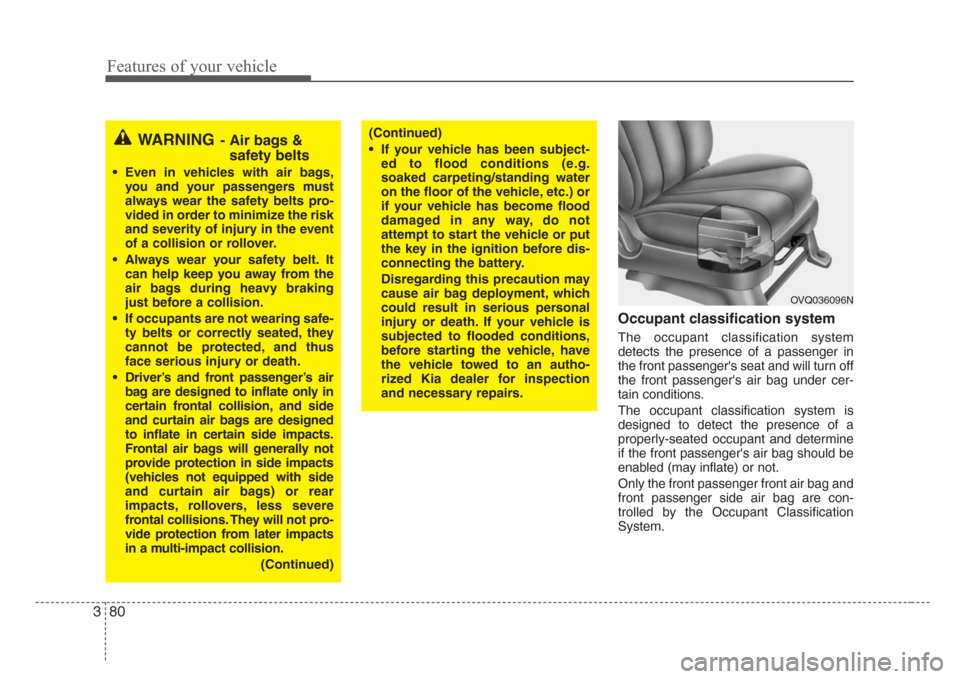
Occupant classification system
The occupant classification system
detects the presence of a passenger in
the front passenger's seat and will turn off
the front passenger's air bag under cer-
tain conditions.
The occupant classification system is
designed to detect the presence of a
properly-seated occupant and determine
if the front passenger's air bag should be
enabled (may inflate) or not.
Only the front passenger front air bag and
front passenger side air bag are con-
trolled by the Occupant Classification
System.
WARNING- Air bags &
safety belts
• Even in vehicles with air bags,
you and your passengers must
always wear the safety belts pro-
vided in order to minimize the risk
and severity of injury in the event
of a collision or rollover.
• Always wear your safety belt. It
can help keep you away from the
air bags during heavy braking
just before a collision.
• If occupants are not wearing safe-
ty belts or correctly seated, they
cannot be protected, and thus
face serious injury or death.
• Driver’s and front passenger’s air
bag are designed to inflate only in
certain frontal collision, and side
and curtain air bags are designed
to inflate in certain side impacts.
Frontal air bags will generally not
provide protection in side impacts
(vehicles not equipped with side
and curtain air bags) or rear
impacts, rollovers, less severe
frontal collisions. They will not pro-
vide protection from later impacts
in a multi-impact collision.
(Continued)
(Continued)
• If your vehicle has been subject-
ed to flood conditions (e.g.
soaked carpeting/standing water
on the floor of the vehicle, etc.) or
if your vehicle has become flood
damaged in any way, do not
attempt to start the vehicle or put
the key in the ignition before dis-
connecting the battery.
Disregarding this precaution may
cause air bag deployment, which
could result in serious personal
injury or death. If your vehicle is
subjected to flooded conditions,
before starting the vehicle, have
the vehicle towed to an autho-
rized Kia dealer for inspection
and necessary repairs.
OVQ036096N
Page 104 of 339

395
Features of your vehicle
• Just before impact, drivers often brake
heavily. Such heavy braking lowers the
front portion of the vehicle causing it to
“ride” under a vehicle with a higher
ground clearance. Air bags may not
inflate in this "under-ride" situation
because deceleration forces that are
detected by sensors may be signifi-
cantly altered by such “under-ride” col-
lisions.• Air bags may not inflate in rollover acci-
dents because air bag deployment
would not provide proper protection to
the occupants.
However, side air bags may inflate
when the vehicle is rolled over by a
side impact collision, if the vehicle is
equipped with side air bags and cur-
tain air bags.• Air bags may not inflate if the vehicle
collides with objects such as utility
poles or trees, where the point of
impact is concentrated to one area and
the full force of the impact is not deliv-
ered to the sensors.
1VQA20901VQA20911VQA2092
Page 127 of 339
Features of your vehicle
118 3
Checking operation
All warning lights are checked by turning
the ignition switch ON (do not start the
engine). Any light that does not illuminate
should be checked by an Authorized Kia
Dealer.
After starting the engine, check to make
sure that all warning lights are off. If any
are still on, this indicates a situation that
needs attention. When releasing the
parking brake, the brake system warning
light should go off. The fuel warning light
will stay on if the fuel level is low.
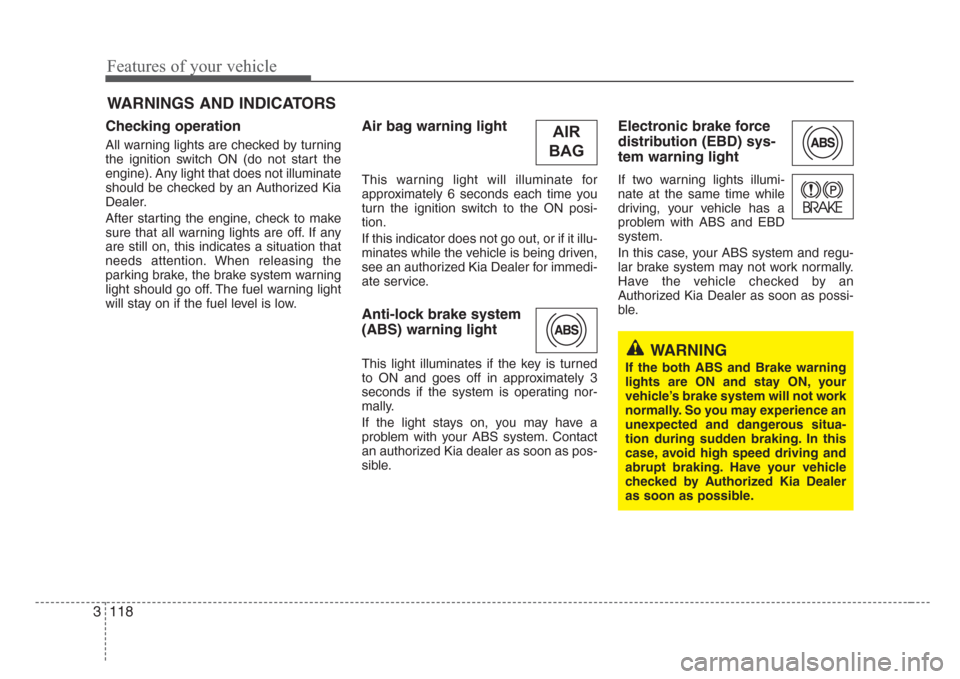
Air bag warning light
This warning light will illuminate for
approximately 6 seconds each time you
turn the ignition switch to the ON posi-
tion.
If this indicator does not go out, or if it illu-
minates while the vehicle is being driven,
see an authorized Kia Dealer for immedi-
ate service.
Anti-lock brake system
(ABS) warning light
This light illuminates if the key is turned
to ON and goes off in approximately 3
seconds if the system is operating nor-
mally.
If the light stays on, you may have a
problem with your ABS system. Contact
an authorized Kia dealer as soon as pos-
sible.
Electronic brake force
distribution (EBD) sys-
tem warning light
If two warning lights illumi-
nate at the same time while
driving, your vehicle has a
problem with ABS and EBD
system.
In this case, your ABS system and regu-
lar brake system may not work normally.
Have the vehicle checked by an
Authorized Kia Dealer as soon as possi-
ble.
WARNINGS AND INDICATORS
WARNING
If the both ABS and Brake warning
lights are ON and stay ON, your
vehicle’s brake system will not work
normally. So you may experience an
unexpected and dangerous situa-
tion during sudden braking. In this
case, avoid high speed driving and
abrupt braking. Have your vehicle
checked by Authorized Kia Dealer
as soon as possible.
AIR
BAG
Page 173 of 339
Features of your vehicle
164 3
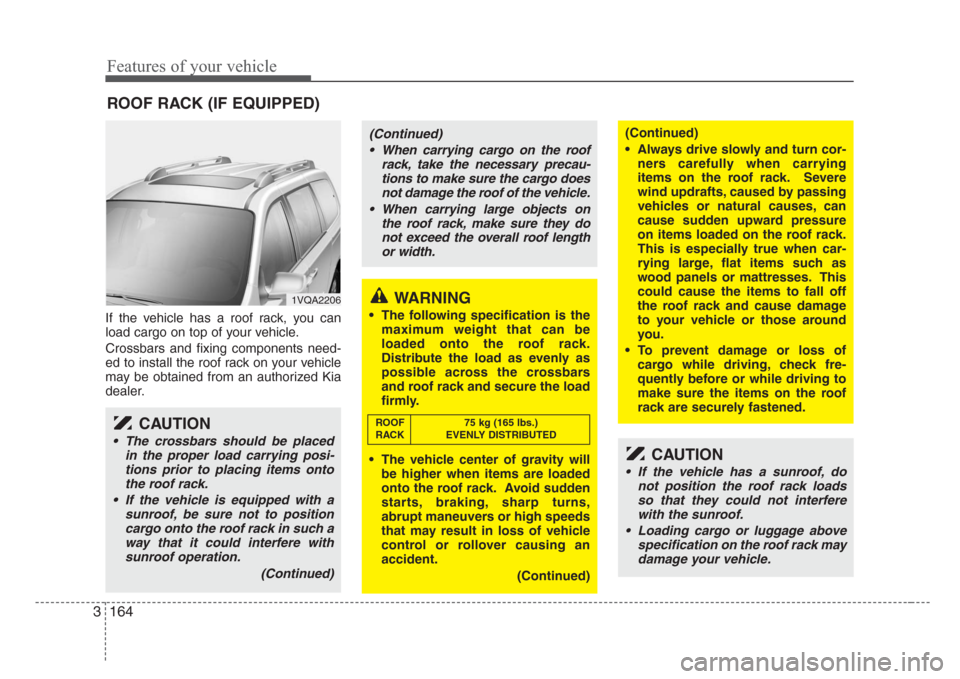
If the vehicle has a roof rack, you can
load cargo on top of your vehicle.
Crossbars and fixing components need-
ed to install the roof rack on your vehicle
may be obtained from an authorized Kia
dealer.
ROOF RACK (IF EQUIPPED)
1VQA2206
CAUTION
• The crossbars should be placed
in the proper load carrying posi-
tions prior to placing items onto
the roof rack.
• If the vehicle is equipped with a
sunroof, be sure not to position
cargo onto the roof rack in such a
way that it could interfere with
sunroof operation.
(Continued)
WARNING
• The following specification is the
maximum weight that can be
loaded onto the roof rack.
Distribute the load as evenly as
possible across the crossbars
and roof rack and secure the load
firmly.
• The vehicle center of gravity will
be higher when items are loaded
onto the roof rack. Avoid sudden
starts, braking, sharp turns,
abrupt maneuvers or high speeds
that may result in loss of vehicle
control or rollover causing an
accident.
(Continued)
(Continued)
• Always drive slowly and turn cor-
ners carefully when carrying
items on the roof rack. Severe
wind updrafts, caused by passing
vehicles or natural causes, can
cause sudden upward pressure
on items loaded on the roof rack.
This is especially true when car-
rying large, flat items such as
wood panels or mattresses. This
could cause the items to fall off
the roof rack and cause damage
to your vehicle or those around
you.
• To prevent damage or loss of
cargo while driving, check fre-
quently before or while driving to
make sure the items on the roof
rack are securely fastened.
CAUTION
• If the vehicle has a sunroof, do
not position the roof rack loads
so that they could not interfere
with the sunroof.
• Loading cargo or luggage above
specification on the roof rack may
damage your vehicle.
(Continued)
• When carrying cargo on the roof
rack, take the necessary precau-
tions to make sure the cargo does
not damage the roof of the vehicle.
• When carrying large objects on
the roof rack, make sure they do
not exceed the overall roof length
or width.
ROOF 75 kg (165 lbs.)
RACK EVENLY DISTRIBUTED