Page 313 of 339
Maintenance
28 6
OVQ066018N
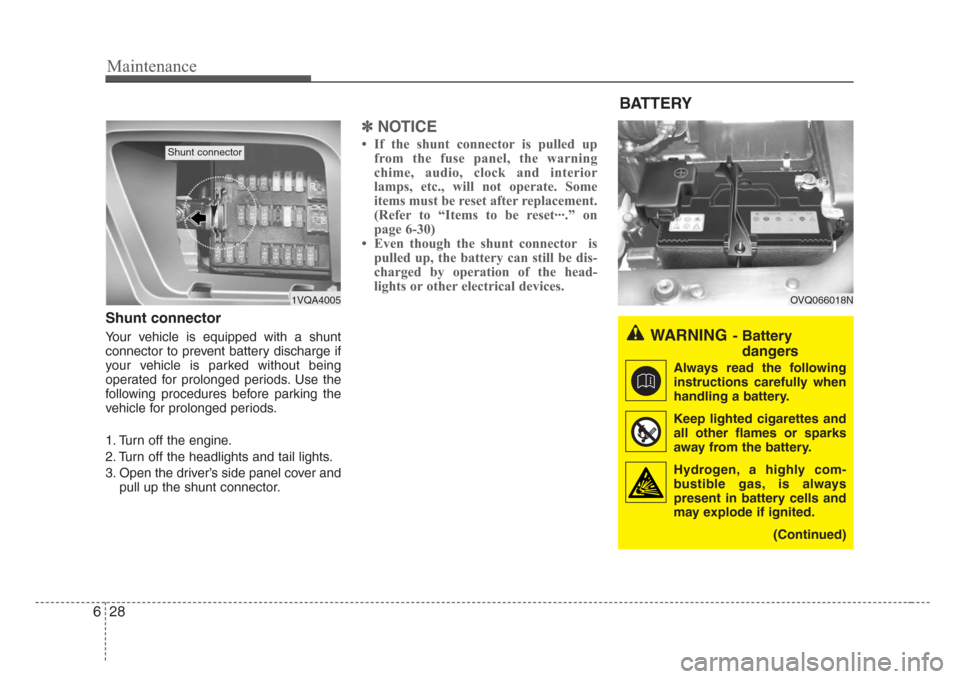
Shunt connector
Your vehicle is equipped with a shunt
connector to prevent battery discharge if
your vehicle is parked without being
operated for prolonged periods. Use the
following procedures before parking the
vehicle for prolonged periods.
1. Turn off the engine.
2. Turn off the headlights and tail lights.
3. Open the driver’s side panel cover and
pull up the shunt connector.
✽
NOTICE
• If the shunt connector is pulled up
from the fuse panel, the warning
chime, audio, clock and interior
lamps, etc., will not operate. Some
items must be reset after replacement.
(Refer to “Items to be reset···.” on
page 6-30)
• Even though the shunt connector is
pulled up, the battery can still be dis-
charged by operation of the head-
lights or other electrical devices.
1VQA4005
Shunt connector
BATTERY
WARNING- Battery
dangers
Always read the following
instructions carefully when
handling a battery.
Keep lighted cigarettes and
all other flames or sparks
away from the battery.
Hydrogen, a highly com-
bustible gas, is always
present in battery cells and
may explode if ignited.
(Continued)
Page 315 of 339
Maintenance
30 6
Items to be reset after the battery
has been discharged or the bat-
tery has been disconnected.
• Clock (See Chapter 3)
• Sunroof (See Chapter 3)
• Trip computer (See Chapter 3)
• Climate control system (See Chapter
3)
• Audio (See Chapter 3)
• Power sliding door and power tailgate
(See Chapter 3)
Tire care
For proper maintenance, safety, and
maximum fuel economy, you must
always maintain recommended tire
inflation pressures and stay within
the load limits and weight distribution
recommended for your vehicle.
Recommended cold tire infla-
tion pressures
All tire pressures (including the
spare) should be checked every day
when the tires are cold. “Cold Tires”
means the vehicle has not been driv-
en for at least three hours or driven
less than 1.6 km (one mile).
Recommended pressures must be
maintained for the best ride, top vehi-
cle handling, and minimum tire wear.
CAUTION
• Before performing maintenance
or recharging the battery, turn off
all accessories and stop the
engine.
• The negative battery cable must
be removed first and installed last
when the battery is disconnected.
WARNING- Recharging
battery
When recharging the battery,
observe the following precautions:
• The battery must be removed
from the vehicle and placed in an
area with good ventilation.
• Do not allow cigarettes, sparks, or
flame near the battery.
• Watch the battery during charg-
ing, and stop or reduce the charg-
ing rate if the battery cells begin
gassing (boiling) violently or if
the temperature of the electrolyte
of any cell exceeds 49°C (120°F).
(Continued)
(Continued)
• Wear eye protection when check-
ing the battery during charging.
• Disconnect the battery charger in
the following order.
1. Turn off the battery charger main
switch.
2. Unhook the negative clamp from
the negative battery terminal.
3. Unhook the positive clamp from
the positive battery terminal.
TIRES AND WHEELS
Page 337 of 339

Index
2 8
Air bags-advanced restraint system ·······························3-78
Air cleaner ·····································································6-13
Antenna ········································································3-177
Appearance care·····························································6-43
Audio remote control ···················································3-178
Audio system ·······························································3-179
Automatic climate control system ·······························3-147
Automatic transaxle················································4-5, 6-13
Battery············································································6-28
Before driving ··································································4-2
Brake system··································································4-14
Brakes ············································································6-15
Bulb wattage ····································································7-2
Capacities ·········································································7-3
Child restraint system ····················································3-71
Cruise control system ····················································4-11
Climate control air filter ················································6-17
Defroster ······································································3-135
Dimensions ······································································7-2Door locks ······································································3-11
Driver position memory system ····································3-57
Economical operation ···················································4-25
Electronic stability control·············································4-19
Emergency starting ··························································5-2
Emission control system ················································6-46
Engine compartment ························································6-9
Engine coolant ·······························································6-11
Engine oil ·······································································6-10
Fuel filler lid ··································································3-30
Fuel requirements ····························································1-2
Fuses ··············································································6-20
Gauges ·········································································3-109
Hazard warning flasher ···············································3-136
Homelink® wireless control system····························3-165
Hood···············································································3-29
Horn ·············································································3-134
How to use this manual ···················································1-2
A
B
C
D
E
F
G
H