2008 KIA PICANTO battery
[x] Cancel search: batteryPage 13 of 335

Your vehicle at a glance
4
2
ENGINE COMPARTMENT B030000ASA
OSA017003
■■
Gasoline Engine
1. Engine coolant reservoir ...................7-25
2. Engine oil filler cap ...........................7-24
3. Brake fluid reservoir ..........................7-27
4. Air cleaner.........................................7-34
5. Fuse box ...........................................7-52
6. Negative battery terminal..................7-39
7. Positive battery terminal ...................7-39
8. Automatic transaxle fluid dipstick* ....7-29
9. Radiator cap .....................................7-25
10. Engine oil dipstick ...........................7-23
11. Windshield washer fluid reservoir ...7-31
* : if equipped
Page 14 of 335

25
Your vehicle at a glance
OSA077002
■
■
Diesel Engine
1. Engine coolant reservoir ..................7-25
2. Engine oil filler cap ...........................7-24
3. Brake fluid reservoir .........................7-27
4. Fuel filter ..........................................7-32
5. Air cleaner ........................................7-34
6. Fuse box ..........................................7-52
7. Negative battery terminal .................7-39
8. Positive battery terminal ...................7-39
9. Radiator cap .....................................7-25
10. Engine oil dipstick ..........................7-23
11. Windshield washer fluid reservoir ..7-31
Page 29 of 335

315
Safety features of your vehicle
C020100AUN Seat belt restraint systemSEAT BELTS
WARNING
For maximum restraint system protection, the seat belts must
always be used whenever the car
is moving.
Seat belts are most effective when seatbacks are in theupright position.
Children age 12 and under must always be properly restrained in
the rear seat. Never allow chil-
dren to ride in the front passen-
ger seat. If a child over 12 must
be seated in the front seat, he/she
must be properly belted and the
seat should be moved as far back
as possible.
Never wear the shoulder belt under your arm or behind your
back. An improperly positionedshoulder belt can cause serious
injuries in a crash. The shoulder
belt should be positioned midway
over your shoulder across your
collarbone.
(Continued)
WARNING
Seat belts are designed to bear
upon the bony structure of the
body, and should be worn low
across the front of the pelvis, or the
pelvis, chest and shoulders, as
applicable; wearing the lap section
of the belt across the abdominal
area must be avoided. Seat belts should be adjusted as
firmly as possible, consistent with
comfort, to provide the protection
for which they have been designed.
A slack belt will greatly reduce the
protection afforded to the occu-pant.
(Continued)
(Continued)
Care should be taken to avoid con- tamination of the webbing with pol-
ishes, oils and chemicals and par-
ticularly battery acid. Cleaning may
safely be carried out using mild
soap and water. The belt should bereplaced if webbing becomes
frayed, contaminated or damaged.It is essential to replace the entire
assembly after it has been worn in
a severe impact even if damage to
the assembly is not obvious. Belts
should not be worn with straps
twisted. Each seat belt assembly
must only be used by one occu-
pant; it is dangerous to put a belt
around a child being carried on theoccupant's lap.
WARNING
No modifications or additions
should be made by the user which
will either prevent the seat belt
adjusting devices from operating to
remove slack, or prevent the seat
belt assembly from being adjusted
to remove slack.
(Continued)
Avoid wearing twisted seat belts. A twisted belt can't do its job as
well. In a collision, it could even
cut into you. Be sure the beltwebbing is straight and not twist-ed.
Be careful not to damage the belt webbing or hardware. If the belt
webbing or hardware is dam-
aged, replace it.
Page 56 of 335
Safety features of your vehicle
42
3
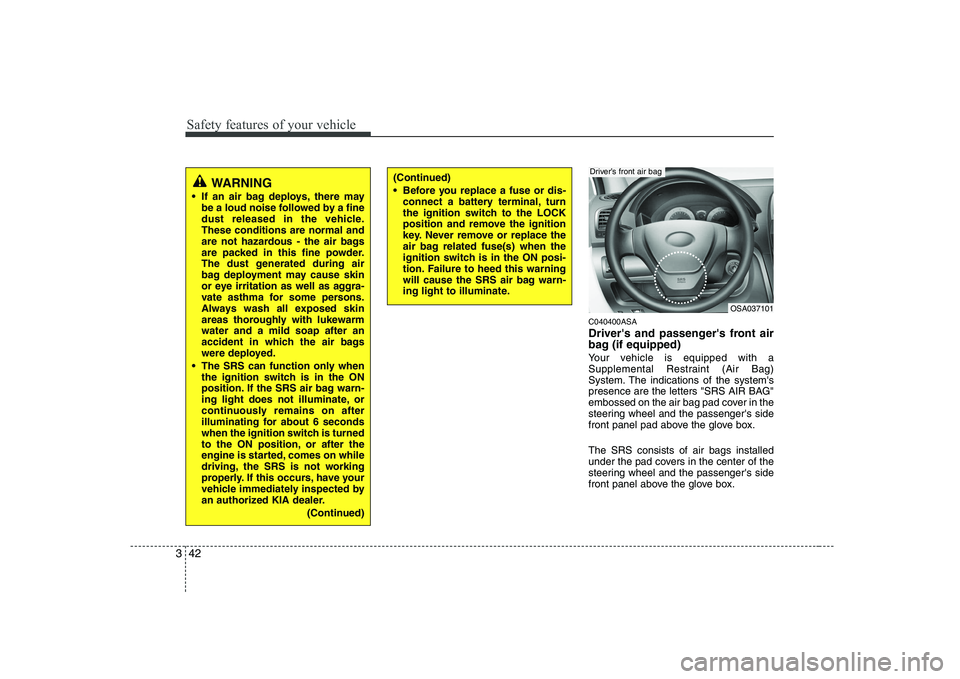
C040400ASA
Driver's and passenger's front air
bag (if equipped)
Your vehicle is equipped with a
Supplemental Restraint (Air Bag)
System. The indications of the system's
presence are the letters "SRS AIR BAG"
embossed on the air bag pad cover in the
steering wheel and the passenger's side
front panel pad above the glove box. The SRS consists of air bags installed
under the pad covers in the center of the
steering wheel and the passenger's side
front panel above the glove box.
WARNING
If an air bag deploys, there may be a loud noise followed by a fine
dust released in the vehicle.These conditions are normal and
are not hazardous - the air bags
are packed in this fine powder.
The dust generated during air
bag deployment may cause skin
or eye irritation as well as aggra-
vate asthma for some persons.
Always wash all exposed skin
areas thoroughly with lukewarmwater and a mild soap after an
accident in which the air bags
were deployed.
The SRS can function only when the ignition switch is in the ON
position. If the SRS air bag warn-
ing light does not illuminate, or
continuously remains on after
illuminating for about 6 seconds
when the ignition switch is turned
to the ON position, or after the
engine is started, comes on while
driving, the SRS is not working
properly. If this occurs, have your
vehicle immediately inspected by
an authorized KIA dealer.
(Continued)(Continued)
Before you replace a fuse or dis-connect a battery terminal, turn
the ignition switch to the LOCK
position and remove the ignition
key. Never remove or replace the
air bag related fuse(s) when the
ignition switch is in the ON posi-
tion. Failure to heed this warning
will cause the SRS air bag warn-
ing light to illuminate.
OSA037101
Driver’s front air bag
Page 76 of 335

45
Features of your vehicle
D020300ASA
Battery replacement
The transmitter uses a 3 volt lithium bat-
tery which will normally last for several
years. When replacement is necessary,
use the following procedure.1. Remove the screw (1) using a cross-
tip screwdriver.
2. Insert a slim tool into the slot and gen- tly pry open the transmitter center
cover.
3. Remove the battery cover (2).
4. Replace the battery with a new one. When replacing the battery, make sure
the battery’s positive “+” symbol faces
up as indicated in the illustration.
5. Install the battery in the reverse order of removal.
CAUTION
Changes or modifications not
expressly approved by the party responsible for compliance couldvoid the user’s authority to operate
the equipment. If the keyless entrysystem is inoperative due tochanges or modifications notexpressly approved by the party
responsible for compliance, it willnot be covered by your manufactur-er’s vehicle warranty.
OPA047003
Page 77 of 335

Features of your vehicle
6
4
D030000AEN
This system is designed to provide pro-
tection from unauthorized entry into the
car. This system is operated in three
stages: the first is the "Armed" stage, the
second is the "Theft-alarm" stage, and
the third is the "Disarmed" stage. If trig-
gered, the system provides an audible
alarm with blinking of the hazard warning
lights. D030100ASA
Armed stage
Park the car and stop the engine. Arm
the system as described below.
1. Remove the ignition key from the igni-
tion switch and exit the vehicle.
2. Make sure that all doors (and tailgate) and engine hood are closed and latched.
3. Lock the doors using the transmitter of the keyless entry system.
After completion of the steps above, the
hazard warning lights will blink once to
indicate that the system is armed.
If any door (or tailgate) or engine hood
remains open, the hazard warning lights
will not operate and the theft-alarm will
not arm. If all doors (and tailgate) and
engine hood are closed after the lock
button is pressed, the hazard warning
lights will blink once and the theft-alarm
system will be armed.
CAUTION
The keyless entry system trans- mitter is designed to give youyears of trouble-free use, howev-er it can malfunction if exposed to
moisture or static electricity. Ifyou are unsure how to use yourtransmitter or replace the battery, contact an authorized KIA dealer.
Using the wrong battery can cause the transmitter to malfunc-tion. Be sure to use the correctbattery.
To avoid damaging the transmit- ter, don't drop it, get it wet, orexpose it to heat or sunlight.
THEFT-ALARM SYSTEM (IF EQUIPPED)
Armedstage
Theft-alarm stageDisarmedstage
Page 107 of 335

Features of your vehicle
36
4
D150334ASA
Electronic power steering
(EPS) system warning light(if equipped)
This light comes on when the ignition
switch is turned to the ON position and
then it will go out when the engine starts. This light also comes on if the EPS has a
malfunction. If it comes on while driving,
have your vehicle inspected by an
authorized KIA dealer. D150326APA
Lights on warning chime
(if equipped)
The lights on warning chime will sound if
the driver's door is opened and when the
headlight switch is left in the 1st or 2ndposition.
D150327AUN
Key reminder warning chime (if equipped)
If the driver’s door is opened while the
ignition key is left in the ignition switch
(ACC or LOCK position), the key
reminder warning chime will sound. This
is to prevent you from locking your keys
in the vehicle. The chime sounds until the
key is removed from the ignition switch or
the driver’s door is closed. D150328ASA
Glow indicator
(Diesel engine)
The indicator light illuminates when the
ignition switch is placed at the ON posi-
tion. The engine can be started after the
preheat indicator light goes off. The illu-
minating time varies with the water tem-
perature, air temperature and batterycondition.
✽✽ NOTICE
If the engine does not start within 10
seconds after the preheating is complet-
ed, turn the ignition switch once more to
the LOCK position for 10 seconds, and
then to the ON position, in order to pre-heat again.
EPS
CAUTION
If the preheat indicator light contin- ues to illuminate or flash on and off after the engine has warmed up orwhile driving, check the system by
an authorized KIA dealer as soon aspossible.
Page 112 of 335

441
Features of your vehicle
D190100AUN
Battery saver function (if equipped)
The purpose of this feature is to pre-vent the battery from being dis-
charged. The system automatically
turns off the exterior lights when the
driver removes the ignition key and
opens the driver-side door.
With this feature, the parking lights will be turned off automatically if the driver
parks on the side of road at night.
If necessary, to keep the lights on
when the ignition key is removed, per-
form the following:
1) Open the driver-side door.
2) Turn the parking lights OFF and ON again using the light switch on the
steering column. D190400ASA
Lighting control
The light switch has a Headlight and a
Parking light position.
To operate the lights, turn the knob at the
end of the control lever to one of the fol-
lowing positions:
(1) OFF position
(2) Parking light position
(3) Headlight position D190401AEN
Parking light position ( )
When the light switch is in the parking light position (1st position), the tail,
license and instrument panel lights areON.
LIGHTING
OSA047090OSA047091