Page 224 of 335
6
Road warning / 6-2 In case of an emergency while driving / 6-2If the engine will not start / 6-3Emergency starting / 6-4If the engine overheats / 6-6
If you have a flat tire (with spare tire) / 6-7
If you have a flat tire (with TireMobilityKit) / 6-15
Towing / 6-24Emergency commodity / 6-28
What to do in an emergency
Page 225 of 335

What to do in an emergency
2
6
ROAD WARNING
F010100ASA
Hazard warning flasher
The hazard warning flasher serves as a
warning to other drivers to exercise
extreme caution when approaching,
overtaking, or passing your vehicle. It should be used whenever emergency
repairs are being made or when the vehi-cle is stopped near the edge of a road-
way.
Depress the flasher switch with the igni-
tion switch in any position. The flasher
switch is located in the center console
switch panel. All turn signal lights will
flash simultaneously.
• The hazard warning flasher operates
whether your vehicle is running or not.
The turn signals do not work when the hazard flasher is on.
The hazard warning flasher should always be on while the vehicle is being
towed. F020100ASA
If you have a flat tire while driving
If a tire goes flat while you are driving:
1. Take your foot off the accelerator pedal
and let the car slow down while driving
straight ahead. Do not apply the brakesimmediately or attempt to pull off the
road as this may cause a loss of con-
trol. When the car has slowed to such
a speed that it is safe to do so, brake
carefully and pull off the road. Drive off
the road as far as possible and park on
a firm level ground. If you are on a
divided highway, do not park in the
median area between the two traffic
lanes.
2. When the car is stopped, turn on your emergency hazard flashers, set the
parking brake and put the transaxle in
P (automatic transaxle) or Reverse
(manual transaxle).
3. Have all passengers get out of the car. Be sure they all get out on the side of
the car that is away from traffic.
4. When changing a flat tire, follow the instruction provided later in this sec-tion.
IN CASE OF AN EMERGENCY WHILE DRIVING
OSA047061
Page 227 of 335
What to do in an emergency
4
6
EMERGENCY STARTING
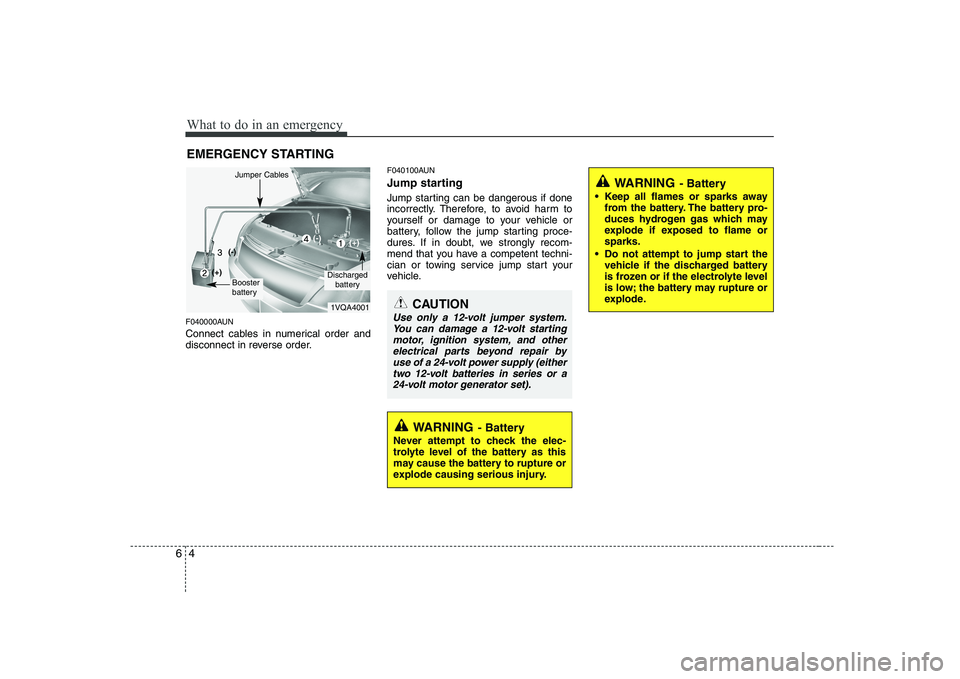
F040000AUN
Connect cables in numerical order and
disconnect in reverse order. F040100AUN
Jump starting
Jump starting can be dangerous if done
incorrectly. Therefore, to avoid harm to
yourself or damage to your vehicle or
battery, follow the jump starting proce-
dures. If in doubt, we strongly recom-
mend that you have a competent techni-
cian or towing service jump start your
vehicle.
CAUTION
Use only a 12-volt jumper system.
You can damage a 12-volt startingmotor, ignition system, and other electrical parts beyond repair byuse of a 24-volt power supply (either
two 12-volt batteries in series or a24-volt motor generator set).
WARNING - Battery
• Keep all flames or sparks away from the battery. The battery pro-
duces hydrogen gas which may
explode if exposed to flame orsparks.
Do not attempt to jump start the vehicle if the discharged battery
is frozen or if the electrolyte level
is low; the battery may rupture or
explode.
WARNING - Battery
Never attempt to check the elec-
trolyte level of the battery as this
may cause the battery to rupture or
explode causing serious injury.
1VQA4001
Discharged battery
Jumper Cables
Booster
battery
(-)
(+)
(+)(-)
Page 228 of 335

65
What to do in an emergency
F040101ASA
Jump starting procedure
1. Make sure the booster battery is 12-volt and that its negative terminal is
grounded.
2. If the booster battery is in another vehicle, do not allow the vehicles comein contact.
3. Turn off all unnecessary electrical loads.
4. Connect the jumper cables in the exact sequence shown in the illustration.First connect one end of a jumper
cable to the positive terminal of the
discharged battery (1), then connect
the other end to the positive terminal
on the booster battery (2).
Proceed to connect one end of the
other jumper cable to the negative ter-
minal of the booster battery (3), then
the other end to a solid, stationary,
metallic point (for example, the engine
lifting bracket) away from the battery
(4). Do not connect it to or near any
part that moves when the engine is
cranked. Do not allow the jumper cables to con-
tact anything except the correct battery
terminals or the correct ground. Do not
lean over the battery when making
connections.
5. Start the engine of the vehicle with the booster battery and let it run at 2,000
rpm, then start the engine of the vehi-
cle with the discharged battery.
If the cause of your battery discharging is
not apparent, you should have your vehi-
cle checked by an authorized KIA dealer.
F040200AUN
Push-starting
Your manual transaxle-equipped vehicle
should not be push-started because itmight damage the emission control sys-tem.
Vehicles equipped with automatic
transaxle cannot be push-started.
Follow the directions in this section for
jump-starting.
CAUTION - Battery cables
Do not connect the jumper cable
from the negative terminal of thebooster battery to the negative ter-
minal of the discharged battery.This can cause the discharged bat- tery to overheat and crack, releas-
ing battery acid.
WARNING
Never tow a vehicle to start it
because the sudden surge forward
when the engine starts could cause
a collision with the tow vehicle.
Page 230 of 335
67
What to do in an emergency
IF YOU HAVE A FLAT TIRE (WITH SPARE TIRE, IF EQUIPPED)
F070100ASA
Jack and tools
The jack, jack handle, wheel lug nut wrench are stored in the luggage
compartment.
Pull up the luggage box cover to reach this equipment. (1) Jack handle
(2) Jack
(3) Wheel lug nut wrench
F070101ASA
Jacking instructions
The jack is provided for emergency
tire changing only.
To prevent the jack from “rattling”
while the vehicle is in motion, store it
properly.
Follow jacking instructions to reduce
the possibility of personal injury.
WARNING
- Changing tires
Never attempt vehicle repairs in the traffic lanes of a public
road or highway.
Always move the vehicle com- pletely off the road and onto
the shoulder before trying to
change a tire. The jack should
be used on a firm level
ground. If you cannot find a
firm level place off the road,
call a towing service company
for assistance.
(Continued)OSA067020
Page 237 of 335

What to do in an emergency
14
6
Do not take this vehicle through an
automatic car wash while the com- pact spare tire is installed.
Do not use tire chains on the com- pact spare tire. Because of the
smaller size, a tire chain will not fit
properly. This could damage the
vehicle and result in loss of thechain.
The compact spare tire should not be installed on the front axle if the
vehicle must be driven in snow or
on ice.
Do not use the compact spare tire on any other vehicle because thistire has been designed especially
for your vehicle.
The compact spare tire’s tread life is shorter than a regular tire.
Inspect your compact spare tire
regularly and replace worn com-
pact spare tires with the same sizeand design, mounted on the samewheel. The compact spare tire should not
be used on any other wheels, nor
should standard tires, snow tires,
wheel covers or trim rings be used
with the compact spare wheel. Ifsuch use is attempted, damage tothese items or other car compo-
nents may occur.
Do not use more than one compact spare tire at a time.
Do not tow a trailer while the com- pact spare tire is installed.
Page 241 of 335

What to do in an emergency
18
6
10. Switch the On/Off switch (8) to
the "I"-position.
Please note: When the sealing compound is added through the
tire valve the pressure gauge
could increase from approxi-
mately 4-6 bar (60-90 psi), but itwill drop again after about 30
seconds. 11. Inflate the tire to at least 1.8 bar
(26 psi) and at most 3.5 bar (51
psi) within 7 minutes. Switch off
the compressor briefly by press-
ing "O" so you are be able to readthe actual tire inflation pressure
on the gauge.
CAUTION
During the tire inflation opera-
tion do not stand next to thedamaged tire. Check the side-wall of the tire for unusual bulges or deformations.Discontinue the inflation opera-tion and deflate the tire by using the pressure release (10), if anyunusual appearance is noticed.
CAUTION
If a tire inflation pressure of 1.8 bar (26 psi) is not achievablewithin 7 minutes, the tire is tooseverely damaged and you must not drive on the tire. Call forroad side service or towing.
OUN066103L
Page 242 of 335

619
What to do in an emergency
12. If a tire inflation pressure of 1.8bar (26 psi) is reached, turn the
On/Off switch to the "O"-position,
quickly unscrew the hose from
the tire. Unplug the cable from
the cigarette lighter. Do not
unscrew the bottle. Stow theTireMobilityKit, the bottle cap and
the bottle holder cap safely in the
vehicle in an easily accessible
place, as it will be needed again
to check tire pressure.
13. Drive immediately and cautiously for about 3 km (2 miles) so thatthe sealing compound can seal
the puncture. Do not exceed 80
km/h (50 mph). While driving, if
you experience any unusual
vibration, ride disturbance or
noise, reduce your speed and
drive with caution until you can
safely pull off to the side of the
road. Call for road side service or
towing. F120202ASA
2nd Stage: Check tire pressure
14. Stop after driving for about 3 km
(2 miles) and check the pressure
of the punctured tire as follows:
a) Ensure that the On/Off switch (8) of the compressor is in the"O"-position.
b) Screw the hose onto the valve of the punctured tire.
c) Plug the power cable into the cigarette lighter (12 volt socket).
d) Read the inflation pressure on the gauge of the TireMobilityKit.
CAUTION
If the inflation pressure is below
1.3 bar (19 psi), do not continueto drive. Call for road side serv- ice or towing.
OUN066103L

