2008 KIA Opirus Motor
[x] Cancel search: MotorPage 2 of 283
i
Thank you for choosing a Kia vehicle.
When you require service, remember that your dealer knows
your vehicle best. Your dealer has factory-trained technicians,
recommended special tools, genuine Kia replacement parts and
is dedicated to your complete satisfaction.
Because subsequent owners require this important information
as well, this publication should remain with the vehicle if it is
sold.
This manual will familiarize you with operational, mainte-
nance and safety information about your new vehicle. It is sup-
plemented by a Warranty and Consumer Information manual
that provides important information on all warranties regarding
your vehicle. If your vehicle is equipped with an audio system,
you will also have a Kia Integrated Audio System manual
explaining its operation. We urge you to read these publica-
tions carefully and follow the recommendations to help assure
enjoyable and safe operation of your new vehicle.
Kia offers a great variety of options, components and features
for its various models.
Therefore, the equipment described in this manual, along with
the various illustrations, may not all be applicable to your par-
ticular vehicle.
The information and specifications provided in this manual
were accurate at the time of printing. Kia reserves the right to
discontinue or change specifications or design at any time
without notice and without incurring any obligation. If you
have questions, always check with your Kia Dealer.
We assure you of our continuing interest in your motoring
pleasure and satisfaction in your Kia vehicle.
© 2007 Kia Motors Corp.
All rights reserved. May not be reproduced or translated in
whole or in part without the written consent of Kia Motors
America, Inc.
Printed in Korea
Foreword
Page 13 of 283

33
Knowing your vehicle
Restrictions in handling keys
When leaving keys with parking lot and
valet attendants, the following proce-
dures will ensure that your vehicle’s trunk
and glove box compartment cannot be
opened in your absence.1. Unlock the glove box with the master
key and open it.
2. Set the trunk lid control button in the glove box compartment to OFF (not
depressed). In the OFF position, the
trunk cannot be unlocked with either
the trunk release lever inside the car or
trunk open button of transmitter.
3. Close the glove box, and lock the glove box using the master key.
4. Leave the sub key with the attendant. The trunk and glove box are secured
because the sub key only allows the
engine to start and locks and unlocks
the door.
1GHA2004
WARNING
Use only Kia original part s for the
ignition key in your vehicle. If an
aftermarket key i s used, the ignition
s witch may not return to ON after
START. If this happens, the starter
will continue to operate caus ing
damage to the starter motor and
possible fire due to excessive cur-
rent in the wiring.
Page 21 of 283

311
Knowing your vehicle
• When pushing down on the front por-tion (
➀) of the door lock switch, all
vehicle doors will lock.
• When pushing down on the rear por- tion (
➁) of the switch, all vehicle doors
will unlock.
• However, if the key is in the ignition switch and any front door is open, the
doors will not lock by pressing the door
lock switch.
CAUTION
• The door s should always be fully
clo sed and locked while the vehi-
cle is in motion to prevent acci- dental opening of the door. Locked door s will also discour-
age potential intruder s when the
vehicle stops or slows.
• Be careful when opening door s
and watch for vehicle s, motorcy-
cle s, bicycles or pedes trians
approaching the vehicle in the path of the door. Opening a doorwhen something i s approaching
can cause damage or injury.
WARNING
Leaving your vehicle unlocked can
invite theft or possible harm to you
or other s from someone hiding in
your vehicle while you are gone.
Always remove the ignition key,
engage the parking brake, close all
windows and lock all door s when
leaving your vehicle unattended.
WARNING- Unattended children
An enclosed vehicle can become
extremely hot, caus ing death or
severe injury to unattended chil-
dren or animals who cannot e scape
the vehicle. Furthermore, children
might operate feature s of the vehi-
cle that could injure them, or they
could encounter other harm, possi-
bly from someone gaining entry to
the vehicle. Never leave children or
animals unattended in your vehicle.
Page 28 of 283

Knowing your vehicle
183
For a seating position more comfortable
to the driver and front passenger, adjust
the seat forward, backward, up and
down.
WARNING
• Loose objects in the driver’s foot
area could interfere with the oper-
ation of the foot pedal s,possibly
caus ing an accident. Loos e
objects might interfere with the
s eat slide mechanis m. Do not
place anything under the front
seats.
• The power s eats are operable
with the ignition OFF.
Therefore, children should never
be left unattended in the car.
WARNING- Driver’ s seat
• Never attempt to adjus t the seat
while the vehicle is moving. This
could res ult in loss of control, and
an accident caus ing death,seri-
ous injury, or property damage.
• Do not allow anything to interfere with the normal pos ition of the
s eatback. Storing items against a
s eatback or in any other way inter-
fering with proper locking of a
s eatback could res ult in serious
or fatal injury in a s udden stop or
collis ion.
(Continued)
(Continued)
• Always drive and ride with yourseatback upright and the lap por-
tion of the safety belt, or lap belt,
snug and low across the hips.
This pos ition puts your safety
belts in the best position to pro-
tect you in case of an accident.
• In order to avoid unnece ssary air
bag injuries including the po ssi-
bility of severe injury or death,
always sit as far back as possible
from the steering wheel while still
being able to maintain comfort-
able control of your vehicle.
• The Canadian Motor Vehicle Safety Standards (CMVSS) rec-
ommends that the driver sit at
least 250 mm (10 inches) away
from the steering wheel to avoid
the risk of serious injury or death
due to the deployment of the dri-
ver’ s air bag.
CAUTION
• Power seats are driven by electric
motor. Stop operating when the adjustment is completed.
Excessive operation may damagethe electrical equipment.
• When in operation, the power seats consume large amounts ofelectrical power. To preventunnecessary charging s ystem
drain, don’t adjus t the power
s eats longer than necessary
while the engine is not running.
• Do not operate two or more power seat control buttons at the sametime. Doing so may res ult in
power seat motor or electrical
component malfunction.
Page 42 of 283
Knowing your vehicle
323
Safety belt restraint system We strongly recommend that the driver
and all passengers be properly
restrained at all times by using the safety
belts provided with the vehicle. Proper
use of the safety belts decreases the risk
of severe injury or death in accidents or
sudden stops. In most states, and in
Canada, the law requires their use.
All seats have lap/shoulder belts. Inertial
locks in the safety belt retractors allow all
of the lap/shoulder safety belts to remain
unlocked during normal vehicle opera-
tion. This allows the occupants some
freedom of movement and increased
comfort while using the safety belts. If a
force is applied to the vehicle, such as a
strong stop, a sharp turn, or a collision,
the safety belt retractors will automatical-
ly lock the safety belts.
WARNING
• Do not strike the pre-tensioner
seat belt assemblies.
• Do not attempt to s ervice or
repair the pre-tensioner seat belt
system in any manner.
• Improper handling of the pre-ten- sioner seat belt assemblies, and
failure to heed the warning s not
to strike, modify, inspect, place,
service or repair the pre-tension-
er seat belt assemblies may lead
to improper operation or inadver-
tent activation caus ing serious
injury.
Always wear the seat belts
when driving or riding in a motor
vehicle.WARNING- Safety belts
To minimize the risk of serious or
fatal injury in an accident, the driv-
er and all passenger s should use
the appropriate safety restraints for
their age and size. The presence of
air bags does not change the need
to be properly restrained by a safe-
ty belt or s ize-appropriate child
res traint. In fact, air bags are
designed to work the be st when
passenger s are correctly re strained
in the vehicle. Be s ure you are
familiar with the information in this
section, including the information
on infant and child re straints. Read
the safety warnings on the sun
visor s of your vehicle also.
Page 51 of 283
341
Knowing your vehicle
Restraint of infants and small
children
To increase their safety, infants and
young children should always be
restrained by a restraint system
approved for their age and size.
Never allow a child to stand or kneel on
the seat of a moving vehicle. Never allow
a safety belt to be placed around both a
child and an adult or around two children
at the same time.
It is best for children to be seated in the
rear seats. Many companies manufacture child
restraint systems (often called child
seats) for infants and small children. An
acceptable child restraint system must
always satisfy Canadian Motor Vehicle
Safety Standards. Make sure that any
child-restraint system you use in your
vehicle is labelled as complying with
Federal Safety Standards.
The child-restraint system should be
chosen to fit both the size of the child and
the size of the vehicle seat. Be sure to fol-
low any instructions provided by the
child-restraint system manufacturer
when installing the child-restraint system.
WARNING- Children on
laps
Never hold a child on your lap or in
your arms in a moving vehicle.
Even a very strong per son cannot
hold onto a child in the event of
even a minor collision.
WARNING- Infants and
young children
• Infants and young children are at
much greater ris k of serious injury
or death in an accident or s udden
s top if they are unres trained or
res trained improperly. Follow all
ins tructions in this s ection of your
Kia manual and the ins tructions
that came on and with an
improved child s afety restraint
s ystem. The child res traint must
be correctly ins talled in the vehi-
cle, and the child mus t be correct-
ly in stalled in the child res traint.
• All children under 12 are safest in the back seat.
• Never install a child or infant seat in the front passenger position.
The baby could be injured or
killed by the air bag if it deploys in
an accident.
•
Never allow a child to s tand or
kneel on the s eat of a moving vehi-
cle. In sis t the child s it down in an
approved res traint system.
Page 85 of 283
375
Knowing your vehicle
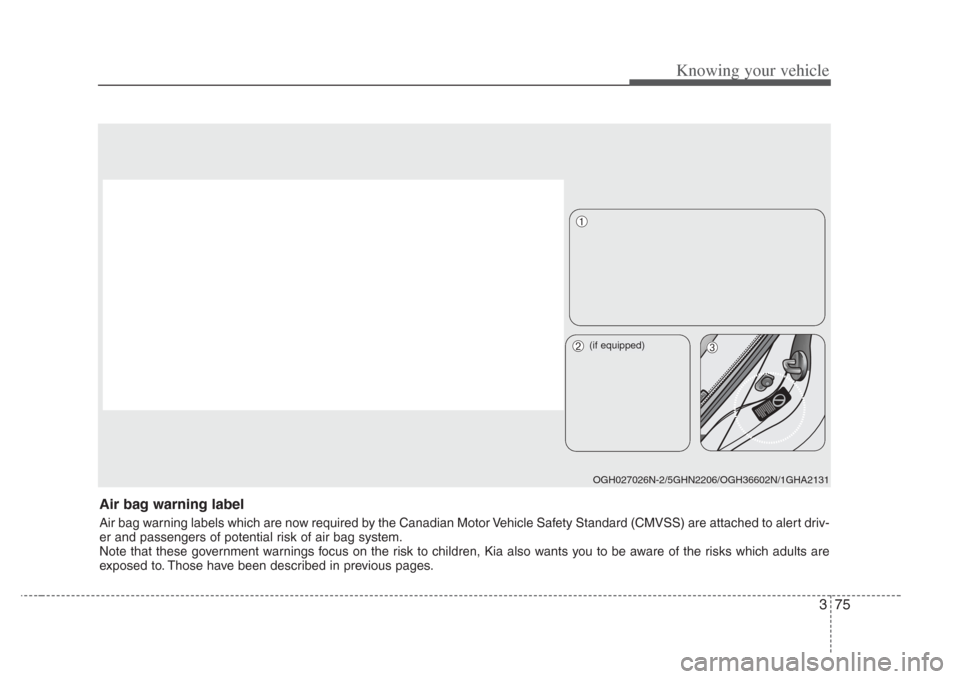
Air bag warning label
Air bag warning labels which are now required by the Canadian Motor Vehicle Safety Standard (CMVSS) are attached to alert driv-
er and passengers of potential risk of air bag system.
Note that these government warnings focus on the risk to children, Kia also wants you to be aware of the risks which adults are
exposed to. Those have been described in previous pages.
OGH027026N-2/5GHN2206/OGH36602N/1GHA2131
➀
➂➁(if equipped)
Page 94 of 283

Knowing your vehicle
843
Outside rearview mirror
Be sure to adjust mirror angles before
driving.The electric remote control mirror switch
allows you to adjust the position of the
left and right outside rearview mirrors. To
adjust the position of either mirror, move
the lever (
➀) to R or L to select the right
side mirror or the left side mirror, then
press a corresponding point ( ▲) on the
mirror adjustment control to position the
selected mirror up, down, left or right.
After adjustment, put the lever into
neutral position to prevent inadver-
tent adjustment.
MIRRORS
2GHA2205
CAUTION
Do not scrape ice off the mirror face; this may damage the surfaceof the glass. If ice should restrictmovement of the mirror, do not force the mirror for adju stment. To
remove ice, use a deicer spray, or a sponge or soft cloth with very warm water.
CAUTION
• The mirror s stop moving when
they reach the maximum adjust- ing angles, but the motor contin-ues to operate while the switch is
depressed. Do not depress the s witch longer than necessary, the
motor may be damaged.
• Do not attempt to adju st the out-
side rearview mirror by hand s.
Doing so may damage the parts.
➀
WARNING
• The right out side rearview mirror
is convex. Object s seen in the
mirror are clos er than they
appear.
•U se your interior rearview mirror
or direct obs ervation to deter-
mine the actual di stance of fol-
lowing vehicles when changing
lanes.