Page 52 of 466
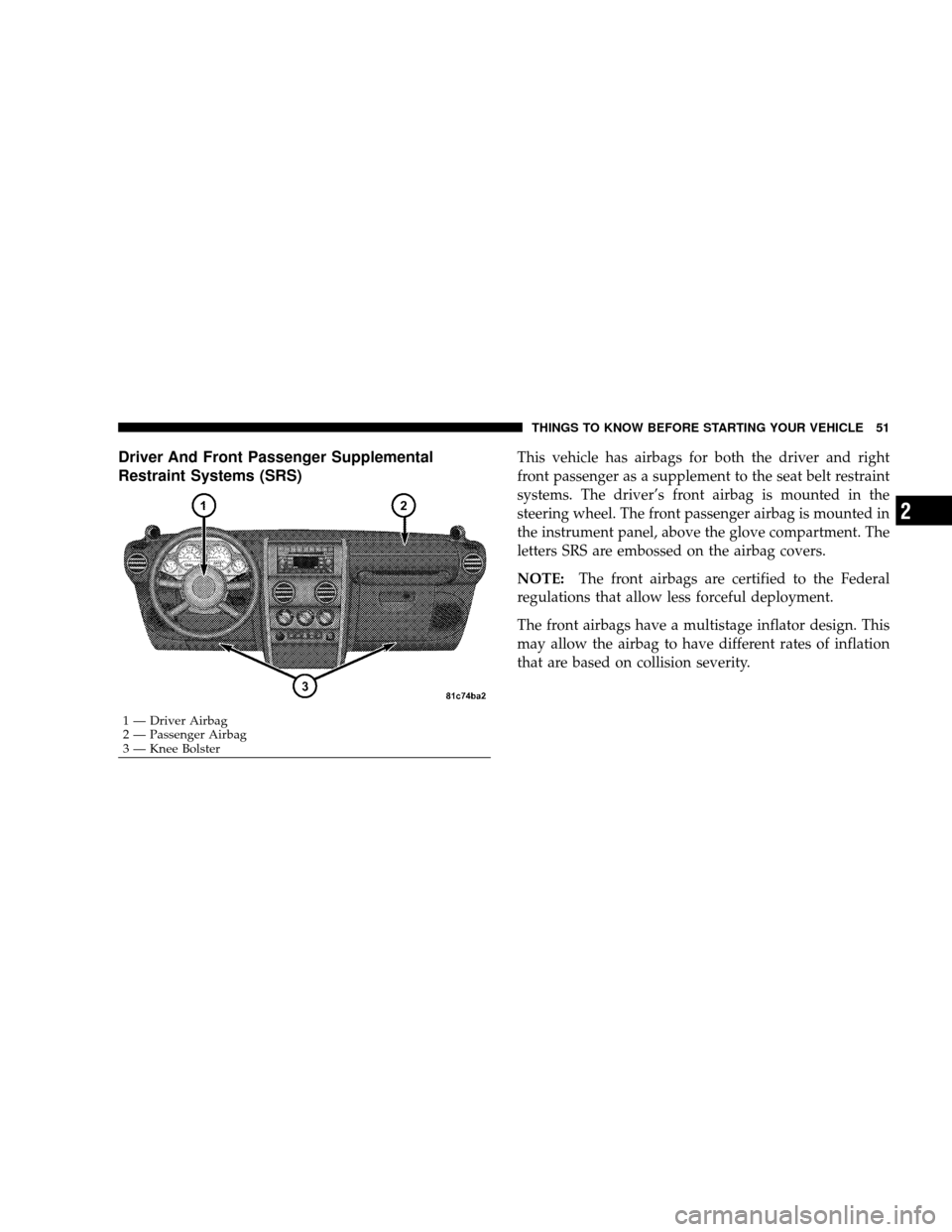
Driver And Front Passenger Supplemental
Restraint Systems (SRS)This vehicle has airbags for both the driver and right
front passenger as a supplement to the seat belt restraint
systems. The driver’s front airbag is mounted in the
steering wheel. The front passenger airbag is mounted in
the instrument panel, above the glove compartment. The
letters SRS are embossed on the airbag covers.
NOTE:The front airbags are certified to the Federal
regulations that allow less forceful deployment.
The front airbags have a multistage inflator design. This
may allow the airbag to have different rates of inflation
that are based on collision severity.
1 — Driver Airbag
2 — Passenger Airbag
3 — Knee Bolster THINGS TO KNOW BEFORE STARTING YOUR VEHICLE 51
2
Page 54 of 466
The front airbags have a multistage inflator design. This
allows the airbag to have different rates of inflation that
are based on collision severity. Along with the seat belts,
front airbags work with the instrument panel knee bol-
sters to provide improved protection for the driver and
front passenger. Side airbags also work with seat belts to
improve occupant protection.
The seat belts are designed to protect you in many types
of collisions. The front airbags deploy in moderate to
severe frontal collisions.
If your vehicle is so equipped, the side airbag on the
crash side of the vehicle is triggered in moderate to
severe side collisions. In certain types of collisions, both
the front and side airbags may be triggered. But even in
collisions where the airbags work, you need the seat belts
to keep you in the right position for the airbags to protect
you properly.Here are some simple steps you can take to minimize the
risk of harm from a deploying airbag.
1. Children 12 years and under should always ride
buckled up in a rear seat.
Infants in rear facing child restraints should
NEVERride
in the front seat of a vehicle with a passenger airbag. An
airbag deployment could cause severe injury or death to
infants in that position.
Children that are not big enough to properly wear the
vehicle seat belt should be secured in the rear seat, in a
child restraint or belt-positioning booster seat. Older
children who do not use child restraints or belt-
positioning booster seats should ride properly buckled
up in the rear seat. Never allow children to slide the
shoulder belt behind them or under their arm.
If a child from 1 to 12 years old must ride in the front
passenger seat because the vehicle is crowded, move the
THINGS TO KNOW BEFORE STARTING YOUR VEHICLE 53
2
Page 55 of 466
seat as far back as possible, and use the proper child
restraint. Refer to “Child Restraint” in this section.
You should read the instructions provided with your
child restraint to make sure that you are using it properly.
2. All occupants should use their lap and shoulder belts
properly.
3. The driver and front passenger seats should be moved
back as far as practical to allow the front airbags room to
inflate.
4. If your vehicle has side airbags, do not lean against the
door, airbags will inflate forcefully into the space be-
tween you and the door.
5. If the airbag system in this vehicle needs to be
modified to accommodate a disabled person, contact the
Customer Center. Phone numbers are provided under “If
You Need Assistance” in Section 9 of this manual.WARNING!
•Relying on the airbags alone could lead to more
severe injuries in a collision. The airbags work
with your seat belt to restrain you properly. In
some collisions the airbags won’t deploy at all.
Always wear your seat belts even though you have
airbags.
•Being too close to the steering wheel or instrument
panel during airbag deployment could cause seri-
ous injury. Airbags need room to inflate. Sit back,
comfortably extending your arms to reach the
steering wheel or instrument panel.
•If the vehicle has side airbags, they also need room
to inflate. Do not lean against the door. Sit upright
in the center of the seat.
54 THINGS TO KNOW BEFORE STARTING YOUR VEHICLE
Page 56 of 466
Airbag System Components
The airbag system consists of the following:
•Occupant Restraint Control (ORC) Module
•Airbag Warning Light
•Driver Airbag
•Passenger Airbag
•Front Seat-Mounted Side Airbags (If Equipped)
•Steering Wheel and Column
•Instrument Panel
•Interconnecting Wiring
•Knee Impact Bolsters
•Front Acceleration Sensors
•Remote Side Impact Acceleration Sensors (If
Equipped)
•Driver Seat Track Position Sensors
•Driver and Front Passenger Seat Belt Pretensioner
How The Airbag System Works
•
TheOccupant Restraint Control (ORC) Module de-
termines if a frontal or side collision is severe enough
to require the front and/or side airbags to inflate. The
front airbag inflators are designed to provide different
rates of airbag inflation from direction provided by the
ORC.
The ORC also monitors the readiness of the electronic
parts of the system whenever the ignition switch is in
the START or ON positions. These include all of the
items listed above except the knee bolster, the instru-
ment panel, and the steering wheel and column. If the
key is in the LOCK position, in the ACC position, or
not in the ignition, the airbags are not on and will not
inflate.
THINGS TO KNOW BEFORE STARTING YOUR VEHICLE 55
2
Page 59 of 466

passenger as the airbags deploy and unfold. The
abrasions are similar to friction rope burns or those
you might get sliding along a carpet or gymnasium
floor. They are not caused by contact with chemicals.
They are not permanent and normally heal quickly.
However, if you haven’t healed significantly within a
few days, or if you have any blistering, see your doctor
immediately.
•As the airbags deflate you may see some smoke-like
particles. The particles are a normal by-product of the
process that generates the nontoxic gas used for airbag
inflation. These airborne particles may irritate the skin,
eyes, nose, or throat. If you have skin or eye irritation,
rinse the area with cool water. For nose or throat
irritation, move to fresh air. If the irritation continues,
see your doctor. If these particles settle on your
clothing, follow the garment manufacturer’s instruc-
tions for cleaning.
•It is not advisable to drive your vehicle after the
airbags have deployed. If you are involved in another
collision, the airbags will not be in place to protect you.
WARNING!
Deployed airbags and seat belt pretensioners cannot
protect you in another collision. Have the airbags,
seat belt pretensioner, and seat belt retractor assem-
bly, replaced by an authorized dealer as soon as
possible.
58 THINGS TO KNOW BEFORE STARTING YOUR VEHICLE
Page 63 of 466

•Airbag deployment level (if applicable)
•Impact acceleration and angle
•Seat belt status
•Brake status (service and parking brakes)
•Accelerator status (including vehicle speed)
•Engine control status (including engine speed)
•Transmission gear selection
•Cruise control status
•Traction/stability control status
•Tire pressure monitoring system (TPMS) status
Child Restraint
Everyone in your vehicle needs to be buckled up at all
times — babies and children, too. Every state in the
United States and all Canadian provinces require that
small children ride in proper restraint systems. This is the
law, and you can be prosecuted for ignoring it.
Children 12 years and under should ride properly buck-
led up in a rear seat, if available. According to crash
statistics, children are safer when properly restrained in
the rear seats, rather than in the front.
There are different sizes and types of restraints for
children from newborn size to the child almost large
enough for an adult safety belt. Always check the child
seat owner’s manual to ensure you have the correct seat
for your child. Use the restraint that is correct for your
child.
62 THINGS TO KNOW BEFORE STARTING YOUR VEHICLE
Page 64 of 466

WARNING!
In a collision, an unrestrained child, even a tiny baby,
can become a missile inside the vehicle. The force
required to hold even an infant on your lap could
become so great that you could not hold the child, no
matter how strong you are. The child and others
could be badly injured. Any child riding in your
vehicle should be in a proper restraint for the child’s
size.
Infants and Child Restraints
•
Safety experts recommend that children ride
rearward-facing in the vehicle until they are at least
one-year oldandweigh at least 20 lbs (9 kg). Two
types of child restraints can be used rearward-facing:
infant carriers and “convertible” child seats.
•The infant carrier is only used rearward-facing in the
vehicle. It is recommended for children who weigh up
to about 20 lbs (9 kg). “Convertible” child seats often
have a higher weight limit in the rearward-facing
direction than infant carriers do, so they can be used
rearward-facing by children who weigh more than 20
lbs (9 kg) but are less than one year old. Both types of
child restraints are held in the vehicle by the lap/
shoulder belt or the LATCH child restraint anchorage
system (Refer to LATCH — Child Seat Anchorage
System in this section.)
•Rearward-facing child seats must NEVERbe used in
the front seat of a vehicle with the front passenger
airbag unless the airbag is turned off. An airbag
deployment could cause severe injury or death to
infants in this position.
THINGS TO KNOW BEFORE STARTING YOUR VEHICLE 63
2
Page 65 of 466

WARNING!
•Improper installation can lead to failure of an
infant or child restraint. It could come loose in a
collision. The child could be badly injured or
killed. Follow the manufacturer’s directions ex-
actly when installing an infant or child restraint.
•A rearward facing infant restraint should only be
used in a rear seat. A rearward facing infant
restraint in the front seat may be struck by a
deploying passenger airbag which may cause se-
vere or fatal injury to the infant.
Here are some tips for getting the most out of your child
restraint:
•Before buying any restraint system, make sure that it
has a label certifying that it meets all applicable Safety Standards. The manufacturer also recommends that
you try a child restraint in the vehicle seats where you
will use it before you buy it.
•The restraint must be appropriate for your child’s
weight and height. Check the label on the restraint for
weight and height limits.
•Carefully follow the instructions that come with the
restraint. If you install the restraint improperly, it may
not work when you need it.
•All seating positions (except for driver) have a auto-
matic locking retractor identified by a distinctive label.
The seat belts are designed to keep the lap portion
tight around the child restraint so that it is not
necessary to use a locking clip. For the seat belt with
the automatic locking retractor, pull the belt from the
retractor until there is enough to allow you to pass
through the child restraint and slide the latch plate
into the buckle. Then, pull the belt until it is fully
64 THINGS TO KNOW BEFORE STARTING YOUR VEHICLE