Page 142 of 438
ESP Operating Modes
The ESP system has three available operating modes for
4WD equipped vehicles and two available operating
modes for 2WD equipped vehicles.
Full On (4WD Models) or On (2WD Models)
This is the normal operating mode for ESP. Whenever the
vehicle is started the ESP system will be in this “On”
mode. This mode should be used for most driving
situations. ESP should only be turned to “Partial Off” or
“ESP Off” for specific reasons as noted below.
Partial Off (4WD Models) or On (2WD Models)
This mode is entered by momentarily depressing the ESP
OFF switch. When in “Partial Off” mode the “ESP
Indicator Light” will be illuminated. This mode is in-
tended to be used if the vehicle is in deep snow, sand or
gravel conditions and more wheel spin than ESP would
normally allow is required to gain traction.To turn ESP on again, momentarily depress the ESP OFF
switch. This will restore the normal “ESP On” mode of
operation.
NOTE:To improve the vehicle’s traction when driving
with snow chains, or starting off in deep snow, sand or
gravel, it may be desirable to switch to the “Partial Off”
mode by pressing the ESP OFF switch. Once the situation
requiring ESP to be switched to the “Partial Off” mode is
overcome, turn ESP back on by momentarily depressing
the ESP OFF switch. This may be done while the vehicle
is in motion.
Full Off (4WD Models Only)
This mode is intended for off-highway or off-road use
when ESP stability features could inhibit vehicle maneu-
verability due to trail conditions. This mode is entered by
depressing and holding the ESP OFF switch for five
seconds when the vehicle is stopped and the engine is
running. After five seconds, the “ESP Indicator Light”
140 UNDERSTANDING THE FEATURES OF YOUR VEHICLE
Page 143 of 438

will illuminate and the “ESP Off” message will appear in
the odometer. Press and release the Trip Odometer button
located on the instrument cluster to clear this message.
In this mode, ESP is turned off until the vehicle reaches a
speed of 35 mph (56 km/h). At 35 mph (56 km/h) the
system returns to “Partial Off” mode, as described above.
When the vehicle speed drops below 30 mph (48 km/h)
the ESP system shuts off. ESP is deactivated at low
vehicle speeds so that it will not interfere with off-road
driving however, ESP function returns to provide the
stability feature at speeds above 35 mph (56 km/h). The
“ESP Indicator Light” will always be illuminated when
ESP is off.
To turn ESP on again, momentarily depress the ESP OFF
switch. This will restore the “ESP On” mode of operation.NOTE:The “ESP OFF” message will display and an
audible chime will sound when the shift lever is placed
into the PARK position from any other position, and then
moved out of the PARK position. This will occur even if
the message was previously cleared.
WARNING!
With the ESP switched off, the enhanced vehicle
stability offered by ESP is unavailable. In an emer-
gency evasive maneuver, the ESP system will not
engage to assist in maintaining stability. “ESP Off”
mode is intended for off-highway or off-road use,
only.
UNDERSTANDING THE FEATURES OF YOUR VEHICLE 141
3
Page 144 of 438
ESP/BAS Warning Light and ESP Indicator Light
The malfunction indicator for the ESP is combined with
the BAS indicator. The yellow “ESP/BAS Warning Light”
and the yellow “ESP Indicator Light” in the instrument
cluster both come on when the ignition switch is turned
to the ON position. They should both go out with the
engine running. If the “ESP/BAS Warning Light” comes
on continuously with the engine running, a malfunction
has been detected in either the ESP or BAS system, or
both. If this light remains on after several ignition cycles,
and the vehicle has been driven several miles/kilometers
at speeds greater than 30 mph (48 km/h), see your
authorized dealer as soon as possible to have the problem
diagnosed and corrected.NOTE:•The “ESP Indicator Light” and the “ESP/BAS Warning
Light” come onmomentarilyeach time the ignition
switch is turned ON.
•Each time the ignition is turned ON, the ESP System
will be ON even if it was turned off previously.
•The ESP Control System will make buzzing or clicking
sounds when it is active. This is normal; the sounds
will stop when ESP becomes inactive following the
maneuver that caused the ESP activation.
GARAGE DOOR OPENER — IF EQUIPPED
HomeLink�replaces up to three remote controls (hand-
held transmitters) that operate devices such as garage
door openers, motorized gates, lighting, or home security
systems. The HomeLink�unit operates off your vehicle’s
battery.
142 UNDERSTANDING THE FEATURES OF YOUR VEHICLE
Page 151 of 438
General Information
This device complies with FCC rules Part 15 and Industry
Canada RSS-210. Operation is subject to the following
two conditions:
1. This device may not cause harmful interference
2. This device must accept any interference that may be
received including interference that may cause undesired
operation
NOTE:The transmitter has been tested and it complies
with FCC and IC rules. Changes or modifications not
expressly approved by the party responsible for compli-
ance could void the user ’s authority to operate the
device.
The term IC before the certification/registration number
only signifies that Industry Canada technical specifica-
tions were met.
POWER SUNROOF — IF EQUIPPED
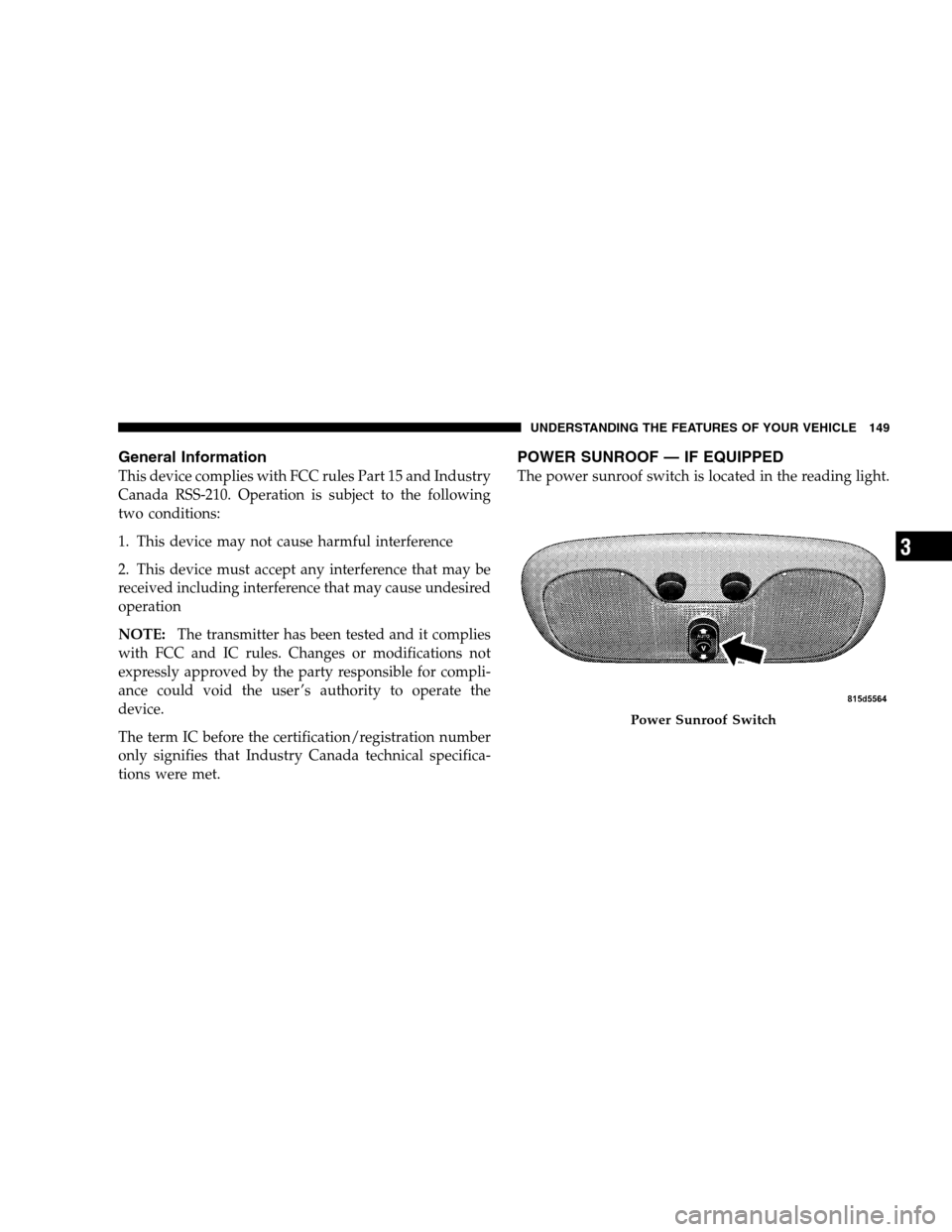
The power sunroof switch is located in the reading light.
Power Sunroof Switch
UNDERSTANDING THE FEATURES OF YOUR VEHICLE 149
3
Page 167 of 438
CAUTION!
•To prevent damage to the roof of your vehicle, DO NOT
carry any loads on the roof rack without cross rails installed.
The load should be secured and placed on top of the cross
rails, not directly on the roof. If it is necessary to place the
load on the roof, place a blanket or some other protection
between the load and the roof surface.
•To avoid damage to the roof rack and vehicle, do not exceed
the rated load capacity of your cross rail system or the roof
rack system maximum load capacity of 150 lbs (68 kg).
Always distribute heavy loads as evenly as possible and
secure the load appropriately.
•Long loads which extend over the windshield, such as wood
panels or surfboards, should be secured to both the front
and rear of the vehicle.
•Travel at reduced speeds and turn corners carefully when
carrying large or heavy loads on the roof rack. Wind forces,
due to natural causes or nearby truck traffic, can add sudden
upward loads. This is especially true on large flat loads and
may result in damage to the cargo or your vehicle.
WARNING!
Cargo must be securely tied down before driving
your vehicle. Improperly secured loads can fly off the
vehicle, particularly at high speeds, resulting in per-
sonal injury or property damage. Follow the roof rack
“Cautions” when carrying cargo on your roof rack.
UNDERSTANDING THE FEATURES OF YOUR VEHICLE 165
3
Page 172 of 438
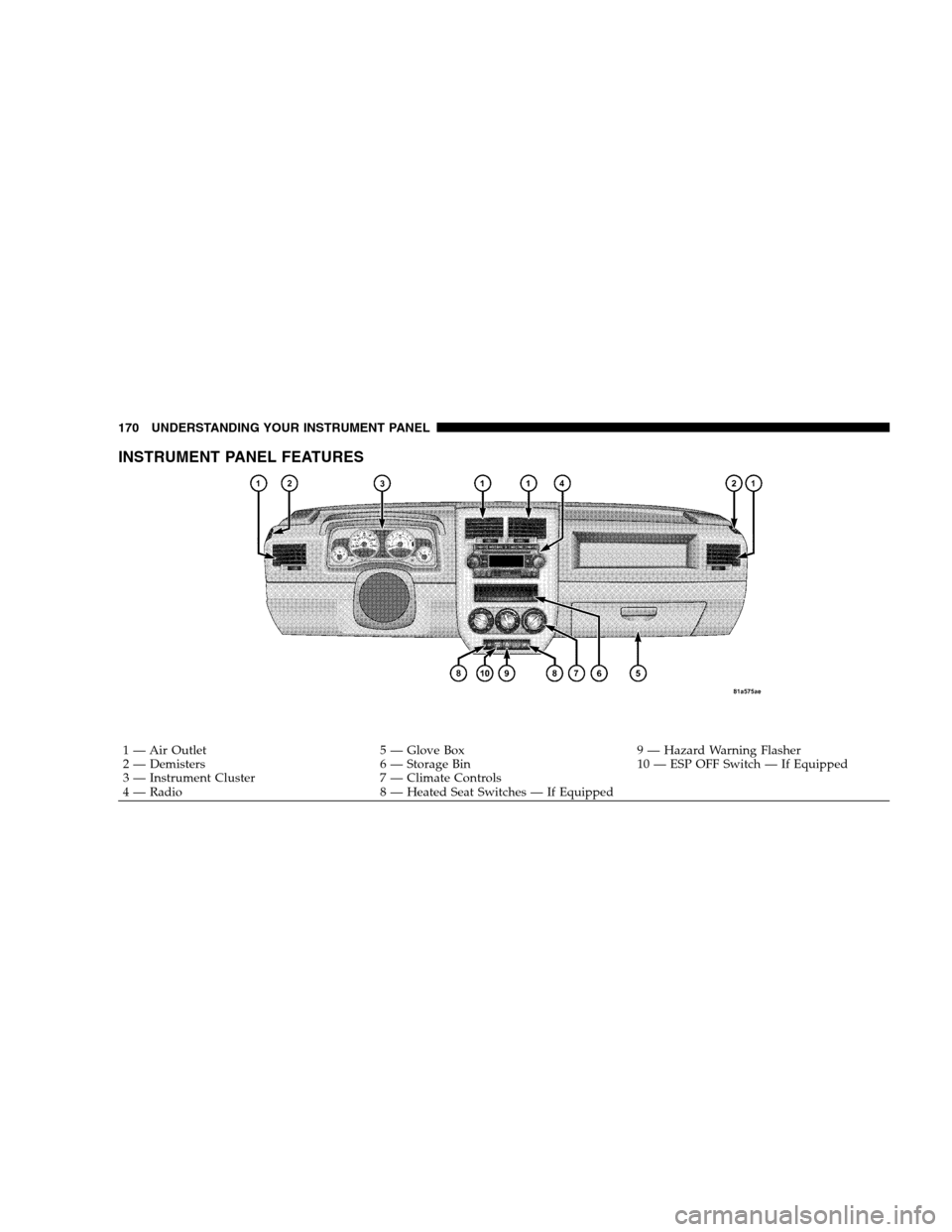
INSTRUMENT PANEL FEATURES
1 — Air Outlet 5 — Glove Box 9 — Hazard Warning Flasher
2 — Demisters 6 — Storage Bin 10 — ESP OFF Switch — If Equipped
3 — Instrument Cluster 7 — Climate Controls
4 — Radio 8 — Heated Seat Switches — If Equipped 170 UNDERSTANDING YOUR INSTRUMENT PANEL
Page 180 of 438
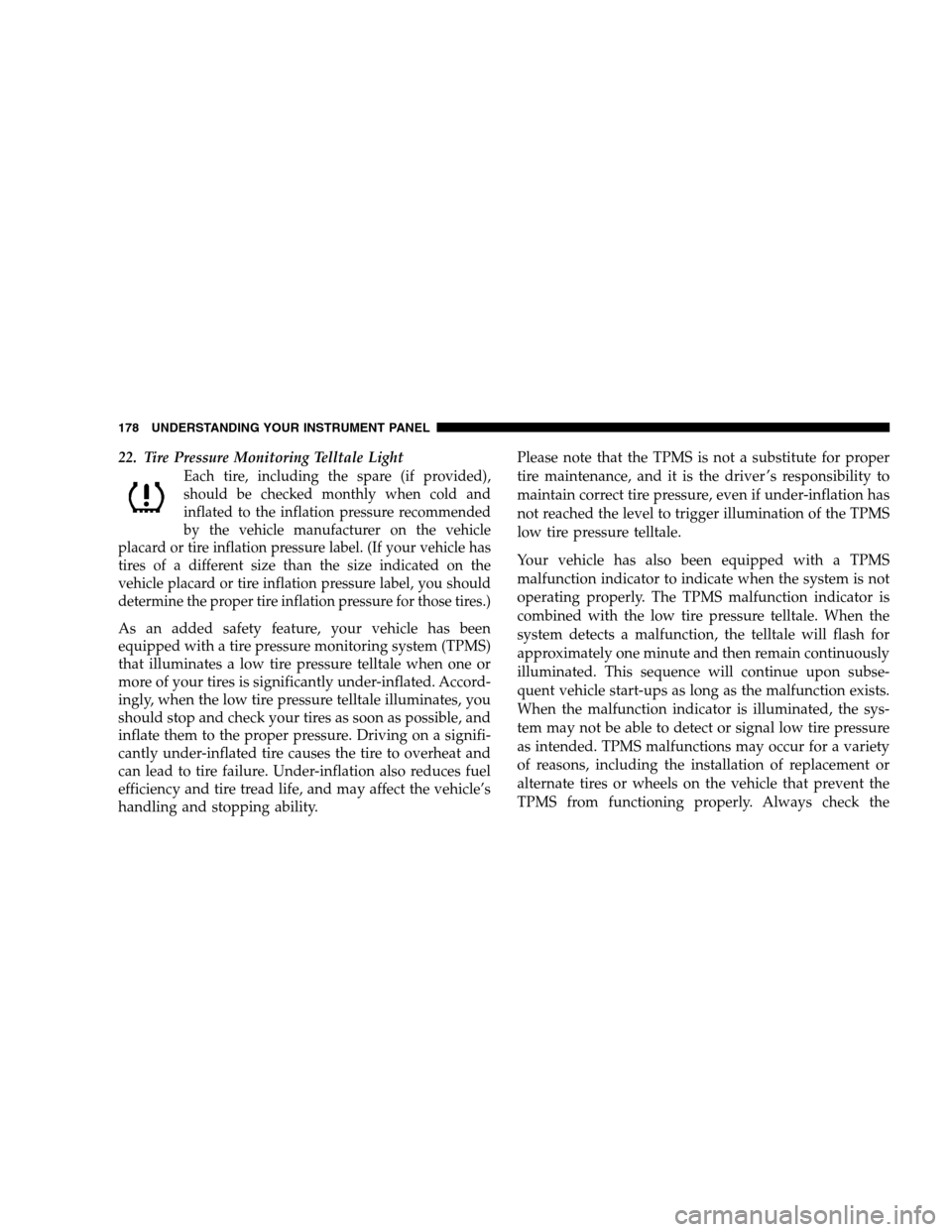
22. Tire Pressure Monitoring Telltale Light
Each tire, including the spare (if provided),
should be checked monthly when cold and
inflated to the inflation pressure recommended
by the vehicle manufacturer on the vehicle
placard or tire inflation pressure label. (If your vehicle has
tires of a different size than the size indicated on the
vehicle placard or tire inflation pressure label, you should
determine the proper tire inflation pressure for those tires.)
As an added safety feature, your vehicle has been
equipped with a tire pressure monitoring system (TPMS)
that illuminates a low tire pressure telltale when one or
more of your tires is significantly under-inflated. Accord-
ingly, when the low tire pressure telltale illuminates, you
should stop and check your tires as soon as possible, and
inflate them to the proper pressure. Driving on a signifi-
cantly under-inflated tire causes the tire to overheat and
can lead to tire failure. Under-inflation also reduces fuel
efficiency and tire tread life, and may affect the vehicle’s
handling and stopping ability.Please note that the TPMS is not a substitute for proper
tire maintenance, and it is the driver ’s responsibility to
maintain correct tire pressure, even if under-inflation has
not reached the level to trigger illumination of the TPMS
low tire pressure telltale.
Your vehicle has also been equipped with a TPMS
malfunction indicator to indicate when the system is not
operating properly. The TPMS malfunction indicator is
combined with the low tire pressure telltale. When the
system detects a malfunction, the telltale will flash for
approximately one minute and then remain continuously
illuminated. This sequence will continue upon subse-
quent vehicle start-ups as long as the malfunction exists.
When the malfunction indicator is illuminated, the sys-
tem may not be able to detect or signal low tire pressure
as intended. TPMS malfunctions may occur for a variety
of reasons, including the installation of replacement or
alternate tires or wheels on the vehicle that prevent the
TPMS from functioning properly. Always check the
178 UNDERSTANDING YOUR INSTRUMENT PANEL
Page 183 of 438
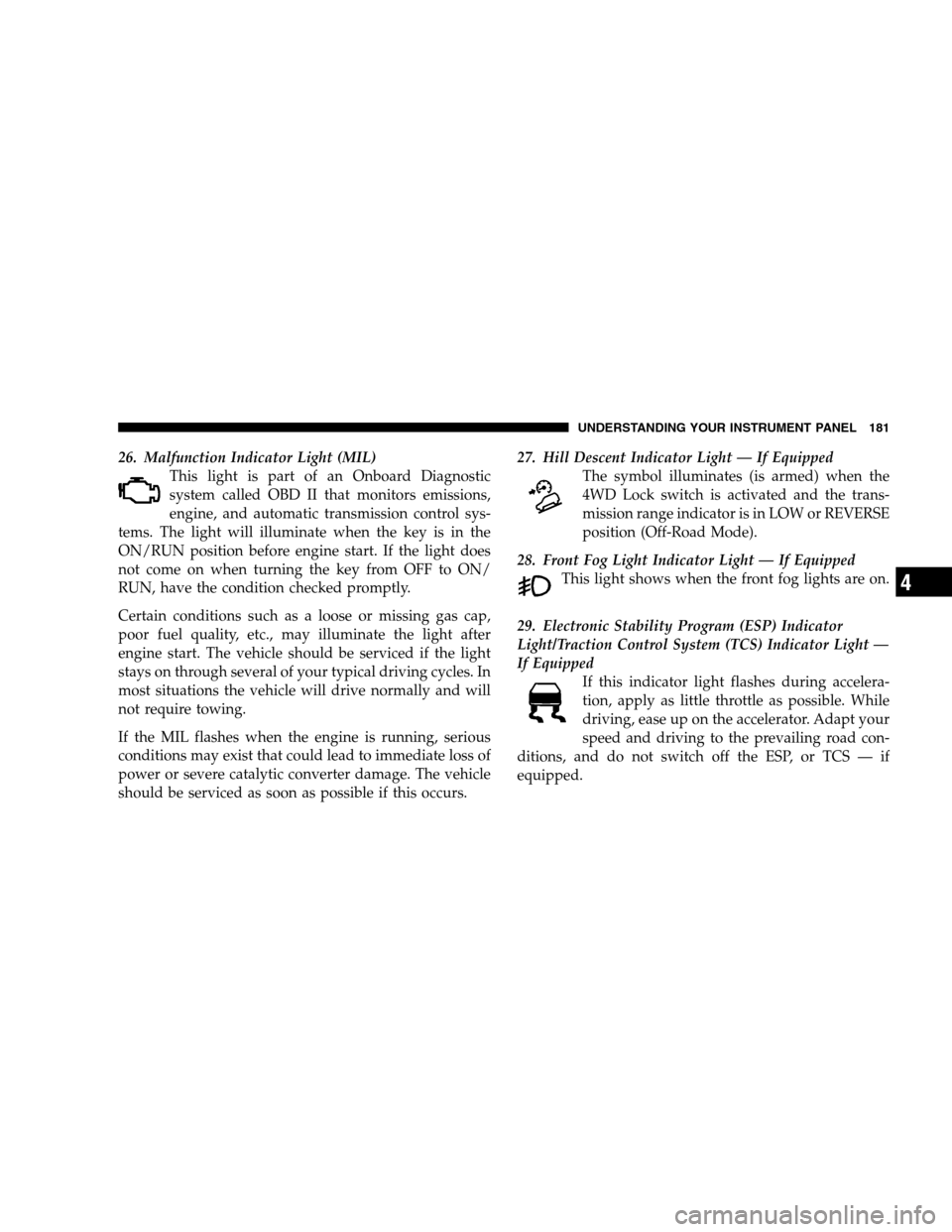
26. Malfunction Indicator Light (MIL)
This light is part of an Onboard Diagnostic
system called OBD II that monitors emissions,
engine, and automatic transmission control sys-
tems. The light will illuminate when the key is in the
ON/RUN position before engine start. If the light does
not come on when turning the key from OFF to ON/
RUN, have the condition checked promptly.
Certain conditions such as a loose or missing gas cap,
poor fuel quality, etc., may illuminate the light after
engine start. The vehicle should be serviced if the light
stays on through several of your typical driving cycles. In
most situations the vehicle will drive normally and will
not require towing.
If the MIL flashes when the engine is running, serious
conditions may exist that could lead to immediate loss of
power or severe catalytic converter damage. The vehicle
should be serviced as soon as possible if this occurs.27. Hill Descent Indicator Light — If Equipped
The symbol illuminates (is armed) when the
4WD Lock switch is activated and the trans-
mission range indicator is in LOW or REVERSE
position (Off-Road Mode).
28. Front Fog Light Indicator Light — If Equipped
This light shows when the front fog lights are on.
29. Electronic Stability Program (ESP) Indicator
Light/Traction Control System (TCS) Indicator Light —
If Equipped
If this indicator light flashes during accelera-
tion, apply as little throttle as possible. While
driving, ease up on the accelerator. Adapt your
speed and driving to the prevailing road con-
ditions, and do not switch off the ESP, or TCS — if
equipped.
UNDERSTANDING YOUR INSTRUMENT PANEL 181
4