Page 146 of 493
TILT STEERING COLUMN
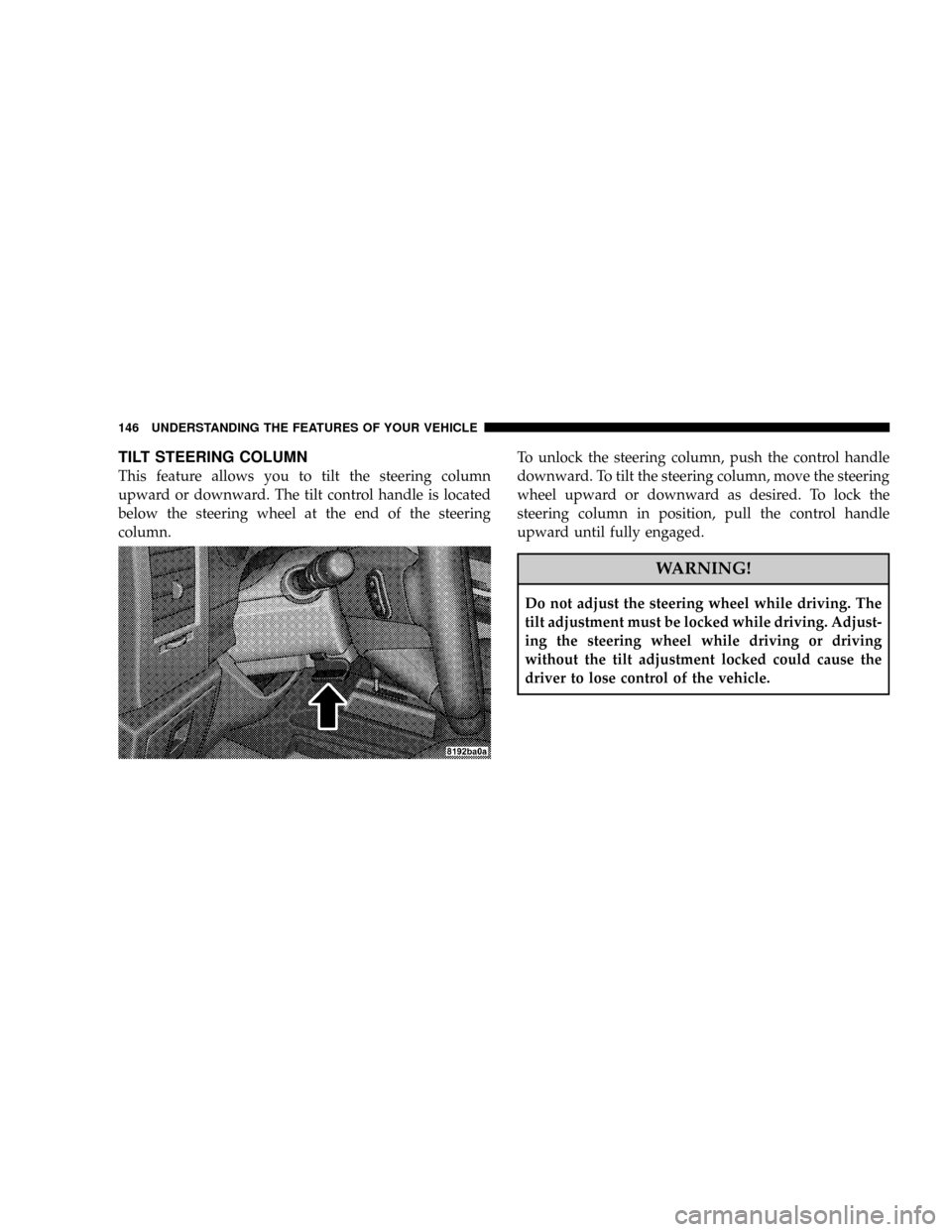
This feature allows you to tilt the steering column
upward or downward. The tilt control handle is located
below the steering wheel at the end of the steering
column.To unlock the steering column, push the control handle
downward. To tilt the steering column, move the steering
wheel upward or downward as desired. To lock the
steering column in position, pull the control handle
upward until fully engaged.
WARNING!
Do not adjust the steering wheel while driving. The
tilt adjustment must be locked while driving. Adjust-
ing the steering wheel while driving or driving
without the tilt adjustment locked could cause the
driver to lose control of the vehicle.
146 UNDERSTANDING THE FEATURES OF YOUR VEHICLE
Page 148 of 493
WARNING!
Leaving the Electronic Speed Control system on
when not in use is dangerous. You could accidentally
set the system or cause it to go faster than you want.
You could lose control and have an accident. Always
leave the system OFF when you are not using it.
To Set At A Desired Speed:
When the vehicle reaches the speed desired, press down
on the lever and release (ªSET DECELº). Release the
accelerator and the vehicle will operate at the selected
speed.
NOTE:
²The vehicle must be traveling at least 25 mph (40
km/h) for the speed control to set.
²The vehicle should be traveling at a steady speed and
on level ground before pressing the lever (ªSET DE-
CELº).
To Deactivate:
A soft tap on the brake pedal, or pulling the speed control
lever toward you (ªCANCELº), or normal brake or
clutch pressure while slowing the vehicle will deactivate
the speed control without erasing the set speed from
memory. Pressing the (ON/OFF) button or turning off
the ignition erases the set speed from memory.
NOTE:For vehicles equipped with a manual transmis-
sion, depressing the clutch pedal will disengage the
speed control. A slight increase in engine RPM before the
speed control disengages is normal.
148 UNDERSTANDING THE FEATURES OF YOUR VEHICLE
Page 150 of 493
Vehicles equipped with a manual transmission may need
to be shifted into a lower gear to climb hills without
speed loss.
WARNING!
Speed Control can be dangerous where the system
can't maintain a constant speed. Your vehicle could
go too fast for the conditions, and you could lose
control. An accident could be the result. Don't use
Speed Control in heavy traffic or on roads that are
winding, icy, snow-covered, or slippery.
REAR PARK ASSIST SYSTEM Ð IF EQUIPPED
The Rear Park Assist System is a driver aid that senses for
obstacles behind the vehicle and provides both visible
and audible warnings to indicate the range of the object.
System Usage Precautions
NOTE:
²Ensure that the rear bumper is free of dirt and debris
to keep the Rear Park Assist System operating prop-
erly.
²Jackhammers, large trucks, and other vibrations could
affect the performance of the Rear Park Assist System.
²When you turn off the Rear Park Assist System, the
instrument cluster will display ªPARK ASSIST DIS-
ABLED.º Furthermore, once you turn off the Rear
Park Assist System, it remains off until you turn it on
again, even if you cycle the ignition key.
150 UNDERSTANDING THE FEATURES OF YOUR VEHICLE
Page 152 of 493
WARNING!
²Drivers must be careful when backing up even when
using the Rear Park Assist System. Always check
carefully behind your vehicle, look behind you, and
be sure to check for pedestrians, animals, other
vehicles, obstructions, and blind spots before back-
ing up. You are responsible for safety and must
continue to pay attention to your surroundings. Fail-
ure to do so can result in serious injury or death.
²Before using the Rear Park Assist System, it is
strongly recommended that the ball mount and hitch
ball assembly is disconnected from the vehicle when
the vehicle is not used for towing. Failure to do so
can result in injury or damage to vehicles or obstacles
because the hitch ball will be much closer to the
obstacle than the rear fascia when the warning dis-
play turns the red LEDs ON. Also, the sensors could
detect the ball mount and hitch ball assembly, de-
pending on its size and shape, giving a false indica-
tion that an obstacle is behind the vehicle.
Enabling & Disabling the System
There are times when you may want to disable the Rear
Park Assist System, such as when towing a trailer.
Vehicles Equipped With the Electronic Vehicle
Information Center (EVIC)
You can turn the Rear Park Assist System on or off
through the EVIC. For details, refer to ªPersonal Settings
(Customer Programmable Features)º under ªElectronic
Vehicle Information Center (EVIC)º in Section 4 of this
manual.
Vehicles Equipped with Rear Park Assist Switch
You can turn the Rear Park Assist System on or off by
pressing the Rear Park Assist switch located the lower
switch bank below the climate controls.
152 UNDERSTANDING THE FEATURES OF YOUR VEHICLE
Page 153 of 493
System Operation
The system uses four sensors located in the rear bumper
fascia to scan for obstacles up to 79 inches (200 cm) away
from the rear bumper fascia. The warning display located
above the rear window provides both visible and audible
warnings to indicate the range of the object.The warning display contains two sets of yellow and red
LEDs, one set to warn of obstacles behind the left rear of
the vehicle and the other set to warn of obstacles behind
the right rear of the vehicle. The driver can view the LEDs
either through the rear view mirror or by looking at the
display above the rear window.
Rear Park Assist SwitchRear Park Assist Indicator
UNDERSTANDING THE FEATURES OF YOUR VEHICLE 153
3
Page 154 of 493
When the ignition is turned to the ON position, and the
system is enabled, the warning display will turn ON all
of its LEDs for approximately one second. Then, the
system dimly illuminates the two outer most yellow
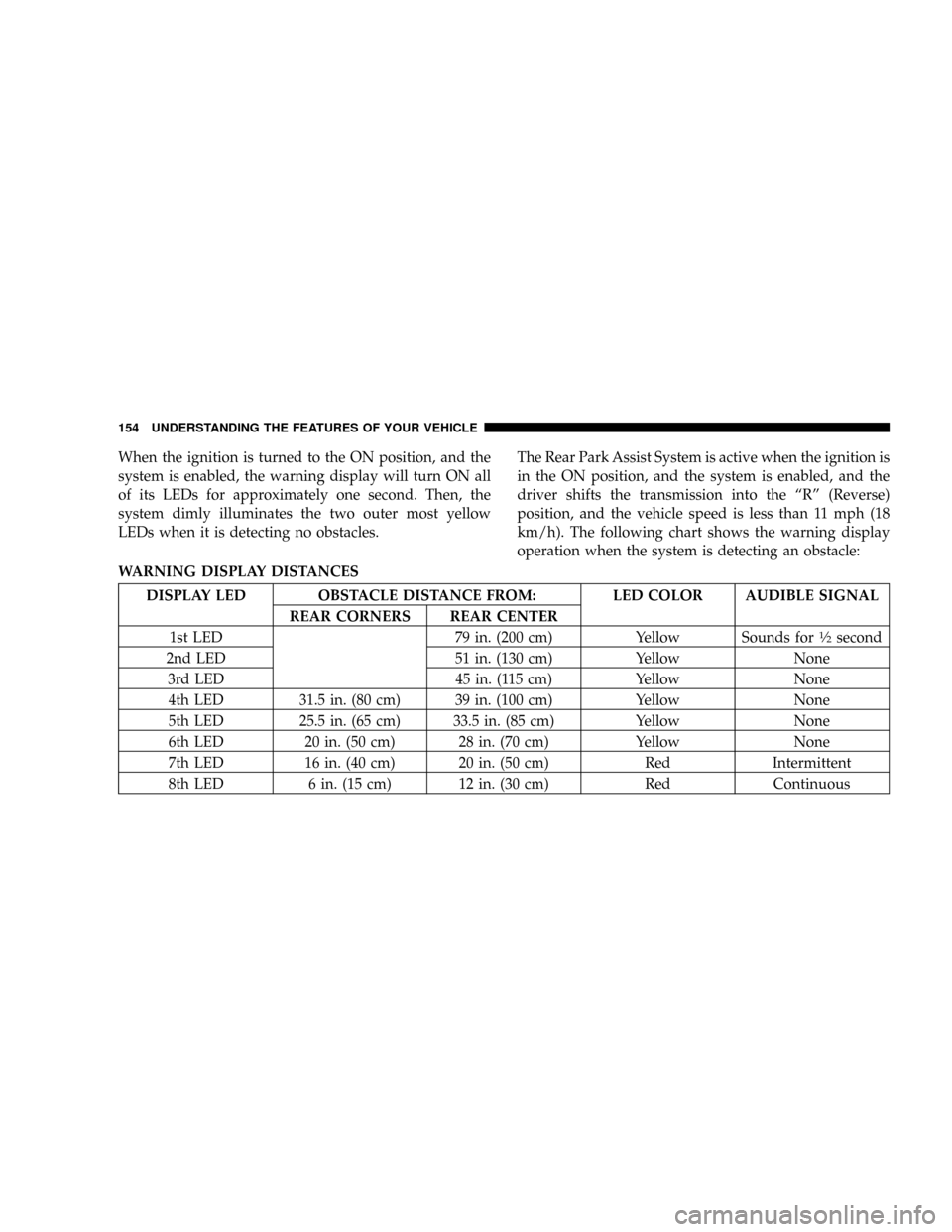
LEDs when it is detecting no obstacles.The Rear Park Assist System is active when the ignition is
in the ON position, and the system is enabled, and the
driver shifts the transmission into the ªRº (Reverse)
position, and the vehicle speed is less than 11 mph (18
km/h). The following chart shows the warning display
operation when the system is detecting an obstacle:
WARNING DISPLAY DISTANCES
DISPLAY LED OBSTACLE DISTANCE FROM: LED COLOR AUDIBLE SIGNAL
REAR CORNERS REAR CENTER
1st LED 79 in. (200 cm) Yellow Sounds for
1¤2second
2nd LED 51 in. (130 cm) Yellow None
3rd LED 45 in. (115 cm) Yellow None
4th LED 31.5 in. (80 cm) 39 in. (100 cm) Yellow None
5th LED 25.5 in. (65 cm) 33.5 in. (85 cm) Yellow None
6th LED 20 in. (50 cm) 28 in. (70 cm) Yellow None
7th LED 16 in. (40 cm) 20 in. (50 cm) Red Intermittent
8th LED 6 in. (15 cm) 12 in. (30 cm) Red Continuous
154 UNDERSTANDING THE FEATURES OF YOUR VEHICLE
Page 155 of 493
GARAGE DOOR OPENER Ð IF EQUIPPED
HomeLinktreplaces up to three remote controls (hand
held transmitters) that operate devices such as garage
door openers, motorized gates, lighting, or home security
systems. The HomeLinktunit operates off your vehicle's
battery.
NOTE:HomeLinktis disabled when the Vehicle Secu-
rity Alarm is active.WARNING!
Your motorized door or gate will open and close while
you are training the Universal Transceiver. Do not train
the transceiver if people or pets are in the path of the
door or gate. Only use this transceiver with a garage
door opener that has a ªstop and reverseº feature as
required by federal safety standards. This includes
most garage door opener models manufactured after
1982. Do not use a garage door opener without these
safety features. Call toll-free 1±800±355±3515 or, on the
Internet at www.HomeLink.com for safety information
or assistance.
UNDERSTANDING THE FEATURES OF YOUR VEHICLE 155
3
Page 156 of 493
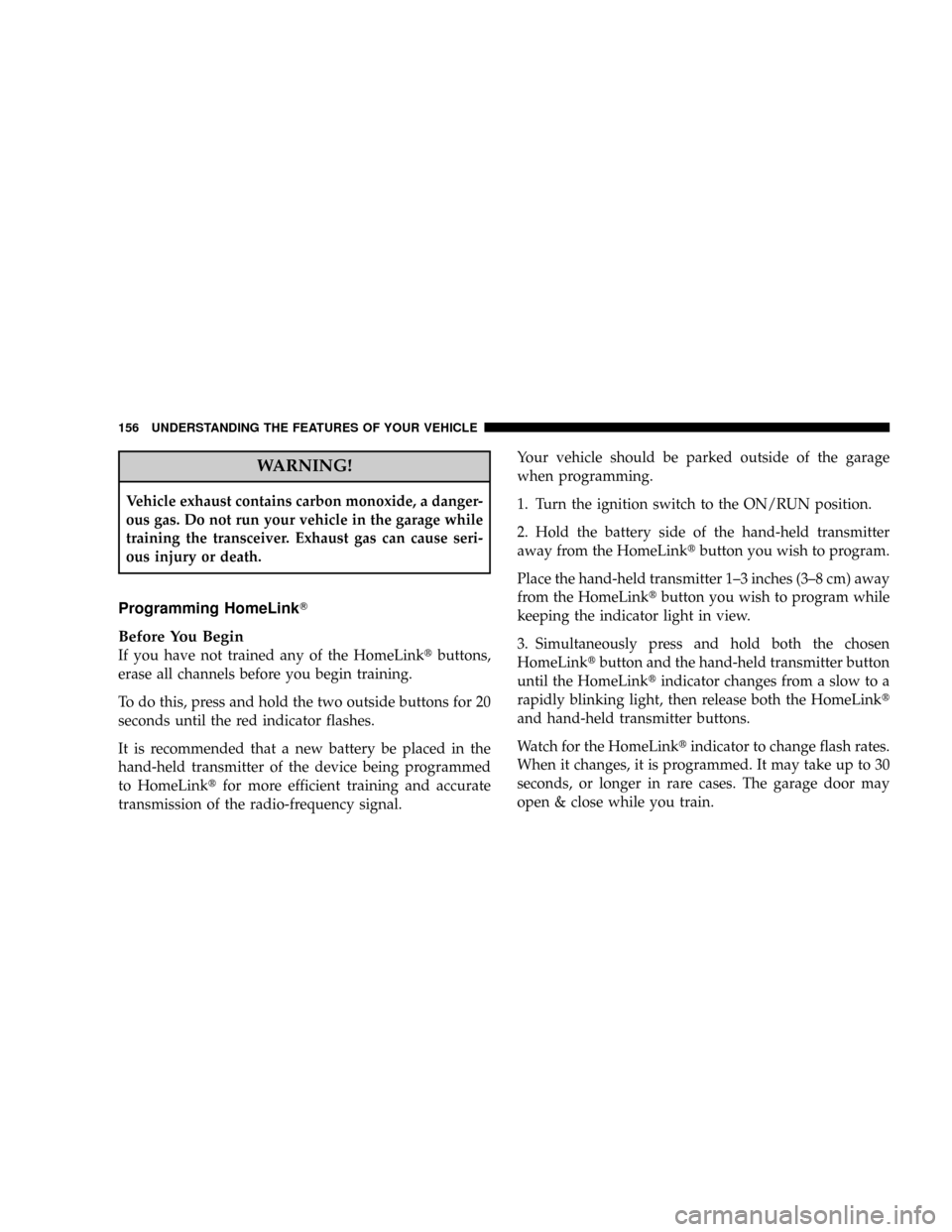
WARNING!
Vehicle exhaust contains carbon monoxide, a danger-
ous gas. Do not run your vehicle in the garage while
training the transceiver. Exhaust gas can cause seri-
ous injury or death.
Programming HomeLinkT
Before You Begin
If you have not trained any of the HomeLinktbuttons,
erase all channels before you begin training.
To do this, press and hold the two outside buttons for 20
seconds until the red indicator flashes.
It is recommended that a new battery be placed in the
hand-held transmitter of the device being programmed
to HomeLinktfor more efficient training and accurate
transmission of the radio-frequency signal.Your vehicle should be parked outside of the garage
when programming.
1. Turn the ignition switch to the ON/RUN position.
2. Hold the battery side of the hand-held transmitter
away from the HomeLinktbutton you wish to program.
Place the hand-held transmitter 1±3 inches (3±8 cm) away
from the HomeLinktbutton you wish to program while
keeping the indicator light in view.
3. Simultaneously press and hold both the chosen
HomeLinktbutton and the hand-held transmitter button
until the HomeLinktindicator changes from a slow to a
rapidly blinking light, then release both the HomeLinkt
and hand-held transmitter buttons.
Watch for the HomeLinktindicator to change flash rates.
When it changes, it is programmed. It may take up to 30
seconds, or longer in rare cases. The garage door may
open & close while you train.
156 UNDERSTANDING THE FEATURES OF YOUR VEHICLE