Page 387 of 493

CAUTION!
The winch mechanism is designed for use with the
jack extension tube only. Use of an air wrench or
other power tools is not recommended and they can
damage the winch.
When the spare is clear, tilt the retainer at the end of the
cable, and pull it through the center of the wheel.
Preparations For Jacking
²
Park the vehicle on a firm level surface as far from the
edge of the roadway as possible. Avoid icy or slippery
areas.
²Set the parking brakeand place the gear selector in
PARK (automatic transmission) or REVERSE (manual
transmission).
²Turn the ignition to the LOCK position.
WARNING!
Do not attempt to change a tire on the side of the
vehicle close to moving traffic. Pull far enough off
the road to avoid being hit when operating the jack
or changing the wheel.
²Turn on the Hazard Warning Flasher.
²Block both the front and rear
of the wheel diagonally oppo-
site of the jacking position.
For example, if changing the
right front tire, block the left
rear wheel.
²Passengers should not remain in the vehicle when the
vehicle is being jacked.
WHAT TO DO IN EMERGENCIES 387
6
Page 390 of 493
nuts until each nut has been tightened twice. Correct
wheel nut tightness is 130 N´m (95 ft. lbs). If in doubt
about the correct tightness, have them checked with a
torque wrench by your authorized dealer or at a service
station.
10. Lower the jack to it's fully closed position.
WARNING!
A loose tire or jack, thrown forward in a collision or
hard stop could endanger the occupants of the ve-
hicle. Always stow the jack parts and the spare tire in
the places provided.
11. Secure the tire, jack, and tools in their proper loca-
tions.
JUMP STARTING
WARNING!
²Take care to avoid the radiator cooling fan whenever the hood is
raised. It can start anytime the ignition switch is on. You can be hurt
by the fan.
²Do not attempt to push or tow your vehicle to get it started. Vehicles
equipped with an automatic transmission cannot be started this
way. Unburned fuel could enter the catalytic converter and once the
engine has started, ignite and damage the converter and vehicle. If
the vehicle has a discharged battery, booster cables may be used to
obtain a start from another vehicle. This type of start can be
dangerous if done improperly, so follow this procedure carefully.
²Battery fluid is a corrosive acid solution; do not allow battery fluid
to contact eyes, skin, or clothing. Don't lean over battery when
attaching clamps or allow the clamps to touch each other. If acid
splashes in eyes or on skin, flush contaminated area immediately
with large quantities of water.
²A battery generates hydrogen gas, which is flammable and explo-
sive. Keep flame or spark away from the vent holes.
²Do not use a booster battery or any other booster source with an
output that exceeds 12 volts.
390 WHAT TO DO IN EMERGENCIES
Page 391 of 493
1. Wear eye protection and remove all metal jewelry such
as watchbands or bracelets that might make an unin-
tended electrical contact.
2. When boosting from a battery in another vehicle, park
that vehicle within booster cable reach, but without
allowing the vehicles to touch.
WARNING!
Do not permit vehicles to touch each other as this
could establish a ground connection and personal
injury could result.3. Set the parking brake, place the automatic transmis-
sion in PARK (or NEUTRAL for manual transmission),
and turn the ignition OFF for both vehicles.
4. Turn OFF the heater, radio and all unnecessary elec-
trical loads.
5. Connect one end of the jumper cable to the positive
battery post. Connect the other end of the same cable to
the positive terminal of the booster battery.
6. Connect the other cable, first to the negative terminal
of the booster battery and then to the engine ground of
the vehicle with the discharged battery. Make sure you
have a good contact on the engine ground.
WHAT TO DO IN EMERGENCIES 391
6
Page 396 of 493

NA/C Air Filter Ð If Equipped............412
NPower Steering Ð Fluid Check............412
NDriveline And Steering Component
Lubrication..........................413
NBody Lubrication.....................413
NWindshield Wiper Blades................413
NWindshield & Rear Window Washers.......414
NExhaust System......................415
NCooling System.......................416
NHoses And Vacuum/Vapor Harnesses.......421
NFuel System.........................421
NBrake System........................422
NClutch Hydraulic System Ð Manual
Transmission (If Equipped)..............424NAutomatic Transmission................425
NManual Transmission Ð If Equipped.......426
NTransfer Case........................426
NFront/Rear Axle Fluid..................428
NAppearance Care And Protection From
Corrosion...........................428
mSky SlidertTopCare ....................434
NWashing............................434
NGeneral Cleaning.....................434
NAdditional Cleaning Procedure............435
NProtection...........................435
NWeather Strip Care....................436
mFuses (Integrated Power Module)...........436
396 MAINTAINING YOUR VEHICLE
Page 399 of 493

ONBOARD DIAGNOSTIC SYSTEM Ð OBD II
Your vehicle is equipped with a sophisticated onboard
diagnostic system called OBD II. This system monitors
the performance of the emissions, engine, and automatic
transmission control systems. When these systems are
operating properly, your vehicle will provide excellent
performance and fuel economy, as well as engine emis-
sions well within current government regulations.
If any of these systems require service, the OBD II system
will turn on the ªMalfunction Indicator Light.º It will
also store diagnostic codes and other information to
assist your service technician in making repairs. Al-
though your vehicle will usually be drivable and not
need towing, see your dealer for service as soon as
possible.CAUTION!
²Prolonged driving with the ªMalfunction Indica-
tor Lightº on could cause further damage to the
emission control system. It could also affect fuel
economy and driveability. The vehicle must be
serviced before any emissions tests can be per-
formed.
²If the ªMalfunction Indicator Lightº is flashing
while the engine is running, severe catalytic con-
verter damage and power loss will soon occur.
Immediate service is required.
MAINTAINING YOUR VEHICLE 399
7
Page 425 of 493

Automatic Transmission
Fluid Level Check
Your vehicle is equipped with a capped dipstick tube that
is sealed and it should not be tampered with. Your
authorized dealer has the proper tools to ensure that the
fluid level is set properly.
CAUTION!
Using a transmission fluid other than the manufac-
turer's recommended fluid may cause deterioration
in transmission shift quality and/or torque converter
shudder. Using a transmission fluid other than that
recommended by the manufacturer will result in
more frequent fluid and filter changes. Refer to
ªFluids, Lubricants, and Genuine Partsº in this sec-
tion for the correct fluid type.
Fluid and Filter Changes
Change the automatic transmission fluid and filter at the
intervals shown in the ªMaintenance Scheduleº in Sec-
tion 8 of this manual.
In addition, change the fluid and filter if the transmission
is disassembled for any reason.
NOTE:Be sure to follow the ªpolice, taxi, fleet, off-road,
or frequent trailer towingº maintenance interval if appli-
cable.
Special Additives
Automatic Transmission Fluid (ATF) is an engineered
product and its performance may be impaired by supple-
mental additives. Therefore, do not add any fluid addi-
tives to the transmission. The only exception to this
policy is the use of special dyes to aid in detecting fluid
leaks. In addition, avoid using transmission sealers as
they may adversely affect seals.
MAINTAINING YOUR VEHICLE 425
7
Page 449 of 493
Chassis
Component Fluids, Lubricants, and Genuine Parts
Automatic Transmission MopartATF+4, Automatic Transmission Fluid.
Manual Transmission MopartManual Transmission Lubricant or equivalent (meeting the re-
quirements of DaimlerChrysler Material Standard MS-9224)
Transfer Case MopartATF+4, Automatic Transmission Fluid.
Front Axle SAE 80W-90 Multipurpose Type, GL-5 Gear Lubricant or equivalent.
Rear Axle SAE 75W-140 Synthetic Gear Lubricant or equivalent.
Brake Master Cylinder/Manual
Transmission Clutch SystemMopartDOT 3, SAE J1703 or equivalent should be used. If DOT 3 brake
fluid is not available, then DOT 4 is acceptable. Use only recommended
brake fluids.
Power Steering Reservoir MopartATF+4, Automatic Transmission Fluid.
MAINTAINING YOUR VEHICLE 449
7
Page 456 of 493
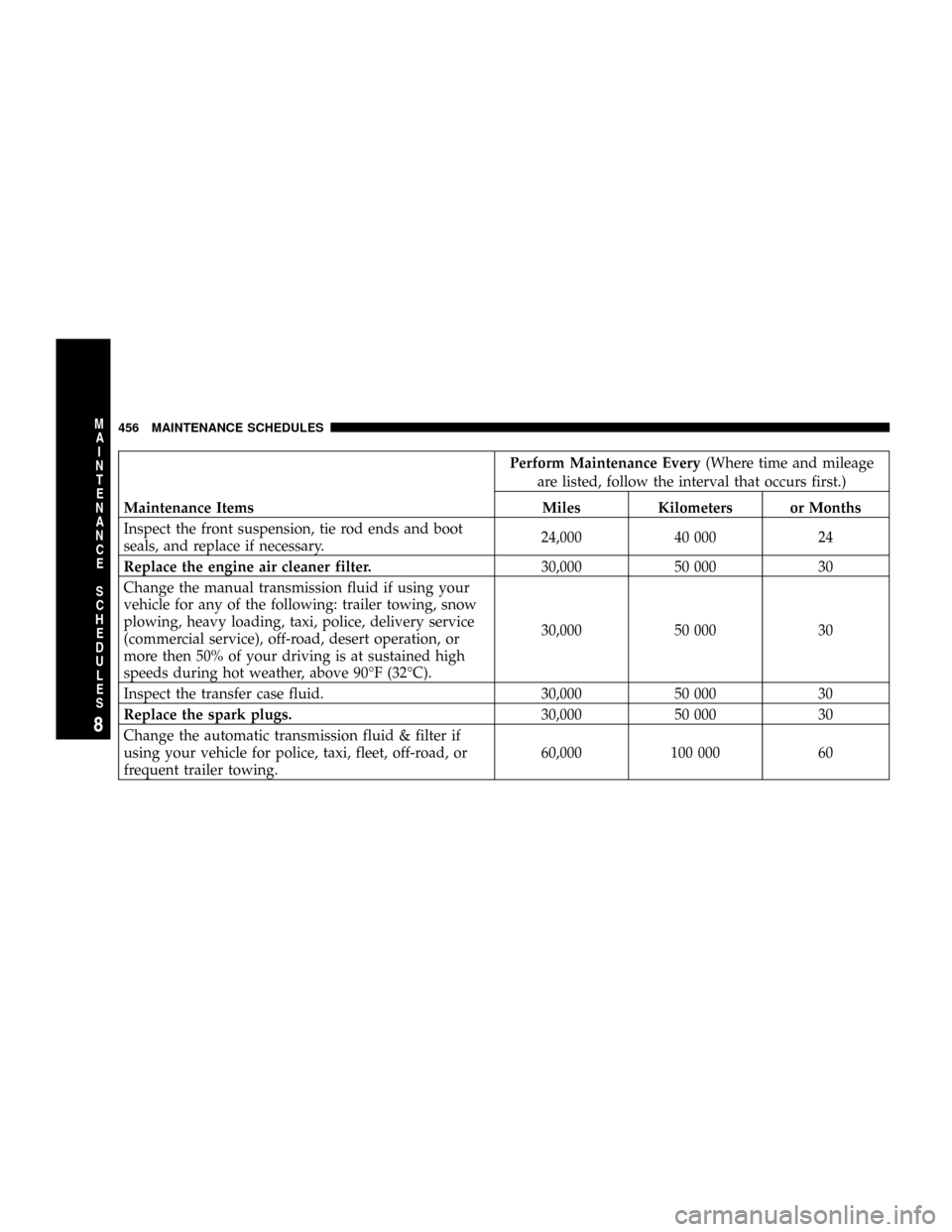
Perform Maintenance Every(Where time and mileage
are listed, follow the interval that occurs first.)
Maintenance Items Miles Kilometers or Months
Inspect the front suspension, tie rod ends and boot
seals, and replace if necessary.24,000 40 000 24
Replace the engine air cleaner filter.30,000 50 000 30
Change the manual transmission fluid if using your
vehicle for any of the following: trailer towing, snow
plowing, heavy loading, taxi, police, delivery service
(commercial service), off-road, desert operation, or
more then 50% of your driving is at sustained high
speeds during hot weather, above 90ÉF (32ÉC).30,000 50 000 30
Inspect the transfer case fluid. 30,000 50 000 30
Replace the spark plugs.30,000 50 000 30
Change the automatic transmission fluid & filter if
using your vehicle for police, taxi, fleet, off-road, or
frequent trailer towing.60,000 100 000 60
456 MAINTENANCE SCHEDULES
8
M
A
I
N
T
E
N
A
N
C
E
S
C
H
E
D
U
L
E
S