2008 JEEP GRAND CHEROKEE recommended oil
[x] Cancel search: recommended oilPage 25 of 490

Programming Additional Transmitters
Refer to SENTRY KEY ªCustomer Key (Fob) Program-
ming.º
If you do not have a programmed transmitter, contact
your dealer for details.
Transmitter Battery Service
The recommended replacement battery is one CR2032
battery.
NOTE:
Perchlorate Material Ð special handling may
apply. See www.dtsc.ca.gov/hazardouswaste/perchlorate
NOTE:Do not touch the battery terminals that are on
the back housing or the printed circuit board.
1. Battery access is through a door located on the rear of
the FOBIK. Insert a small, flat bladed screwdriver into the
slot and gently pry open the access door.2. Remove and replace the batteries. Avoid touching the
new batteries with your fingers. Skin oils may cause
battery deterioration. If you touch a battery, clean it with
rubbing alcohol.
3. Reposition the access door panel over the battery
opening and snap into place.FOBIK Battery Replacement
THINGS TO KNOW BEFORE STARTING YOUR VEHICLE 25
2
Page 68 of 490

ENGINE BREAK-IN RECOMMENDATIONS
A long break-in period is not required for the engine in
your new vehicle.
Drive moderately during the first 300 miles (500 km).
After the initial 60 miles (100 km), speeds up to 50 or 55
mph (80 or 90 km/h) are desirable.
While cruising, brief full-throttle acceleration, within the
limits of local traffic laws, contributes to a good break-in.
Wide-open throttle acceleration in low gear can be detri-
mental and should be avoided.The engine oil installed in the engine at the factory is a
high quality energy conserving type lubricant. Oil
changes should be consistent with anticipated climate
conditions under which vehicle operations will occur.
The recommended viscosity and quality grades are
shown in Section 7 of this manual. NON-DETERGENT
OR STRAIGHT MINERAL OILS MUST NEVER BE
USED.
A new engine may consume some oil during its first few
thousand miles (kilometers) of operation. This should be
considered as a normal part of the break-in and not
interpreted as an indication of difficulty.
68 THINGS TO KNOW BEFORE STARTING YOUR VEHICLE
Page 268 of 490

Operating Tips
Window Fogging
Windows will fog on the inside when the humidity inside
the vehicle is high. This often occurs in mild or cool
temperatures when it's rainy or humid. In most cases
turning on the Air-conditioning (pressing the snowflake
button) will clear the fog. Adjust the temperature control,
air direction and blower speed to maintain comfort.
As the temperature gets colder it may be necessary to
direct air onto the windshield. Adjust the temperature
control and blower speed to maintain comfort. Higher
blower speeds will reduce fogging. Interior fogging on
the windshield can be quickly removed by selecting the
defrost mode.
Regular cleaning of the inside of the windows with a
non-filming cleaning solution (vinegar and water works
very well) will help prevent contaminates (cigarettesmoke, perfumes, etc.) from sticking to the windows.
Contaminates increase the rate of window fogging.Summer Operation
Air conditioned vehicles must be protected with a high
quality antifreeze coolant during summer to provide
proper corrosion protection and to raise the boiling point
of the coolant for protection against overheating. A 50 %
concentration is recommended. Refer to Recommended
Fluids and Genuine Parts for the proper coolant type.
When using the air conditioner in extremely heavy traffic
in hot weather especially when towing a trailer, addi-
tional engine cooling may be required. If this situation is
encountered, operate the transmission in a lower gear to
increase engine RPM, coolant flow and fan speed. When
stopped in heavy traffic, it may be necessary to shift into
N (Neutral) and depress the accelerator slightly for fast
idle operation to increase coolant flow and fan speed.
268 UNDERSTANDING YOUR INSTRUMENT PANEL
Page 395 of 490
Change Engine Oil
Refer to the Maintenance Schedule for recommended
engine oil change intervals.
Engine Oil Selection Ð Gasoline Engines
For best performance and maximum protection for all
engines under all types of operating conditions, the
manufacturer recommends engine oils that are API Cer-
tified and meet the requirements of DaimlerChrysler
Material Standard MS-6395.
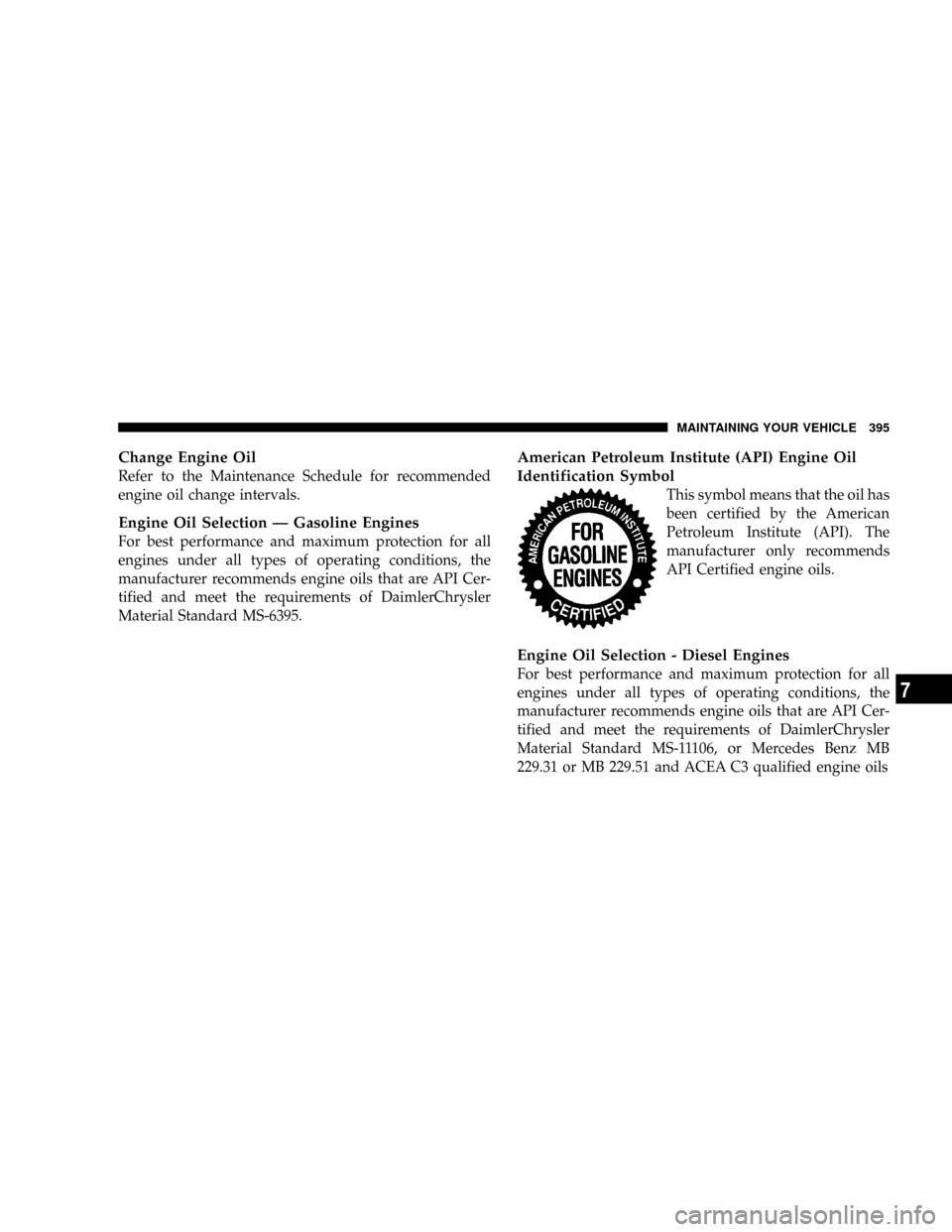
American Petroleum Institute (API) Engine Oil
Identification Symbol
This symbol means that the oil has
been certified by the American
Petroleum Institute (API). The
manufacturer only recommends
API Certified engine oils.
Engine Oil Selection - Diesel Engines
For best performance and maximum protection for all
engines under all types of operating conditions, the
manufacturer recommends engine oils that are API Cer-
tified and meet the requirements of DaimlerChrysler
Material Standard MS-11106, or Mercedes Benz MB
229.31 or MB 229.51 and ACEA C3 qualified engine oils
MAINTAINING YOUR VEHICLE 395
7
Page 396 of 490

Engine Oil Viscosity (3.7L/4.7L/5.7L Engines)
SAE 5W-20 engine oil is recommended for all operating
temperatures. This engine oil improves low temperature
starting and vehicle fuel economy.
The engine oil filler cap also shows the recommended
engine oil viscosity for your vehicle. For information on
engine oil filler cap location, see the ªEngine Compart-
mentº illustration in this section.
NOTE:Vehicles equipped with a 5.7L engine must use
SAE 5W-20 oil. Failure to do so may result in improper
operation of the Multiple Displacement System (MDS).
Refer to ªMulti Displacement Systemº in Section 5 for
more details.
Lubricants which do not have both, the engine oil certi-
fication mark and the correct SAE viscosity grade num-
ber should not be used.
Engine Oil Viscosity (3.0L Diesel Engine)
CAUTION!
Your vehicle is equipped with an advanced technol-
ogy Diesel Engine and an emission device designed
to limit Diesel Particulate Emissions from being
released into the atmosphere. The durability of your
engine and life expectancy of this diesel particulate
filter emission device is highly dependent on the use
of the correct engine oil.
In order to protect your engine and emission system, use
only SAE 5W-30 Synthetic Engine Oil that meets
DaimlerChrysler Material Standard MS-11106, Mercedes
Benz MB 229.31 or MB 229.51, and ACEA C3 qualified
engine oils.
396 MAINTAINING YOUR VEHICLE
Page 397 of 490
Synthetic Engine Oils
You may use synthetic engine oils provided the recom-
mended oil quality requirements are met, and the recom-
mended maintenance intervals for oil and filter changes
are followed.
Materials Added to Engine Oils
The manufacturerstrongly recommendsagainst the ad-
dition of any additives (other than leak detection dyes) to
the engine oil. Engine oil is an engineered product and
it's performance may be impaired by supplemental ad-
ditives.
Disposing of Used Engine Oil and Oil Filters
Care should be taken in disposing of used engine oil and
oil filters from your vehicle. Used oil and oil filters,
indiscriminately discarded, can present a problem to theenvironment. Contact your local authorized dealer, ser-
vice station, or governmental agency for advice on how
and where used oil and oil filters can be safely discarded
in your area.
Engine Oil Filter
The engine oil filter should be replaced with a new filter
at every oil change.
Engine Oil Filter Selection
The manufacturer's engines have a full-flow type dispos-
able oil filter. Use a filter of this type for replacement. The
quality of replacement filters varies considerably. Only
high quality filters should be used to assure most efficient
service. Mopartengine oil filters are high quality oil
filters and are recommended.
MAINTAINING YOUR VEHICLE 397
7
Page 423 of 490

²If you detect any stone chips or scratches in the paint,
touch them up immediately. The cost of such repairs is
considered the responsibility of the owner.
²If your vehicle is damaged due to an accident or
similar cause which destroys the paint and protective
coating have your vehicle repaired as soon as possible.
The cost of such repairs is considered the responsibil-
ity of the owner.
²If you carry special cargo such as chemicals, fertilizers,
de-icer salt, etc., assure that such materials are well
packaged and sealed.
²If a lot of driving is done on gravel roads, consider
mud or stone shields behind each wheel.
²Use MopartTouch Up Paint on scratches or chips as
soon as possible. Your authorized dealer has touch up
paint to match the color of your vehicle.
Wheel and Wheel Trim Care
All wheels and wheel trim, especially aluminum and
chrome plated wheels should be cleaned regularly with a
mild soap and water to prevent corrosion. To remove
heavy soil, use MopartWheel Cleaner or select a non-
abrasive, non-acidic cleaner. Do not use scouring pads,
steel wool, a bristle brush or metal polishes. Only Mo-
partcleaners are recommended. Do not use oven cleaner.
Avoid automatic car washes that use acidic solutions or
harsh brushes that may damage the wheels' protective
finish.
YES EssentialstFabric Cleaning Procedure ± If
Equipped
YES Essentialstseats may be cleaned in the following
manner:
²Remove as much of the stain as possible by blotting
with a clean, dry towel.
²Blot any remaining stain with a clean, damp towel.
MAINTAINING YOUR VEHICLE 423
7
Page 424 of 490

²For tough stains, apply MopartTotal Clean or a mild
soap solution to a clean, damp cloth and remove stain.
Use a fresh, damp towel to remove soap residue.
²For grease stains, apply MopartMulti-Purpose
Cleaner to a clean, damp cloth and remove stain. Use
a fresh, damp towel to remove soap residue.
²Do not use any solvents or protectants on Yes Essen-
tialstproducts.
Interior Care
Use MopartTotal Clean to clean fabric upholstery and
carpeting.
Interior Trim should be cleaned starting with a damp
cloth, a damp cloth with MopartTotal Clean, then
MopartSpot & Stain Remover if absolutely necessary. Do
not use harsh cleaners or Armorall. Use MopartTotal
Clean to clean vinyl upholstery.
Leather Seat Care & Cleaning
MopartTotal Clean is specifically recommended for
leather upholstery.
Your leather upholstery can be best preserved by regular
cleaning with a damp soft cloth. Small particles of dirt
can act as an abrasive and damage the leather upholstery
and should be removed promptly with a damp cloth.
Stubborn soils can be removed easily with a soft cloth
and MopartTotal Clean. Care should be taken to avoid
soaking your leather upholstery with any liquid. Please
do not use polishes, oils, cleaning fluids, solvents, deter-
gents, or ammonia based cleaners to clean your leather
upholstery. Application of a leather conditioner is not
required to maintain the original condition.
424 MAINTAINING YOUR VEHICLE