Page 382 of 490
TOWING A DISABLED VEHICLE
2WD Models Only
Provided the transmission is operable, tow only in N
(Neutral) at speeds not exceeding 30 mph (48 km/h), for
distances of not more than 15 miles (24 km). Towing at
more than 30 mph (48 km/h) or for more than 15 miles
(24 km) can cause severe transmission damage. If the
transmission is not operable, or the vehicle must be
towed faster than 30 mph (48 km/h) or farther than 15
miles (24 km), remove the driveshaft or tow with all four
wheelsOFFthe ground. Acceptable methods are to tow
the vehicle on a flatbed or with one end of the vehicle
raised and the other end on a towing dolly.
4WD Models Only
The manufacturer recommends towing with all four
wheelsOFFthe ground. Acceptable methods are to tow
the vehicle on a flatbed or with one end of the vehicle
raised and the other end on a towing dolly.
382 WHAT TO DO IN EMERGENCIES
Page 390 of 490
ONBOARD DIAGNOSTIC SYSTEM Ð OBD II
Your vehicle is equipped with a sophisticated onboard
diagnostic system called OBD II. This system monitors
the performance of the emissions, engine, and automatic
transmission control systems. When these systems are
operating properly, your vehicle will provide excellent
performance and fuel economy, as well as engine emis-
sions well within current government regulations.
If any of these systems require service, the OBD II system
will turn on the ªMalfunction Indicator Light.º It will
also store diagnostic codes and other information to
assist your service technician in making repairs. Al-
though your vehicle will usually be drivable and not
need towing, see your dealer for service as soon as
possible.CAUTION!
²Prolonged driving with the ªMalfunction Indica-
tor Lightº on could cause further damage to the
emission control system. It could also affect fuel
economy and driveability. The vehicle must be
serviced before any emissions tests can be per-
formed.
²If the ªMalfunction Indicator Lightº is flashing
while the engine is running, severe catalytic con-
verter damage and power loss will soon occur.
Immediate service is required.
390 MAINTAINING YOUR VEHICLE
Page 400 of 490

NOTE:Intentional tampering with emissions control
systems can result in civil penalties being assessed
against you.
WARNING!
A hot exhaust system can start a fire if you park over
materials that can burn. Such materials might be
grass or leaves coming into contact with your exhaust
system. Do not park or operate your vehicle in areas
where your exhaust system can contact anything that
can burn.
In unusual situations involving grossly malfunctioning
engine operation, a scorching odor may suggest severe
and abnormal catalyst overheating. If this occurs, stop
the vehicle, turn off the engine and allow it to cool.
Service, including a tune up to manufacturer's specifica-
tions, should be obtained immediately.
To minimize the possibility of catalytic converter damage:
²Do not shut off the engine or interrupt the ignition
when the transmission is in gear and the vehicle is in
motion.
²Do not try to start the engine by pushing or towing the
vehicle.
²Do not idle the engine with any spark plug wires
disconnected or removed, such as when diagnostic
testing, or for prolonged periods during very rough
idle or malfunctioning operating conditions.
Crankcase Emission Control System
Proper operation of this system depends on freedom
from sticking or plugging due to deposits. As vehicle
mileage builds up, the PCV valve and passages may
accumulate deposits. If a valve is not working properly,
replace it with a new valve. DO NOT ATTEMPT TO
CLEAN THE OLD PCV VALVE!
400 MAINTAINING YOUR VEHICLE
Page 447 of 490
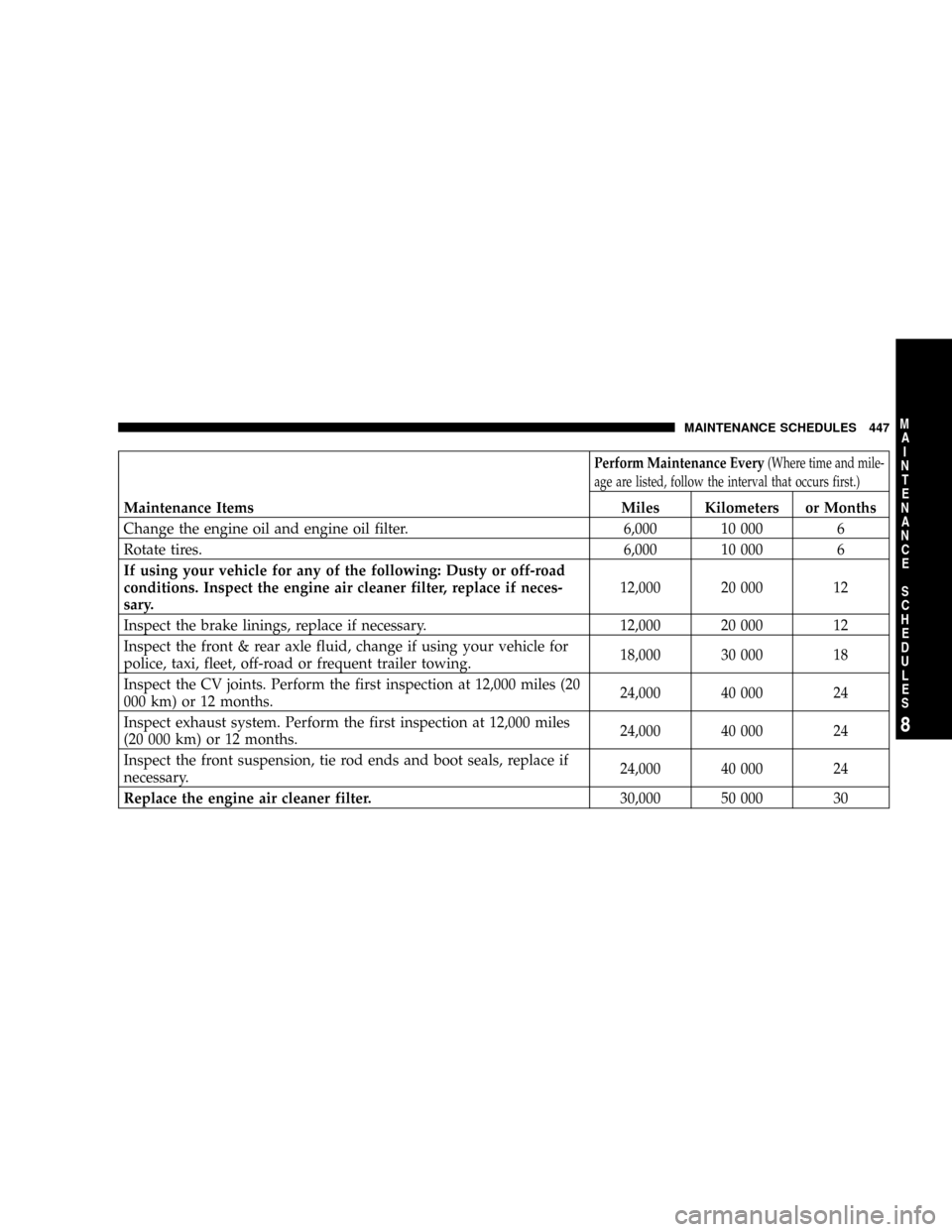
Perform Maintenance Every(Where time and mile-
age are listed, follow the interval that occurs first.)
Maintenance Items Miles Kilometers or Months
Change the engine oil and engine oil filter. 6,000 10 000 6
Rotate tires. 6,000 10 000 6
If using your vehicle for any of the following: Dusty or off-road
conditions. Inspect the engine air cleaner filter, replace if neces-
sary.12,000 20 000 12
Inspect the brake linings, replace if necessary. 12,000 20 000 12
Inspect the front & rear axle fluid, change if using your vehicle for
police, taxi, fleet, off-road or frequent trailer towing.18,000 30 000 18
Inspect the CV joints. Perform the first inspection at 12,000 miles (20
000 km) or 12 months.24,000 40 000 24
Inspect exhaust system. Perform the first inspection at 12,000 miles
(20 000 km) or 12 months.24,000 40 000 24
Inspect the front suspension, tie rod ends and boot seals, replace if
necessary.24,000 40 000 24
Replace the engine air cleaner filter.30,000 50 000 30
MAINTENANCE SCHEDULES 447
8
M
A
I
N
T
E
N
A
N
C
E
S
C
H
E
D
U
L
E
S
Page 448 of 490

Perform Maintenance Every(Where time and mile-
age are listed, follow the interval that occurs first.)
Maintenance Items Miles Kilometers or Months
Check the PCV valve, replace if necessary. Perform the first in-
spection at 60,000 miles (100 000 km) or 60 months.30,000 50 000 30
Inspect the transfer case fluid. 30,000 50 000 30
Replace the top row of spark plugs (4.7L Only). **30,000 50 000 30
Replace the spark plugs (3.7L/5.7L Engines).30,000 50 000 30
Change the automatic transmission fluid & filter if using your vehicle
for any of the following: police, taxi, fleet or frequent trailer towing.60,000 100 000 60
Change the transfer case fluid if using your vehicle for any of the
following: police, taxi, fleet, off-road or frequent trailer towing.60,000 100 000 60
Flush and replace the engine coolant. 102,000 170 000 60
Replace the ignition cables (4.7L Only).102,000 170 000 102
Replace the side row of spark plugs (4.7L Only). **102,000 170 000 102
Change the automatic transmission fluid & filter. 120,000 200 000 120
Replace accessory drive belt(s) (3.7L/4.7L/5.7L Engines). 120,000 200 000 120
448 MAINTENANCE SCHEDULES
8
M
A
I
N
T
E
N
A
N
C
E
S
C
H
E
D
U
L
E
S
Page 449 of 490
WARNING!
You can be badly injured working on or around a
motor vehicle. Do only that service work for which
you have the knowledge and the right equipment. If
you have any doubt about your ability to perform a
service job, take your vehicle to a competent
mechanic.
MAINTENANCE SCHEDULES Ð DIESEL ENGINE
There are two maintenance schedules that show the
requiredservice for your vehicle.
First is Schedule(B(. It is for vehicles that are operated
under the conditions that are listed below and at the
beginning of the schedule.
²Day or night temperatures are below 32ÉF (0ÉC).
²Stop and go driving.
²Extensive engine idling.
²Driving in dusty conditions.
²Short trips of less than 10 miles (16.2 km).
²More than 50% of your driving is at sustained high
speeds during hot weather, above 90ÉF (32ÉC).
²Trailer towing.
²Taxi, police, or delivery service (commercial service).
MAINTENANCE SCHEDULES 449
8
M
A
I
N
T
E
N
A
N
C
E
S
C
H
E
D
U
L
E
S
Page 452 of 490
Schedule ªBº Ð Diesel Engine
Follow schedule ªBº if you usually operate your vehicle
under one or more of the following conditions.
²Day or night temperatures are below 32ÉF (0ÉC).
²Stop and go driving.
²Extensive engine idling.
²Driving in dusty conditions.
²Short trips of less than 10 miles (16.2 km).
²More than 50% of your driving is at sustained high
speeds during hot weather, above 90ÉF (32ÉC).
²Trailer towing.
²Taxi, police, or delivery service (commercial service).
²Off-road or desert driving.
452 SCHEDULE ªBº Ð DIESEL ENGINE
8
M
A
I
N
T
E
N
A
N
C
E
S
C
H
E
D
U
L
E
S
Page 456 of 490
LApplies only if vehicle is used for frequent trailer
towing, or fleet/commercial service.
² The replacement of such component is requested when
there is superficial wear, bearing clearance, or evident
grease leak.Inspection and service should be performed anytime a
malfunction is observed or suspected. Retain all receipts.
456 SCHEDULE ªBº Ð DIESEL ENGINE
8
M
A
I
N
T
E
N
A
N
C
E
S
C
H
E
D
U
L
E
S